z
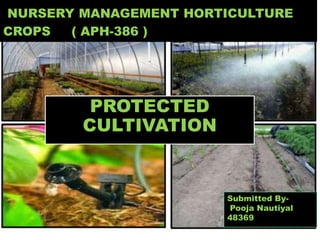
PROTECTED
CULTIVATION
NURSERY MANAGEMENT HORTICULTURE
CROPS ( APH-386 )
Submitted By-
Pooja Nautiyal
48369
z
INTRODUCTION -
 With Globalization of market, shrinking land
and climate change Protected cultivation of
high value crop has emerged as single
most important technology for ensuring-
 HIGH PRODUCTIVITY
 HIGH QUALITY
 PROFITABLE RETURNS
z
What is Protected
cultivation -
 It ensures conservation of soil moisture and efficient
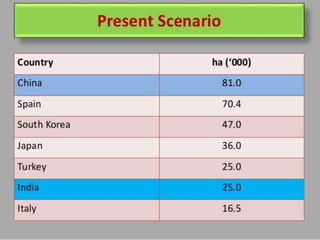
use of solar energy. Currently In India around 25000 ha
land area is under protected cultivation.
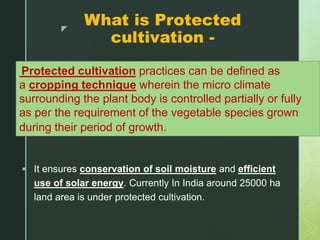
Protected cultivation practices can be defined as
a cropping technique wherein the micro climate
surrounding the plant body is controlled partially or fully
as per the requirement of the vegetable species grown
during their period of growth.
z
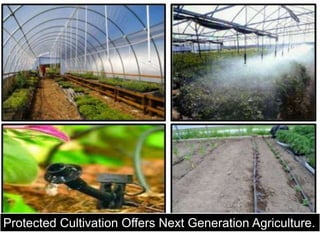
Protected Cultivation Offers Next Generation Agriculture.
zNeed for Protected Cultivation –
1)Higher Yield
2) Year Round Cultivation
3) Better Quality
4) Efficient use of resources
5) Nursery raising and hardening of plant
6) Least pesticidal Residues
7) Easier plant protection
8)Weed Free Cultivation
zGovt. Initiatives on Protected
Cultivation
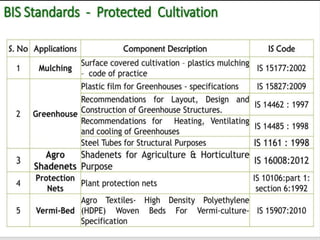
• Water Management –
Drip Irrigation System and Sprinkler Irrigation
System
• Protected Cultivation – Greenhouse – Plastic
Tunnel – Shadenet House – Walk in Tunnels –
Plant Protection Nets •
Surface Cover Cultivation – Plastic Mulching –
Soil Solarisation •
Water Resource Management – Farm Pond &
Reservoir lined with Plastic Films
• Vermi Bed – Organic Farming
…
z
Potential Crop For Protected
Cultivation -
Vegetables –
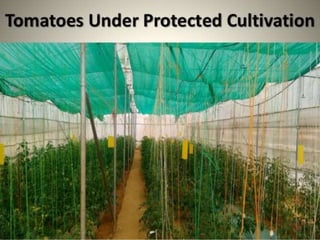
Tomato
Capsicum
Cucumber
Beans
Chilies
Spinach
Cabbage
Cauliflower
Flowers –
Gerbera
Rose
Carnation
z History –
 First modern green houses were built in Italy in
round 13th century.
 In India the green house technology started in
1980 for research purpose only and first Poly
house was designed and setup in 1985 in Leh
ladakh ( J & K).
 In India green house cultivation is mainly
practiced in Maharashtra, J&K , Uttarakhand
and Karnataka.
z
z
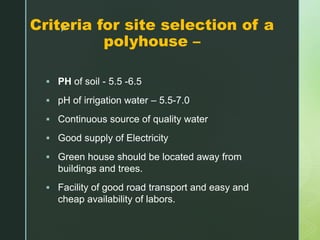
zCriteria for site selection of a
polyhouse –
 PH of soil - 5.5 -6.5
 pH of irrigation water – 5.5-7.0
 Continuous source of quality water
 Good supply of Electricity
 Green house should be located away from
buildings and trees.
 Facility of good road transport and easy and
cheap availability of labors.
z
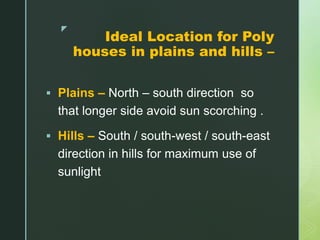
Ideal Location for Poly
houses in plains and hills –
 Plains – North – south direction so
that longer side avoid sun scorching .
 Hills – South / south-west / south-east
direction in hills for maximum use of
sunlight
zType of polyhouses
–
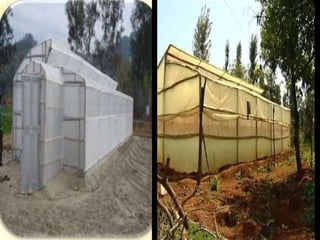
Low cost or Naturally Ventilated
Polyhouses–
• They are constructed with locally available
material like bamboo, timber.
•Suitable during cold weather especially in
dry hilly areas.
• There is low initial investment.
z
z
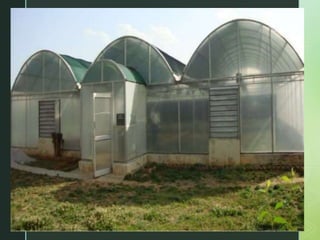
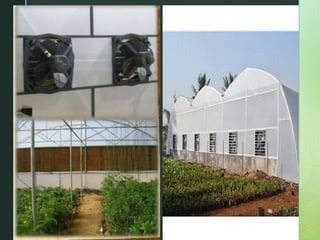
Medium cost or Partial Climate
controlled Polyhouses –
 The structural frame is made up of
galvanized iron pipes.
 Exhaust Fans are used for ventilation .
 Cooling ads are used for humidifying
the air entering the polyhouses .
 suitable for cultivation of vegetables in
low hills in NW Himalayas.
z
z
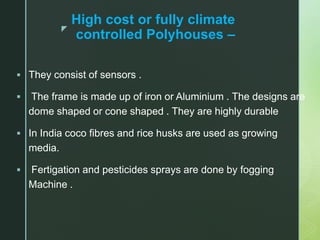
High cost or fully climate
controlled Polyhouses –
 They consist of sensors .
 The frame is made up of iron or Aluminium . The designs are
dome shaped or cone shaped . They are highly durable
 In India coco fibres and rice husks are used as growing
media.
 Fertigation and pesticides sprays are done by fogging
Machine .
z
z
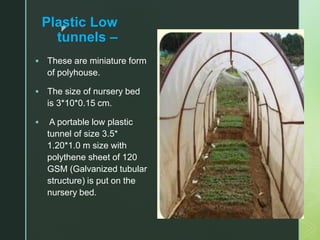
Plastic Low
tunnels –
 These are miniature form
of polyhouse.
 The size of nursery bed
is 3*10*0.15 cm.
 A portable low plastic
tunnel of size 3.5*
1.20*1.0 m size with
polythene sheet of 120
GSM (Galvanized tubular
structure) is put on the
nursery bed.
z
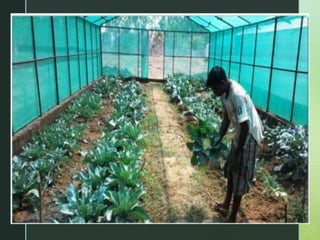
Shadenet /shade house –
 The shadenet house is ideal for cultivation of vegetable
during dry period in the tropical islands
 These structures are constructed using a UV stabilized
agro-shadenet (35%–70% shade) materials for creating
partial shade condition
 Shade houses are most often constructed as a pole-
supported structure and covered with polypropylene
shade fabric
z
z
Disadvantages of Poly
house technology –
1-High upfront and operation
expenses
2- Lack of pollination
3- Careful precaution must
be taken to eliminate any
pest or disease to make sure
next crop won’t be affected .
 Advantages of Poly house
Technology –
 1 – 10-12% increase in yield.
 2- Reliability of crop increase in green
house cultivation .
 3- Expand your growing season
 4- Minimize external threat to our crop .




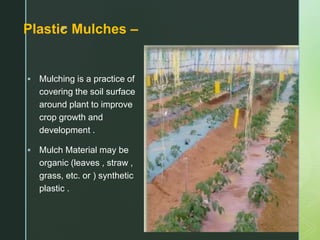
zPlastic Mulches –
 Mulching is a practice of
covering the soil surface
around plant to improve
crop growth and
development .
 Mulch Material may be
organic (leaves , straw ,
grass, etc. or ) synthetic
plastic .
z
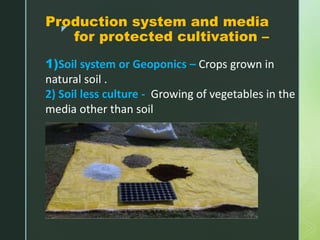
Production system and media
for protected cultivation –
1)Soil system or Geoponics – Crops grown in
natural soil .
2) Soil less culture - Growing of vegetables in the
media other than soil
z
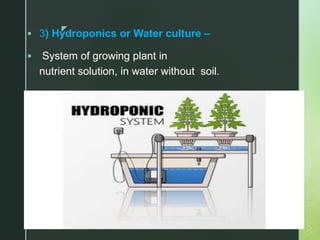
 3) Hydroponics or Water culture –
 System of growing plant in
nutrient solution, in water without soil.
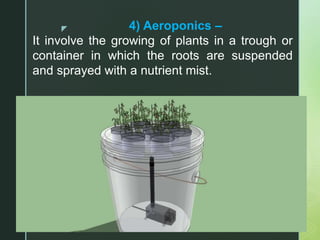
z 4) Aeroponics –
It involve the growing of plants in a trough or
container in which the roots are suspended
and sprayed with a nutrient mist.
z
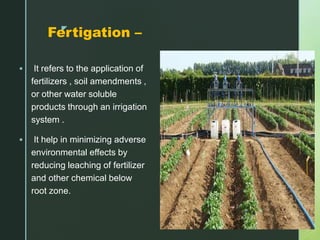
Fertigation –
 It refers to the application of
fertilizers , soil amendments ,
or other water soluble
products through an irrigation
system .
 It help in minimizing adverse
environmental effects by
reducing leaching of fertilizer
and other chemical below
root zone.
z
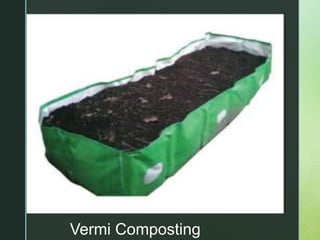
Vermi Composting
z
z
z

Protected cultivation

  • 1.
    z PROTECTED CULTIVATION NURSERY MANAGEMENT HORTICULTURE CROPS( APH-386 ) Submitted By- Pooja Nautiyal 48369
  • 2.
    z INTRODUCTION -  WithGlobalization of market, shrinking land and climate change Protected cultivation of high value crop has emerged as single most important technology for ensuring-  HIGH PRODUCTIVITY  HIGH QUALITY  PROFITABLE RETURNS
  • 3.
    z What is Protected cultivation-  It ensures conservation of soil moisture and efficient use of solar energy. Currently In India around 25000 ha land area is under protected cultivation. Protected cultivation practices can be defined as a cropping technique wherein the micro climate surrounding the plant body is controlled partially or fully as per the requirement of the vegetable species grown during their period of growth.
  • 4.
    z Protected Cultivation OffersNext Generation Agriculture.
  • 5.
    zNeed for ProtectedCultivation – 1)Higher Yield 2) Year Round Cultivation 3) Better Quality 4) Efficient use of resources 5) Nursery raising and hardening of plant 6) Least pesticidal Residues 7) Easier plant protection 8)Weed Free Cultivation
  • 6.
    zGovt. Initiatives onProtected Cultivation • Water Management – Drip Irrigation System and Sprinkler Irrigation System • Protected Cultivation – Greenhouse – Plastic Tunnel – Shadenet House – Walk in Tunnels – Plant Protection Nets • Surface Cover Cultivation – Plastic Mulching – Soil Solarisation • Water Resource Management – Farm Pond & Reservoir lined with Plastic Films • Vermi Bed – Organic Farming …
  • 7.
    z Potential Crop ForProtected Cultivation - Vegetables – Tomato Capsicum Cucumber Beans Chilies Spinach Cabbage Cauliflower Flowers – Gerbera Rose Carnation
  • 8.
    z History – First modern green houses were built in Italy in round 13th century.  In India the green house technology started in 1980 for research purpose only and first Poly house was designed and setup in 1985 in Leh ladakh ( J & K).  In India green house cultivation is mainly practiced in Maharashtra, J&K , Uttarakhand and Karnataka.
  • 9.
  • 10.
  • 11.
    zCriteria for siteselection of a polyhouse –  PH of soil - 5.5 -6.5  pH of irrigation water – 5.5-7.0  Continuous source of quality water  Good supply of Electricity  Green house should be located away from buildings and trees.  Facility of good road transport and easy and cheap availability of labors.
  • 12.
    z Ideal Location forPoly houses in plains and hills –  Plains – North – south direction so that longer side avoid sun scorching .  Hills – South / south-west / south-east direction in hills for maximum use of sunlight
  • 13.
    zType of polyhouses – Lowcost or Naturally Ventilated Polyhouses– • They are constructed with locally available material like bamboo, timber. •Suitable during cold weather especially in dry hilly areas. • There is low initial investment.
  • 14.
  • 15.
    z Medium cost orPartial Climate controlled Polyhouses –  The structural frame is made up of galvanized iron pipes.  Exhaust Fans are used for ventilation .  Cooling ads are used for humidifying the air entering the polyhouses .  suitable for cultivation of vegetables in low hills in NW Himalayas.
  • 16.
  • 17.
    z High cost orfully climate controlled Polyhouses –  They consist of sensors .  The frame is made up of iron or Aluminium . The designs are dome shaped or cone shaped . They are highly durable  In India coco fibres and rice husks are used as growing media.  Fertigation and pesticides sprays are done by fogging Machine .
  • 18.
  • 19.
    z Plastic Low tunnels – These are miniature form of polyhouse.  The size of nursery bed is 3*10*0.15 cm.  A portable low plastic tunnel of size 3.5* 1.20*1.0 m size with polythene sheet of 120 GSM (Galvanized tubular structure) is put on the nursery bed.
  • 20.
    z Shadenet /shade house–  The shadenet house is ideal for cultivation of vegetable during dry period in the tropical islands  These structures are constructed using a UV stabilized agro-shadenet (35%–70% shade) materials for creating partial shade condition  Shade houses are most often constructed as a pole- supported structure and covered with polypropylene shade fabric
  • 21.
  • 22.
    z Disadvantages of Poly housetechnology – 1-High upfront and operation expenses 2- Lack of pollination 3- Careful precaution must be taken to eliminate any pest or disease to make sure next crop won’t be affected .  Advantages of Poly house Technology –  1 – 10-12% increase in yield.  2- Reliability of crop increase in green house cultivation .  3- Expand your growing season  4- Minimize external threat to our crop .    
  • 23.
    zPlastic Mulches – Mulching is a practice of covering the soil surface around plant to improve crop growth and development .  Mulch Material may be organic (leaves , straw , grass, etc. or ) synthetic plastic .
  • 24.
    z Production system andmedia for protected cultivation – 1)Soil system or Geoponics – Crops grown in natural soil . 2) Soil less culture - Growing of vegetables in the media other than soil
  • 25.
    z  3) Hydroponicsor Water culture –  System of growing plant in nutrient solution, in water without soil.
  • 26.
    z 4) Aeroponics– It involve the growing of plants in a trough or container in which the roots are suspended and sprayed with a nutrient mist.
  • 27.
    z Fertigation –  Itrefers to the application of fertilizers , soil amendments , or other water soluble products through an irrigation system .  It help in minimizing adverse environmental effects by reducing leaching of fertilizer and other chemical below root zone.
  • 28.
  • 29.
  • 30.
  • 31.