Powerpoint Templates Page 1
Peer Group Presentation
Subject – Medical Surgical Nursing
Topic - Nephrotic Syndrome
Presented by
Mr. Hari Singh Nagar
M.Sc Nursing 1st year
Powerpoint Templates Page 2
Nephrotic Syndrome
Introduction –The syndrome is apparent in any
condition that seriously damage the glomerular
capillary membrane that results in increase
glomerular capillary permeability to plasma
proteins. Although liver is capable of increasing
the production of protein. It can’t keep up with
the daily loss of albumin through the kidney.
Thus hypoalbuminemia results.
Powerpoint Templates Page 3
Definition
It is a clinical disorder that is characterized by
proteinuria, hypoalbuminemia, edema and
hyperlipidemia. This occurs due to excessive
leakage of plasma proteins in urine because of
increase capillary permeability of the glomerulus.
Powerpoint Templates Page 4
Etiology
• Glomerulonephritis
• DM
• SLE
• Amyloidosis o kidney
• Sarcoidosis
• Cancer
• Trauma
• Infection
• Drugs
• Renal thrombosis
Powerpoint Templates Page 5
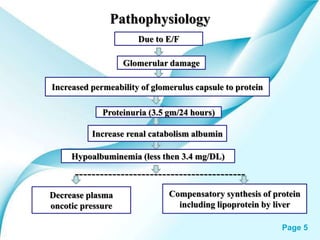
Pathophysiology
-----------------------------------------
Decrease plasma
oncotic pressure
Compensatory synthesis of protein
including lipoprotein by liver
Due to E/F
Glomerular damage
Increased permeability of glomerulus capsule to protein
Proteinuria (3.5 gm/24 hours)
Increase renal catabolism albumin
Hypoalbuminemia (less then 3.4 mg/DL)
Powerpoint Templates Page 6
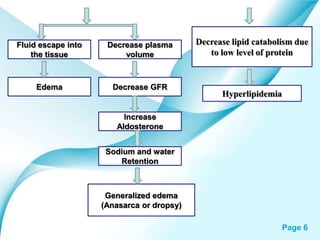
Hyperlipidemia
Fluid escape into
the tissue
Decrease plasma
volume
Edema Decrease GFR
Increase
Aldosterone
Sodium and water
Retention
Generalized edema
(Anasarca or dropsy)
Decrease lipid catabolism due
to low level of protein
Powerpoint Templates Page 7
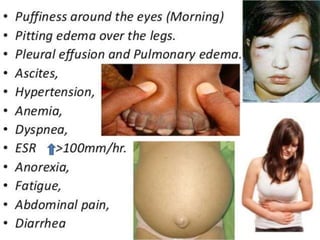
Clinical manifestation
• Proteinuria
• Hypoalbuminemia
• Edema – Periorbital edema, pitting edema, ankle edema,
Ascites, pleural effusion, Weight gain, hypertension
• Fatigue, headache, malaise and irritability
• Foamy appearance of urine (decrease surface tension by
severe proteinuria)
• Hematuria
• Thrombophilia (clot formation)
• Lipiduria
• Dyspnoea
• Anaemia
Powerpoint Templates Page 8
Powerpoint Templates Page 9
Diagnostic evaluation
• History
• Physical examination
• Urinalysis - 24 hours urine
• Serum chemistry
• Creatinine clearance test
• Needle biopsy of kidney
Powerpoint Templates Page 10
Management
1. Symptomatic treatment
• Edema –
 Rest – not for prolong time
 Nutrition – 1 gm protein/kg/day, not more that, sodium
restriction, water not greater then the level of diuresis.
 Medication – Loop diuretics (furosemide)
• Hypoalbuminemia – moderate intake of protein, rich
in animal protein.
• Hyperlipidemia – low saturated fat, high unsaturated
fat, if unresponsive to nutrition therapy then take
hypolipidemic drugs such as statin.
Powerpoint Templates Page 11
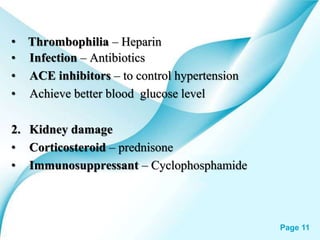
• Thrombophilia – Heparin
• Infection – Antibiotics
• ACE inhibitors – to control hypertension
• Achieve better blood glucose level
2. Kidney damage
• Corticosteroid – prednisone
• Immunosuppressant – Cyclophosphamide
Powerpoint Templates Page 12
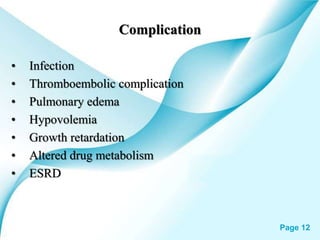
Complication
• Infection
• Thromboembolic complication
• Pulmonary edema
• Hypovolemia
• Growth retardation
• Altered drug metabolism
• ESRD
Powerpoint Templates Page 13
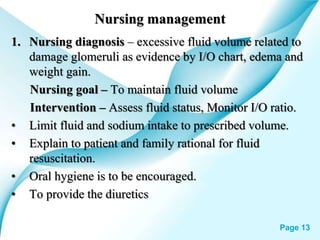
Nursing management
1. Nursing diagnosis – excessive fluid volume related to
damage glomeruli as evidence by I/O chart, edema and
weight gain.
Nursing goal – To maintain fluid volume
Intervention – Assess fluid status, Monitor I/O ratio.
• Limit fluid and sodium intake to prescribed volume.
• Explain to patient and family rational for fluid
resuscitation.
• Oral hygiene is to be encouraged.
• To provide the diuretics
Powerpoint Templates Page 14
2. Nursing diagnosis – risk of infection related to edema
& altered immune response as evidence by weight gain,
I/O chart, taking temperature.
Nursing goal – To prevent from infection
Intervention - Limit fluid intake
• Provide meticulous skin care
• To monitor I/O chart.
• To check daily weight.
• To check the TPR.
• Use strict aseptic technique
• To provide the diuretics and antipyretics.
Powerpoint Templates Page 15
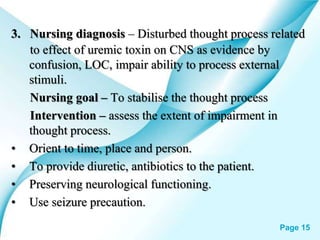
3. Nursing diagnosis – Disturbed thought process related
to effect of uremic toxin on CNS as evidence by
confusion, LOC, impair ability to process external
stimuli.
Nursing goal – To stabilise the thought process
Intervention – assess the extent of impairment in
thought process.
• Orient to time, place and person.
• To provide diuretic, antibiotics to the patient.
• Preserving neurological functioning.
• Use seizure precaution.
Powerpoint Templates Page 16
• Encourage the patient to turn & in any type of
activity as due to drowsiness and lethargy.
• Give psychological support.
• Prepare for haemodialysis.
Powerpoint Templates Page 17
Chlorambucil Treatment of Frequently
Relapsing Nephrotic Syndrome
Chlorambucil, in combination with prednisone, was
compared with prednisone alone in a randomized
controlled trial in 21 children to assess its effect on the
duration of remission (improvement) and the rate of
relapse (deterioration after improvement). All control
patients treated with prednisone alone continued to
relapse at the same rate, with all patients experiencing a
return of proteinuria by seven months. Conversely, those
who received the same prednisone therapy along with
chlorambucil for six to 12 weeks remained in complete
remission, without further medication, during 12 to 34
Powerpoint Templates Page 18
months of follow-up observation. Complications
were minimal. Immediate Side effects commonly
reported with cyclophosphamide were not seen with
chlorambucil. Comparison with published reports
also suggests that remission induced by chlorambucil
is more stable than that after cyclophosphamide.
Chlorambucil appears to be of value in the frequently
relapsing nephrotic patient, adding an effect that is
unattainable with prednisone alone. (N Engl J Med
295:746–749, 1976)
Powerpoint Templates Page 19
The effects of corticosteroids on behaviour in patient
with nephrotic syndrome
The objective of this study was to measure the frequency
and severity of the behavioural effects of high-dose oral
steroid therapy in children with nephrotic syndrome. We
conducted a prospective assessment of the behaviour of
12 children using a standardized psychological
questionnaire at the time of diagnosis and again after
4 weeks of steroid therapy. A group of control children
was also assessed. There was a significant increase in the
total behaviour score (P=0.03) and specifically in
aggressive and poor attention behaviour items in
Powerpoint Templates Page 20
the group of nephrotic children compared with
the control group. Four of the children with nephrotic
syndrome developed abnormal behaviour in the
clinical range compared with none of the controls. In
conclusion, children with nephrotic syndrome treated
with high-dose oral steroids are at risk of developing
clinically relevant behavioural changes

Nephrotic syndrome

  • 1.
    Powerpoint Templates Page1 Peer Group Presentation Subject – Medical Surgical Nursing Topic - Nephrotic Syndrome Presented by Mr. Hari Singh Nagar M.Sc Nursing 1st year
  • 2.
    Powerpoint Templates Page2 Nephrotic Syndrome Introduction –The syndrome is apparent in any condition that seriously damage the glomerular capillary membrane that results in increase glomerular capillary permeability to plasma proteins. Although liver is capable of increasing the production of protein. It can’t keep up with the daily loss of albumin through the kidney. Thus hypoalbuminemia results.
  • 3.
    Powerpoint Templates Page3 Definition It is a clinical disorder that is characterized by proteinuria, hypoalbuminemia, edema and hyperlipidemia. This occurs due to excessive leakage of plasma proteins in urine because of increase capillary permeability of the glomerulus.
  • 4.
    Powerpoint Templates Page4 Etiology • Glomerulonephritis • DM • SLE • Amyloidosis o kidney • Sarcoidosis • Cancer • Trauma • Infection • Drugs • Renal thrombosis
  • 5.
    Powerpoint Templates Page5 Pathophysiology ----------------------------------------- Decrease plasma oncotic pressure Compensatory synthesis of protein including lipoprotein by liver Due to E/F Glomerular damage Increased permeability of glomerulus capsule to protein Proteinuria (3.5 gm/24 hours) Increase renal catabolism albumin Hypoalbuminemia (less then 3.4 mg/DL)
  • 6.
    Powerpoint Templates Page6 Hyperlipidemia Fluid escape into the tissue Decrease plasma volume Edema Decrease GFR Increase Aldosterone Sodium and water Retention Generalized edema (Anasarca or dropsy) Decrease lipid catabolism due to low level of protein
  • 7.
    Powerpoint Templates Page7 Clinical manifestation • Proteinuria • Hypoalbuminemia • Edema – Periorbital edema, pitting edema, ankle edema, Ascites, pleural effusion, Weight gain, hypertension • Fatigue, headache, malaise and irritability • Foamy appearance of urine (decrease surface tension by severe proteinuria) • Hematuria • Thrombophilia (clot formation) • Lipiduria • Dyspnoea • Anaemia
  • 8.
  • 9.
    Powerpoint Templates Page9 Diagnostic evaluation • History • Physical examination • Urinalysis - 24 hours urine • Serum chemistry • Creatinine clearance test • Needle biopsy of kidney
  • 10.
    Powerpoint Templates Page10 Management 1. Symptomatic treatment • Edema –  Rest – not for prolong time  Nutrition – 1 gm protein/kg/day, not more that, sodium restriction, water not greater then the level of diuresis.  Medication – Loop diuretics (furosemide) • Hypoalbuminemia – moderate intake of protein, rich in animal protein. • Hyperlipidemia – low saturated fat, high unsaturated fat, if unresponsive to nutrition therapy then take hypolipidemic drugs such as statin.
  • 11.
    Powerpoint Templates Page11 • Thrombophilia – Heparin • Infection – Antibiotics • ACE inhibitors – to control hypertension • Achieve better blood glucose level 2. Kidney damage • Corticosteroid – prednisone • Immunosuppressant – Cyclophosphamide
  • 12.
    Powerpoint Templates Page12 Complication • Infection • Thromboembolic complication • Pulmonary edema • Hypovolemia • Growth retardation • Altered drug metabolism • ESRD
  • 13.
    Powerpoint Templates Page13 Nursing management 1. Nursing diagnosis – excessive fluid volume related to damage glomeruli as evidence by I/O chart, edema and weight gain. Nursing goal – To maintain fluid volume Intervention – Assess fluid status, Monitor I/O ratio. • Limit fluid and sodium intake to prescribed volume. • Explain to patient and family rational for fluid resuscitation. • Oral hygiene is to be encouraged. • To provide the diuretics
  • 14.
    Powerpoint Templates Page14 2. Nursing diagnosis – risk of infection related to edema & altered immune response as evidence by weight gain, I/O chart, taking temperature. Nursing goal – To prevent from infection Intervention - Limit fluid intake • Provide meticulous skin care • To monitor I/O chart. • To check daily weight. • To check the TPR. • Use strict aseptic technique • To provide the diuretics and antipyretics.
  • 15.
    Powerpoint Templates Page15 3. Nursing diagnosis – Disturbed thought process related to effect of uremic toxin on CNS as evidence by confusion, LOC, impair ability to process external stimuli. Nursing goal – To stabilise the thought process Intervention – assess the extent of impairment in thought process. • Orient to time, place and person. • To provide diuretic, antibiotics to the patient. • Preserving neurological functioning. • Use seizure precaution.
  • 16.
    Powerpoint Templates Page16 • Encourage the patient to turn & in any type of activity as due to drowsiness and lethargy. • Give psychological support. • Prepare for haemodialysis.
  • 17.
    Powerpoint Templates Page17 Chlorambucil Treatment of Frequently Relapsing Nephrotic Syndrome Chlorambucil, in combination with prednisone, was compared with prednisone alone in a randomized controlled trial in 21 children to assess its effect on the duration of remission (improvement) and the rate of relapse (deterioration after improvement). All control patients treated with prednisone alone continued to relapse at the same rate, with all patients experiencing a return of proteinuria by seven months. Conversely, those who received the same prednisone therapy along with chlorambucil for six to 12 weeks remained in complete remission, without further medication, during 12 to 34
  • 18.
    Powerpoint Templates Page18 months of follow-up observation. Complications were minimal. Immediate Side effects commonly reported with cyclophosphamide were not seen with chlorambucil. Comparison with published reports also suggests that remission induced by chlorambucil is more stable than that after cyclophosphamide. Chlorambucil appears to be of value in the frequently relapsing nephrotic patient, adding an effect that is unattainable with prednisone alone. (N Engl J Med 295:746–749, 1976)
  • 19.
    Powerpoint Templates Page19 The effects of corticosteroids on behaviour in patient with nephrotic syndrome The objective of this study was to measure the frequency and severity of the behavioural effects of high-dose oral steroid therapy in children with nephrotic syndrome. We conducted a prospective assessment of the behaviour of 12 children using a standardized psychological questionnaire at the time of diagnosis and again after 4 weeks of steroid therapy. A group of control children was also assessed. There was a significant increase in the total behaviour score (P=0.03) and specifically in aggressive and poor attention behaviour items in
  • 20.
    Powerpoint Templates Page20 the group of nephrotic children compared with the control group. Four of the children with nephrotic syndrome developed abnormal behaviour in the clinical range compared with none of the controls. In conclusion, children with nephrotic syndrome treated with high-dose oral steroids are at risk of developing clinically relevant behavioural changes