BLADDER IRRIGATION
Mr. Melvin Jacob
MSc (N)
Definition
Bladder irrigation
means to flush out
the urinary bladder
with a liquid
Purpose
• To cleans the bladder from decomposed urine,
bacteria, excess of mucus, pus and blood clots.
• To maintain the patency of the urinary catheter.
• To relieve congestion and pain in case of
inflammatory conditions by the application of
heat.
cont….
• To promote healing.
• To prevent the clot formation in case of bladder
surgeries.
• To prevent and treat infections.
• To arrest bleeding
Types
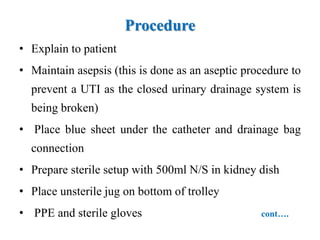
• Manual bladder irrigation
• Continuous bladder irrigation
Manual BI
• Manual bladder irrigation is used for clearing
clot retention
• Catheter blockage is a very common
complication in long term catheter users.
• Up to 50% of long term catheters are changed
prematurely due to catheter blockages
Signs of a blocked catheter
• No urine flow from the catheter
• Patient complaining of suprapubic pain, becoming
more pronounced as the bladder fills
• If unrelieved vaso-vagal symptoms may develop
ie sweating ,tachycardia and hypotension
• Bypassing around the catheter
Equipments
• Dressing pack x1
• Catheter tip 50ml syringe x1
• Chlorhexidine swabs 70% alcohol
• Blue under sheet
• Unsterile jug
• 500ml bottle Normal Saline
• PPE ie sterile gloves, goggles and apron
Procedure
• Explain to patient
• Maintain asepsis (this is done as an aseptic procedure to
prevent a UTI as the closed urinary drainage system is
being broken)
• Place blue sheet under the catheter and drainage bag
connection
• Prepare sterile setup with 500ml N/S in kidney dish
• Place unsterile jug on bottom of trolley
• PPE and sterile gloves cont….
• Place sterile towel under site where urinary
catheter and drainage bag attached
• Clean catheter and drainage bag connection with
chlorhexidine wipes, disconnect and wrap the
drainage bag end in a chlorhexidine swab and if
possible give to the patient to hold. If not keep the
end wrapped in clean packaging or gauze cont….
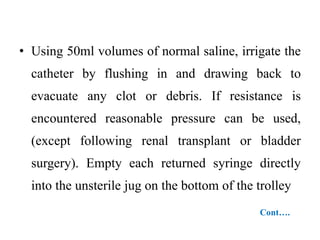
• Using 50ml volumes of normal saline, irrigate the
catheter by flushing in and drawing back to
evacuate any clot or debris. If resistance is
encountered reasonable pressure can be used,
(except following renal transplant or bladder
surgery). Empty each returned syringe directly
into the unsterile jug on the bottom of the trolley
Cont….
• Continue to irrigate with 50ml volumes until
you achieve a clear or clot free return
• Reconnect catheter to drainage bag without
contaminating either
• Calculate the difference between volume
infused and volume returned and record on the
fluid balance chart.
CBI
PURPOSE
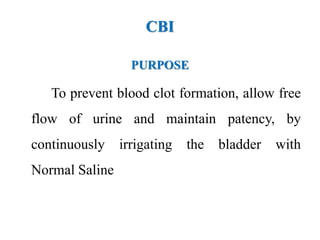
To prevent blood clot formation, allow free
flow of urine and maintain patency, by
continuously irrigating the bladder with
Normal Saline
Articles
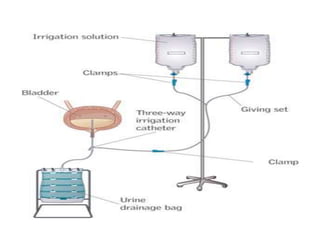
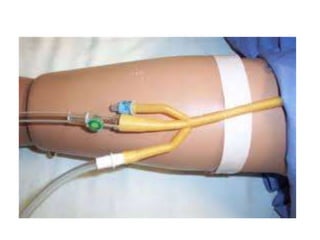
• 3way catheter
• 0.9% sodium Chloride irrigation bags as per facility policy
• Continuous bladder irrigation set and closed urinary drainage bag with anti-
reflux valve.
• Alcohol wipes
• Non sterile gloves
• Personal protective equipment (PPE)
• Under pad
• IV pole
Procedure
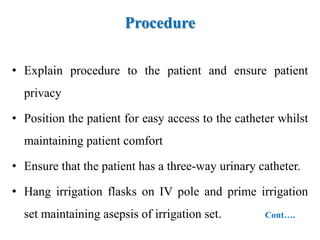
• Explain procedure to the patient and ensure patient
privacy
• Position the patient for easy access to the catheter whilst
maintaining patient comfort
• Ensure that the patient has a three-way urinary catheter.
• Hang irrigation flasks on IV pole and prime irrigation
set maintaining asepsis of irrigation set. Cont….
• Don goggles and impervious gown , place under
pad underneath catheter connection
• Attend hand wash and don non-sterile gloves
• Swab IDC irrigation and catheter ports with
alcohol swabs and allow to dry
• Open the irrigation lumen of the catheter
Cont…..
• Connect the irrigation set to the irrigation lumen of
the catheter, maintaining clean procedure
• Ensure urine is draining freely before commencing
continuous irrigation.
• Unclamp the irrigation flask that was used to prime
the irrigation set and set the rate of administration by
adjusting the roller clamp.
Cont…..
Documentation
Record in the progress notes
a) Date and time of procedure
b) Indication for the manual irrigation including the patients
clinical symptoms
c) Result of irrigation ie volume of return, describe
output/clots/debris and also colour of urine
d) On the fluid balance chart record volume infused,
volume returned and the difference being urine volume
General instructions
• Should not be done without written order.
• As far as possible, bladder irrigation are to be
avoided.
• The safest and most effective means of irrigating
the urinary system is by “internal irrigation”
• The fluid should be instilled gently and allowed to
drain back by gravity. Cont….
• If the fluid flows easily into the bladder but fails to
return, there is a clot over the eye of the catheter
• In such situation no more fluid is introduced into the
bladder but try to dislodge the clot by milking the
tubing.
• All the articles that are used for the irrigation must be
sterile. Cont…..
Nurses responsibility
Before
• Check for order
• Inform the patient
• Arrange articles
• Comfortable position
• Privacy
• Hand washing
• Expose only the area
During
• Maintain aseptic technique
• Follow all the steps
• Use only recommended solutions
• Arrange the flow rate for CBI
• Make sure that the fluid is coming back
After
• Clean the area
• Replace the articles
• Regular catheter care should be given to CBI pt.
• Watch for any contraindications
• Record and report the procedure
Complications
• Infection : urinary tract offer a favourable
environment for the multiplication of bacteria
because it is dark, moist & warm . Injury to the
mucosa of the bladder leads to growth of the
bacteria in bladder. Changing the pH value of
urine by medication .force of the flow cause
injury . Cont…
• Tissue trauma : during the insertion of the
catheter & procedures applied to the bladder ,
tissue trauma may take place .even the slight
movement of the catheter can cause tissue
trauma & breakdown.
cont……
• Urethral irritation : symptoms include
burning sensation & pain at urethral meatus
will be experienced especially by the male pt.
due to indwelling catheter
cont….
• Bladder spasm : bladder spasm may occur
due to the balloon of an indwelling catheter
resting directly on the bladder neck . Forcing
fluid more than what is tolerable by the pt. will
lead to muscle spasm & pain
Thank you

Bladder irrigation

  • 1.
  • 2.
    Definition Bladder irrigation means toflush out the urinary bladder with a liquid
  • 3.
    Purpose • To cleansthe bladder from decomposed urine, bacteria, excess of mucus, pus and blood clots. • To maintain the patency of the urinary catheter. • To relieve congestion and pain in case of inflammatory conditions by the application of heat. cont….
  • 4.
    • To promotehealing. • To prevent the clot formation in case of bladder surgeries. • To prevent and treat infections. • To arrest bleeding
  • 5.
    Types • Manual bladderirrigation • Continuous bladder irrigation
  • 6.
    Manual BI • Manualbladder irrigation is used for clearing clot retention • Catheter blockage is a very common complication in long term catheter users. • Up to 50% of long term catheters are changed prematurely due to catheter blockages
  • 7.
    Signs of ablocked catheter • No urine flow from the catheter • Patient complaining of suprapubic pain, becoming more pronounced as the bladder fills • If unrelieved vaso-vagal symptoms may develop ie sweating ,tachycardia and hypotension • Bypassing around the catheter
  • 8.
    Equipments • Dressing packx1 • Catheter tip 50ml syringe x1 • Chlorhexidine swabs 70% alcohol • Blue under sheet • Unsterile jug • 500ml bottle Normal Saline • PPE ie sterile gloves, goggles and apron
  • 9.
    Procedure • Explain topatient • Maintain asepsis (this is done as an aseptic procedure to prevent a UTI as the closed urinary drainage system is being broken) • Place blue sheet under the catheter and drainage bag connection • Prepare sterile setup with 500ml N/S in kidney dish • Place unsterile jug on bottom of trolley • PPE and sterile gloves cont….
  • 10.
    • Place steriletowel under site where urinary catheter and drainage bag attached • Clean catheter and drainage bag connection with chlorhexidine wipes, disconnect and wrap the drainage bag end in a chlorhexidine swab and if possible give to the patient to hold. If not keep the end wrapped in clean packaging or gauze cont….
  • 11.
    • Using 50mlvolumes of normal saline, irrigate the catheter by flushing in and drawing back to evacuate any clot or debris. If resistance is encountered reasonable pressure can be used, (except following renal transplant or bladder surgery). Empty each returned syringe directly into the unsterile jug on the bottom of the trolley Cont….
  • 12.
    • Continue toirrigate with 50ml volumes until you achieve a clear or clot free return • Reconnect catheter to drainage bag without contaminating either • Calculate the difference between volume infused and volume returned and record on the fluid balance chart.
  • 15.
    CBI PURPOSE To prevent bloodclot formation, allow free flow of urine and maintain patency, by continuously irrigating the bladder with Normal Saline
  • 16.
    Articles • 3way catheter •0.9% sodium Chloride irrigation bags as per facility policy • Continuous bladder irrigation set and closed urinary drainage bag with anti- reflux valve. • Alcohol wipes • Non sterile gloves • Personal protective equipment (PPE) • Under pad • IV pole
  • 17.
    Procedure • Explain procedureto the patient and ensure patient privacy • Position the patient for easy access to the catheter whilst maintaining patient comfort • Ensure that the patient has a three-way urinary catheter. • Hang irrigation flasks on IV pole and prime irrigation set maintaining asepsis of irrigation set. Cont….
  • 18.
    • Don gogglesand impervious gown , place under pad underneath catheter connection • Attend hand wash and don non-sterile gloves • Swab IDC irrigation and catheter ports with alcohol swabs and allow to dry • Open the irrigation lumen of the catheter Cont…..
  • 19.
    • Connect theirrigation set to the irrigation lumen of the catheter, maintaining clean procedure • Ensure urine is draining freely before commencing continuous irrigation. • Unclamp the irrigation flask that was used to prime the irrigation set and set the rate of administration by adjusting the roller clamp. Cont…..
  • 24.
    Documentation Record in theprogress notes a) Date and time of procedure b) Indication for the manual irrigation including the patients clinical symptoms c) Result of irrigation ie volume of return, describe output/clots/debris and also colour of urine d) On the fluid balance chart record volume infused, volume returned and the difference being urine volume
  • 25.
    General instructions • Shouldnot be done without written order. • As far as possible, bladder irrigation are to be avoided. • The safest and most effective means of irrigating the urinary system is by “internal irrigation” • The fluid should be instilled gently and allowed to drain back by gravity. Cont….
  • 26.
    • If thefluid flows easily into the bladder but fails to return, there is a clot over the eye of the catheter • In such situation no more fluid is introduced into the bladder but try to dislodge the clot by milking the tubing. • All the articles that are used for the irrigation must be sterile. Cont…..
  • 27.
    Nurses responsibility Before • Checkfor order • Inform the patient • Arrange articles • Comfortable position • Privacy • Hand washing • Expose only the area
  • 28.
    During • Maintain aseptictechnique • Follow all the steps • Use only recommended solutions • Arrange the flow rate for CBI • Make sure that the fluid is coming back
  • 29.
    After • Clean thearea • Replace the articles • Regular catheter care should be given to CBI pt. • Watch for any contraindications • Record and report the procedure
  • 30.
    Complications • Infection :urinary tract offer a favourable environment for the multiplication of bacteria because it is dark, moist & warm . Injury to the mucosa of the bladder leads to growth of the bacteria in bladder. Changing the pH value of urine by medication .force of the flow cause injury . Cont…
  • 31.
    • Tissue trauma: during the insertion of the catheter & procedures applied to the bladder , tissue trauma may take place .even the slight movement of the catheter can cause tissue trauma & breakdown. cont……
  • 32.
    • Urethral irritation: symptoms include burning sensation & pain at urethral meatus will be experienced especially by the male pt. due to indwelling catheter cont….
  • 33.
    • Bladder spasm: bladder spasm may occur due to the balloon of an indwelling catheter resting directly on the bladder neck . Forcing fluid more than what is tolerable by the pt. will lead to muscle spasm & pain
  • 34.