FLUID & ELECTROLYTE IMBALANCE
Mr. Melvin Jacob
MSc Nursing
Introduction
• Every part of your body needs water to function. When
you are healthy, your body is able to balance the
amount of water that enters or leaves your body.
• Water is the major body component, accounting 60%
of the adult body weight.
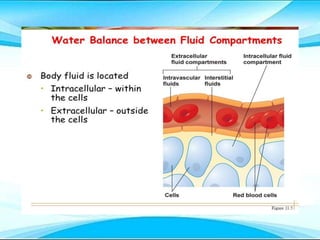
• 2/3rd of the water is with in the cells. (intracellular fluid)
• 1/3rd of body water is outside the cells(extracellular
fluid).
The extra cellular fluid compartment is
further divided into
• intravascular (eg:plasma)
• interstitial(between cells).
Types of fluid imbalances
5 major types
• Extracellular fluid volume deficit
• Intra cellular fluid volume deficit
• Extra cellular fluid volume excess
• Intra cellular fluid volume excess
• Extracellular fluid volume shift.
1.Extra cellular fluid volume deficit(dehydration):
It is a decrease in intravascular and interstitial
fluids.
 Etiology :-
 Lack of fluid intake
 Excess fluid losses -severe vomiting and diarrhea.
 other potential causes are fever, burns, blood loss,
Increased ADH secretion, use of diuretics, diuretic
phase of acute renal failure
Clinical manifestations
 Loss of body weight
 Changes in intake and output.
 Increased thirst
 Decreased pulse
 Manifestations of cellular dehydrationdry mouth and eyes,
decreased skin turgor, soft and sunken eyes, muscle
weakness, constipation .
 cerebral signs:-restlessness, head ache, confusion, followed
by coma.
Management
Fluid restoration
• Oral rehydration
• Intravenous rehydration
• Correction of underlying problem with
antiemetics, antidiarrheals, antibiotics, and
antipyretics.
2.Intra cellular fluid volume deficit
• It occurs quite often in older clients
• Thirst and oliguria are the most common
compensatory signs.
• Cellular manifestations  fever, CNS changes
such as confusion, coma, and cerebral
hemorrhage.
• Rx:- I/V fluids, correction of underlying cause.
3. Extracellular fluid volume excess
ECF volume excess is fluid overload or overhydration.
• It can be seen in
Vascular system hypervolemia
Interstitial space third spacing
Etiology:- it can develop from two processes.
a. Simple overloading with fluids
b. Failure to excrete fluids.
4. Intra cellular fluid volume excess
Water excess or solute deficit
• Most common cause during hospitalization ;
- administration of hypo osmolar I/V fluids
such as 0.45%NS ,5% dextrose in water.
• people with certain psychiatric disorders
,such as schizophrenia
5. Extracellular fluid volume shift
• Fluid shift are of two types:
a. Vascular to interstitial spaces leads to fluid
volume deficit (hypovolemia)
b. Interstitial to vascular space leads to fluid volume
excess (hypervolemia).
Common sites of third spacing:
pleural cavity, peritoneal cavity, and pericardial
sac.
CLINICAL MANIFESTATIONS
Respiratory manifestations:
• Coughing
• Dyspnoea
• crackles over affected area
• Pallor, cyanosis
• decreased tissue perfusion
• If hydrostatic pressure continues to rise fluid shifts
into the pleural space leads to pleural effusion.
Cardiac manifestations:
• distended jugular vein
• a bounding pulse and elevated blood
pressure
• increased CVP
• heart sound S3 can often be auscultated.
• Edema of the feet
• rapid weight gain(a classical sign of fluid
overload)
• CNS changes include confusion and head
ache.
• As the fluid excess increases lethargy occurs,
followed by seizures and coma.
MANAGEMENT
• Restriction of sodium and fluids.
• Promoting urine output: Mild diuretics and digitalis
promote urine output and myocardial contractility.
• Perform neurologic assessment.
• Monitor I/V fluids and I/O hourly ,daily weight.
• Provide safety measures to protect the patient.
Nursing management
Assessment:
 Monitor vital signs for bounding pulse, elevated BP.
 Assess breath sounds every 4-8 hrs for crackles, wheezes,
rhonchi.
 Compare I/O every 4-8 hrs
 Weigh the client daily.
 Monitor, sodium level, hematocrit, and urine special gravity.
 Observe changes in LOC.
INTRODUCTION
• Electrolyte imbalance is an abnormality in the
concentration of electrolytes in the body.
• Electrolytes play a vital role in
maintaining homeostasis within the body.
• They help to regulate heart and neurological
function, fluid balance, oxygen delivery, acid–
base balance and much more.
ELECTROLYTE
• Na+: most abundant electrolyte in the body.
• K+: essential for normal membrane excitability
for nerve impulse.
• Cl-: regulates osmotic pressure and assists in
regulating acid-base balance.
• Ca2+: usually combined with phosphorus to form
the mineral salts of bones and teeth, promotes
nerve impulse and muscle contraction/relaxation
• Mg2+: plays role in carbohydrate and protein
metabolism, storage and use of intracellular
energy and neural transmission. Important in the
functioning of the heart, nerves, and muscles
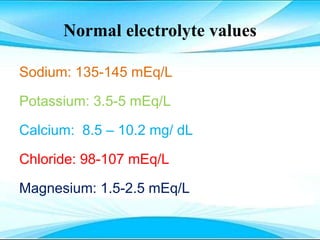
Normal electrolyte values
Sodium: 135-145 mEq/L
Potassium: 3.5-5 mEq/L
Calcium: 8.5 – 10.2 mg/ dL
Chloride: 98-107 mEq/L
Magnesium: 1.5-2.5 mEq/L
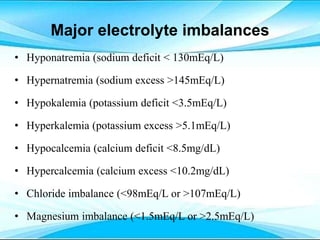
Major electrolyte imbalances
• Hyponatremia (sodium deficit < 130mEq/L)
• Hypernatremia (sodium excess >145mEq/L)
• Hypokalemia (potassium deficit <3.5mEq/L)
• Hyperkalemia (potassium excess >5.1mEq/L)
• Hypocalcemia (calcium deficit <8.5mg/dL)
• Hypercalcemia (calcium excess <10.2mg/dL)
• Chloride imbalance (<98mEq/L or >107mEq/L)
• Magnesium imbalance (<1.5mEq/L or >2.5mEq/L)
Hyponatremia
Definition: Commonly defined as a
serum Na concentration <135 mEq/L.
Hyponatremia represents a relative excess of
water in relation to sodium.
It is the most common electrolyte disorder
Types
• Hypovolemic hyponatremia
• Euvolemic hyponatremia
• Hypervolemic hyponatremia
• Redistributive hyponatremia
• Hypovolemic hyponatremia
Developsas sodiumand free water are lost
and/or replaced by inappropriately hypotonic
fluids
Etiology
Sodium can be lost through renal or non-renal
routes
GI losses- Vomiting, Diarrhea, fistulas, pancreatitis
 Excessive sweating
 Third spacing of fluids- ascites, peritonitis,
pancreatitis, and burns
Cerebral salt-wasting syndrome- traumatic brain
injury, aneurysmal subarachnoid hemorrhage, and
intracranial surgery
Renal Loss- Acute or chronic renal insufficiency,
Diuretics
• Euvolemic hyponatremia- Sodium deficit is
more and the water volume remainssame.
• Hypervolemic hyponatremia- Total body sodium
increases, and total body water increases to a
greater extent.
• Redistributive hyponatremia- Water shifts from
the intracellular to the extra cellular compartment,
with a resultant dilution of sodium. The total body
water and total body sodium are unchanged.
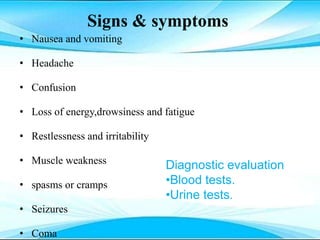
Signs & symptoms
• Nausea and vomiting
• Headache
• Confusion
• Loss of energy,drowsiness and fatigue
• Restlessness and irritability
• Muscle weakness
• spasms or cramps
• Seizures
• Coma
Diagnostic evaluation
•Blood tests.
•Urine tests.
Complication
• In acute hyponatremia, sodium levels drop
rapidly — resulting in potentially
dangerous effects, such as rapid brain
swelling, which can result in a coma and
death.
Medical management
• Determine cause.
• If fluid volume excess, intake of fluids will be
restricted to allow the sodium to regain balance.
• Na <125 mEq/L, sodium replacement is needed.
• Moderate hyponatremia 125 meq/ L - IVsolution
(0.9% NaCl) or RL solution .
• Na level is 115 meq / L or less, a concentrated
saline solution such as 3 % NaCl is indicated.
Nursing management
• Monitor cardiovascular, respiratory, neuromuscular, cerebral,
renal, and gastrointestinal status of the client.
Monitor VS & CVP
Weigh client daily.
Neck and peripheral vein distention, pitting edema, and
dyspnea.
 Auscultate lung and heart sounds.
 Monitor intake and output.
 Monitor infusion rate of parenteral fluids closely
HYPERNATREMIA
Hypernatremia is an electrolyte imbalance
and is indicated by a high level of sodium in
the blood. The normal adult value for Na is
135-145mEq/L. It implies a deficit of total
body water relative to total body Na, caused by
water intake being less than water losses
Causes
• Impaired thirst: eg - primary hypodypsia
• Excessive Na+ retention
• Excessive salt intake
• Hyperventilation
• Obstructive uropathy
• Heavy exercise, exertion
• Drugs such – steroids, certain blood pressure lowering medicines.
• Administration of hypertonic enteral feedings with out adequate water
supplements.
• Less intake
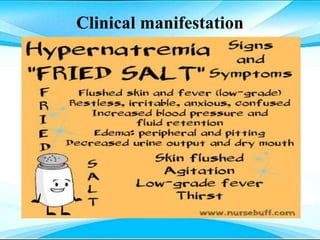
Clinical manifestation
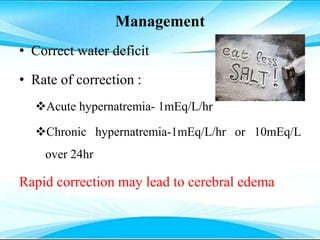
Management
• Correct water deficit
• Rate of correction :
Acute hypernatremia- 1mEq/L/hr
Chronic hypernatremia-1mEq/L/hr or 10mEq/L
over 24hr
Rapid correction may lead to cerebral edema
Complications
• Cerebral bleeding
• Cerebral edema
• Subarachnoid hemorrhage
• Permanent brain damage
• Death due to brain shrinkage
Nursing concern
• Fever, tachycardia, decreased blood pressure,
• Poor skin turgor; flushed skin color; dry
mucous membranes and a rough, dry tongue
• Tremors, seizures, and rigid paralysis
• Safety measures for the patient
• safety measures for the patient
Meaning- Hypokalemia is a serum potassium
level less than 3.5 mEq /L
Ethiology
• Decreased potassium intake
• Increased losses or shifts in intracellular and
extracellular distribution.
G I - Prolonged diarrhea, Vomiting, Excessive
use of laxatives
Renal
• Diuretic therapy
• Urinary loss in congestive heart failure
• Hypomagnesaemia
• Primary or secondary hyperaldosteronism
• Cushings syndrome or disease
• Large doses of corticosteroids
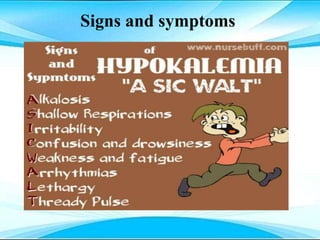
Signs and symptoms
Laboratory & diagnostic findings
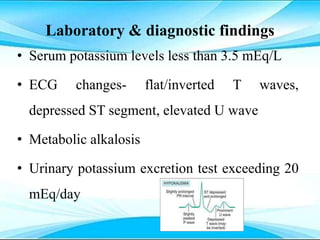
• Serum potassium levels less than 3.5 mEq/L
• ECG changes- flat/inverted T waves,
depressed ST segment, elevated U wave
• Metabolic alkalosis
• Urinary potassium excretion test exceeding 20
mEq/day
Management
Medical management
• Determining & correcting the cause of the
imbalance.
• Extreme hypokalemia requires cardiac
monitoring
Pharmacological management
 Oral potassium replacement - mild hypokalemia.
(irritating to gastric mucosa -with Glass of water
or juice).
 Sk IV for moderate or severe hypokalemia
 Can be given in doses of 10 to 20 mEq/ hour
diluted
Nursing assessment
• Identify ECG changes.
• Observe for dehydration
• Observe for neuromuscular - fatigue and muscular
weakness.
Complications
Heart problems
Paralysis
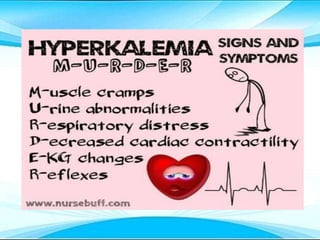
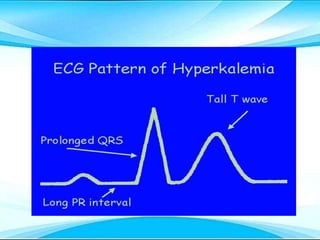
Hyperkalemia is an Elevated potassium
level over 5.0 mEq/L.
ETIOLOGY
• Retention of Potassium- Renal insufficiency, renal
failure,
• Decreased urine output, potassium sparing diuretics.
• Excessive release of Cellular Potassium - severe
traumatic injuries. Severe burns, severe infection,
metabolic acidosis.
• Excessive IV infusions or Oral administration of
potassium.
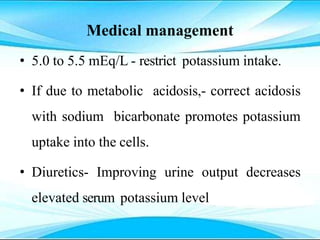
Medical management
• 5.0 to 5.5 mEq/L - restrict potassium intake.
• If due to metabolic acidosis,- correct acidosis
with sodium bicarbonate promotes potassium
uptake into the cells.
• Diuretics- Improving urine output decreases
elevated serum potassium level
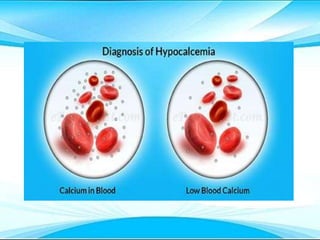
Total serum level of less than 8.5 mg/dl
It can result for decreased total body calcium
stores or low levels of extracellular calcium
with normal amounts of Calcium stored in
bones.
Causes
• Parathyroidectomy
• Acute Pancreatitis
• Inadequate dietary intake
• Lack of sun exposure
• Lack of weight bearing exercise
• Drugs: Loop diuretics, calcitonin
• Hypomagnesemia, alcohol abuse
Clinical manifestation
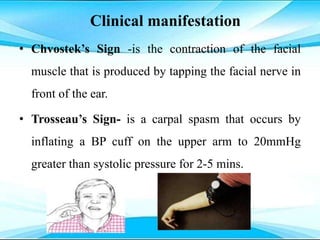
• Chvostek’s Sign -is the contraction of the facial
muscle that is produced by tapping the facial nerve in
front of the ear.
• Trosseau’s Sign- is a carpal spasm that occurs by
inflating a BP cuff on the upper arm to 20mmHg
greater than systolic pressure for 2-5 mins.
Muscle spasms
Laryngospasms
Seizures
Anxiety, confusion, psychosis
Bronchospasm
 diarrhoea
Numbness
Management
Pharmacological management
Oral or intravenous calcium
Calcium Chloride
Calcium Gluconate
Calcium Lactate
Calcium Citrate
Calcium Gluceptate
Calcium Carbonate
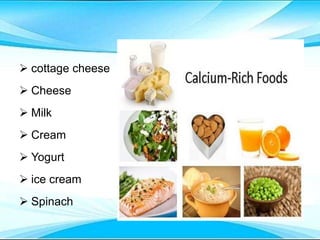
 cottage cheese
 Cheese
 Milk
 Cream
 Yogurt
 ice cream
 Spinach
Nursing managements
Fatigue
Tingling/numbness; fingers l
Abdominal cramps
Palpitations
Dyspnea
Muscle spasms
• Serum calcium value greater than 10.2 mg/dl
• Usually results from increased absorption of
calcium from the bones and intestines.
Contributing factors
• Excessive calcium intake
• Excessive vitamin D intake
• Renal failure
• Hyperparathyroidism
• Malignancy
• Hyperthyroidism
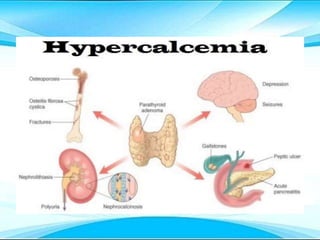
Clinical manifestations
• Muscular weakness
• Constipation
• Anorexia
• Nausea & vomiting
• Dehydration
• Hypoactive deep tendon reflexes
• Calcium stones
Management
• Eliminate calcium administration
• Drug Therapy
• Isotonic NaCL (Inc. the excretion of Ca)
• Diuretics
• Calcium reabsorption inhibitors (Phosphorus)
• Cardiac Monitoring
• Restrict calcium intake
Nursing management
• Increasing patient mobility and encouraging
fluids
• Encourage to drink 2.8 to 3.8L of fluid daily
• Adequate fiber in diet is encouraged
• Safety precaution are implemented
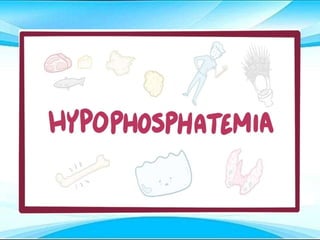
Hypophosphatemia is an electrolyte
disturbance in which there is an abnormally
low level of phosphate in the blood.
Hypophosphatemia is defined as:
Mild 2-2.5 mg/dL
Moderate 1-2 mg/dL
Severe < 1 mg/dL
Etiology and risk factors
• loss or long term lack of intake
• increased growth or tissue repair and recovery
from malnourished states.
• Prolonged and excessive intake of antacids.
• Increased calcium found in hyperparathyroidism.
• Phosphate loss occurring in burns and metabolic
alkalosis
Clinical manifestations
• Decreased cardiac and respiratory functions
• Muscle weakness
• Brittle bones, bone pain
• Confusion and seizure
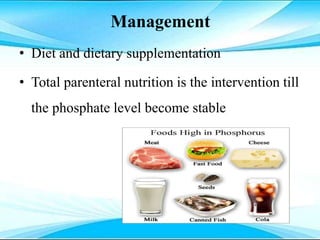
Management
• Diet and dietary supplementation
• Total parenteral nutrition is the intervention till
the phosphate level become stable
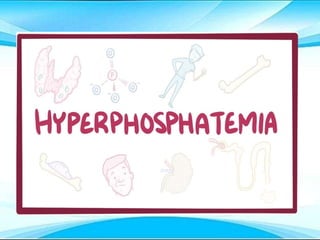
• Hyperphosphatemia is an electrolyte
disturbance in which there is an abnormally
elevated level of phosphate in the blood, ie.
serum phosphate concentration > 4.5 mg/dL
Clinical manifestations
• Tachycardia, palpitations and restlessness.
• Anorexia, nausea, vomiting.
• Tetany, serious dysrrythmias.
• All the clinical features of hypocalcemia
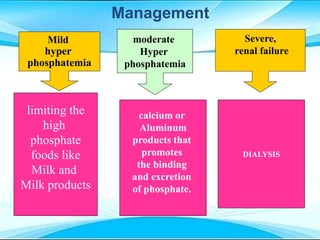
Management
Mild
hyper
phosphatemia
limiting the
high
phosphate
foods like
Milk and
Milk products
moderate
Hyper
phosphatemia
calcium or
Aluminum
products that
promotes
the binding
and excretion
of phosphate.
Severe,
renal failure
DIALYSIS
• Normal magnesium levels are between 1.46–
2.68 mg/dL (0.6-1.1 mmol/L)
• levels less than 1.46 mg/dL (0.6 mmol/L)
defining hypomagnesemia.
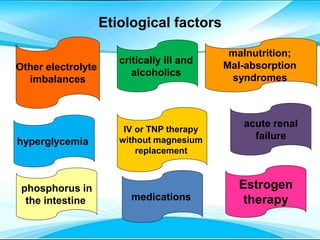
Etiological factors
Other electrolyte
imbalances
critically ill and
alcoholics
malnutrition;
Mal-absorption
syndromes
hyperglycemia
IV or TNP therapy
without magnesium
replacement
acute renal
failure
phosphorus in
the intestine medications
Estrogen
therapy
Clinical manifestations
• Myocardial irritability
• GI changes from decreased contractility
• Neuromuscular changes

• Cardiac abnormalities
Management
• oral magnesium replacement in the form of
magnesium-containing antacids or parenteral
magnesium sulfate.
• Increase in dietary intake of magnesium
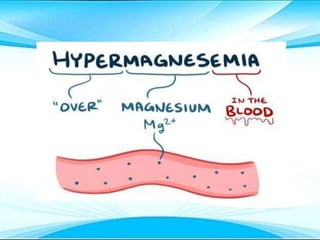
• levels greater than 2.68 mg/dL
(1.1 mmol/L) defining as
hypermagnesemia.
Etiology and risk factors
• renal insufficiency
• excessive use of magnesium-containing
antacids or laxatives
• administration of potassium sparing diuretics
• severe dehydration from ketoacidosis
• overuse of IV magnesium sulfate
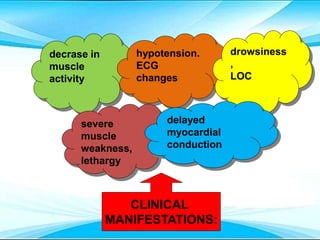
CLINICAL
MANIFESTATIONS:
decrase in
muscle
activity
hypotension.
ECG
changes
drowsiness
,
LOC
severe
muscle
weakness,
lethargy
delayed
myocardial
conduction
Management
– Decreasing the use of magnesium sulfate.
– Diuretic increases renal elimination of magnesium.
– IV calcium may also be used ot antagonize the effect of
hypermagnesemis.
– Albuterol has also been used to reduce magnesium levels.
– The presence of severe respiratory distresses require
ventilatory assistance.
– If renal failure is present, hemodialysis may be necessary
Conclusion
Electrolytes are chemicals in the body that
regulate important physiological functions.
Electrolyte imbalance causes a variety of
symptoms that can be severe. These can be
life-threatening if not managed appropriately.
Fluid & electrolyte imbalance

Fluid & electrolyte imbalance

  • 1.
    FLUID & ELECTROLYTEIMBALANCE Mr. Melvin Jacob MSc Nursing
  • 2.
    Introduction • Every partof your body needs water to function. When you are healthy, your body is able to balance the amount of water that enters or leaves your body. • Water is the major body component, accounting 60% of the adult body weight. • 2/3rd of the water is with in the cells. (intracellular fluid) • 1/3rd of body water is outside the cells(extracellular fluid).
  • 3.
    The extra cellularfluid compartment is further divided into • intravascular (eg:plasma) • interstitial(between cells).
  • 5.
    Types of fluidimbalances 5 major types • Extracellular fluid volume deficit • Intra cellular fluid volume deficit • Extra cellular fluid volume excess • Intra cellular fluid volume excess • Extracellular fluid volume shift.
  • 6.
    1.Extra cellular fluidvolume deficit(dehydration): It is a decrease in intravascular and interstitial fluids.  Etiology :-  Lack of fluid intake  Excess fluid losses -severe vomiting and diarrhea.  other potential causes are fever, burns, blood loss, Increased ADH secretion, use of diuretics, diuretic phase of acute renal failure
  • 7.
    Clinical manifestations  Lossof body weight  Changes in intake and output.  Increased thirst  Decreased pulse  Manifestations of cellular dehydrationdry mouth and eyes, decreased skin turgor, soft and sunken eyes, muscle weakness, constipation .  cerebral signs:-restlessness, head ache, confusion, followed by coma.
  • 8.
    Management Fluid restoration • Oralrehydration • Intravenous rehydration • Correction of underlying problem with antiemetics, antidiarrheals, antibiotics, and antipyretics.
  • 9.
    2.Intra cellular fluidvolume deficit • It occurs quite often in older clients • Thirst and oliguria are the most common compensatory signs. • Cellular manifestations  fever, CNS changes such as confusion, coma, and cerebral hemorrhage. • Rx:- I/V fluids, correction of underlying cause.
  • 10.
    3. Extracellular fluidvolume excess ECF volume excess is fluid overload or overhydration. • It can be seen in Vascular system hypervolemia Interstitial space third spacing Etiology:- it can develop from two processes. a. Simple overloading with fluids b. Failure to excrete fluids.
  • 11.
    4. Intra cellularfluid volume excess Water excess or solute deficit • Most common cause during hospitalization ; - administration of hypo osmolar I/V fluids such as 0.45%NS ,5% dextrose in water. • people with certain psychiatric disorders ,such as schizophrenia
  • 12.
    5. Extracellular fluidvolume shift • Fluid shift are of two types: a. Vascular to interstitial spaces leads to fluid volume deficit (hypovolemia) b. Interstitial to vascular space leads to fluid volume excess (hypervolemia). Common sites of third spacing: pleural cavity, peritoneal cavity, and pericardial sac.
  • 13.
    CLINICAL MANIFESTATIONS Respiratory manifestations: •Coughing • Dyspnoea • crackles over affected area • Pallor, cyanosis • decreased tissue perfusion • If hydrostatic pressure continues to rise fluid shifts into the pleural space leads to pleural effusion.
  • 14.
    Cardiac manifestations: • distendedjugular vein • a bounding pulse and elevated blood pressure • increased CVP • heart sound S3 can often be auscultated.
  • 15.
    • Edema ofthe feet • rapid weight gain(a classical sign of fluid overload) • CNS changes include confusion and head ache. • As the fluid excess increases lethargy occurs, followed by seizures and coma.
  • 16.
    MANAGEMENT • Restriction ofsodium and fluids. • Promoting urine output: Mild diuretics and digitalis promote urine output and myocardial contractility. • Perform neurologic assessment. • Monitor I/V fluids and I/O hourly ,daily weight. • Provide safety measures to protect the patient.
  • 17.
    Nursing management Assessment:  Monitorvital signs for bounding pulse, elevated BP.  Assess breath sounds every 4-8 hrs for crackles, wheezes, rhonchi.  Compare I/O every 4-8 hrs  Weigh the client daily.  Monitor, sodium level, hematocrit, and urine special gravity.  Observe changes in LOC.
  • 19.
    INTRODUCTION • Electrolyte imbalanceis an abnormality in the concentration of electrolytes in the body. • Electrolytes play a vital role in maintaining homeostasis within the body. • They help to regulate heart and neurological function, fluid balance, oxygen delivery, acid– base balance and much more.
  • 20.
    ELECTROLYTE • Na+: mostabundant electrolyte in the body. • K+: essential for normal membrane excitability for nerve impulse. • Cl-: regulates osmotic pressure and assists in regulating acid-base balance.
  • 21.
    • Ca2+: usuallycombined with phosphorus to form the mineral salts of bones and teeth, promotes nerve impulse and muscle contraction/relaxation • Mg2+: plays role in carbohydrate and protein metabolism, storage and use of intracellular energy and neural transmission. Important in the functioning of the heart, nerves, and muscles
  • 22.
    Normal electrolyte values Sodium:135-145 mEq/L Potassium: 3.5-5 mEq/L Calcium: 8.5 – 10.2 mg/ dL Chloride: 98-107 mEq/L Magnesium: 1.5-2.5 mEq/L
  • 23.
    Major electrolyte imbalances •Hyponatremia (sodium deficit < 130mEq/L) • Hypernatremia (sodium excess >145mEq/L) • Hypokalemia (potassium deficit <3.5mEq/L) • Hyperkalemia (potassium excess >5.1mEq/L) • Hypocalcemia (calcium deficit <8.5mg/dL) • Hypercalcemia (calcium excess <10.2mg/dL) • Chloride imbalance (<98mEq/L or >107mEq/L) • Magnesium imbalance (<1.5mEq/L or >2.5mEq/L)
  • 24.
    Hyponatremia Definition: Commonly definedas a serum Na concentration <135 mEq/L. Hyponatremia represents a relative excess of water in relation to sodium. It is the most common electrolyte disorder
  • 25.
    Types • Hypovolemic hyponatremia •Euvolemic hyponatremia • Hypervolemic hyponatremia • Redistributive hyponatremia
  • 26.
    • Hypovolemic hyponatremia Developsassodiumand free water are lost and/or replaced by inappropriately hypotonic fluids Etiology Sodium can be lost through renal or non-renal routes
  • 27.
    GI losses- Vomiting,Diarrhea, fistulas, pancreatitis  Excessive sweating  Third spacing of fluids- ascites, peritonitis, pancreatitis, and burns Cerebral salt-wasting syndrome- traumatic brain injury, aneurysmal subarachnoid hemorrhage, and intracranial surgery Renal Loss- Acute or chronic renal insufficiency, Diuretics
  • 28.
    • Euvolemic hyponatremia-Sodium deficit is more and the water volume remainssame. • Hypervolemic hyponatremia- Total body sodium increases, and total body water increases to a greater extent. • Redistributive hyponatremia- Water shifts from the intracellular to the extra cellular compartment, with a resultant dilution of sodium. The total body water and total body sodium are unchanged.
  • 29.
    Signs & symptoms •Nausea and vomiting • Headache • Confusion • Loss of energy,drowsiness and fatigue • Restlessness and irritability • Muscle weakness • spasms or cramps • Seizures • Coma Diagnostic evaluation •Blood tests. •Urine tests.
  • 30.
    Complication • In acutehyponatremia, sodium levels drop rapidly — resulting in potentially dangerous effects, such as rapid brain swelling, which can result in a coma and death.
  • 31.
    Medical management • Determinecause. • If fluid volume excess, intake of fluids will be restricted to allow the sodium to regain balance. • Na <125 mEq/L, sodium replacement is needed. • Moderate hyponatremia 125 meq/ L - IVsolution (0.9% NaCl) or RL solution . • Na level is 115 meq / L or less, a concentrated saline solution such as 3 % NaCl is indicated.
  • 32.
    Nursing management • Monitorcardiovascular, respiratory, neuromuscular, cerebral, renal, and gastrointestinal status of the client. Monitor VS & CVP Weigh client daily. Neck and peripheral vein distention, pitting edema, and dyspnea.  Auscultate lung and heart sounds.  Monitor intake and output.  Monitor infusion rate of parenteral fluids closely
  • 33.
    HYPERNATREMIA Hypernatremia is anelectrolyte imbalance and is indicated by a high level of sodium in the blood. The normal adult value for Na is 135-145mEq/L. It implies a deficit of total body water relative to total body Na, caused by water intake being less than water losses
  • 34.
    Causes • Impaired thirst:eg - primary hypodypsia • Excessive Na+ retention • Excessive salt intake • Hyperventilation • Obstructive uropathy • Heavy exercise, exertion • Drugs such – steroids, certain blood pressure lowering medicines. • Administration of hypertonic enteral feedings with out adequate water supplements. • Less intake
  • 35.
  • 36.
    Management • Correct waterdeficit • Rate of correction : Acute hypernatremia- 1mEq/L/hr Chronic hypernatremia-1mEq/L/hr or 10mEq/L over 24hr Rapid correction may lead to cerebral edema
  • 37.
    Complications • Cerebral bleeding •Cerebral edema • Subarachnoid hemorrhage • Permanent brain damage • Death due to brain shrinkage
  • 38.
    Nursing concern • Fever,tachycardia, decreased blood pressure, • Poor skin turgor; flushed skin color; dry mucous membranes and a rough, dry tongue • Tremors, seizures, and rigid paralysis • Safety measures for the patient
  • 39.
    • safety measuresfor the patient
  • 40.
    Meaning- Hypokalemia isa serum potassium level less than 3.5 mEq /L
  • 41.
    Ethiology • Decreased potassiumintake • Increased losses or shifts in intracellular and extracellular distribution. G I - Prolonged diarrhea, Vomiting, Excessive use of laxatives
  • 42.
    Renal • Diuretic therapy •Urinary loss in congestive heart failure • Hypomagnesaemia • Primary or secondary hyperaldosteronism • Cushings syndrome or disease • Large doses of corticosteroids
  • 43.
  • 44.
    Laboratory & diagnosticfindings • Serum potassium levels less than 3.5 mEq/L • ECG changes- flat/inverted T waves, depressed ST segment, elevated U wave • Metabolic alkalosis • Urinary potassium excretion test exceeding 20 mEq/day
  • 45.
    Management Medical management • Determining& correcting the cause of the imbalance. • Extreme hypokalemia requires cardiac monitoring
  • 46.
    Pharmacological management  Oralpotassium replacement - mild hypokalemia. (irritating to gastric mucosa -with Glass of water or juice).  Sk IV for moderate or severe hypokalemia  Can be given in doses of 10 to 20 mEq/ hour diluted
  • 48.
    Nursing assessment • IdentifyECG changes. • Observe for dehydration • Observe for neuromuscular - fatigue and muscular weakness. Complications Heart problems Paralysis
  • 50.
    Hyperkalemia is anElevated potassium level over 5.0 mEq/L.
  • 51.
    ETIOLOGY • Retention ofPotassium- Renal insufficiency, renal failure, • Decreased urine output, potassium sparing diuretics. • Excessive release of Cellular Potassium - severe traumatic injuries. Severe burns, severe infection, metabolic acidosis. • Excessive IV infusions or Oral administration of potassium.
  • 54.
    Medical management • 5.0to 5.5 mEq/L - restrict potassium intake. • If due to metabolic acidosis,- correct acidosis with sodium bicarbonate promotes potassium uptake into the cells. • Diuretics- Improving urine output decreases elevated serum potassium level
  • 57.
    Total serum levelof less than 8.5 mg/dl It can result for decreased total body calcium stores or low levels of extracellular calcium with normal amounts of Calcium stored in bones.
  • 58.
    Causes • Parathyroidectomy • AcutePancreatitis • Inadequate dietary intake • Lack of sun exposure • Lack of weight bearing exercise • Drugs: Loop diuretics, calcitonin • Hypomagnesemia, alcohol abuse
  • 59.
    Clinical manifestation • Chvostek’sSign -is the contraction of the facial muscle that is produced by tapping the facial nerve in front of the ear. • Trosseau’s Sign- is a carpal spasm that occurs by inflating a BP cuff on the upper arm to 20mmHg greater than systolic pressure for 2-5 mins.
  • 60.
    Muscle spasms Laryngospasms Seizures Anxiety, confusion,psychosis Bronchospasm  diarrhoea Numbness
  • 62.
    Management Pharmacological management Oral orintravenous calcium Calcium Chloride Calcium Gluconate Calcium Lactate Calcium Citrate Calcium Gluceptate Calcium Carbonate
  • 63.
     cottage cheese Cheese  Milk  Cream  Yogurt  ice cream  Spinach
  • 64.
    Nursing managements Fatigue Tingling/numbness; fingersl Abdominal cramps Palpitations Dyspnea Muscle spasms
  • 66.
    • Serum calciumvalue greater than 10.2 mg/dl • Usually results from increased absorption of calcium from the bones and intestines.
  • 67.
    Contributing factors • Excessivecalcium intake • Excessive vitamin D intake • Renal failure • Hyperparathyroidism • Malignancy • Hyperthyroidism
  • 68.
    Clinical manifestations • Muscularweakness • Constipation • Anorexia • Nausea & vomiting • Dehydration • Hypoactive deep tendon reflexes • Calcium stones
  • 69.
    Management • Eliminate calciumadministration • Drug Therapy • Isotonic NaCL (Inc. the excretion of Ca) • Diuretics • Calcium reabsorption inhibitors (Phosphorus) • Cardiac Monitoring • Restrict calcium intake
  • 70.
    Nursing management • Increasingpatient mobility and encouraging fluids • Encourage to drink 2.8 to 3.8L of fluid daily • Adequate fiber in diet is encouraged • Safety precaution are implemented
  • 72.
    Hypophosphatemia is anelectrolyte disturbance in which there is an abnormally low level of phosphate in the blood. Hypophosphatemia is defined as: Mild 2-2.5 mg/dL Moderate 1-2 mg/dL Severe < 1 mg/dL
  • 73.
    Etiology and riskfactors • loss or long term lack of intake • increased growth or tissue repair and recovery from malnourished states. • Prolonged and excessive intake of antacids. • Increased calcium found in hyperparathyroidism. • Phosphate loss occurring in burns and metabolic alkalosis
  • 74.
    Clinical manifestations • Decreasedcardiac and respiratory functions • Muscle weakness • Brittle bones, bone pain • Confusion and seizure
  • 75.
    Management • Diet anddietary supplementation • Total parenteral nutrition is the intervention till the phosphate level become stable
  • 77.
    • Hyperphosphatemia isan electrolyte disturbance in which there is an abnormally elevated level of phosphate in the blood, ie. serum phosphate concentration > 4.5 mg/dL
  • 78.
    Clinical manifestations • Tachycardia,palpitations and restlessness. • Anorexia, nausea, vomiting. • Tetany, serious dysrrythmias. • All the clinical features of hypocalcemia
  • 79.
    Management Mild hyper phosphatemia limiting the high phosphate foods like Milkand Milk products moderate Hyper phosphatemia calcium or Aluminum products that promotes the binding and excretion of phosphate. Severe, renal failure DIALYSIS
  • 81.
    • Normal magnesiumlevels are between 1.46– 2.68 mg/dL (0.6-1.1 mmol/L) • levels less than 1.46 mg/dL (0.6 mmol/L) defining hypomagnesemia.
  • 82.
    Etiological factors Other electrolyte imbalances criticallyill and alcoholics malnutrition; Mal-absorption syndromes hyperglycemia IV or TNP therapy without magnesium replacement acute renal failure phosphorus in the intestine medications Estrogen therapy
  • 83.
    Clinical manifestations • Myocardialirritability • GI changes from decreased contractility • Neuromuscular changes • Cardiac abnormalities
  • 84.
    Management • oral magnesiumreplacement in the form of magnesium-containing antacids or parenteral magnesium sulfate. • Increase in dietary intake of magnesium
  • 87.
    • levels greaterthan 2.68 mg/dL (1.1 mmol/L) defining as hypermagnesemia.
  • 88.
    Etiology and riskfactors • renal insufficiency • excessive use of magnesium-containing antacids or laxatives • administration of potassium sparing diuretics • severe dehydration from ketoacidosis • overuse of IV magnesium sulfate
  • 89.
  • 90.
    Management – Decreasing theuse of magnesium sulfate. – Diuretic increases renal elimination of magnesium. – IV calcium may also be used ot antagonize the effect of hypermagnesemis. – Albuterol has also been used to reduce magnesium levels. – The presence of severe respiratory distresses require ventilatory assistance. – If renal failure is present, hemodialysis may be necessary
  • 91.
    Conclusion Electrolytes are chemicalsin the body that regulate important physiological functions. Electrolyte imbalance causes a variety of symptoms that can be severe. These can be life-threatening if not managed appropriately.