POLYCYTHEMIA
PRESESNTED BY:
MUHAMMAD BILAL
UNIVERSITY OF EDUCATION, TOWNSHIP LAHORE
POLYCYTHEMIA
• Polycythemia is a blood disorder in which the
body produces too many red blood cells as a
result of a problem with the bone marrow or an
increased production of the hormone
erythropoietin (EPO).
• Polycythemia is normally reported in terms of
 Increased hematocrit
 Hemoglobin concentration.
• The normal range for hematocrit varies between sexes and is
approximately 45% to 52% for men and 37% to 48% for women.
• Polycythemia is considered when the hematocrit is greater than 48% in
women and 52% in men.
• The normal range for hemoglobin is: For men, 13.5 to 17.5 grams per
deciliter. For women, 12.0 to 15.5 grams per deciliter.
• Hemoglobin (HGB): Polycythemia is considered when there is a
hemoglobin level of greater than 16.5g/dL in women or hemoglobin level
greater than18.5 g/dL in men.
CLASIFICATION
• Polycythemia can be divided into two categories:
• Relative polycythemia
• Absolute polycythemia
primary polycythemia
secondary polycythemia
RELATIVE POLYCYTHEMIA
PRIMARY POLYCYTHEMIA OR
POLYCYTHEMIA VERA
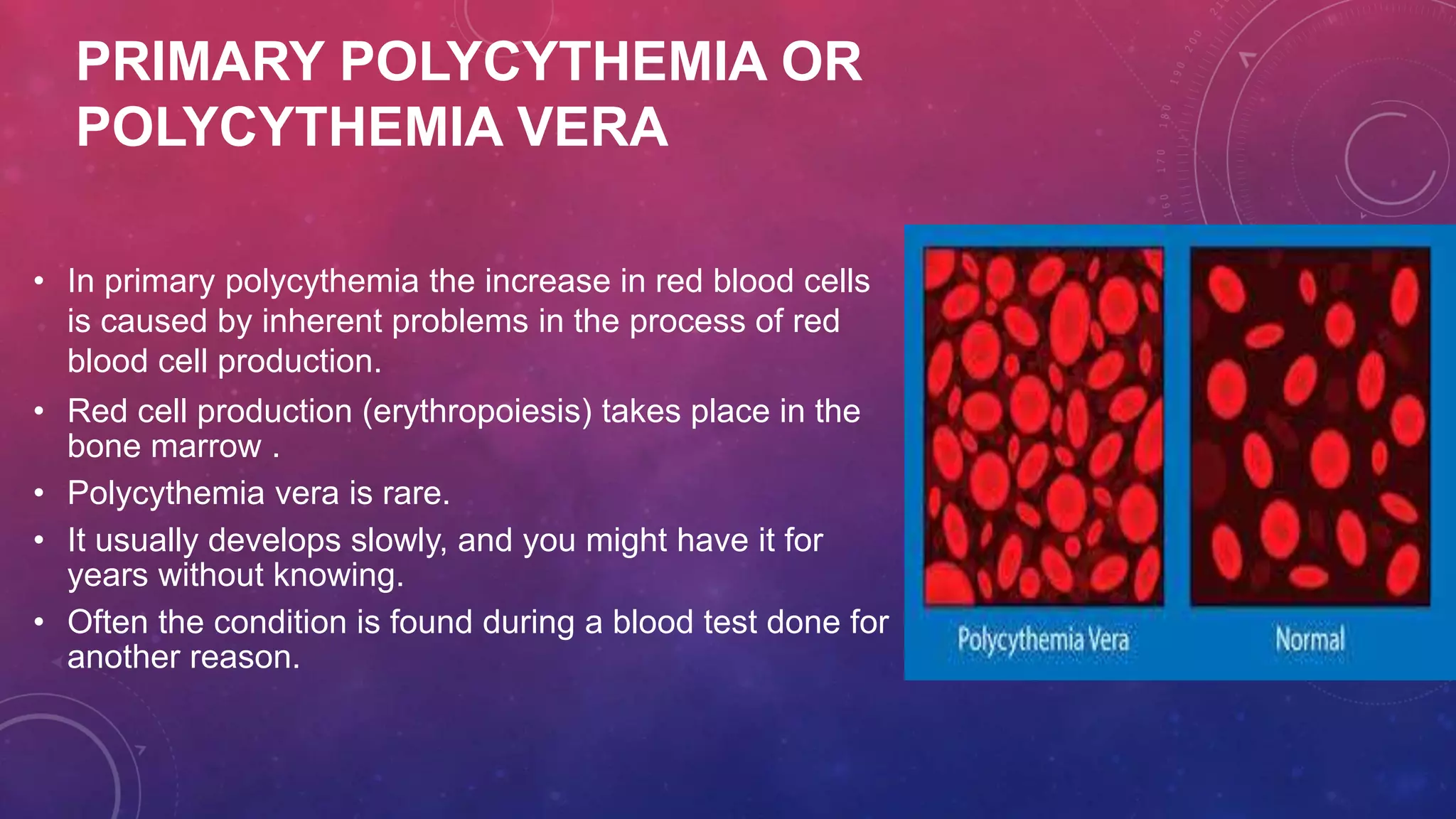
• In primary polycythemia the increase in red blood cells
is caused by inherent problems in the process of red
blood cell production.
• Red cell production (erythropoiesis) takes place in the
bone marrow .
• Polycythemia vera is rare.
• It usually develops slowly, and you might have it for
years without knowing.
• Often the condition is found during a blood test done for
another reason.
NEONATAL (NEWBORN) POLYCYTHEMIA
• Neonatal polycythemia can be seen in 1% to 5% of newborns.
• The most common causes may be related to
Transfusion of blood
Transfer of placental blood to the infant after delivery
Chronic inadequate oxygenation of the fetus (intrauterine
hypoxia) due to placental insufficiency.
SYMPTOMS
• Elevated hematocrit level
• Elevated hemoglobin level
• Plethora
• Pruritus after bathing
• Splenomegaly
• Weight loss
• Weakness
• sweating
• Bruising/epistaxis
• Erythromyalgia
• Hemorrhagic events
• Hepatomegaly
• Ischemic digits
• Transient neurological
symptoms
• Atypical chest pain
• Hyperemic and inflamed
condition of extremities
CAUSES OF POLYCYTHEMIA VERA
• Polycythemia vera occurs when a mutation in a gene causes a problem
with blood cell production.
• Genetic mutations of the JAK2 gene were found to be responsible for
most cases of polycythemia vera.
• These mutations are thought to possibly increase the sensitivity of the
red blood cell precursors to erythropoietin, thereby, increasing red blood
cell production.
• The cause of the gene mutation in polycythemia vera is unknown, but it's
generally not inherited from your parents.
CAUSES OF SECONDARY POLYCYTHEMIA
• In secondary polycythemia, factors external to red blood cell production
result in polycythemia.
• Secondary polycythemia most often develops as a response to chronic
hypoxemia, which triggers increased production of erythropoietin by the
kidneys.
• The most common causes of secondary polycythemia include
obstructive sleep apnea, obesity hypoventilation syndrome, and chronic
obstructive pulmonary disease (COPD)
• Other causes include testosterone replacement therapy and heavy
cigarette smoking.
COMPLICATIONS OF POLYCYTHEMIA VERA
• Blood clots: Increased blood thickness and decreased blood flow, as
well as abnormalities in your platelets, raise your risk of blood clots.
• Enlarged spleen: The increased number of blood cells caused by
polycythemia vera makes your spleen work harder than normal, which
causes it to enlarge.
• Other complications, including open sores on the inside lining of your
stomach, upper small intestine or esophagus (peptic ulcers) and
inflammation in your joints (gout).
• Other blood disorders
COMPLICATIONS OF SECONDARY
POLYCYTHEMIA
• Excessive polycythemia occur when hematocrit levels higher than 65-
70%, may result in increased whole blood viscosity.
• This, in turn, may lead to impaired blood flow locally, resulting in
thrombosis.
• Hyperviscosity may also lead to generalized sluggish blood flow,
resulting in impaired tissue oxygenation in multiple organs, which may
lead to decreased mentation, fatigue, generalized weakness, and poor
exercise tolerance.
DIAGNOSIS
HISTORY COLLECTION AND PHYSICAL EXAMINATION
History usually includes questions about smoking, living at high altitudes,
breathing difficulty, sleep disturbances and chronic cough.
Blood tests
The blood studies will show
An increase in the
number of red blood cells
Elevated levels of
hemoglobin
Elevated hematocrit
measurement
Very low levels of
erythropoietin
BONE MARROW ASPIRATION OR BIOPSY
• A bone marrow biopsy involves taking a
sample of solid bone marrow material.
• If an examination of the bone marrow
shows that it's producing higher than
normal numbers of blood cells, it may be a
sign of polycythemia.
Bone marrow biopsy
OTHER DIAGNOSTING MEASSURES
• Chest X-Ray
• Electrocardiogram
• Echocardiogram
• SpO2 measurement
(oxygen saturation)
TREATMENT
Phlebotomy or Blood withdrawals:
• The most common treatment for polycythemia vera is having
frequent blood withdrawals, using a needle in a vein
(phlebotomy). It's the same procedure used for donating blood.
• This reduces the number of blood cells and decreases your
blood volume, making it easier for your blood to function
properly.
 LOW-DOSE ASPIRIN
The doctor may recommend that to take a low dose of aspirin to reduce
your risk of blood clots. Low-dose aspirin may also help reduce burning
pain in your feet or hands
Therapy to reduce itching
If you have bother some itching, the doctor may prescribe medication, such
as antihistamines, or recommend ultraviolet light treatment to relieve your
discomfort
 MEDICATION TO DECREASE BLOOD
CELLS
• For people with polycythemia, who aren't helped by phlebotomy alone,
medications, such as hydroxyurea (Droxia, Hydrea), to suppress the
bone marrow's ability to produce blood cells may be used.
• Interferon alpha may be used to stimulate the immune system to fight
the overproduction of red blood cells
LIFESTYLE AND HOME REMEDIES
• Exercise
• Avoid tobacco
• Watch for sores
• Be good to your skin
• Avoid extreme temperature
Polycythemia

Polycythemia

  • 1.
  • 2.
    POLYCYTHEMIA • Polycythemia isa blood disorder in which the body produces too many red blood cells as a result of a problem with the bone marrow or an increased production of the hormone erythropoietin (EPO). • Polycythemia is normally reported in terms of  Increased hematocrit  Hemoglobin concentration.
  • 3.
    • The normalrange for hematocrit varies between sexes and is approximately 45% to 52% for men and 37% to 48% for women. • Polycythemia is considered when the hematocrit is greater than 48% in women and 52% in men. • The normal range for hemoglobin is: For men, 13.5 to 17.5 grams per deciliter. For women, 12.0 to 15.5 grams per deciliter. • Hemoglobin (HGB): Polycythemia is considered when there is a hemoglobin level of greater than 16.5g/dL in women or hemoglobin level greater than18.5 g/dL in men.
  • 4.
    CLASIFICATION • Polycythemia canbe divided into two categories: • Relative polycythemia • Absolute polycythemia primary polycythemia secondary polycythemia
  • 5.
  • 6.
    PRIMARY POLYCYTHEMIA OR POLYCYTHEMIAVERA • In primary polycythemia the increase in red blood cells is caused by inherent problems in the process of red blood cell production. • Red cell production (erythropoiesis) takes place in the bone marrow . • Polycythemia vera is rare. • It usually develops slowly, and you might have it for years without knowing. • Often the condition is found during a blood test done for another reason.
  • 7.
    NEONATAL (NEWBORN) POLYCYTHEMIA •Neonatal polycythemia can be seen in 1% to 5% of newborns. • The most common causes may be related to Transfusion of blood Transfer of placental blood to the infant after delivery Chronic inadequate oxygenation of the fetus (intrauterine hypoxia) due to placental insufficiency.
  • 8.
    SYMPTOMS • Elevated hematocritlevel • Elevated hemoglobin level • Plethora • Pruritus after bathing • Splenomegaly • Weight loss • Weakness • sweating • Bruising/epistaxis • Erythromyalgia • Hemorrhagic events • Hepatomegaly • Ischemic digits • Transient neurological symptoms • Atypical chest pain • Hyperemic and inflamed condition of extremities
  • 9.
    CAUSES OF POLYCYTHEMIAVERA • Polycythemia vera occurs when a mutation in a gene causes a problem with blood cell production. • Genetic mutations of the JAK2 gene were found to be responsible for most cases of polycythemia vera. • These mutations are thought to possibly increase the sensitivity of the red blood cell precursors to erythropoietin, thereby, increasing red blood cell production. • The cause of the gene mutation in polycythemia vera is unknown, but it's generally not inherited from your parents.
  • 10.
    CAUSES OF SECONDARYPOLYCYTHEMIA • In secondary polycythemia, factors external to red blood cell production result in polycythemia. • Secondary polycythemia most often develops as a response to chronic hypoxemia, which triggers increased production of erythropoietin by the kidneys. • The most common causes of secondary polycythemia include obstructive sleep apnea, obesity hypoventilation syndrome, and chronic obstructive pulmonary disease (COPD) • Other causes include testosterone replacement therapy and heavy cigarette smoking.
  • 11.
    COMPLICATIONS OF POLYCYTHEMIAVERA • Blood clots: Increased blood thickness and decreased blood flow, as well as abnormalities in your platelets, raise your risk of blood clots. • Enlarged spleen: The increased number of blood cells caused by polycythemia vera makes your spleen work harder than normal, which causes it to enlarge. • Other complications, including open sores on the inside lining of your stomach, upper small intestine or esophagus (peptic ulcers) and inflammation in your joints (gout). • Other blood disorders
  • 12.
    COMPLICATIONS OF SECONDARY POLYCYTHEMIA •Excessive polycythemia occur when hematocrit levels higher than 65- 70%, may result in increased whole blood viscosity. • This, in turn, may lead to impaired blood flow locally, resulting in thrombosis. • Hyperviscosity may also lead to generalized sluggish blood flow, resulting in impaired tissue oxygenation in multiple organs, which may lead to decreased mentation, fatigue, generalized weakness, and poor exercise tolerance.
  • 13.
    DIAGNOSIS HISTORY COLLECTION ANDPHYSICAL EXAMINATION History usually includes questions about smoking, living at high altitudes, breathing difficulty, sleep disturbances and chronic cough. Blood tests The blood studies will show An increase in the number of red blood cells Elevated levels of hemoglobin Elevated hematocrit measurement Very low levels of erythropoietin
  • 14.
    BONE MARROW ASPIRATIONOR BIOPSY • A bone marrow biopsy involves taking a sample of solid bone marrow material. • If an examination of the bone marrow shows that it's producing higher than normal numbers of blood cells, it may be a sign of polycythemia. Bone marrow biopsy
  • 15.
    OTHER DIAGNOSTING MEASSURES •Chest X-Ray • Electrocardiogram • Echocardiogram • SpO2 measurement (oxygen saturation)
  • 16.
    TREATMENT Phlebotomy or Bloodwithdrawals: • The most common treatment for polycythemia vera is having frequent blood withdrawals, using a needle in a vein (phlebotomy). It's the same procedure used for donating blood. • This reduces the number of blood cells and decreases your blood volume, making it easier for your blood to function properly.
  • 17.
     LOW-DOSE ASPIRIN Thedoctor may recommend that to take a low dose of aspirin to reduce your risk of blood clots. Low-dose aspirin may also help reduce burning pain in your feet or hands Therapy to reduce itching If you have bother some itching, the doctor may prescribe medication, such as antihistamines, or recommend ultraviolet light treatment to relieve your discomfort
  • 18.
     MEDICATION TODECREASE BLOOD CELLS • For people with polycythemia, who aren't helped by phlebotomy alone, medications, such as hydroxyurea (Droxia, Hydrea), to suppress the bone marrow's ability to produce blood cells may be used. • Interferon alpha may be used to stimulate the immune system to fight the overproduction of red blood cells
  • 19.
    LIFESTYLE AND HOMEREMEDIES • Exercise • Avoid tobacco • Watch for sores • Be good to your skin • Avoid extreme temperature