INTRODUCTION
Polycythemia orerythrocytosis is characterized by an
increase in the red cell mass, measured as increased
hemoglobin and hematocrit above the normal level, which
is Male: 138 to 172 grams per liter (g/L) and Female:
121 to 151 g/L.
We see that the prefix 'poly' means many, the word 'cyt'
refers to cells and the suffix 'emia' refers to in the blood
So polycythemia is literally 'many cells in the blood’.
3.
Continued>>
For example,If you are a casual fan of professional
sports, you have probably heard about an athlete who
was fined or kicked out of their sport due to blood doping.
When an athlete 'dopes' their blood, what they are really
doing is injecting themselves with extra blood or a
substance that increases the number of oxygen-carrying
red blood cells in their body.
With more oxygen comes more endurance and an unfair
edge over their competition.
4.
Continued>>
From ahealth standpoint, this is not such a great
idea because the athlete is actually creating a
blood condition known as polycythemia, which is
a blood disorder in which there are too many red
blood cells.
These extra cells thicken the blood, making a
person more prone to blood clots, which in turn
heightens their risk of heart attack or stroke.
Pathophysiology
•Normal RBCproduction results in daily replacement of 0.8
- 1% of circulating RBCs.
•The functional capacity of the erythron requires:-
normal renal production of EPO
a functioning erythroid marrow
an adequate supply of substrates for hemoglobin synthesis.
•A defect in any of these key components can lead
to anemia
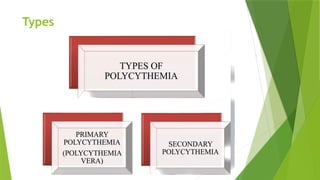
1. Polycythemia Vera/primary
polycythemia
POLYSTHEMIA VERA:- is overproduction (proliferation) of red blood cells
due to bone marrow disease (myeloproliferative disorder).
Its most prominent feature is an elevated absolute red
blood cell mass because of uncontrolled red blood cell
production. This is accompanied by increased white blood
cell (myeloid) and platelet production, which is due to an
abnormal clone of the hematopoietic stem cells with
increased sensitivity to the different growth factors for
maturation.
9.
Epidemiology
Polycythaemia verais a rare chronic disease
diagnosed in an estimated 2 to 3 people per 100,000
population.
Although it can occur at any age, polycythemia vera
usually affects older people, with most patients
diagnosed over the age of 55 years.
Polycythaemia vera is rare in children and young
adults. It occurs more commonly in males than in
females.
10.
Signs and symptomsof polycythemia
vera
Impaired oxygen delivery due to sludging of blood may
lead to the following symptoms:
Headache
Dizziness
Vertigo
Tinnitus
Visual disturbances
Angina pectoris
Intermittent claudication
11.
Bleeding complications,seen in approximately
1% of patients with PV, include epistaxis, gum
bleeding, ecchymoses, and gastrointestinal (GI)
bleeding. Thrombotic complications (1%)
include venous thrombosis or
thromboembolism and an increased prevalence
of stroke and other arterial thromboses.
12.
Complications
Possible complicationsof polycythemia vera include:
Blood clots - Polycythemia vera causes an increase in
blood thickness and decrease in blood flow, as well as
abnormalities in the platelets, and this increase the risk of
blood clots.
Blood clots can cause a stroke, a heart attack, or
blockage of an artery in the lungs (pulmonary embolism)
or in a vein deep within a muscle (deep vein thrombosis.
It is the major cause of death in 10-40% of patients.
13.
Pathophysiology
The bonemarrow of patients with polycythemia
vera (PV),contains normal stem cells but also
contains abnormal clonal stem cells that
interfere with or suppress normal stem cell
growth and maturation. Evidence indicates that
the etiology of panmyelosis is unregulated
neoplastic proliferation. The origin of the stem
cell transformation remains unknown.
14.
Physical examinationfindings may include
the following:
Splenomegaly (75% of patients)
Hepatomegaly (30%)
Plethora
Hypertension
15.
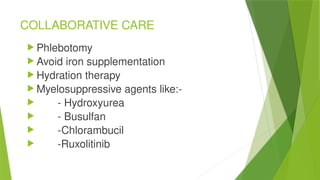
Treatment measuresare as follows:
Phlebotomy – To keep hematocrit below 45%
Aspirin – 81 mg daily
Cytoreductive therapy – For patients at high risk for thrombosis
Splenectomy in patients with painful splenomegaly or repeated episodes of
splenic infarction
Hydroxyurea is the most commonly used cytoreductive agent. If hydroxyurea is
not effective or not tolerated, alternatives include the following:
Interferon alfa
Busulfan – In patients older than 65 years
Ruxolitinib
Fedratinib
16.
2. Secondary polycythemia
SECONDARY POLYSYTHEMIA is an absolute increase in red
blood cell mass that is caused by enhanced stimulation of red
blood cell production.
Secondary polycythemia is an apparent rise of the erythrocyte
level in the blood; however, the underlying cause is reduced blood
plasma.
A specific type of relative polycythemia is Gaisböck syndrome.
17.
Continued>>
Gaisbock syndromeis characterized by
hypertension and erythrocytosis without
splenomegaly, leukocytosis, or
thrombocytosis.
It is associated with mild obesity and
increased blood viscosity, explaining why
patients often develop cardiovascular
complications
18.
Pathophysiology
Increased hemoglobinand hematocrit
values reflect an increase in the ratio of
red blood cell mass to plasma volume.
Any change in either the hemoglobin or
the hematocrit can alter test results.
19.
In primarypolycythemia, the disorder results from a
mutation expressed within the hematopoietic stem
cell or progenitor cells, which drives the
overproduction and accumulation of red blood cells.
The secondary polycythemic disorders may be
acquired or congenital; however, they are driven by
factors that are independent of the function of
hematopoietic stem cells. Elevated hemoglobin levels
due to chronic hypoxia in patients with chronic lung
disorders such as COPD or sleep apnea are the result
of an increased production of erythropoietin, which in
turn causes increased production of red blood cells.
20.
Congenital causes
Hemoglobinmutants associated with tight binding to
oxygen and a failure to deliver oxygen in the venous
blood can cause high EPO levels. The high level of
EPO is compensatory to elevate hemoglobin levels to
deliver an optimal amount of oxygen to the tissues.
Hypoxia-inducible factor 1-alpha (HIF1-alpha) binds
to the hypoxia-responsive element, which is
downstream of the gene for EPO. The activity of HIF1-
alpha is increased by a lowered oxygen tension.
21.
Epidemiology
The frequencyof secondary polycythemia
depends on the underlying disease. The
mortality and morbidity of secondary
polycythemia depend on the underlying
condition.
22.
Prognosis
The prognosisof patients with secondary
polycythemia is driven by the underlying
disorder. The polycythemia itself, when
physiologic and not sufficiently extreme to cause
significant hyperviscosity, generally has no effect
on life span. However, patients with secondary
polycythemia generally have a shorter survival
following diagnosis than patients with
polycythemia vera.
23.
SYMPTOMS
Headaches, dyspnea,numbness or tingling in the
fingers.
Blurred vision
Sweating during nights.
Redness of the skin especially the face, may look red,
ruddy cyanosis.
Weight loss.
Hypertension.
24.
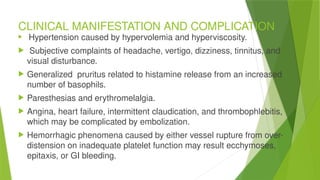
CLINICAL MANIFESTATION ANDCOMPLICATION
Hypertension caused by hypervolemia and hyperviscosity.
Subjective complaints of headache, vertigo, dizziness, tinnitus, and
visual disturbance.
Generalized pruritus related to histamine release from an increased
number of basophils.
Paresthesias and erythromelalgia.
Angina, heart failure, intermittent claudication, and thrombophlebitis,
which may be complicated by embolization.
Hemorrhagic phenomena caused by either vessel rupture from over-
distension on inadequate platelet function may result ecchymoses,
epitaxis, or GI bleeding.
25.
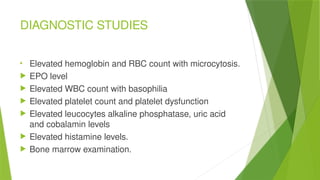
DIAGNOSTIC STUDIES
Elevated hemoglobinand RBC count with microcytosis.
EPO level
Elevated WBC count with basophilia
Elevated platelet count and platelet dysfunction
Elevated leucocytes alkaline phosphatase, uric acid
and cobalamin levels
Elevated histamine levels.
Bone marrow examination.