RNA & itsTypes
Arbab Muhammad Amir
Lecturer MLT (CUSIT)
2.
RIBONUCLEIC ACID (RNA):
•Ribonucleic acid is a polymer of ribonucleotides of Adenine, Uracil, Guanine
and Cytosine, joined together by 3’ – 5’ phosphodiester bonds.
• Thymine is absent in RNA.
• DNA Master Plan
• RNA Working copy
• DNA RNA (Transcription) Protein (Translation)
• Coding RNA mRNA translated to proteins
• Noncoding RNAs (ncRNAs): ribosomal RNAs (rRNAs), transfer RNAs
(tRNAs), and additional small RNA molecules that perform specialized
structural, catalytic, and regulatory functions and are not translated.
3.
• Ribonucleic acid(RNA) is a single-stranded nucleic acid that
plays various roles in the cell, primarily involved in the coding,
decoding, regulation, and expression of genes.
• While DNA stores genetic information, RNA helps to convert
this information into proteins, which perform numerous
functions in living organisms.
4.
Genetic Expression ishighly selective
• Only 1-2% of the total genome is transcribed and translated into proteins
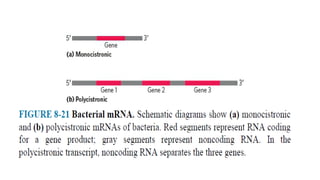
• A single mRNA molecule may code for one or several polypeptide
chains in bacteria and archaea.
• If it carries the code for only one polypeptide (chain of amino acids), the
mRNA is monocistronic; if it codes for two or more different
polypeptides, the mRNA is polycistronic.
• In eukaryotes, most mRNAs are monocistronic.
6.
STRUCTURE OF RNA:
•Primary Structure of RNA:
• Linear sequence of nucleotides in the RNA chain, similar to DNA, but
with uracil (U) replacing thymine (T).
• Each linear strand is held together by the ribonucleotides bound to each
other by 3’,–5’ phosphodiester bonds joining 3’–OH of one nucleotide
with the 5’–OH of the next.
• The product of transcription of DNA is always single-stranded RNA.
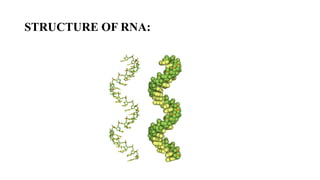
• The single strand tends to assume a right-handed helical conformation
dominated by base-stacking interactions (interactions between purine
and pyrimidine bases).
8
STRUCTURE OF RNA:
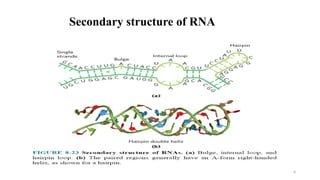
•Secondary Structure of RNA:
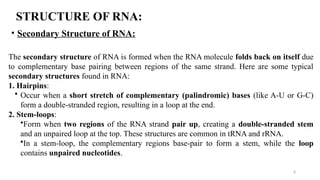
The secondary structure of RNA is formed when the RNA molecule folds back on itself due
to complementary base pairing between regions of the same strand. Here are some typical
secondary structures found in RNA:
1. Hairpins:
• Occur when a short stretch of complementary (palindromic) bases (like A-U or G-C)
form a double-stranded region, resulting in a loop at the end.
2. Stem-loops:
•Form when two regions of the RNA strand pair up, creating a double-stranded stem
and an unpaired loop at the top. These structures are common in tRNA and rRNA.
•In a stem-loop, the complementary regions base-pair to form a stem, while the loop
contains unpaired nucleotides.
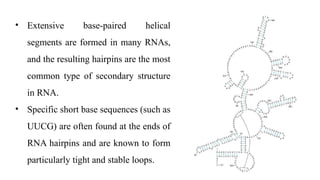
• Extensive base-pairedhelical
segments are formed in many RNAs,
and the resulting hairpins are the most
common type of secondary structure
in RNA.
• Specific short base sequences (such as
UUCG) are often found at the ends of
RNA hairpins and are known to form
particularly tight and stable loops.
11.
11
STRUCTURE OF RNA:
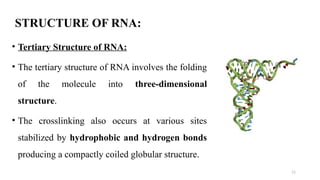
•Tertiary Structure of RNA:
• The tertiary structure of RNA involves the folding
of the molecule into three-dimensional
structure.
• The crosslinking also occurs at various sites
stabilized by hydrophobic and hydrogen bonds
producing a compactly coiled globular structure.
12.
12
Types of RNA:
•There are three main types of RNA found in human beings. These are:
1. Messenger RNA or m-RNA,
2. Transfer soluble RNA or t-RNA, and
3. Ribosomal RNA or rRNA.
• The main function of each of these RNA is protein synthesis
13.
13
Messenger RNA (mRNA):
•mRNA covers only about 5% of the RNA in the cell,
• Most heterogeneous types of RNA in size and base sequence.
• mRNA carries genetic information from DNA for use in protein
synthesis.
• If the mRNA carries information from more than one gene, it is
considered polycistronic (cistron = gene).
• Polycistronic mRNA is characteristic of prokaryotes.
• If the mRNA carries information from just one gene, it is said to be
monocistronic and is characteristic of eukaryotes.
14.
14
Messenger RNA (mRNA)
•The m-RNA molecules are formed with the help of DNA template strand (3’ – 5’)
during the process called transcription.
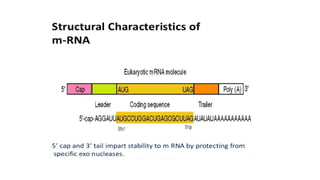
• The m-RNA carries a specific sequence of nucleotides in “triplets” called codons,
responsible for the synthesis of a specific protein molecule.
• Two special structural characteristics:
a) 3’ Poly A tail (20 to 250 residues in length)
• maintain the intracellular stability of the specific m-RNA by preventing the attack
of 3' – exonucleases
b) 5’ cap (7-methylguanosine triphosphate)
• The cap is probably involved in recognition of protein biosynthetic machinery
and it helps in stabilizing the m-RNA by preventing the attack of 5‘-
exonucleases.
• The protein synthesis begins at 5’ end of the capped structure of m-RNA
16.
Ribosomal RNA (rRNA):
•rRNAs make up about 80% of the total RNA in the
cell.
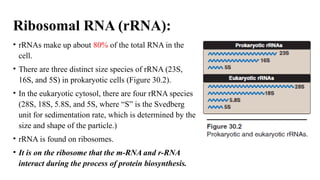
• There are three distinct size species of rRNA (23S,
16S, and 5S) in prokaryotic cells (Figure 30.2).
• In the eukaryotic cytosol, there are four rRNA species
(28S, 18S, 5.8S, and 5S, where “S” is the Svedberg
unit for sedimentation rate, which is determined by the
size and shape of the particle.)
• rRNA is found on ribosomes.
• It is on the ribosome that the m-RNA and r-RNA
interact during the process of protein biosynthesis.
17.
17
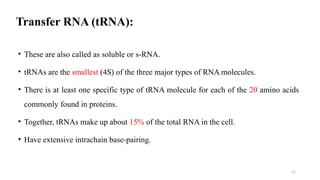
Transfer RNA (tRNA):
•These are also called as soluble or s-RNA.
• tRNAs are the smallest (4S) of the three major types of RNA molecules.
• There is at least one specific type of tRNA molecule for each of the 20 amino acids
commonly found in proteins.
• Together, tRNAs make up about 15% of the total RNA in the cell.
• Have extensive intrachain base-pairing.
18.
18
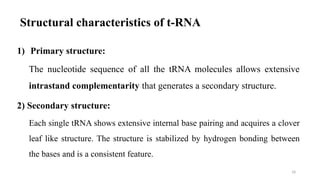
Structural characteristics oft-RNA
1) Primary structure:
The nucleotide sequence of all the tRNA molecules allows extensive
intrastand complementarity that generates a secondary structure.
2) Secondary structure:
Each single tRNA shows extensive internal base pairing and acquires a clover
leaf like structure. The structure is stabilized by hydrogen bonding between
the bases and is a consistent feature.
19.
19
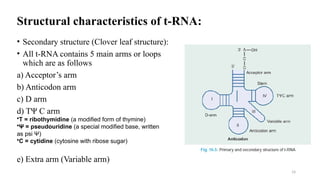
Structural characteristics oft-RNA:
• Secondary structure (Clover leaf structure):
• All t-RNA contains 5 main arms or loops
which are as follows
a) Acceptor’s arm
b) Anticodon arm
c) D arm
d) TΨ C arm
e) Extra arm (Variable arm)
•T = ribothymidine (a modified form of thymine)
•Ψ = pseudouridine (a special modified base, written
as psi Ψ)
•C = cytidine (cytosine with ribose sugar)
20.
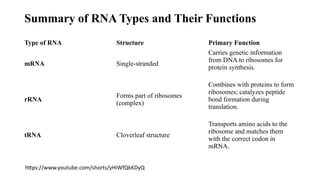
Summary of RNATypes and Their Functions
Type of RNA Structure Primary Function
mRNA Single-stranded
Carries genetic information
from DNA to ribosomes for
protein synthesis.
rRNA
Forms part of ribosomes
(complex)
Combines with proteins to form
ribosomes; catalyzes peptide
bond formation during
translation.
tRNA Cloverleaf structure
Transports amino acids to the
ribosome and matches them
with the correct codon in
mRNA.
https://www.youtube.com/shorts/yHiWfQkKDyQ