POLISHES
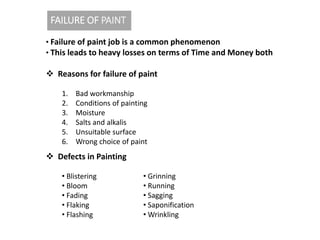
FAILURE OF PAINT
• Failure of paint job is a common phenomenon
• This leads to heavy losses on terms of Time and Money both
 Reasons for failure of paint
1. Bad workmanship
2. Conditions of painting
3. Moisture
4. Salts and alkalis
5. Unsuitable surface
6. Wrong choice of paint
 Defects in Painting
• Blistering
• Bloom
• Fading
• Flaking
• Flashing
• Grinning
• Running
• Sagging
• Saponification
• Wrinkling
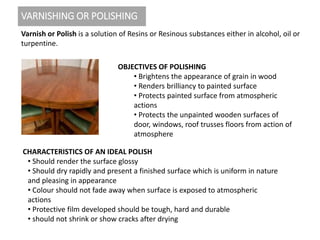
VARNISHING OR POLISHING
Varnish or Polish is a solution of Resins or Resinous substances either in alcohol, oil or
turpentine.
OBJECTIVES OF POLISHING
• Brightens the appearance of grain in wood
• Renders brilliancy to painted surface
• Protects painted surface from atmospheric
actions
• Protects the unpainted wooden surfaces of
door, windows, roof trusses floors from action of
atmosphere
CHARACTERISTICS OF AN IDEAL POLISH
• Should render the surface glossy
• Should dry rapidly and present a finished surface which is uniform in nature
and pleasing in appearance
• Colour should not fade away when surface is exposed to atmospheric
actions
• Protective film developed should be tough, hard and durable
• should not shrink or show cracks after drying
INGREDIENTS OF POLISH
RESINS OR RESINOUS SUBSTANCES
• The commonly used resins are Copal, Lac or Shellac and Rosin
• Copal is a hard substance available from the earth at places where Pine trees
existed in past
• Lac or Shellac is obtained by exudation of small types of insects in India
• Rosin is obtained from Pine trees
• Other resins are Amber, Mastic, Gum dammar etc
DRIERS
• The function of a drier is to accelerate the process of drying
• The common dryers used are Litharge, White copper and Lead acetate
SOLVENTS
• Depending upon the resins the type of solvent is decided
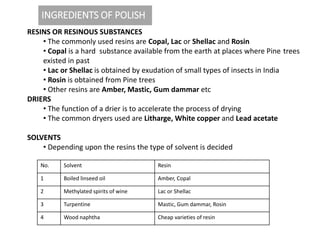
No. Solvent Resin
1 Boiled linseed oil Amber, Copal
2 Methylated spirits of wine Lac or Shellac
3 Turpentine Mastic, Gum dammar, Rosin
4 Wood naphtha Cheap varieties of resin
TYPES OF VARNISHES
• Oil varnishes – The linseed oil is used as solvent in this type
• Spirit varnishes – Methylated spirits of wine are used as solvent in this
type
• Turpentine varnish – Turpentine is used as solvent in this type
• Water varnish – Shellac is dissolved in hot water as solvent
PROCESS OF POLISHING OR VARNISHING
• Preparation of surface – The wood work is thoroughly rubbed
down by means of sand paper. The surface is then made smooth and
clean
• Knotting – The process of knotting is then carried out
• Stopping – This is done with hot weak glue. It will fill the pores on
the surface. The surface is once again rubbed with sand paper.
• Coats of polish – The polish is then applied on the surface in thin
coats. The next coat is applied after the previous one has thoroughly
dried. Polishing should not be done by ordinary paint brushes. Fine
haired brushes should be used.
WOOD POLISHING
Wood Polishing refers to the enhancing and protecting of wooden surfaces
to improve their longevity. Wood is vulnerable to aging and coating it with
wax, oil and their substitutes protect it.
In today’s world, natural waxes with oil consisting of petroleum based
products and synthetic polymers.
MATERIALS:
-Linseed cedar wood oil
-Tung
-Perilla oil
-Beeswax, Sugarcane wax, Cotton wax, Shellac wax(insect wax)
-Paraffin waxes
-Inexpensive solvents( kerosene, naphtha)
-Mineral waxes( Montan wax)
-Synthetic polymers( based on silicone oils)
-Micro-crystalline waxes
-Synthetic resins like methyl acrylate, ethyl acrylate ,butyl acrylate,
vinyl acetate, styrene, vinyl chloride, acrylonitrile.
RAW MATERIALS
SOLVENTS
Solvents are used to help dissolve or soften some of the water insoluble materials
used in polishes. Common solvents include mineral spirits, turpentine, and
naphtha.
EMULSIFIERS/SURFACTANTS.
Proper blending of oil and water-soluble ingredients requires special chemicals
known as surfactants .These have the ability to bridge water and oil to create a
stable cream, paste, or lotion called an emulsion.
PROPELLANTS
Propellants are liquefied gases, which are used to dispense aerosol products as a
spray. such as propane or butane, both of which are highly flammable.
Other ingredients
polishes may contain abrasives, colorants, fragrance, and preservatives. These are
often nitrogen containing materials that raise the pH of the solution.
These ingredients can be formulated into pastes, creams, liquids, and aerosol
(including non-aerosol pump sprays).
TYPES
- Varnish
- Spirit of French Polish
- Melamine based Finish Polish
- Polyurethane based Finish Polish(PU)
MATERIALS REQUIRED FOR SURFACE PREPARATION
Filler filling material, staining, sealing material, top coat
Implementation :
Steps to be followed:
- All dust and dirt should be removed from the surface.
- Cracks and holes should be cleaned and be filled with wood putty.
- The surfaces should be finished(smooth) with the help of carpenter’s plane.
- Previous coats of polish, if any, should be allowed to dry and be rubbed down
lightly and cleaned.
- For exterior work, a normal dry day should be chosen to avoid exposure to
extreme heat, cold
or damp atmosphere.
- While applying varnish , care should be taken to avoid the formation of fumes
or air- bubbles.
MAINTENANCE
Polished surfaces in question are easy to clean. Additional care is required for surfaces that
are exposed to the sun. Requires re-polishing after a couple of years. If the surface is likely to
be exposed to water, then it should be painted.
ADVANTAGES
•Enhances the aesthetic quality of the wood.
•Helps in protecting the wood by binding the surface.
•Helps to prevent hairline cracks and absorb the effects of scratching and external damage.
•Helps in reducing the transfer of moisture between the wood and the surrounding
weather.
•Provides softness and lasting flexibility.
DISADVANTAGES
•Become yellowish with age.
•Can incur additional costs.
• The minor defects like pores in the wood etc. are covered in polish finish but other defects
like cracks in the wood and knotting are not hidden in polish finish.
• Easily affected by changing weather conditions. (especially damp weather)
DURABILITY
Polish finish is generally done on interior surface. This mainly due to destructive action on
the clear finishes by ultraviolet rays present in the sun light.
Exposure to extreme heat, cold or damp atmosphere will reduce the life of polish finish.
TYPES OF POLISHES
Mainly classified as:
- Solvent-based
The different types of solvent-based finishes are French Polish, Varnish, NC Lacquer,
Alkyd, Melamine, PU & Polyester.
- Water-based
Water-based finishes are a comparatively recent introduction in market.
- They are also further classified as Matt and Glossy and based on the area of use as
Exterior and Interior wood finishes.
- On the basis of application, wood finishes are classified as Brush- able (those which
can be applied with a brush) and Spray-ons (which have to be sprayed).
DISTRIBUTION
Wood finishes in India are mainly retailed through paint and hardware stores.
The institutional segment is addressed through an institutional sales team.
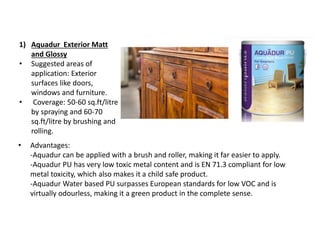
1) Aquadur Exterior Matt
and Glossy
• Suggested areas of
application: Exterior
surfaces like doors,
windows and furniture.
• Coverage: 50-60 sq.ft/litre
by spraying and 60-70
sq.ft/litre by brushing and
rolling.
• Advantages:
-Aquadur can be applied with a brush and roller, making it far easier to apply.
-Aquadur PU has very low toxic metal content and is EN 71.3 compliant for low
metal toxicity, which also makes it a child safe product.
-Aquadur Water based PU surpasses European standards for low VOC and is
virtually odourless, making it a green product in the complete sense.
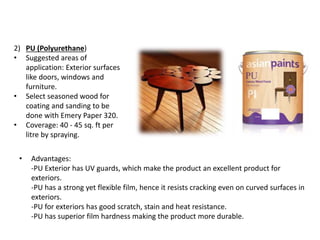
2) PU (Polyurethane)
• Suggested areas of
application: Exterior surfaces
like doors, windows and
furniture.
• Select seasoned wood for
coating and sanding to be
done with Emery Paper 320.
• Coverage: 40 - 45 sq. ft per
litre by spraying.
• Advantages:
-PU Exterior has UV guards, which make the product an excellent product for
exteriors.
-PU has a strong yet flexible film, hence it resists cracking even on curved surfaces in
exteriors.
-PU for exteriors has good scratch, stain and heat resistance.
-PU has superior film hardness making the product more durable.
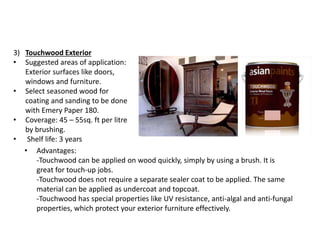
3) Touchwood Exterior
• Suggested areas of application:
Exterior surfaces like doors,
windows and furniture.
• Select seasoned wood for
coating and sanding to be done
with Emery Paper 180.
• Coverage: 45 – 55sq. ft per litre
by brushing.
• Shelf life: 3 years
• Advantages:
-Touchwood can be applied on wood quickly, simply by using a brush. It is
great for touch-up jobs.
-Touchwood does not require a separate sealer coat to be applied. The same
material can be applied as undercoat and topcoat.
-Touchwood has special properties like UV resistance, anti-algal and anti-fungal
properties, which protect your exterior furniture effectively.
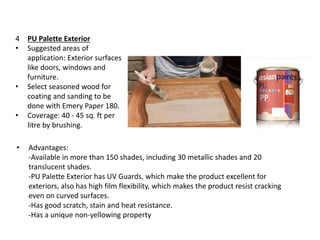
4 PU Palette Exterior
• Suggested areas of
application: Exterior surfaces
like doors, windows and
furniture.
• Select seasoned wood for
coating and sanding to be
done with Emery Paper 180.
• Coverage: 40 - 45 sq. ft per
litre by brushing.
• Advantages:
-Available in more than 150 shades, including 30 metallic shades and 20
translucent shades.
-PU Palette Exterior has UV Guards, which make the product excellent for
exteriors, also has high film flexibility, which makes the product resist cracking
even on curved surfaces.
-Has good scratch, stain and heat resistance.
-Has a unique non-yellowing property
 Rubbing the wood with an abrasive between coats of finish levels out the surface and
gives it a ‘ tooth’ to grip the next layer . Polishing then adds lustre and smoothness .
 Penetrating finishes are rubbed and polished as they are applied , and nothing more
need be done to the surface , except perhaps waxing .
WAX POLISH :
 Use paste wax as a buffer to shield the finish it covers , as well as to enhance its
beauty .
 Carnauba wax , made from the leaves of a palm tree native to Brazil , is the most
common ingredient in most paste waxes .
 It is too hard to use on its own , but in combination with other ingredients , it protects
well and polishes to a high gloss .
Method for making wax polish :
1. Put 1 table-spoon carnauba wax and 1 pint mineral oil in the top of a double boiler .
2. Heat and stir until the wax is completely melted .
3. Stir in 3 or 4 drops lemon oil if wanted .
4. Cool the mixture , and store it in a metal or glass container .
5. Apply with a soft cloth , then buff with a second cloth .
6. Always work in one limited area at a time , allowing the wax to set before you buff it .
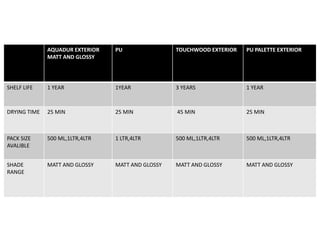
AQUADUR EXTERIOR
MATT AND GLOSSY
PU TOUCHWOOD EXTERIOR PU PALETTE EXTERIOR
SHELF LIFE 1 YEAR 1YEAR 3 YEARS 1 YEAR
DRYING TIME 25 MIN 25 MIN 45 MIN 25 MIN
PACK SIZE
AVALIBLE
500 ML,1LTR,4LTR 1 LTR,4LTR 500 ML,1LTR,4LTR 500 ML,1LTR,4LTR
SHADE
RANGE
MATT AND GLOSSY MATT AND GLOSSY MATT AND GLOSSY MATT AND GLOSSY
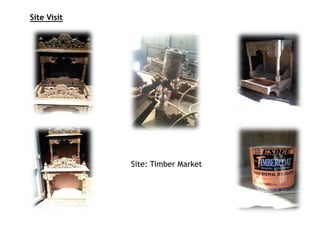
Site Visit
Site: Timber Market

Polishing

  • 1.
  • 2.
    FAILURE OF PAINT •Failure of paint job is a common phenomenon • This leads to heavy losses on terms of Time and Money both  Reasons for failure of paint 1. Bad workmanship 2. Conditions of painting 3. Moisture 4. Salts and alkalis 5. Unsuitable surface 6. Wrong choice of paint  Defects in Painting • Blistering • Bloom • Fading • Flaking • Flashing • Grinning • Running • Sagging • Saponification • Wrinkling
  • 3.
    VARNISHING OR POLISHING Varnishor Polish is a solution of Resins or Resinous substances either in alcohol, oil or turpentine. OBJECTIVES OF POLISHING • Brightens the appearance of grain in wood • Renders brilliancy to painted surface • Protects painted surface from atmospheric actions • Protects the unpainted wooden surfaces of door, windows, roof trusses floors from action of atmosphere CHARACTERISTICS OF AN IDEAL POLISH • Should render the surface glossy • Should dry rapidly and present a finished surface which is uniform in nature and pleasing in appearance • Colour should not fade away when surface is exposed to atmospheric actions • Protective film developed should be tough, hard and durable • should not shrink or show cracks after drying
  • 4.
    INGREDIENTS OF POLISH RESINSOR RESINOUS SUBSTANCES • The commonly used resins are Copal, Lac or Shellac and Rosin • Copal is a hard substance available from the earth at places where Pine trees existed in past • Lac or Shellac is obtained by exudation of small types of insects in India • Rosin is obtained from Pine trees • Other resins are Amber, Mastic, Gum dammar etc DRIERS • The function of a drier is to accelerate the process of drying • The common dryers used are Litharge, White copper and Lead acetate SOLVENTS • Depending upon the resins the type of solvent is decided No. Solvent Resin 1 Boiled linseed oil Amber, Copal 2 Methylated spirits of wine Lac or Shellac 3 Turpentine Mastic, Gum dammar, Rosin 4 Wood naphtha Cheap varieties of resin
  • 5.
    TYPES OF VARNISHES •Oil varnishes – The linseed oil is used as solvent in this type • Spirit varnishes – Methylated spirits of wine are used as solvent in this type • Turpentine varnish – Turpentine is used as solvent in this type • Water varnish – Shellac is dissolved in hot water as solvent PROCESS OF POLISHING OR VARNISHING • Preparation of surface – The wood work is thoroughly rubbed down by means of sand paper. The surface is then made smooth and clean • Knotting – The process of knotting is then carried out • Stopping – This is done with hot weak glue. It will fill the pores on the surface. The surface is once again rubbed with sand paper. • Coats of polish – The polish is then applied on the surface in thin coats. The next coat is applied after the previous one has thoroughly dried. Polishing should not be done by ordinary paint brushes. Fine haired brushes should be used.
  • 6.
    WOOD POLISHING Wood Polishingrefers to the enhancing and protecting of wooden surfaces to improve their longevity. Wood is vulnerable to aging and coating it with wax, oil and their substitutes protect it. In today’s world, natural waxes with oil consisting of petroleum based products and synthetic polymers. MATERIALS: -Linseed cedar wood oil -Tung -Perilla oil -Beeswax, Sugarcane wax, Cotton wax, Shellac wax(insect wax) -Paraffin waxes -Inexpensive solvents( kerosene, naphtha) -Mineral waxes( Montan wax) -Synthetic polymers( based on silicone oils) -Micro-crystalline waxes -Synthetic resins like methyl acrylate, ethyl acrylate ,butyl acrylate, vinyl acetate, styrene, vinyl chloride, acrylonitrile.
  • 7.
    RAW MATERIALS SOLVENTS Solvents areused to help dissolve or soften some of the water insoluble materials used in polishes. Common solvents include mineral spirits, turpentine, and naphtha. EMULSIFIERS/SURFACTANTS. Proper blending of oil and water-soluble ingredients requires special chemicals known as surfactants .These have the ability to bridge water and oil to create a stable cream, paste, or lotion called an emulsion. PROPELLANTS Propellants are liquefied gases, which are used to dispense aerosol products as a spray. such as propane or butane, both of which are highly flammable. Other ingredients polishes may contain abrasives, colorants, fragrance, and preservatives. These are often nitrogen containing materials that raise the pH of the solution. These ingredients can be formulated into pastes, creams, liquids, and aerosol (including non-aerosol pump sprays).
  • 8.
    TYPES - Varnish - Spiritof French Polish - Melamine based Finish Polish - Polyurethane based Finish Polish(PU) MATERIALS REQUIRED FOR SURFACE PREPARATION Filler filling material, staining, sealing material, top coat Implementation : Steps to be followed: - All dust and dirt should be removed from the surface. - Cracks and holes should be cleaned and be filled with wood putty. - The surfaces should be finished(smooth) with the help of carpenter’s plane. - Previous coats of polish, if any, should be allowed to dry and be rubbed down lightly and cleaned. - For exterior work, a normal dry day should be chosen to avoid exposure to extreme heat, cold or damp atmosphere. - While applying varnish , care should be taken to avoid the formation of fumes or air- bubbles.
  • 9.
    MAINTENANCE Polished surfaces inquestion are easy to clean. Additional care is required for surfaces that are exposed to the sun. Requires re-polishing after a couple of years. If the surface is likely to be exposed to water, then it should be painted. ADVANTAGES •Enhances the aesthetic quality of the wood. •Helps in protecting the wood by binding the surface. •Helps to prevent hairline cracks and absorb the effects of scratching and external damage. •Helps in reducing the transfer of moisture between the wood and the surrounding weather. •Provides softness and lasting flexibility. DISADVANTAGES •Become yellowish with age. •Can incur additional costs. • The minor defects like pores in the wood etc. are covered in polish finish but other defects like cracks in the wood and knotting are not hidden in polish finish. • Easily affected by changing weather conditions. (especially damp weather) DURABILITY Polish finish is generally done on interior surface. This mainly due to destructive action on the clear finishes by ultraviolet rays present in the sun light. Exposure to extreme heat, cold or damp atmosphere will reduce the life of polish finish.
  • 10.
    TYPES OF POLISHES Mainlyclassified as: - Solvent-based The different types of solvent-based finishes are French Polish, Varnish, NC Lacquer, Alkyd, Melamine, PU & Polyester. - Water-based Water-based finishes are a comparatively recent introduction in market. - They are also further classified as Matt and Glossy and based on the area of use as Exterior and Interior wood finishes. - On the basis of application, wood finishes are classified as Brush- able (those which can be applied with a brush) and Spray-ons (which have to be sprayed). DISTRIBUTION Wood finishes in India are mainly retailed through paint and hardware stores. The institutional segment is addressed through an institutional sales team.
  • 11.
    1) Aquadur ExteriorMatt and Glossy • Suggested areas of application: Exterior surfaces like doors, windows and furniture. • Coverage: 50-60 sq.ft/litre by spraying and 60-70 sq.ft/litre by brushing and rolling. • Advantages: -Aquadur can be applied with a brush and roller, making it far easier to apply. -Aquadur PU has very low toxic metal content and is EN 71.3 compliant for low metal toxicity, which also makes it a child safe product. -Aquadur Water based PU surpasses European standards for low VOC and is virtually odourless, making it a green product in the complete sense.
  • 12.
    2) PU (Polyurethane) •Suggested areas of application: Exterior surfaces like doors, windows and furniture. • Select seasoned wood for coating and sanding to be done with Emery Paper 320. • Coverage: 40 - 45 sq. ft per litre by spraying. • Advantages: -PU Exterior has UV guards, which make the product an excellent product for exteriors. -PU has a strong yet flexible film, hence it resists cracking even on curved surfaces in exteriors. -PU for exteriors has good scratch, stain and heat resistance. -PU has superior film hardness making the product more durable.
  • 13.
    3) Touchwood Exterior •Suggested areas of application: Exterior surfaces like doors, windows and furniture. • Select seasoned wood for coating and sanding to be done with Emery Paper 180. • Coverage: 45 – 55sq. ft per litre by brushing. • Shelf life: 3 years • Advantages: -Touchwood can be applied on wood quickly, simply by using a brush. It is great for touch-up jobs. -Touchwood does not require a separate sealer coat to be applied. The same material can be applied as undercoat and topcoat. -Touchwood has special properties like UV resistance, anti-algal and anti-fungal properties, which protect your exterior furniture effectively.
  • 14.
    4 PU PaletteExterior • Suggested areas of application: Exterior surfaces like doors, windows and furniture. • Select seasoned wood for coating and sanding to be done with Emery Paper 180. • Coverage: 40 - 45 sq. ft per litre by brushing. • Advantages: -Available in more than 150 shades, including 30 metallic shades and 20 translucent shades. -PU Palette Exterior has UV Guards, which make the product excellent for exteriors, also has high film flexibility, which makes the product resist cracking even on curved surfaces. -Has good scratch, stain and heat resistance. -Has a unique non-yellowing property
  • 15.
     Rubbing thewood with an abrasive between coats of finish levels out the surface and gives it a ‘ tooth’ to grip the next layer . Polishing then adds lustre and smoothness .  Penetrating finishes are rubbed and polished as they are applied , and nothing more need be done to the surface , except perhaps waxing . WAX POLISH :  Use paste wax as a buffer to shield the finish it covers , as well as to enhance its beauty .  Carnauba wax , made from the leaves of a palm tree native to Brazil , is the most common ingredient in most paste waxes .  It is too hard to use on its own , but in combination with other ingredients , it protects well and polishes to a high gloss . Method for making wax polish : 1. Put 1 table-spoon carnauba wax and 1 pint mineral oil in the top of a double boiler . 2. Heat and stir until the wax is completely melted . 3. Stir in 3 or 4 drops lemon oil if wanted . 4. Cool the mixture , and store it in a metal or glass container . 5. Apply with a soft cloth , then buff with a second cloth . 6. Always work in one limited area at a time , allowing the wax to set before you buff it .
  • 16.
    AQUADUR EXTERIOR MATT ANDGLOSSY PU TOUCHWOOD EXTERIOR PU PALETTE EXTERIOR SHELF LIFE 1 YEAR 1YEAR 3 YEARS 1 YEAR DRYING TIME 25 MIN 25 MIN 45 MIN 25 MIN PACK SIZE AVALIBLE 500 ML,1LTR,4LTR 1 LTR,4LTR 500 ML,1LTR,4LTR 500 ML,1LTR,4LTR SHADE RANGE MATT AND GLOSSY MATT AND GLOSSY MATT AND GLOSSY MATT AND GLOSSY
  • 17.