Vincent Reed Ltd
Conservation & Restoration
for Period Woodwork
10 September, 2013
Monday, 9 September 13
What we are going to talk about
• The importance of conservation and restoration
• Conservation and restoration of period woodwork
• Case studies will be used to illustrate how to;
• Identify original architectural woodwork
• Understand the importance of Patina
• Prepare the woodwork for refinishing
• Identify and apply the correct finish to woodwork
• Materials and techniques you can use - and those you must avoid!
Monday, 9 September 13
What is the difference between conservation and
restoration?
Conservation
To preserve against
further deterioration
Restoration
To restore the original
appearance and
functionality
- without erasing history!
Monday, 9 September 13
Why is conservation and restoration so important?
History Heritage Identity
We can’t rewrite our history
Our heritage is our unique identity and needs to be preserved
How do we safeguard our heritage?
Unified policy
Wider education
Sharing best practice
Monday, 9 September 13
Identifying what you see and making the right decision
What is the
purpose of
the
woodwork?
What type
of finish is
required - if
any?
Aesthetic
Interior doors, panelling,
mouldings, rails and furniture
Durability
Exterior doors, windows, floors
and staircases
Aesthetic
Preparation will be gentle
by hand
Finish will be softer;
Shellacs,Waxes and Oils
Durability
Preparation can be more
vigorous
Finish will be harder;
Varnishes and Lacquers
QUESTION QUESTIONANSWER
ANSWER ANSWER
ANSWER
Monday, 9 September 13
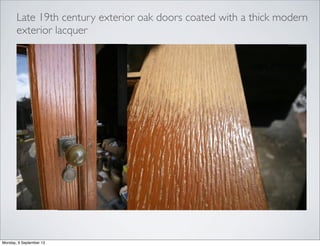
Late 19th century exterior oak doors coated with a thick modern
exterior lacquer
Monday, 9 September 13
Dry Scrapping the modern ‘Finish’
Monday, 9 September 13
Water based exterior acrylic lacquer applied with synthetic
brushes and a wax finish
Monday, 9 September 13
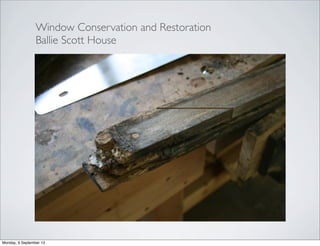
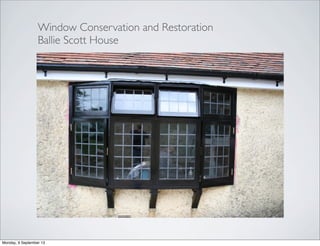
Window Conservation and Restoration
Ballie Scott House
Monday, 9 September 13
Window Conservation and Restoration
Ballie Scott House
Monday, 9 September 13
Window Conservation and Restoration
Ballie Scott House
Monday, 9 September 13
Window Conservation and Restoration
Ballie Scott House
Monday, 9 September 13
Window Conservation and Restoration
Ballie Scott House
Monday, 9 September 13
Window Conservation and Restoration
Ballie Scott House
Monday, 9 September 13
Window Conservation and Restoration
Ballie Scott House
Monday, 9 September 13
An example of over cleaning a17th century staircase
caustic soda
Monday, 9 September 13
Preparation
How to safely prepare a wood surface
Solvent Strippers
A traditional stripper still used in
period woodwork restoration
today
Removes finishes gradually without
damaging the surface
No discolouration
Patina can be partially preserved
with care
A finer cleaner finish
Prevents irreversible damage
Time consuming and costly
Caustic Strippers
NEVER used in period woodwork
restoration
Main ingredient sodium or
potassium hydroxide - stains the
wood surface by reacting with the
natural acids
Staining permanently masks all
original patina
Dissolves glues and weakens joints
Eco Strippers
A modern stripper used in period
woodwork restoration today
Removes finishes gradually without
damaging the surface
No discolouration
Patina can be preserved with care
A finer cleaner finish
Prevents irreversible damage
Time consuming and costly
Methylated Spirits
A modern stripper used in period
woodwork restoration today
Removes finishes gradually without
damaging the surface
No discolouration
Patina is preserved
A finer cleaner finish
Prevents irreversible damage
Time consuming and costly
Reviver Solutions
& Detergents
A modern stripper used in period
woodwork restoration today
Removes finishes gradually without
damaging the surface
No discolouration
Patina is preserved
A finer cleaner finish
Prevents irreversible damage
Time consuming and costly
CLEANING STRIPPING
ONLY USE WHEN REVIVER SOLUTIONS,
DETERGENTS AND METHYLATED SPIRITS ARE NOT
STRONG ENOUGH
NEVER USE ON PERIOD
WOODWORK
Monday, 9 September 13
Late17th century oak paneling painted with lead based paints
at the turn of the century
Monday, 9 September 13
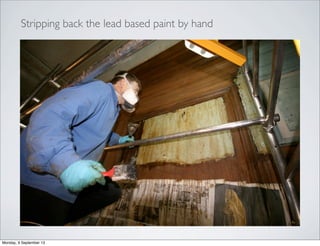
Stripping back the lead based paint by hand
Monday, 9 September 13
The original oak paneling fully restored
Monday, 9 September 13
Materials and Techniques
What to use and how to use it - and what to avoid
Materials
Preparations:
Reviver solutions & Detergents
Methylated Spirits
Finishes:
ConservationVarnish
French Polishes
Oils
Shellacs
Water Lacquers
Waxes
New timber for old repairs
Techniques
Hand cleaning with suitable
preparations
Blunt hand held scrappers
Fine wire wools
Stiff brushes
Ultra fine sand paper
- only to be used in very specific instances
Hot air gun
- with extreme caution
SUITABLE NOT SUITABLE
Materials
Preparations:
Caustic strippers
Coarse sand paper
Finishes:
PolyurethaneVarnish
Marine Paints
MarineVarnishes
Screw and nails to repair joints
Irreversible glues to repair joints
Techniques
Sand blasting
Sanding below 150 grit
- unless extenuating circumstances
Blow lamps
Monday, 9 September 13
New timber for old repairs
Restoration of a late 18th century solid oak floor
Monday, 9 September 13
New timber for old repairs
Restoration of a late 18th century oak floor
Monday, 9 September 13
New timber for old repairs
Restoration of a late 18th century oak floor
Monday, 9 September 13
New timber for old repairs
Restoration of a late 18th century oak floor
Monday, 9 September 13
New timber for old repairs
Restoration of a late 18th century oak floor
Monday, 9 September 13
New timber for old repairs
Restoration of late 18th century oak floor – a repair
Monday, 9 September 13
New timber for old repairs
Restoration of a late 18th century oak floor – applying the correct
finish by hand
Monday, 9 September 13
New timber for old repairs
Restoration of late 18th century oak floor – fully restored
Monday, 9 September 13
Sandpaper
What really happens when coarse sandpaper is used on wood?
Example of how polish ‘pools’ in the grooves made by
the sandpaper scoring the surface of
the wood
Example of how polish is displaced evenly across the
surface of wood that has been sympathetically cleaned
back and stripped
by hand
Wood Surface
POLISH
Wood Surface
Sanding causes damage the fibre in the wood
The surface becomes rough to the touch
Absorbency factor of the wood is increased significantly
As a result polish applied will cause the fibres to expand - resulting in an uneven finish
This is called ‘furring the grain’
The original patina is permanently lost
Monday, 9 September 13
Sandblasting
What happens when a sand blasting machine is used on wood?
Advantages
of sandblasting
What sandblasting
really does
Quick
Cheap
Natural character
destroyed
Quality destroyed
Patina destroyed
Mouldings and details
destroyed
Fibers are damaged
Pitted surface that cannot
be cleaned
Monday, 9 September 13
An unfortunate example of the costly devastation that sand
blasting causes
Monday, 9 September 13
An unfortunate example of the costly devastation that
sand blasting causes – continued!
Monday, 9 September 13
The paneling when fully restored
Monday, 9 September 13
A careful reminder
Monday, 9 September 13
Stains
Different types of stains and how to use them correctly
Soluble when mixed
with methylated spirits
Light fast
Typically used for
general colour change
Suitable for use on all
wood surfaces
Methanol Stains Nitro Stains Water StainsSpirit StainsFumesEarth PigmentsOil Stains
Soluble when mixed
with turpentine or
thinners
Can be used to colour
polishes applied with
a spray gun
Slightly more aggressive
than methanol based
stains
Soluble when mixed
with turpentine
Widely used in all
manner of staining
Ideal for use as a ‘base
colour’ - a milds stain
that provides an even
base colour over which
a main colour can be
built
Naturally occurring
minerals
- mostly iron oxides
E.g. Ochre, Umber,
Sienna
Used since prehistoric
times - cave paintings
Used to produce a
‘blind’ to block grain
Raises the grain
Bichromate of potash
Potassium
permanganate
Ammonia
Nitric acid
Staining of wood is
caused by a chemical
reaction with the wood
Used on woods prone
to uneven natural
colouring
E.g. Pine
Soluble when mixed
with methylated spirits
Quick to dry
Can be mixed with
shellac based polishes
to provide colour
Probe to fading
Soluble when mixed
with water
Produces the best
quality colours
Slow to dry
Can NOT be used with
unsealed wood - it will
‘fur’ and raise the grain
Ideal for use on antique
wood with good patina
Professional use only
NON AGGRESSIVE AGGRESSIVE
VERY
AGGRESSIVE
Monday, 9 September 13
Finishes
Different types of finish and how to use them
Soluble when mixed
with turpentine
Typically used as a
‘barrier’ to preserve the
surface of the wood
from the final finish
being applied
Conservation
Varnish
Waxes Oils
Water
Lacquers
Shellac
Polishes
French
Polishes
Soluble when mixed
with turpentine
Can be used on
interior woodwork that
does not need re-
polishing
Applied as a final step
to all manner of
finishes for it’s silky
appearance
Soluble when mixed
with methylated spirits
Widely used for all
types of interior
woodwork
Can be applied in thin
coats - low build
Not suitable for hard
wearing surfaces that
require a durable finish
E.g. floors
Applied by hand with a
‘Rubber’ - cotton wool
wrapped in a cotton
sheet
Boiled Linseed Oil:
Soluble when mixed
with turpentine
Widely used for all
types of interior
woodwork
Slow to dry - up to 1
week per coat
Flooring Oil:
Quick to dry
Tough and durable -
high build
REVERSIBILITY EXCELLENT
Soluble when mixed
with methylated spirits
Widely used for all
types of interior
woodwork
Can be applied in thin
coats - low build
Not suitable for hard
wearing surfaces that
require a durable finish
E.g. floors
REVERSIBILITY GOOD
Soluble when mixed
with water
Widely used for floor
finishing -
Tough and durable -
high build
REVERSIBILITY OK
Monday, 9 September 13
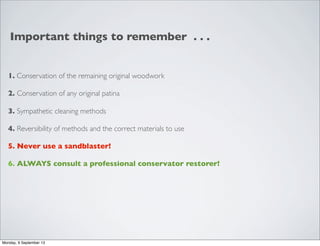
Important things to remember . . .
1. Conservation of the remaining original woodwork
2. Conservation of any original patina
3. Sympathetic cleaning methods
4. Reversibility of methods and the correct materials to use
5. Never use a sandblaster!
6. ALWAYS consult a professional conservator restorer!
Monday, 9 September 13
Sharing best practice starts with you
English
Heritage
PM
Contractor
Architect
Local
Authority
Restorer
Surveyor
Monday, 9 September 13
Questions . . .
Vincent Reed Ltd
Little Washbrook Farm
Brighton Road
Hurstpierpoint
West Sussex
BN6 9EF
Tel: 01273 833 869 / 07815 751 005
email: info@vincentreed.com
Monday, 9 September 13
Some recommended ‘light’ reading . .
• The Elements of Style: A Practical Encyclopedia of Interior Architectural Details, from 1485 to the Present
• Stephen Calloway (Editor), Elizabeth Cromley (Editor)
• Period House Fixtures and Fittings 1300-1900 (England's Living History) [Paperback]
• Linda Hall (Author)
• The Victorian House Explained (England's Living History) [Paperback]
• Trevor Yorke (Author)
• Three Centuries of Architectural Craftsmanship (Library of Period Detailing) [Paperback]
• C AMERY (Author)
Monday, 9 September 13

Vincent Reed

  • 1.
    Vincent Reed Ltd Conservation& Restoration for Period Woodwork 10 September, 2013 Monday, 9 September 13
  • 2.
    What we aregoing to talk about • The importance of conservation and restoration • Conservation and restoration of period woodwork • Case studies will be used to illustrate how to; • Identify original architectural woodwork • Understand the importance of Patina • Prepare the woodwork for refinishing • Identify and apply the correct finish to woodwork • Materials and techniques you can use - and those you must avoid! Monday, 9 September 13
  • 3.
    What is thedifference between conservation and restoration? Conservation To preserve against further deterioration Restoration To restore the original appearance and functionality - without erasing history! Monday, 9 September 13
  • 4.
    Why is conservationand restoration so important? History Heritage Identity We can’t rewrite our history Our heritage is our unique identity and needs to be preserved How do we safeguard our heritage? Unified policy Wider education Sharing best practice Monday, 9 September 13
  • 5.
    Identifying what yousee and making the right decision What is the purpose of the woodwork? What type of finish is required - if any? Aesthetic Interior doors, panelling, mouldings, rails and furniture Durability Exterior doors, windows, floors and staircases Aesthetic Preparation will be gentle by hand Finish will be softer; Shellacs,Waxes and Oils Durability Preparation can be more vigorous Finish will be harder; Varnishes and Lacquers QUESTION QUESTIONANSWER ANSWER ANSWER ANSWER Monday, 9 September 13
  • 6.
    Late 19th centuryexterior oak doors coated with a thick modern exterior lacquer Monday, 9 September 13
  • 7.
    Dry Scrapping themodern ‘Finish’ Monday, 9 September 13
  • 8.
    Water based exterioracrylic lacquer applied with synthetic brushes and a wax finish Monday, 9 September 13
  • 9.
    Window Conservation andRestoration Ballie Scott House Monday, 9 September 13
  • 10.
    Window Conservation andRestoration Ballie Scott House Monday, 9 September 13
  • 11.
    Window Conservation andRestoration Ballie Scott House Monday, 9 September 13
  • 12.
    Window Conservation andRestoration Ballie Scott House Monday, 9 September 13
  • 13.
    Window Conservation andRestoration Ballie Scott House Monday, 9 September 13
  • 14.
    Window Conservation andRestoration Ballie Scott House Monday, 9 September 13
  • 15.
    Window Conservation andRestoration Ballie Scott House Monday, 9 September 13
  • 16.
    An example ofover cleaning a17th century staircase caustic soda Monday, 9 September 13
  • 17.
    Preparation How to safelyprepare a wood surface Solvent Strippers A traditional stripper still used in period woodwork restoration today Removes finishes gradually without damaging the surface No discolouration Patina can be partially preserved with care A finer cleaner finish Prevents irreversible damage Time consuming and costly Caustic Strippers NEVER used in period woodwork restoration Main ingredient sodium or potassium hydroxide - stains the wood surface by reacting with the natural acids Staining permanently masks all original patina Dissolves glues and weakens joints Eco Strippers A modern stripper used in period woodwork restoration today Removes finishes gradually without damaging the surface No discolouration Patina can be preserved with care A finer cleaner finish Prevents irreversible damage Time consuming and costly Methylated Spirits A modern stripper used in period woodwork restoration today Removes finishes gradually without damaging the surface No discolouration Patina is preserved A finer cleaner finish Prevents irreversible damage Time consuming and costly Reviver Solutions & Detergents A modern stripper used in period woodwork restoration today Removes finishes gradually without damaging the surface No discolouration Patina is preserved A finer cleaner finish Prevents irreversible damage Time consuming and costly CLEANING STRIPPING ONLY USE WHEN REVIVER SOLUTIONS, DETERGENTS AND METHYLATED SPIRITS ARE NOT STRONG ENOUGH NEVER USE ON PERIOD WOODWORK Monday, 9 September 13
  • 18.
    Late17th century oakpaneling painted with lead based paints at the turn of the century Monday, 9 September 13
  • 19.
    Stripping back thelead based paint by hand Monday, 9 September 13
  • 20.
    The original oakpaneling fully restored Monday, 9 September 13
  • 21.
    Materials and Techniques Whatto use and how to use it - and what to avoid Materials Preparations: Reviver solutions & Detergents Methylated Spirits Finishes: ConservationVarnish French Polishes Oils Shellacs Water Lacquers Waxes New timber for old repairs Techniques Hand cleaning with suitable preparations Blunt hand held scrappers Fine wire wools Stiff brushes Ultra fine sand paper - only to be used in very specific instances Hot air gun - with extreme caution SUITABLE NOT SUITABLE Materials Preparations: Caustic strippers Coarse sand paper Finishes: PolyurethaneVarnish Marine Paints MarineVarnishes Screw and nails to repair joints Irreversible glues to repair joints Techniques Sand blasting Sanding below 150 grit - unless extenuating circumstances Blow lamps Monday, 9 September 13
  • 22.
    New timber forold repairs New timber for old repairs Restoration of a late 18th century solid oak floor Monday, 9 September 13
  • 23.
    New timber forold repairs New timber for old repairs Restoration of a late 18th century oak floor Monday, 9 September 13
  • 24.
    New timber forold repairs New timber for old repairs Restoration of a late 18th century oak floor Monday, 9 September 13
  • 25.
    New timber forold repairs New timber for old repairs Restoration of a late 18th century oak floor Monday, 9 September 13
  • 26.
    New timber forold repairs New timber for old repairs Restoration of a late 18th century oak floor Monday, 9 September 13
  • 27.
    New timber forold repairs New timber for old repairs Restoration of late 18th century oak floor – a repair Monday, 9 September 13
  • 28.
    New timber forold repairs New timber for old repairs Restoration of a late 18th century oak floor – applying the correct finish by hand Monday, 9 September 13
  • 29.
    New timber forold repairs New timber for old repairs Restoration of late 18th century oak floor – fully restored Monday, 9 September 13
  • 30.
    Sandpaper What really happenswhen coarse sandpaper is used on wood? Example of how polish ‘pools’ in the grooves made by the sandpaper scoring the surface of the wood Example of how polish is displaced evenly across the surface of wood that has been sympathetically cleaned back and stripped by hand Wood Surface POLISH Wood Surface Sanding causes damage the fibre in the wood The surface becomes rough to the touch Absorbency factor of the wood is increased significantly As a result polish applied will cause the fibres to expand - resulting in an uneven finish This is called ‘furring the grain’ The original patina is permanently lost Monday, 9 September 13
  • 31.
    Sandblasting What happens whena sand blasting machine is used on wood? Advantages of sandblasting What sandblasting really does Quick Cheap Natural character destroyed Quality destroyed Patina destroyed Mouldings and details destroyed Fibers are damaged Pitted surface that cannot be cleaned Monday, 9 September 13
  • 32.
    An unfortunate exampleof the costly devastation that sand blasting causes Monday, 9 September 13
  • 33.
    An unfortunate exampleof the costly devastation that sand blasting causes – continued! Monday, 9 September 13
  • 34.
    The paneling whenfully restored Monday, 9 September 13
  • 35.
  • 36.
    Stains Different types ofstains and how to use them correctly Soluble when mixed with methylated spirits Light fast Typically used for general colour change Suitable for use on all wood surfaces Methanol Stains Nitro Stains Water StainsSpirit StainsFumesEarth PigmentsOil Stains Soluble when mixed with turpentine or thinners Can be used to colour polishes applied with a spray gun Slightly more aggressive than methanol based stains Soluble when mixed with turpentine Widely used in all manner of staining Ideal for use as a ‘base colour’ - a milds stain that provides an even base colour over which a main colour can be built Naturally occurring minerals - mostly iron oxides E.g. Ochre, Umber, Sienna Used since prehistoric times - cave paintings Used to produce a ‘blind’ to block grain Raises the grain Bichromate of potash Potassium permanganate Ammonia Nitric acid Staining of wood is caused by a chemical reaction with the wood Used on woods prone to uneven natural colouring E.g. Pine Soluble when mixed with methylated spirits Quick to dry Can be mixed with shellac based polishes to provide colour Probe to fading Soluble when mixed with water Produces the best quality colours Slow to dry Can NOT be used with unsealed wood - it will ‘fur’ and raise the grain Ideal for use on antique wood with good patina Professional use only NON AGGRESSIVE AGGRESSIVE VERY AGGRESSIVE Monday, 9 September 13
  • 37.
    Finishes Different types offinish and how to use them Soluble when mixed with turpentine Typically used as a ‘barrier’ to preserve the surface of the wood from the final finish being applied Conservation Varnish Waxes Oils Water Lacquers Shellac Polishes French Polishes Soluble when mixed with turpentine Can be used on interior woodwork that does not need re- polishing Applied as a final step to all manner of finishes for it’s silky appearance Soluble when mixed with methylated spirits Widely used for all types of interior woodwork Can be applied in thin coats - low build Not suitable for hard wearing surfaces that require a durable finish E.g. floors Applied by hand with a ‘Rubber’ - cotton wool wrapped in a cotton sheet Boiled Linseed Oil: Soluble when mixed with turpentine Widely used for all types of interior woodwork Slow to dry - up to 1 week per coat Flooring Oil: Quick to dry Tough and durable - high build REVERSIBILITY EXCELLENT Soluble when mixed with methylated spirits Widely used for all types of interior woodwork Can be applied in thin coats - low build Not suitable for hard wearing surfaces that require a durable finish E.g. floors REVERSIBILITY GOOD Soluble when mixed with water Widely used for floor finishing - Tough and durable - high build REVERSIBILITY OK Monday, 9 September 13
  • 38.
    Important things toremember . . . 1. Conservation of the remaining original woodwork 2. Conservation of any original patina 3. Sympathetic cleaning methods 4. Reversibility of methods and the correct materials to use 5. Never use a sandblaster! 6. ALWAYS consult a professional conservator restorer! Monday, 9 September 13
  • 39.
    Sharing best practicestarts with you English Heritage PM Contractor Architect Local Authority Restorer Surveyor Monday, 9 September 13
  • 40.
    Questions . .. Vincent Reed Ltd Little Washbrook Farm Brighton Road Hurstpierpoint West Sussex BN6 9EF Tel: 01273 833 869 / 07815 751 005 email: info@vincentreed.com Monday, 9 September 13
  • 41.
    Some recommended ‘light’reading . . • The Elements of Style: A Practical Encyclopedia of Interior Architectural Details, from 1485 to the Present • Stephen Calloway (Editor), Elizabeth Cromley (Editor) • Period House Fixtures and Fittings 1300-1900 (England's Living History) [Paperback] • Linda Hall (Author) • The Victorian House Explained (England's Living History) [Paperback] • Trevor Yorke (Author) • Three Centuries of Architectural Craftsmanship (Library of Period Detailing) [Paperback] • C AMERY (Author) Monday, 9 September 13