SNJV432@GMAIL.COM
PART-VIII
CONTENT
• WHAT IS VARNISH
• WHY VARNISHING IS DONE
• CHARACTERISTICS OF AN IDEAL VARNISH
• INGREDIENTS OF A VARNISH
• TYPES OF VARNISHES
• PROCESS OF VERNISHING
WHAT IS VARNISH
WHY VARNISHING IS DONE
• To intensify or brighten the appearance of natural grain in wood.
• To render brilliancy to the painted surface.
• Varnishes can be used to protect wooden surfaces like windows,
doors, floors and roof trusses from atmosphere.
• To protect the painted surface from the atmospheric action.
CHARACTERISTICS OF AN
IDEAL VARNISH
• It should render the surface glossy.
• It should dry rapidly and present a finished surface which is uniform
in nature and pleasing the appearance.
• The colour of varnish should not fade away when the surface is
exposed to the atmospheric action.
• The protecting film developed by varnish should be tough, hard, and
durable.
• It should not shrink or show the cracks after drying.
INGREDIENTS OF A VARNISH
• Resins
• Driers
• Solvents
RESINS
• The commonly used resins are copal, lac, or shellac and rosin.
• The copal is a hard substance and is available from the earth at place
where pine tress existed in past . It is available in variety of form.
• The lac or shellac is obtained by exudation of some types of insects in
India.
• The rosin is obtained from the pine tress.
DRIERS
• The function of driers in varnish is to accelerate the process of drying .
• The common driers used in varnishes are white copper and lead
acetate.
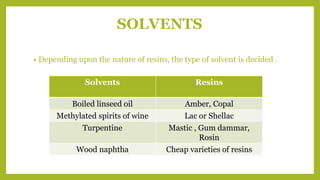
SOLVENTS
• Depending upon the nature of resins, the type of solvent is decided .
Solvents Resins
Boiled linseed oil Amber, Copal
Methylated spirits of wine Lac or Shellac
Turpentine Mastic , Gum dammar,
Rosin
Wood naphtha Cheap varieties of resins
TYPES OF VARNISHES
• Oil varnishes
• Spirit varnishes
• Turpentine varnishes
• Water varnishes
OIL VARNISHES
• The linseed oil is used as solvent in this type of varnish.
• The hard resins such as amber and copal are dissolved in linseed oil
and if the varnish is not workable, a small quantity of turpentine is
added.
• The oil varnishes dry slowly, but they from hard and durable surface.
• They are used on coaches and fittings in houses.
SPIRIT VARNISHES
• The methylated spirits of wine are used as solvents in the type of
varnish.
• The resins are of soft variety such as lac.
• The spirit varnishes dry quickly.
• But they are not durable and are easily affected by weathering action.
• They are generally used for furniture.
TURPENTINE VARNISHES
• The turpentine is used as solvent in this type of varnish.
• The resins adopted are of soft variety such as gum dammar, mastic
and rosin.
• There varnishes dry quickly and possess light colours.
• They are not durable.
WATER VARNISHES
• The shellac is dissolved in hot water and enough quantity of either
ammonia or borax or potash.
• There varnish are used for varnishing maps, picture, etc.
• They ae also used for delicate internal works and as covering for wall
paper.
PROCESS OF VERNISHING
• Preparation of surface:-The woodwork is thoroughly rubbed down
by means of sand paper. The surface is then made smooth and clean.
• Knotting:-The process of knotting is then carried out as in case of
painting.
• Stopping:-This is done by means of hot weak glue size.
• Coats of varnish:-The varnish is then applied on the surface in thin
coats. The next coat is applied after the previous one has thoroughly
dried up.
varnish

varnish

  • 1.
  • 2.
    CONTENT • WHAT ISVARNISH • WHY VARNISHING IS DONE • CHARACTERISTICS OF AN IDEAL VARNISH • INGREDIENTS OF A VARNISH • TYPES OF VARNISHES • PROCESS OF VERNISHING
  • 3.
  • 4.
    WHY VARNISHING ISDONE • To intensify or brighten the appearance of natural grain in wood. • To render brilliancy to the painted surface. • Varnishes can be used to protect wooden surfaces like windows, doors, floors and roof trusses from atmosphere. • To protect the painted surface from the atmospheric action.
  • 5.
    CHARACTERISTICS OF AN IDEALVARNISH • It should render the surface glossy. • It should dry rapidly and present a finished surface which is uniform in nature and pleasing the appearance. • The colour of varnish should not fade away when the surface is exposed to the atmospheric action. • The protecting film developed by varnish should be tough, hard, and durable. • It should not shrink or show the cracks after drying.
  • 6.
    INGREDIENTS OF AVARNISH • Resins • Driers • Solvents
  • 7.
    RESINS • The commonlyused resins are copal, lac, or shellac and rosin. • The copal is a hard substance and is available from the earth at place where pine tress existed in past . It is available in variety of form. • The lac or shellac is obtained by exudation of some types of insects in India. • The rosin is obtained from the pine tress.
  • 8.
    DRIERS • The functionof driers in varnish is to accelerate the process of drying . • The common driers used in varnishes are white copper and lead acetate.
  • 9.
    SOLVENTS • Depending uponthe nature of resins, the type of solvent is decided . Solvents Resins Boiled linseed oil Amber, Copal Methylated spirits of wine Lac or Shellac Turpentine Mastic , Gum dammar, Rosin Wood naphtha Cheap varieties of resins
  • 10.
    TYPES OF VARNISHES •Oil varnishes • Spirit varnishes • Turpentine varnishes • Water varnishes
  • 11.
    OIL VARNISHES • Thelinseed oil is used as solvent in this type of varnish. • The hard resins such as amber and copal are dissolved in linseed oil and if the varnish is not workable, a small quantity of turpentine is added. • The oil varnishes dry slowly, but they from hard and durable surface. • They are used on coaches and fittings in houses.
  • 12.
    SPIRIT VARNISHES • Themethylated spirits of wine are used as solvents in the type of varnish. • The resins are of soft variety such as lac. • The spirit varnishes dry quickly. • But they are not durable and are easily affected by weathering action. • They are generally used for furniture.
  • 13.
    TURPENTINE VARNISHES • Theturpentine is used as solvent in this type of varnish. • The resins adopted are of soft variety such as gum dammar, mastic and rosin. • There varnishes dry quickly and possess light colours. • They are not durable.
  • 14.
    WATER VARNISHES • Theshellac is dissolved in hot water and enough quantity of either ammonia or borax or potash. • There varnish are used for varnishing maps, picture, etc. • They ae also used for delicate internal works and as covering for wall paper.
  • 15.
    PROCESS OF VERNISHING •Preparation of surface:-The woodwork is thoroughly rubbed down by means of sand paper. The surface is then made smooth and clean. • Knotting:-The process of knotting is then carried out as in case of painting. • Stopping:-This is done by means of hot weak glue size. • Coats of varnish:-The varnish is then applied on the surface in thin coats. The next coat is applied after the previous one has thoroughly dried up.