Basic Civil Engineering.
Building Finishes
Building finishes
 It consists of two groups:
 “Group A”- The basic function of group is to protect
and preserve the material used for building construction.
 It includes-
1. Plastering
2. Pointing
3. White wash
4. Colour wash
Building Finishes
 “Group B”-
 The basic function is to provide the decorative finish to
the surfaces of building in addition to protect them from
weathering effects.
 it includes-
1. Paints
2. Vanishes
3. Distemper
4. Miscellaneous finishes
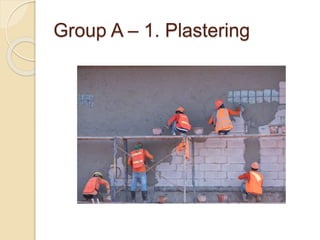
Group A – 1. Plastering
 Plastering is the process of covering rough walls and
uneven surfaces in the construction of houses and other
structures with a plastic material, called plaster/ mortar.
 Mortar = cement + sand + water
 Objectives-
 To protect the external surfaces against penetration of rain,
water, and other atmospheric agencies.
 To protect the surface against insects and bugs.
 To give a smooth surface in which dust and dirt cannot
stick and also giving a decorative look.
REQUIREMENTS OF GOOD
PLASTER
 It should adhere to the background and should remain adhered during all
climatic changes.
 It should be cheap and economical.
 It should be hard and durable.
 It should be possible to apply it during all weather conditions.
 It should effectively check the entry or penetration of moisture from the
surfaces.
 It should offer good insulation against sound and high resistance against fire.
Types of plastering
1. Lime plaster
2. Cement plaster
3. Mud plaster
4. Waterproof plaster
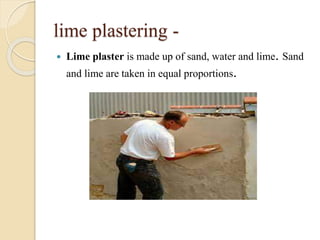
lime plastering -
 Lime plaster is made up of sand, water and lime. Sand
and lime are taken in equal proportions.
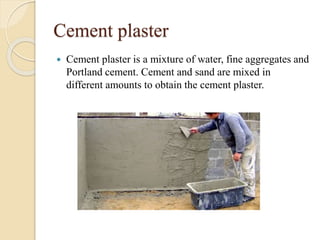
Cement plaster
 Cement plaster is a mixture of water, fine aggregates and
Portland cement. Cement and sand are mixed in
different amounts to obtain the cement plaster.
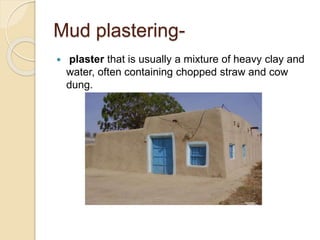
Mud plastering-
 plaster that is usually a mixture of heavy clay and
water, often containing chopped straw and cow
dung.
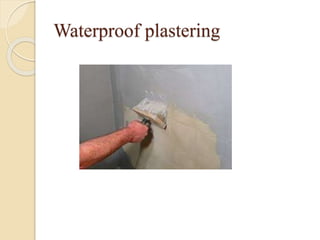
Waterproof plastering
2. Pointing
 Pointing is the finishing of mortar joints in brick or
stone masonry construction.
 The joints are raked out 13 to 20 mm deep, and space is
filled by appropriate mortar in the desired shape.
When pointing can be done?
 When uniform and smooth surface is not required
 Where workmanship is quite good
 Where material used in construction can withstand with
weathering effects
 Where the exhibition of natural beauty of the materials
such as stones, bricks used in construction is to be made.
Types of Pointing
1.Flush pointing
 This type of pointing is formed by removing the excess
mortar from the joint. The joint is made flush with the
face. This type of joint does not give good appearance.
But it is durable as it does not provide any space for
collection of dust, water, etc.

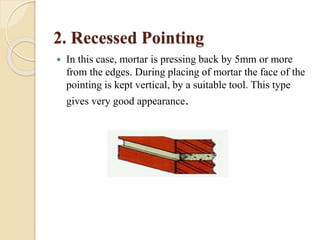
2. Recessed Pointing
 In this case, mortar is pressing back by 5mm or more
from the edges. During placing of mortar the face of the
pointing is kept vertical, by a suitable tool. This type
gives very good appearance.
3. Beaded Pointing
 It is formed by a steel or ironed with a concave edge. It
gives good appearance, but it will damage easily when
compared to other types.
4. Struck Pointing
 This is a modification of flush pointing in which the face
the pointing is kept inclined, with its upper edge pressed
inside the face by 10mm which drains water easily.
5. Rubbed, Keyed or Grooved
Pointing
 This is also a modification of flush pointing in which
groove is formed at its mid height, by a pointing tool. It
gives good appearance.
6. Tuck Pointing
 In this case mortar is pressed in the raked joint first and
finishing flush with the face.
 While the pressed mortar is green, groove or narrow
channel is cut in the centre of groove which is having
5mm width and 3mm depth. This groove is then filled
with white cement putty, kept projecting beyond the face
of the joint by 3 mm. if projection is done in mortar, it is
called bastard pointing or half tuck pointing.
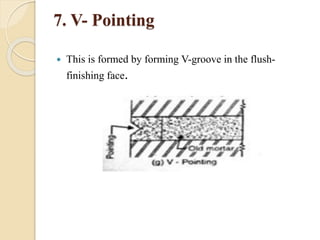
7. V- Pointing
 This is formed by forming V-groove in the flush-
finishing face.
8. Weathered Pointing
 This is made by making a projection in the form of
V-shape.
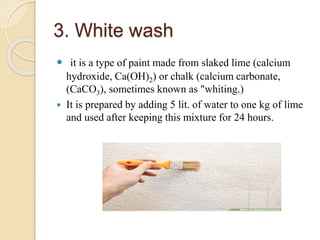
3. White wash
 it is a type of paint made from slaked lime (calcium
hydroxide, Ca(OH)2) or chalk (calcium carbonate,
(CaCO3), sometimes known as "whiting.)
 It is prepared by adding 5 lit. of water to one kg of lime
and used after keeping this mixture for 24 hours.
Application of White Wash
 White wash is applied with brush, to the specified
number of coats (generally three).
 The operation in each coat should consist of a stroke of
the brush given from top down-wards, another from the
bottom upwards over the first before it dries.
 Each coat should be allowed to dry before the next coat
is applied.
 The white washing on ceiling should be down prior to
that on walls.
4. Colour wash
 Colour washing is prepared by adding colouring
pigment to the screened white wash.
 Generally used pigments are yellow earth red ocher and
blue vitriol.
 These are crushed to powder, before mixing.
 The colour wash is applied in the same fashion as the
white wash.
 For colour washing on new surface, the first primary
coat should be of white wash and the subsequent coats
should be of colour wash.
Preparation of colour wash
 Green colour wash – solution of boiled mango bark in
white wash and copper sulphate.
 Blue colour wash – burnt coconut shell and white wash.
 Yellow colour wash – yellow earth and white wash.
 Pink colour wash – vermillion and white wash.
Group B – 1. Paints
 Paint is a liquid or mastic material that can be applied
to surfaces to colour, protect and provide texture.
 Paint is a substance used as the final finish to all
surfaces and as a coating to protect or decorate the
surface
 They are usually stored as a liquid and dry into a thin
film after application.
Types of Paints-
 Oil Paint. Oil paints.
 Enamel Paint.
 Emulsion Paint.
 Cement Paint.
 Bituminous Paint.
 Aluminium Paint.
 Anti-Corrosive Paint.
 Synthetic Rubber Paint.
Painting and its objectives-
 Painting - The process of application of paints as a
coating is termed as painting.
 Objectives
(i) It protects the surface from weathering effects of the
atmosphere and actions by other liquids, fumes and
gases.
(ii) It prevents decay of wood and corrosion in metal.
(iii) It is used to give good appearance to the surface. The
decorative effects may be created by painting and the
surface becomes hygienically good, clean, colourful and
attractive.
(iv) It provides a smooth surface for easy cleaning.
Constituents of Paint
The essential constituents of paints are:
1. Base - It is a principal constituent of paint. It also possesses
the binding properties.
2. A vehicle - The vehicles are the liquid substances which
hold the ingredients of a paint in liquid suspension and allow
them to be applied on the surface to be painted.
3. A pigment - Pigments give required colour for paints.
4. A drier - The function of a drier is to absorb oxygen from
the air and supply it to the vehicle for hardening.
5. A thinner - It helps in spreading paint uniformly over the
surface Turpentine and naphtha are commonly used thinners.
After paint applied, thinner evaporates and paint dries.
Properties of an Ideal Paint
1. It should be possible to apply easily and freely.
2. It should dry in reasonable time.
3. It should form hard and durable surface.
4. It should not be harmful to the health of workers.
5. It should not be easily affected by atmosphere.
6. It should possess attractive and pleasing
appearance.
7. It should form a thin film of uniform nature i.e., it
should not crack.
8. It should possess good spreading power.
9. It should be cheap.
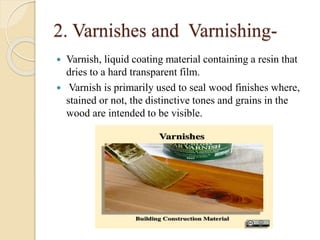
2. Varnishes and Varnishing-
 Varnish, liquid coating material containing a resin that
dries to a hard transparent film.
 Varnish is primarily used to seal wood finishes where,
stained or not, the distinctive tones and grains in the
wood are intended to be visible.
Varnishing
It is the process of applying varnish to the wooden
surfaces (unpainted)and also to the painted surfaces in
order to improve their appearance and protect them from
atmospheric actions.
 The main objectives of applying varnish on a wooden
surface are-
 it brightens the appearance of grain in wood;
 it renders brilliancy to the painted surface;
 it protects the painted surface from atmospheric action;
 it protects the unpainted wooden surface of Doors,
Windows, etc., from weathering action.
Characteristics of good varnish -
 It should give glossy surface.
 Should be durable.
 It should dry rapidly after application.
 It should not develop cracks after drying.
 It is commonly used on wooden surfaces.
 Colour of varnish should not fade away with time.
 It should not hide the natural grain of inner surface of
timber.
Types of varnishes-
According to solvent used -
1. Oil varnishes
2. Turpentine varnishes
3. Spirit varnishes
4. Water varnishes
Distemper
 They are paints used for the treatment of masonry walls.
Water instead of oil is used as a vehicle known as
water-paint too.
 Powdered white chalk and glue boiled in water are
mixed. Usually colored by mixing different pigments.
All Distempers mixed with water only before being
used.
 Distemper affected by weathering condition and takes
off if washed so it can be used only in interior works.
 Cheap, durable and easy interior finish. Should be
applied on clean and dry surface.
 Distemper= powdered chalk + glue+ colouring pigments
Forms of distempers
 White distempers –whiting (i.e. powdered chalk ) +glue
size
 Coloured distempers – powdered chalk + colouring
pigments + glue size
 Oil bounded distempers -
 Casein Paints- finely ground casein + slaked lime
Properties of distempers
 On drying the film of distemper shrinks
 Coatings are usually thick
 The film developed by distemper are porous and allow water
to pass through them.
 Generally light in color so provide good reflective coating.
 Less durable than oil paints
 Treated as water paints
 Can be applied on brickwork, cement plastered surface,
insulating boards
 Exhibit poor workability
 Prove to be unsatisfactory in damp locations such as kitchen ,
bathroom
Miscellaneous finishes
i. Wall tilling
ii. Papering
iii. Whitening
iv. Coal tarring
v. Wax polishing
vi. Wood oiling
vii. Glazing
Wall tilling
 Process of finishing wall surfaces with special tiles for
height varying from 60 cm to 120cm above the floor level
or up to ceiling.
 Used in kitchen, bathroom, WC, or on exterior side of
building for decorative effect.
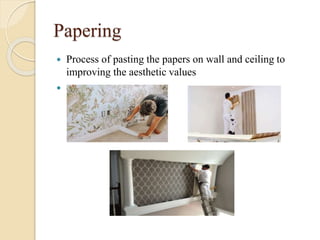
Papering
 Process of pasting the papers on wall and ceiling to
improving the aesthetic values

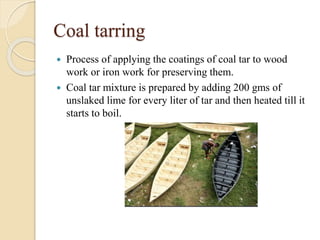
Coal tarring
 Process of applying the coatings of coal tar to wood
work or iron work for preserving them.
 Coal tar mixture is prepared by adding 200 gms of
unslaked lime for every liter of tar and then heated till it
starts to boil.
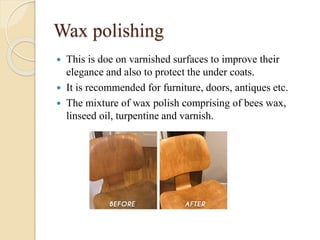
Wax polishing
 This is doe on varnished surfaces to improve their
elegance and also to protect the under coats.
 It is recommended for furniture, doors, antiques etc.
 The mixture of wax polish comprising of bees wax,
linseed oil, turpentine and varnish.
Wood oiling
 It is used as alternative to painting on wood work not
exposed to weather as wood oiling is cheaper.
 Oiling of wood work is done to increase the durability
and improve the appearance of the surface being oiled.
 Types of wood oiling-
I. Linseed oiling
II. Sweet oiling
Glazing
 Glazing is the work of fixing panes of glass in window,
door and other frames. These frames may be made up of
iron , steel or wooden.

Building finishes.pptx

  • 1.
  • 2.
    Building finishes  Itconsists of two groups:  “Group A”- The basic function of group is to protect and preserve the material used for building construction.  It includes- 1. Plastering 2. Pointing 3. White wash 4. Colour wash
  • 3.
    Building Finishes  “GroupB”-  The basic function is to provide the decorative finish to the surfaces of building in addition to protect them from weathering effects.  it includes- 1. Paints 2. Vanishes 3. Distemper 4. Miscellaneous finishes
  • 4.
    Group A –1. Plastering
  • 5.
     Plastering isthe process of covering rough walls and uneven surfaces in the construction of houses and other structures with a plastic material, called plaster/ mortar.  Mortar = cement + sand + water  Objectives-  To protect the external surfaces against penetration of rain, water, and other atmospheric agencies.  To protect the surface against insects and bugs.  To give a smooth surface in which dust and dirt cannot stick and also giving a decorative look.
  • 6.
    REQUIREMENTS OF GOOD PLASTER It should adhere to the background and should remain adhered during all climatic changes.  It should be cheap and economical.  It should be hard and durable.  It should be possible to apply it during all weather conditions.  It should effectively check the entry or penetration of moisture from the surfaces.  It should offer good insulation against sound and high resistance against fire.
  • 7.
    Types of plastering 1.Lime plaster 2. Cement plaster 3. Mud plaster 4. Waterproof plaster
  • 8.
    lime plastering - Lime plaster is made up of sand, water and lime. Sand and lime are taken in equal proportions.
  • 9.
    Cement plaster  Cementplaster is a mixture of water, fine aggregates and Portland cement. Cement and sand are mixed in different amounts to obtain the cement plaster.
  • 10.
    Mud plastering-  plasterthat is usually a mixture of heavy clay and water, often containing chopped straw and cow dung.
  • 11.
  • 12.
    2. Pointing  Pointingis the finishing of mortar joints in brick or stone masonry construction.  The joints are raked out 13 to 20 mm deep, and space is filled by appropriate mortar in the desired shape.
  • 13.
    When pointing canbe done?  When uniform and smooth surface is not required  Where workmanship is quite good  Where material used in construction can withstand with weathering effects  Where the exhibition of natural beauty of the materials such as stones, bricks used in construction is to be made.
  • 14.
  • 15.
    1.Flush pointing  Thistype of pointing is formed by removing the excess mortar from the joint. The joint is made flush with the face. This type of joint does not give good appearance. But it is durable as it does not provide any space for collection of dust, water, etc. 
  • 16.
    2. Recessed Pointing In this case, mortar is pressing back by 5mm or more from the edges. During placing of mortar the face of the pointing is kept vertical, by a suitable tool. This type gives very good appearance.
  • 17.
    3. Beaded Pointing It is formed by a steel or ironed with a concave edge. It gives good appearance, but it will damage easily when compared to other types.
  • 18.
    4. Struck Pointing This is a modification of flush pointing in which the face the pointing is kept inclined, with its upper edge pressed inside the face by 10mm which drains water easily.
  • 19.
    5. Rubbed, Keyedor Grooved Pointing  This is also a modification of flush pointing in which groove is formed at its mid height, by a pointing tool. It gives good appearance.
  • 20.
    6. Tuck Pointing In this case mortar is pressed in the raked joint first and finishing flush with the face.  While the pressed mortar is green, groove or narrow channel is cut in the centre of groove which is having 5mm width and 3mm depth. This groove is then filled with white cement putty, kept projecting beyond the face of the joint by 3 mm. if projection is done in mortar, it is called bastard pointing or half tuck pointing.
  • 21.
    7. V- Pointing This is formed by forming V-groove in the flush- finishing face.
  • 22.
    8. Weathered Pointing This is made by making a projection in the form of V-shape.
  • 23.
    3. White wash it is a type of paint made from slaked lime (calcium hydroxide, Ca(OH)2) or chalk (calcium carbonate, (CaCO3), sometimes known as "whiting.)  It is prepared by adding 5 lit. of water to one kg of lime and used after keeping this mixture for 24 hours.
  • 24.
    Application of WhiteWash  White wash is applied with brush, to the specified number of coats (generally three).  The operation in each coat should consist of a stroke of the brush given from top down-wards, another from the bottom upwards over the first before it dries.  Each coat should be allowed to dry before the next coat is applied.  The white washing on ceiling should be down prior to that on walls.
  • 25.
    4. Colour wash Colour washing is prepared by adding colouring pigment to the screened white wash.  Generally used pigments are yellow earth red ocher and blue vitriol.  These are crushed to powder, before mixing.  The colour wash is applied in the same fashion as the white wash.  For colour washing on new surface, the first primary coat should be of white wash and the subsequent coats should be of colour wash.
  • 26.
    Preparation of colourwash  Green colour wash – solution of boiled mango bark in white wash and copper sulphate.  Blue colour wash – burnt coconut shell and white wash.  Yellow colour wash – yellow earth and white wash.  Pink colour wash – vermillion and white wash.
  • 27.
    Group B –1. Paints  Paint is a liquid or mastic material that can be applied to surfaces to colour, protect and provide texture.  Paint is a substance used as the final finish to all surfaces and as a coating to protect or decorate the surface  They are usually stored as a liquid and dry into a thin film after application.
  • 28.
    Types of Paints- Oil Paint. Oil paints.  Enamel Paint.  Emulsion Paint.  Cement Paint.  Bituminous Paint.  Aluminium Paint.  Anti-Corrosive Paint.  Synthetic Rubber Paint.
  • 29.
    Painting and itsobjectives-  Painting - The process of application of paints as a coating is termed as painting.  Objectives (i) It protects the surface from weathering effects of the atmosphere and actions by other liquids, fumes and gases. (ii) It prevents decay of wood and corrosion in metal. (iii) It is used to give good appearance to the surface. The decorative effects may be created by painting and the surface becomes hygienically good, clean, colourful and attractive. (iv) It provides a smooth surface for easy cleaning.
  • 30.
    Constituents of Paint Theessential constituents of paints are: 1. Base - It is a principal constituent of paint. It also possesses the binding properties. 2. A vehicle - The vehicles are the liquid substances which hold the ingredients of a paint in liquid suspension and allow them to be applied on the surface to be painted. 3. A pigment - Pigments give required colour for paints. 4. A drier - The function of a drier is to absorb oxygen from the air and supply it to the vehicle for hardening. 5. A thinner - It helps in spreading paint uniformly over the surface Turpentine and naphtha are commonly used thinners. After paint applied, thinner evaporates and paint dries.
  • 31.
    Properties of anIdeal Paint 1. It should be possible to apply easily and freely. 2. It should dry in reasonable time. 3. It should form hard and durable surface. 4. It should not be harmful to the health of workers. 5. It should not be easily affected by atmosphere. 6. It should possess attractive and pleasing appearance. 7. It should form a thin film of uniform nature i.e., it should not crack. 8. It should possess good spreading power. 9. It should be cheap.
  • 32.
    2. Varnishes andVarnishing-  Varnish, liquid coating material containing a resin that dries to a hard transparent film.  Varnish is primarily used to seal wood finishes where, stained or not, the distinctive tones and grains in the wood are intended to be visible.
  • 33.
    Varnishing It is theprocess of applying varnish to the wooden surfaces (unpainted)and also to the painted surfaces in order to improve their appearance and protect them from atmospheric actions.  The main objectives of applying varnish on a wooden surface are-  it brightens the appearance of grain in wood;  it renders brilliancy to the painted surface;  it protects the painted surface from atmospheric action;  it protects the unpainted wooden surface of Doors, Windows, etc., from weathering action.
  • 34.
    Characteristics of goodvarnish -  It should give glossy surface.  Should be durable.  It should dry rapidly after application.  It should not develop cracks after drying.  It is commonly used on wooden surfaces.  Colour of varnish should not fade away with time.  It should not hide the natural grain of inner surface of timber.
  • 35.
    Types of varnishes- Accordingto solvent used - 1. Oil varnishes 2. Turpentine varnishes 3. Spirit varnishes 4. Water varnishes
  • 36.
    Distemper  They arepaints used for the treatment of masonry walls. Water instead of oil is used as a vehicle known as water-paint too.  Powdered white chalk and glue boiled in water are mixed. Usually colored by mixing different pigments. All Distempers mixed with water only before being used.  Distemper affected by weathering condition and takes off if washed so it can be used only in interior works.  Cheap, durable and easy interior finish. Should be applied on clean and dry surface.  Distemper= powdered chalk + glue+ colouring pigments
  • 37.
    Forms of distempers White distempers –whiting (i.e. powdered chalk ) +glue size  Coloured distempers – powdered chalk + colouring pigments + glue size  Oil bounded distempers -  Casein Paints- finely ground casein + slaked lime
  • 38.
    Properties of distempers On drying the film of distemper shrinks  Coatings are usually thick  The film developed by distemper are porous and allow water to pass through them.  Generally light in color so provide good reflective coating.  Less durable than oil paints  Treated as water paints  Can be applied on brickwork, cement plastered surface, insulating boards  Exhibit poor workability  Prove to be unsatisfactory in damp locations such as kitchen , bathroom
  • 39.
    Miscellaneous finishes i. Walltilling ii. Papering iii. Whitening iv. Coal tarring v. Wax polishing vi. Wood oiling vii. Glazing
  • 40.
    Wall tilling  Processof finishing wall surfaces with special tiles for height varying from 60 cm to 120cm above the floor level or up to ceiling.  Used in kitchen, bathroom, WC, or on exterior side of building for decorative effect.
  • 41.
    Papering  Process ofpasting the papers on wall and ceiling to improving the aesthetic values 
  • 42.
    Coal tarring  Processof applying the coatings of coal tar to wood work or iron work for preserving them.  Coal tar mixture is prepared by adding 200 gms of unslaked lime for every liter of tar and then heated till it starts to boil.
  • 43.
    Wax polishing  Thisis doe on varnished surfaces to improve their elegance and also to protect the under coats.  It is recommended for furniture, doors, antiques etc.  The mixture of wax polish comprising of bees wax, linseed oil, turpentine and varnish.
  • 44.
    Wood oiling  Itis used as alternative to painting on wood work not exposed to weather as wood oiling is cheaper.  Oiling of wood work is done to increase the durability and improve the appearance of the surface being oiled.  Types of wood oiling- I. Linseed oiling II. Sweet oiling
  • 45.
    Glazing  Glazing isthe work of fixing panes of glass in window, door and other frames. These frames may be made up of iron , steel or wooden.