BUILDING CONSTRUCTION &
MATERIALS
TOPIC: CLADDING
POINTING
JOINTING
PLASTERING
GROUP MEMBERS:
ANUBHAV GUPTA
BHAVYA SHARMA
SHWETA AGRAWAL
ADITI KUMAR
RAJSHRI CHATURVEDI
NEHA SINGH
TUSHAR PANCHAL
SURFACE FINISHES
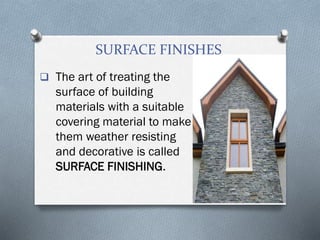
 The art of treating the
surface of building
materials with a suitable
covering material to make
them weather resisting
and decorative is called
SURFACE FINISHING.
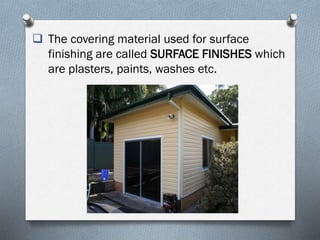
 The covering material used for surface
finishing are called SURFACE FINISHES which
are plasters, paints, washes etc.
PURPOSE
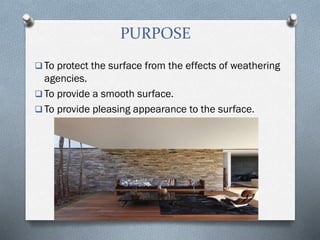
 To protect the surface from the effects of weathering
agencies.
 To provide a smooth surface.
 To provide pleasing appearance to the surface.
CLADDING
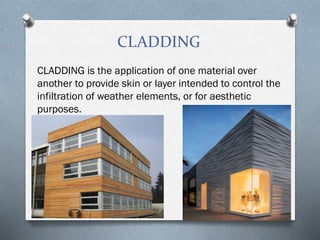
CLADDING is the application of one material over
another to provide skin or layer intended to control the
infiltration of weather elements, or for aesthetic
purposes.
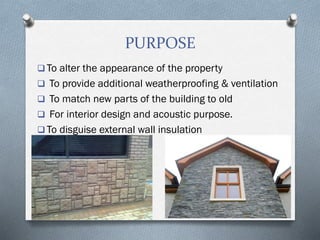
PURPOSE
 To alter the appearance of the property
 To provide additional weatherproofing & ventilation
 To match new parts of the building to old
 For interior design and acoustic purpose.
 To disguise external wall insulation
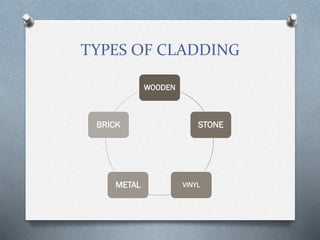
TYPES OF CLADDING
WOODEN
STONE
VINYLMETAL
BRICK
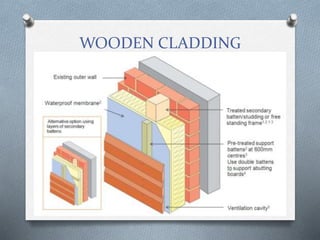
WOODEN CLADDING
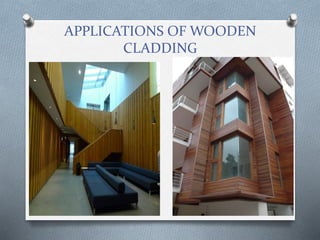
APPLICATIONS OF WOODEN
CLADDING
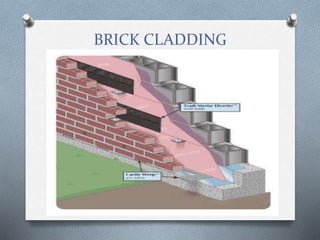
BRICK CLADDING
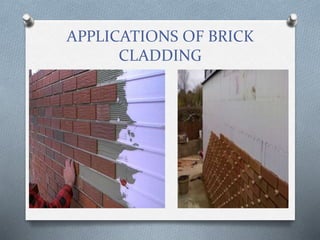
APPLICATIONS OF BRICK
CLADDING
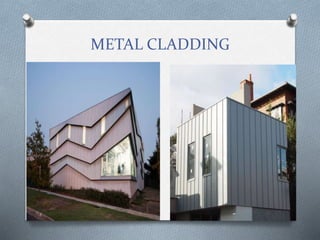
METAL CLADDING
VINYL CLADDING
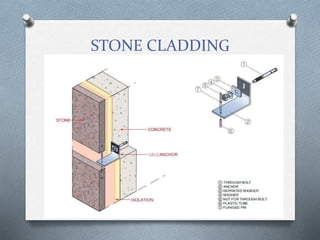
STONE CLADDING
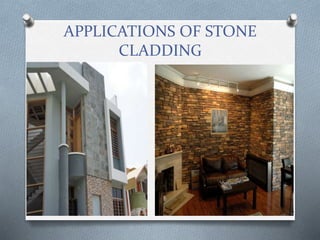
APPLICATIONS OF STONE
CLADDING
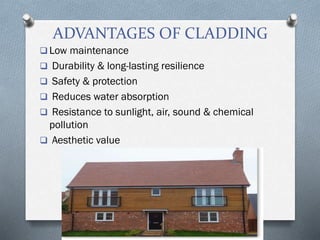
ADVANTAGES OF CLADDING
 Low maintenance
 Durability & long-lasting resilience
 Safety & protection
 Reduces water absorption
 Resistance to sunlight, air, sound & chemical
pollution
 Aesthetic value
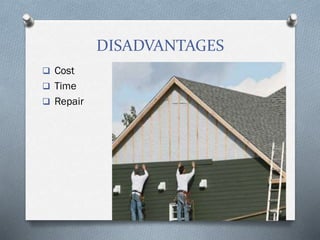
DISADVANTAGES
 Cost
 Time
 Repair
POINTING
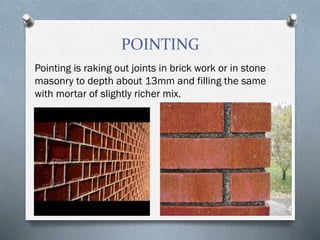
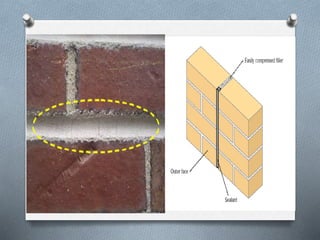
Pointing is raking out joints in brick work or in stone
masonry to depth about 13mm and filling the same
with mortar of slightly richer mix.
PURPOSE
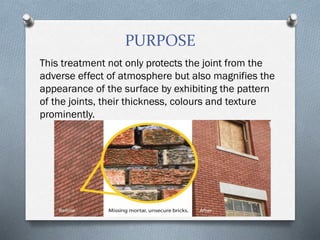
This treatment not only protects the joint from the
adverse effect of atmosphere but also magnifies the
appearance of the surface by exhibiting the pattern
of the joints, their thickness, colours and texture
prominently.
MORTAR FOR POINTING
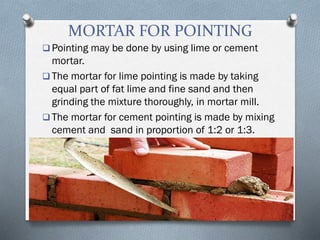
 Pointing may be done by using lime or cement
mortar.
 The mortar for lime pointing is made by taking
equal part of fat lime and fine sand and then
grinding the mixture thoroughly, in mortar mill.
 The mortar for cement pointing is made by mixing
cement and sand in proportion of 1:2 or 1:3.
TYPES OF POINTING
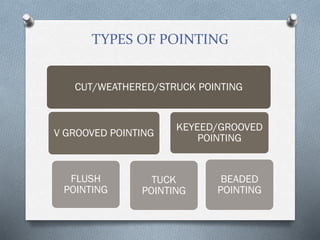
CUT/WEATHERED/STRUCK POINTING
V GROOVED POINTING
FLUSH
POINTING
TUCK
POINTING
KEYEED/GROOVED
POINTING
BEADED
POINTING
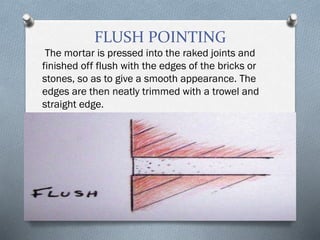
FLUSH POINTING
The mortar is pressed into the raked joints and
finished off flush with the edges of the bricks or
stones, so as to give a smooth appearance. The
edges are then neatly trimmed with a trowel and
straight edge.
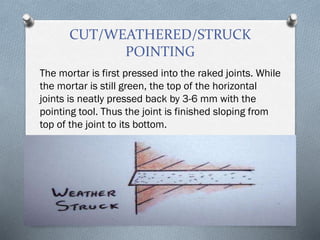
CUT/WEATHERED/STRUCK
POINTING
The mortar is first pressed into the raked joints. While
the mortar is still green, the top of the horizontal
joints is neatly pressed back by 3-6 mm with the
pointing tool. Thus the joint is finished sloping from
top of the joint to its bottom.
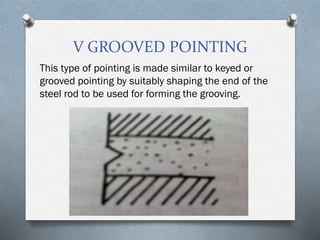
V GROOVED POINTING
This type of pointing is made similar to keyed or
grooved pointing by suitably shaping the end of the
steel rod to be used for forming the grooving.
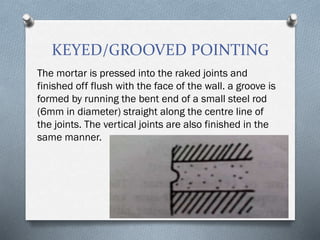
KEYED/GROOVED POINTING
The mortar is pressed into the raked joints and
finished off flush with the face of the wall. a groove is
formed by running the bent end of a small steel rod
(6mm in diameter) straight along the centre line of
the joints. The vertical joints are also finished in the
same manner.
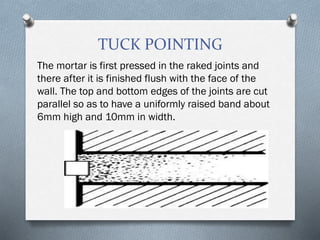
TUCK POINTING
The mortar is first pressed in the raked joints and
there after it is finished flush with the face of the
wall. The top and bottom edges of the joints are cut
parallel so as to have a uniformly raised band about
6mm high and 10mm in width.
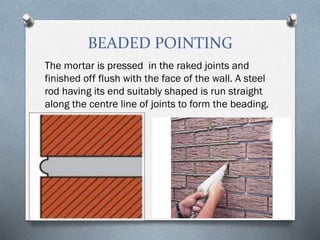
BEADED POINTING
The mortar is pressed in the raked joints and
finished off flush with the face of the wall. A steel
rod having its end suitably shaped is run straight
along the centre line of joints to form the beading.
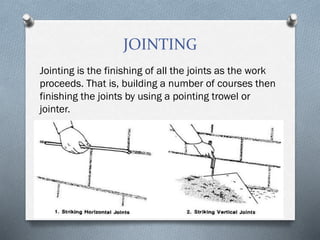
JOINTING
Jointing is the finishing of all the joints as the work
proceeds. That is, building a number of courses then
finishing the joints by using a pointing trowel or
jointer.
DIFFERENCE B/W POINTING &
JOINTING
 Jointing is the finish of the mortar joints between
bricks or blocks , in brickwork or blockwork that is
finished surface.
 Jointing is executed as the brickwork or blockwork is
built.
 Pointing is the finish given to the joints by raking out
to a depth of approximately 20mm and filling in one
the face with a hard-setting cement mortar which
could have a color additive.
 Pointing is executed as an operation separate from
bricklaying
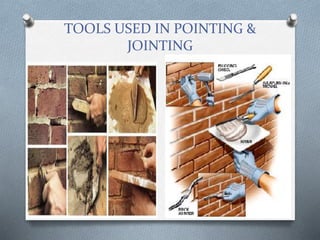
TOOLS USED IN POINTING &
JOINTING
PLASTERING
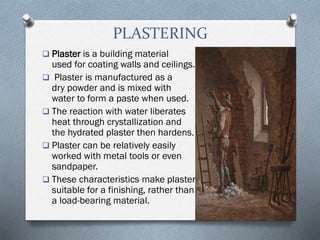
 Plaster is a building material
used for coating walls and ceilings.
 Plaster is manufactured as a
dry powder and is mixed with
water to form a paste when used.
 The reaction with water liberates
heat through crystallization and
the hydrated plaster then hardens.
 Plaster can be relatively easily
worked with metal tools or even
sandpaper.
 These characteristics make plaster
suitable for a finishing, rather than
a load-bearing material.
REQUIRMENTS
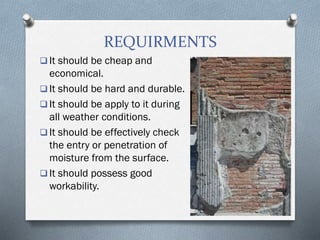
 It should be cheap and
economical.
 It should be hard and durable.
 It should be apply to it during
all weather conditions.
 It should be effectively check
the entry or penetration of
moisture from the surface.
 It should possess good
workability.
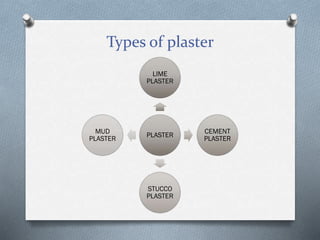
Types of plaster
PLASTER
LIME
PLASTER
CEMENT
PLASTER
STUCCO
PLASTER
MUD
PLASTER
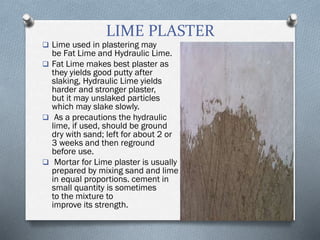
LIME PLASTER
 Lime used in plastering may
be Fat Lime and Hydraulic Lime.
 Fat Lime makes best plaster as
they yields good putty after
slaking, Hydraulic Lime yields
harder and stronger plaster,
but it may unslaked particles
which may slake slowly.
 As a precautions the hydraulic
lime, if used, should be ground
dry with sand; left for about 2 or
3 weeks and then reground
before use.
 Mortar for Lime plaster is usually
prepared by mixing sand and lime
in equal proportions. cement in
small quantity is sometimes added
to the mixture to
improve its strength.
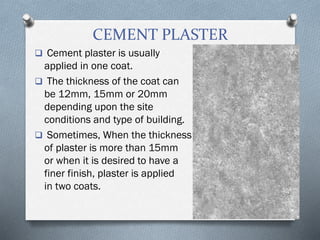
CEMENT PLASTER
 Cement plaster is usually
applied in one coat.
 The thickness of the coat can
be 12mm, 15mm or 20mm
depending upon the site
conditions and type of building.
 Sometimes, When the thickness
of plaster is more than 15mm
or when it is desired to have a
finer finish, plaster is applied
in two coats.
MUD PLASTER
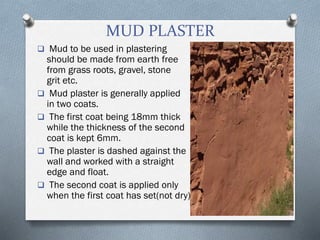
 Mud to be used in plastering
should be made from earth free
from grass roots, gravel, stone
grit etc.
 Mud plaster is generally applied
in two coats.
 The first coat being 18mm thick
while the thickness of the second
coat is kept 6mm.
 The plaster is dashed against the
wall and worked with a straight
edge and float.
 The second coat is applied only
when the first coat has set(not dry).
STUCCO PLASTER
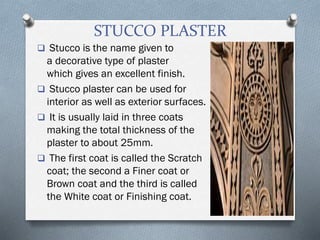
 Stucco is the name given to
a decorative type of plaster
which gives an excellent finish.
 Stucco plaster can be used for
interior as well as exterior surfaces.
 It is usually laid in three coats
making the total thickness of the
plaster to about 25mm.
 The first coat is called the Scratch
coat; the second a Finer coat or
Brown coat and the third is called
the White coat or Finishing coat.
TOOLS USED IN PLASTERING
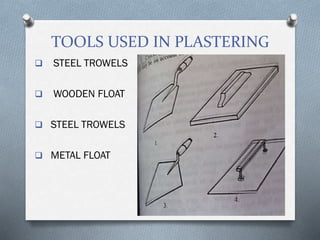
 STEEL TROWELS
 WOODEN FLOAT
 STEEL TROWELS
 METAL FLOAT
Surface finishes(1)

Surface finishes(1)

  • 1.
    BUILDING CONSTRUCTION & MATERIALS TOPIC:CLADDING POINTING JOINTING PLASTERING GROUP MEMBERS: ANUBHAV GUPTA BHAVYA SHARMA SHWETA AGRAWAL ADITI KUMAR RAJSHRI CHATURVEDI NEHA SINGH TUSHAR PANCHAL
  • 2.
    SURFACE FINISHES  Theart of treating the surface of building materials with a suitable covering material to make them weather resisting and decorative is called SURFACE FINISHING.
  • 3.
     The coveringmaterial used for surface finishing are called SURFACE FINISHES which are plasters, paints, washes etc.
  • 4.
    PURPOSE  To protectthe surface from the effects of weathering agencies.  To provide a smooth surface.  To provide pleasing appearance to the surface.
  • 5.
    CLADDING CLADDING is theapplication of one material over another to provide skin or layer intended to control the infiltration of weather elements, or for aesthetic purposes.
  • 6.
    PURPOSE  To alterthe appearance of the property  To provide additional weatherproofing & ventilation  To match new parts of the building to old  For interior design and acoustic purpose.  To disguise external wall insulation
  • 7.
  • 8.
  • 9.
  • 10.
  • 11.
  • 12.
  • 13.
  • 14.
  • 15.
  • 16.
    ADVANTAGES OF CLADDING Low maintenance  Durability & long-lasting resilience  Safety & protection  Reduces water absorption  Resistance to sunlight, air, sound & chemical pollution  Aesthetic value
  • 17.
  • 18.
    POINTING Pointing is rakingout joints in brick work or in stone masonry to depth about 13mm and filling the same with mortar of slightly richer mix.
  • 19.
    PURPOSE This treatment notonly protects the joint from the adverse effect of atmosphere but also magnifies the appearance of the surface by exhibiting the pattern of the joints, their thickness, colours and texture prominently.
  • 20.
    MORTAR FOR POINTING Pointing may be done by using lime or cement mortar.  The mortar for lime pointing is made by taking equal part of fat lime and fine sand and then grinding the mixture thoroughly, in mortar mill.  The mortar for cement pointing is made by mixing cement and sand in proportion of 1:2 or 1:3.
  • 21.
    TYPES OF POINTING CUT/WEATHERED/STRUCKPOINTING V GROOVED POINTING FLUSH POINTING TUCK POINTING KEYEED/GROOVED POINTING BEADED POINTING
  • 22.
    FLUSH POINTING The mortaris pressed into the raked joints and finished off flush with the edges of the bricks or stones, so as to give a smooth appearance. The edges are then neatly trimmed with a trowel and straight edge.
  • 23.
    CUT/WEATHERED/STRUCK POINTING The mortar isfirst pressed into the raked joints. While the mortar is still green, the top of the horizontal joints is neatly pressed back by 3-6 mm with the pointing tool. Thus the joint is finished sloping from top of the joint to its bottom.
  • 24.
    V GROOVED POINTING Thistype of pointing is made similar to keyed or grooved pointing by suitably shaping the end of the steel rod to be used for forming the grooving.
  • 25.
    KEYED/GROOVED POINTING The mortaris pressed into the raked joints and finished off flush with the face of the wall. a groove is formed by running the bent end of a small steel rod (6mm in diameter) straight along the centre line of the joints. The vertical joints are also finished in the same manner.
  • 26.
    TUCK POINTING The mortaris first pressed in the raked joints and there after it is finished flush with the face of the wall. The top and bottom edges of the joints are cut parallel so as to have a uniformly raised band about 6mm high and 10mm in width.
  • 27.
    BEADED POINTING The mortaris pressed in the raked joints and finished off flush with the face of the wall. A steel rod having its end suitably shaped is run straight along the centre line of joints to form the beading.
  • 28.
    JOINTING Jointing is thefinishing of all the joints as the work proceeds. That is, building a number of courses then finishing the joints by using a pointing trowel or jointer.
  • 29.
    DIFFERENCE B/W POINTING& JOINTING  Jointing is the finish of the mortar joints between bricks or blocks , in brickwork or blockwork that is finished surface.  Jointing is executed as the brickwork or blockwork is built.  Pointing is the finish given to the joints by raking out to a depth of approximately 20mm and filling in one the face with a hard-setting cement mortar which could have a color additive.  Pointing is executed as an operation separate from bricklaying
  • 31.
    TOOLS USED INPOINTING & JOINTING
  • 32.
    PLASTERING  Plaster isa building material used for coating walls and ceilings.  Plaster is manufactured as a dry powder and is mixed with water to form a paste when used.  The reaction with water liberates heat through crystallization and the hydrated plaster then hardens.  Plaster can be relatively easily worked with metal tools or even sandpaper.  These characteristics make plaster suitable for a finishing, rather than a load-bearing material.
  • 33.
    REQUIRMENTS  It shouldbe cheap and economical.  It should be hard and durable.  It should be apply to it during all weather conditions.  It should be effectively check the entry or penetration of moisture from the surface.  It should possess good workability.
  • 34.
  • 35.
    LIME PLASTER  Limeused in plastering may be Fat Lime and Hydraulic Lime.  Fat Lime makes best plaster as they yields good putty after slaking, Hydraulic Lime yields harder and stronger plaster, but it may unslaked particles which may slake slowly.  As a precautions the hydraulic lime, if used, should be ground dry with sand; left for about 2 or 3 weeks and then reground before use.  Mortar for Lime plaster is usually prepared by mixing sand and lime in equal proportions. cement in small quantity is sometimes added to the mixture to improve its strength.
  • 36.
    CEMENT PLASTER  Cementplaster is usually applied in one coat.  The thickness of the coat can be 12mm, 15mm or 20mm depending upon the site conditions and type of building.  Sometimes, When the thickness of plaster is more than 15mm or when it is desired to have a finer finish, plaster is applied in two coats.
  • 37.
    MUD PLASTER  Mudto be used in plastering should be made from earth free from grass roots, gravel, stone grit etc.  Mud plaster is generally applied in two coats.  The first coat being 18mm thick while the thickness of the second coat is kept 6mm.  The plaster is dashed against the wall and worked with a straight edge and float.  The second coat is applied only when the first coat has set(not dry).
  • 38.
    STUCCO PLASTER  Stuccois the name given to a decorative type of plaster which gives an excellent finish.  Stucco plaster can be used for interior as well as exterior surfaces.  It is usually laid in three coats making the total thickness of the plaster to about 25mm.  The first coat is called the Scratch coat; the second a Finer coat or Brown coat and the third is called the White coat or Finishing coat.
  • 39.
    TOOLS USED INPLASTERING  STEEL TROWELS  WOODEN FLOAT  STEEL TROWELS  METAL FLOAT