Home MagnetMART
 Project Cost Estimator
 Materials Description
 Wall Panelling Sheets
                                                 Quantity      Cost               Project                                    Home Warehouse

 42mm x 19mm Pine Battens
 Wall Panel Adhesive
 25mm x 1.6mm Panel Pins
 30mm x 2mm Bullet Head Nails (if required)
 Masonry Nails or Screws & Plugs (if required)
                                                                                  Install Sheet
                                                                                  Wall Panels
 Colour Matched Woodfiller
 Clear Polyurethane, finishing oil or stain
 Equipment
 Cross-cut Hand Saw or Electric Jigsaw
 Set Square
 Spirit Level
 Keyhole Saw
 Electric Drill
 Tape Measure
 Screwdriver
 Claw Hammer
 Tack Hammer
 Nail Punch
 Caulking Gun
 Utility Knife
 Straight Edge
 String Line
 Sandpaper (medium & fine grits)
 Scribing Block
 Stud Finder (optional)
 Total
 All these materials you need for this job are available at Magnet
 Mart, your home improvement warehouse.                                           •    Easy to follow step-by-step guide
Note: Due to the general nature of this advice and its individual application,
neither the publisher nor the retailer assumes any responsibility for any loss,   •    Important and handy tips
damage, injury or expense which may be incurred or suffered as a result of
the use of this pamphlet.                     © Magnet Mart 2004                  •    Materials check list
                  Phillip Hindmarsh Dr Ph 6281 1744 Fax 6285 2493                 •    Project Cost Estimator
                  Belconnen Lathlain St Ph 6251 4622 Fax 6253 1087                Before you start, please read through this pamphlet carefully and
                  Mitchell Vicars St Ph 6241 7311 Fax 6241 7545
                                                                                  estimate and assemble all the materials you will need for the
                  Gungahlin Crinigan Cir Ph 6228 9300 Fax 6228 9311
                  Queanbeyan Yass Rd Ph 6297 8711 Fax 6299 2226                   project and gather your tools and equipment together. Refer to
                  Goulburn Sloane St Ph 4821 3533 Fax 4821 7347                   the checklist and estimating form on the back panel of the
                  Bowral Bong Bong St Ph 4861 2355 Fax 4862 1066                  pamphlet to assist in this preparation.
You Can Install Sheet Wall Panelling
Give Your Walls A Lift                                                  2. Preparing the Wall
Sheet wall panelling suits both modern and traditional décor            •   Check the wall surface for flatness using a long straight edge
styles and is easy to install, requiring only a few basic tools and a       (see Fig 1).
little help from Magnet Mart. You can add the warmth and                •   Masonry walls are usually easy – the panelling may be fixed
richness of timber to just about any room using sheet panelling –           direct to the wall surface using panel adhesive. Check that
there’s a solution for every decor and budget.                              the mortar between the bricks is not damaged or loose, clean
Wall panelling sheets come in a variety of timber finishes                  out and replace any loose or damaged mortar prior to fixing
including Teak, Elm, Knotty Pine and Oregon. The sheets are                 panelling.
random grooved to give the look of individual board panelling           •   Plasterboard walls may be uneven or may even move when
and are available pre-finished so you don’t need to apply any               pressed. To provide an even surface for the panelling you will
stain or finish once the sheets are fixed to the wall.                      need to fix battens to the wall studs (see below).
Sheet wall panels are easy to install to just about any wall surface    •   If your plasterboard is in good condition and is flat and
or framing, all you need are basic DIY skills and a little advice           straight the panels may be fixed directly to the surface
from Magnet Mart.                                                           without battens. If you choose this method, ensure that the
1. Estimating – How much Do I Need?                                         wall is clean and dry to achieve a good adhesive bond.
The simplest way to estimate the quantity of panelling you              Fixing Battens
require is to bring your room or wall measurements to your local        •   For masonry walls fix battens using masonry nails or plugs
Magnet Mart store and ask our Timber Associates for assistance.             and screws, on plasterboard walls, nail or screw battens to
We can quickly and accurately estimate the quantities of materials          the wall studs – a stud finder may be necessary to help find
required for your project.                                                  the studs.
If you prefer, here is a method for doing your own estimating:          •   Attach horizontal battens at 400mm centres and vertical
•    Standard wall panel sheets are 2440mm x 1220mm x 3mm                   battens at 1220mm centres (see Fig xx).
     thick, one sheet will cover a wall from floor to ceiling. For      •   Check the battens are exactly plumb with a spirit level, using
     higher walls, you may need to join panels for complete                 packing pieces of scrap timber or masonite behind the batten
     coverage.                                                              to maintain a flat front surface (see Fig xx).
•    Measure the height of the wall at each end and the width at
     top and bottom.                                                                               Fig 2 Fix battens horizontal at 400mm,
                                                                                                         vertical at 1220mm. Check with
•    Using graph paper, make a scale drawing of the wall using                                           a spirit level.
     these measurements, adding in any windows or doors that
     will not be covered by the panelling.
•    Mark off the widths of panelling sheets on the drawing
     allowing for separate pieces to cover above door frames and
     above and below windows. This should give you the number
     of panels you will need for the project.
•    Repeat this procedure for each wall you wish to cover.

    Fig 1 Check flatness of the wall with a long straight edge.

                                                                                                                     Fig 3 Make sure the
                                                                                                                           battens are plumb.
                                                                                                                           Use packing pieces if
                                                                                                                           necessary.
3. Fitting Panels – Using Nails                                                    4. Fitting Panels – Using Adhesive
•   Remove the architraves around windows and doors prior to                       •   Apply a line of wallboard adhesive to enough battens for a
    commencing to fit the wall panels.                                                 single sheet using a caulking gun (see Fig 6).
•   Attaching the first panel is easier if you start in the middle of
                                                                                                               Fig 6 Apply wallboard adhesive
    the wall and work out to each corner, this way you will have                                                     to battens with a
    less problems with out of square walls (even new houses are                                                      caulking gun.
    rarely exactly square).
•   Place the first panel against the wall with one edge in the
    centre of a vertical batten, fix the panel with a single panel
    pin (see Fig 4), then adjust the panel so                                                                                   Fig 7 Apply direct to wall
                                                                                                                                      in lines about
    that it is exactly vertical using a spirit
                                                                                                                                      400mm centres.
    level before nailing all around.
                                                                                   •   If you are fixing direct to
•   Drive panel pins every 150mm along
                                                                                       the wall surface without
    the edges, alternating the angle of each
                                                                                       battens, apply the adhesive
    pin as you go – one pin angled left, the
                                                                                       in lines at about 400mm
    next right, one up the next down, etc.
                                                                                       centres (see Fig 7). Apply
•   When the panel is secured to the                                                   liberally in a constant line.
    vertical battens, fix it to the horizontal
                                                                                   •   With the help of an assistant, lift the first panel into position
    battens driving panel pins through the
                                                                                       and tack it into place with a panel pin at the top (see Fig xx),
    grooves. Use a string line stretched
                                                                                       use a spirit level to ensure the panel is vertical and press the
    along the line of the horizontal batten
                                                    Fig 4 Pinning the first            panel into position against the glue lines.
    to ensure the pins are driven in at the
                                                          panel in the centre of   •   Swing the panel away from the wall at the bottom and prop
    same level (see Fig 5).                               the vertical batten.
                                                                                       with scrap timber blocks (see Fig xx).
                                                                                   •   When the adhesive is touch dry, remove the props and press
                                                                                       the panel firmly into place, tapping along the glue lines with
                                                                                       a hammer and padded timber block to ensure good contact is
                                                                                       made with the adhesive.
                                                                                   •   Repeat the above steps for each panel.
                                                                                                                                  Fig 7 Fix first panel with
                                                                                                                                        a pin at the top.
                                                                                                                                        Check with a spirit
                                                                                                                                        level.


             Fig 5 Fix to horizontal battens using string line.


•   Butt the next panel firmly to the first and nail to the battens
    in the same manner.
•   Punch all nails below the surface with a fine nail punch and                                                                  Fig 8 Swing bottom of
    cover the holes with a coloured wood filler.                                                                                        panel away from
                                                                                                                                        the wall. Prop with
                                                                                                                                        scrap timber blocks.
Cutting Panels                                                            When panelling two or more walls,
•   If you need to cut a panel, first score a line with a sharp utility   •   For an internal corner, butt one sheet into the corner then
    knife to prevent tearing or breaking fibres.                              butt the next sheet at a right angle to the first (see Fig xx).
•   If you use a hand saw, cut with the veneered side facing up,          •   For an external corner, overlap the end of one sheet with the
    is using an electric jigsaw, cut with the veneered side down,             next (see Fig 11) leaving the overlap slightly proud of the first
    ensuring that the surface is padded where it rests on saw                 sheet so that it may be sanded flush with a fine grit
    horses or your bench.                                                     sandpaper later.
•   Lightly sand the cut edge with medium grit sandpaper if               5. Finishing
    required.
                                                                          •   Replace and door and window architraves over the panelling.
Fitting Panels to Corners                                                 •   Cut and fix any beading required to cover minor gaps in
When panelling a single wall:                                                 corners or around doors and windows.
•   If panelling a single wall, cover any slight gap between the          •   If your panelling is pre-finished, there is no need to do
    panel and the corner with quad beading glued into place                   anything more. If you need to apply a clear finish to the
    with woodworking adhesive.                                                panelling, a polyurethane finish will provide excellent
•   Alternatively, to measure a panel for a flush fit to the corner,          protection and highlight the timber veneer grain. If you need
    first cut the sheet about 100mm wider than you need, hold it              advice, drop in and chat with a Magnet Mart paint specialist
    to the corner, ensuring it is vertical with a spirit level and            who will be pleased to assist you with your choice.
    mark with a scribing block (see Fig 9) to match the wall
    contour.                                                                                                        Fig 10 Butt fitting two
                                                                                                                           panels to internal
•   Cut the panel along this line, check that it fits the corner,                                                          corners.
    then mark the top and bottom edges where it overlaps the
    previously fitted panel.
•   Join the marks with a straight edge and cut to size.


                                       Fig 9 Mark with a
                                             scribing block when
                                             fitting panels flush
                                             to corners.


                                                                                                               Fig 11 Finishing panels
                                                                                                                      for the external
                                                                                                                      corner.

Wall panels

  • 1.
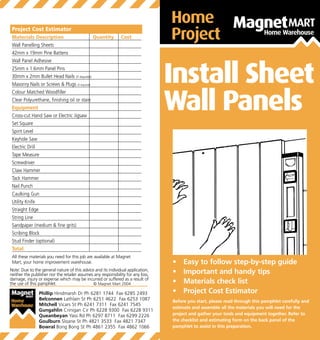
    Home MagnetMART ProjectCost Estimator Materials Description Wall Panelling Sheets Quantity Cost Project Home Warehouse 42mm x 19mm Pine Battens Wall Panel Adhesive 25mm x 1.6mm Panel Pins 30mm x 2mm Bullet Head Nails (if required) Masonry Nails or Screws & Plugs (if required) Install Sheet Wall Panels Colour Matched Woodfiller Clear Polyurethane, finishing oil or stain Equipment Cross-cut Hand Saw or Electric Jigsaw Set Square Spirit Level Keyhole Saw Electric Drill Tape Measure Screwdriver Claw Hammer Tack Hammer Nail Punch Caulking Gun Utility Knife Straight Edge String Line Sandpaper (medium & fine grits) Scribing Block Stud Finder (optional) Total All these materials you need for this job are available at Magnet Mart, your home improvement warehouse. • Easy to follow step-by-step guide Note: Due to the general nature of this advice and its individual application, neither the publisher nor the retailer assumes any responsibility for any loss, • Important and handy tips damage, injury or expense which may be incurred or suffered as a result of the use of this pamphlet. © Magnet Mart 2004 • Materials check list Phillip Hindmarsh Dr Ph 6281 1744 Fax 6285 2493 • Project Cost Estimator Belconnen Lathlain St Ph 6251 4622 Fax 6253 1087 Before you start, please read through this pamphlet carefully and Mitchell Vicars St Ph 6241 7311 Fax 6241 7545 estimate and assemble all the materials you will need for the Gungahlin Crinigan Cir Ph 6228 9300 Fax 6228 9311 Queanbeyan Yass Rd Ph 6297 8711 Fax 6299 2226 project and gather your tools and equipment together. Refer to Goulburn Sloane St Ph 4821 3533 Fax 4821 7347 the checklist and estimating form on the back panel of the Bowral Bong Bong St Ph 4861 2355 Fax 4862 1066 pamphlet to assist in this preparation.
  • 2.
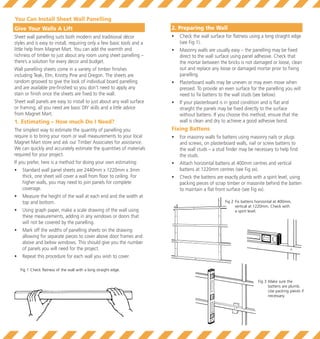
    You Can InstallSheet Wall Panelling Give Your Walls A Lift 2. Preparing the Wall Sheet wall panelling suits both modern and traditional décor • Check the wall surface for flatness using a long straight edge styles and is easy to install, requiring only a few basic tools and a (see Fig 1). little help from Magnet Mart. You can add the warmth and • Masonry walls are usually easy – the panelling may be fixed richness of timber to just about any room using sheet panelling – direct to the wall surface using panel adhesive. Check that there’s a solution for every decor and budget. the mortar between the bricks is not damaged or loose, clean Wall panelling sheets come in a variety of timber finishes out and replace any loose or damaged mortar prior to fixing including Teak, Elm, Knotty Pine and Oregon. The sheets are panelling. random grooved to give the look of individual board panelling • Plasterboard walls may be uneven or may even move when and are available pre-finished so you don’t need to apply any pressed. To provide an even surface for the panelling you will stain or finish once the sheets are fixed to the wall. need to fix battens to the wall studs (see below). Sheet wall panels are easy to install to just about any wall surface • If your plasterboard is in good condition and is flat and or framing, all you need are basic DIY skills and a little advice straight the panels may be fixed directly to the surface from Magnet Mart. without battens. If you choose this method, ensure that the 1. Estimating – How much Do I Need? wall is clean and dry to achieve a good adhesive bond. The simplest way to estimate the quantity of panelling you Fixing Battens require is to bring your room or wall measurements to your local • For masonry walls fix battens using masonry nails or plugs Magnet Mart store and ask our Timber Associates for assistance. and screws, on plasterboard walls, nail or screw battens to We can quickly and accurately estimate the quantities of materials the wall studs – a stud finder may be necessary to help find required for your project. the studs. If you prefer, here is a method for doing your own estimating: • Attach horizontal battens at 400mm centres and vertical • Standard wall panel sheets are 2440mm x 1220mm x 3mm battens at 1220mm centres (see Fig xx). thick, one sheet will cover a wall from floor to ceiling. For • Check the battens are exactly plumb with a spirit level, using higher walls, you may need to join panels for complete packing pieces of scrap timber or masonite behind the batten coverage. to maintain a flat front surface (see Fig xx). • Measure the height of the wall at each end and the width at top and bottom. Fig 2 Fix battens horizontal at 400mm, vertical at 1220mm. Check with • Using graph paper, make a scale drawing of the wall using a spirit level. these measurements, adding in any windows or doors that will not be covered by the panelling. • Mark off the widths of panelling sheets on the drawing allowing for separate pieces to cover above door frames and above and below windows. This should give you the number of panels you will need for the project. • Repeat this procedure for each wall you wish to cover. Fig 1 Check flatness of the wall with a long straight edge. Fig 3 Make sure the battens are plumb. Use packing pieces if necessary.
  • 3.
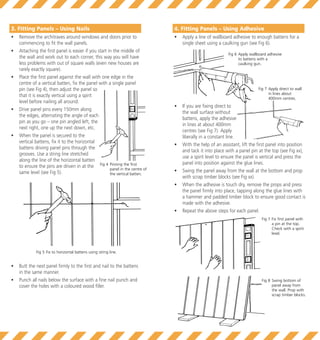
    3. Fitting Panels– Using Nails 4. Fitting Panels – Using Adhesive • Remove the architraves around windows and doors prior to • Apply a line of wallboard adhesive to enough battens for a commencing to fit the wall panels. single sheet using a caulking gun (see Fig 6). • Attaching the first panel is easier if you start in the middle of Fig 6 Apply wallboard adhesive the wall and work out to each corner, this way you will have to battens with a less problems with out of square walls (even new houses are caulking gun. rarely exactly square). • Place the first panel against the wall with one edge in the centre of a vertical batten, fix the panel with a single panel pin (see Fig 4), then adjust the panel so Fig 7 Apply direct to wall in lines about that it is exactly vertical using a spirit 400mm centres. level before nailing all around. • If you are fixing direct to • Drive panel pins every 150mm along the wall surface without the edges, alternating the angle of each battens, apply the adhesive pin as you go – one pin angled left, the in lines at about 400mm next right, one up the next down, etc. centres (see Fig 7). Apply • When the panel is secured to the liberally in a constant line. vertical battens, fix it to the horizontal • With the help of an assistant, lift the first panel into position battens driving panel pins through the and tack it into place with a panel pin at the top (see Fig xx), grooves. Use a string line stretched use a spirit level to ensure the panel is vertical and press the along the line of the horizontal batten Fig 4 Pinning the first panel into position against the glue lines. to ensure the pins are driven in at the panel in the centre of • Swing the panel away from the wall at the bottom and prop same level (see Fig 5). the vertical batten. with scrap timber blocks (see Fig xx). • When the adhesive is touch dry, remove the props and press the panel firmly into place, tapping along the glue lines with a hammer and padded timber block to ensure good contact is made with the adhesive. • Repeat the above steps for each panel. Fig 7 Fix first panel with a pin at the top. Check with a spirit level. Fig 5 Fix to horizontal battens using string line. • Butt the next panel firmly to the first and nail to the battens in the same manner. • Punch all nails below the surface with a fine nail punch and Fig 8 Swing bottom of cover the holes with a coloured wood filler. panel away from the wall. Prop with scrap timber blocks.
  • 4.
    Cutting Panels When panelling two or more walls, • If you need to cut a panel, first score a line with a sharp utility • For an internal corner, butt one sheet into the corner then knife to prevent tearing or breaking fibres. butt the next sheet at a right angle to the first (see Fig xx). • If you use a hand saw, cut with the veneered side facing up, • For an external corner, overlap the end of one sheet with the is using an electric jigsaw, cut with the veneered side down, next (see Fig 11) leaving the overlap slightly proud of the first ensuring that the surface is padded where it rests on saw sheet so that it may be sanded flush with a fine grit horses or your bench. sandpaper later. • Lightly sand the cut edge with medium grit sandpaper if 5. Finishing required. • Replace and door and window architraves over the panelling. Fitting Panels to Corners • Cut and fix any beading required to cover minor gaps in When panelling a single wall: corners or around doors and windows. • If panelling a single wall, cover any slight gap between the • If your panelling is pre-finished, there is no need to do panel and the corner with quad beading glued into place anything more. If you need to apply a clear finish to the with woodworking adhesive. panelling, a polyurethane finish will provide excellent • Alternatively, to measure a panel for a flush fit to the corner, protection and highlight the timber veneer grain. If you need first cut the sheet about 100mm wider than you need, hold it advice, drop in and chat with a Magnet Mart paint specialist to the corner, ensuring it is vertical with a spirit level and who will be pleased to assist you with your choice. mark with a scribing block (see Fig 9) to match the wall contour. Fig 10 Butt fitting two panels to internal • Cut the panel along this line, check that it fits the corner, corners. then mark the top and bottom edges where it overlaps the previously fitted panel. • Join the marks with a straight edge and cut to size. Fig 9 Mark with a scribing block when fitting panels flush to corners. Fig 11 Finishing panels for the external corner.