Construction Errors
(case Studies)
Introduction
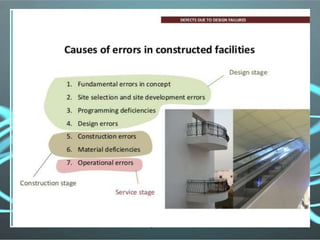
• Construction and engineering practitioners have found it
increasingly difficult to learn from their mistakes, particularly
with regard to the prevention, identification and/or
containment of design errors.
• Design errors have been the root cause of numerous
catastrophic accidents that have resulted in the death injury of
workers and members of the public.
• The classification of design errors provides the foundations to
consider the appropriateness of strategies to contain and
mitigate errors.
4/6/2016 VIT University, Chennai Campus 2
• The enhanced functional requirements of such buildings have
continued to challenge the designers and technological
pressures have continued to grow.
• Accidents prevention has become increasingly important
aspect which could be a major cause of concern in the
construction industry
• Therefore we have to give some effort to identify and explore
possible ways of preventing and controlling accidents should
be sought after,
• Hence we have to learn from these case study.
4/6/2016 VIT University, Chennai Campus 3
4/6/2016 VIT University, Chennai Campus 4
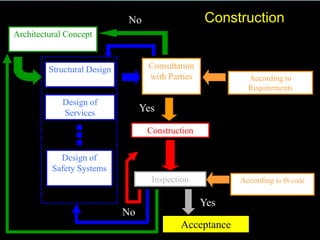
Construction
Architectural Concept
Consultation
with Parties
No
According to
Requirements
Yes
Construction
Inspection
Structural Design
Design of
Services
Design of
Safety Systems
According to IS code
No
Yes
Acceptance
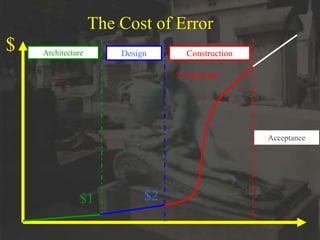
The Cost of Error
Construction
Acceptance
DesignArchitecture
$
$1 $2
$ Unlimited
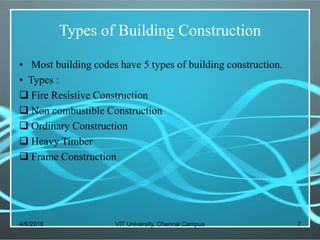
Types of Building Construction
• Most building codes have 5 types of building construction.
• Types :
 Fire Resistive Construction
 Non combustible Construction
 Ordinary Construction
 Heavy Timber
 Frame Construction
4/6/2016 VIT University, Chennai Campus 7
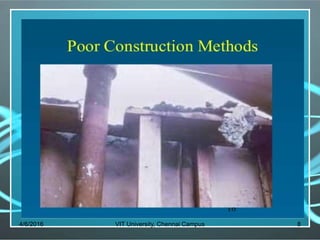
4/6/2016 VIT University, Chennai Campus 8
4/6/2016 VIT University, Chennai Campus 9
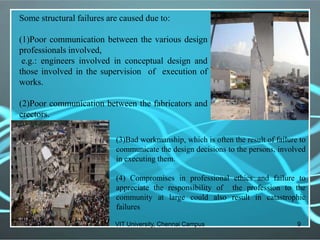
Some structural failures are caused due to:
(1)Poor communication between the various design
professionals involved,
e.g.: engineers involved in conceptual design and
those involved in the supervision of execution of
works.
(2)Poor communication between the fabricators and
erectors.
. (3)Bad workmanship, which is often the result of failure to
communicate the design decisions to the persons, involved
in executing them.
(4) Compromises in professional ethics and failure to
appreciate the responsibility of the profession to the
community at large could also result in catastrophic
failures
4/6/2016 VIT University, Chennai Campus 10
Common causes of structural failure are below:
 lack of appropriate professional design and construction
experience, especially when novel structures are needed.
complexity of codes and specifications leading
to misinterpretation and misapplication.
unwarranted belief in calculations and in specified extreme
loads and properties.
inadequate preparation and review of contract and shop
drawings.
poor training of field inspectors.
compressed design and/or construction time.
Case studies
 Poor conceptual design
 Design inadequacy
 Poor detailing
 Poor judgement
 Indian experience case studies
POOR CONCEPTUAL DESIGN
4/6/2016 VIT University, Chennai Campus 12
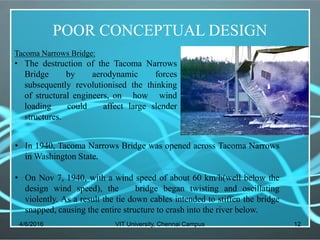
Tacoma Narrows Bridge:
• The destruction of the Tacoma Narrows
Bridge by aerodynamic forces
subsequently revolutionised the thinking
of structural engineers, on how wind
loading could affect large slender
structures.
• In 1940, Tacoma Narrows Bridge was opened across Tacoma Narrows
in Washington State.
• On Nov 7, 1940, with a wind speed of about 60 km/h(well below the
design wind speed), the bridge began twisting and oscillating
violently. As a result the tie down cables intended to stiffen the bridge
snapped, causing the entire structure to crash into the river below.
4/6/2016 VIT University, Chennai Campus 13
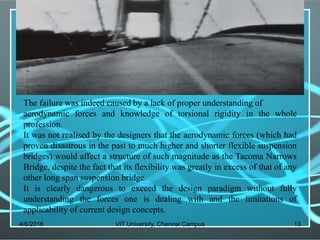
The failure was indeed caused by a lack of proper understanding of
aerodynamic forces and knowledge of torsional rigidity in the whole
profession.
It was not realised by the designers that the aerodynamic forces (which had
proven disastrous in the past to much higher and shorter flexible suspension
bridges) would affect a structure of such magnitude as the Tacoma Narrows
Bridge, despite the fact that its flexibility was greatly in excess of that of any
other long span suspension bridge.
It is clearly dangerous to exceed the design paradigm without fully
understanding the forces one is dealing with and the limitations of
applicability of current design concepts.
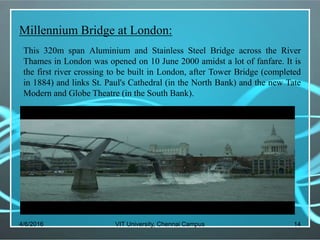
Millennium Bridge at London:
4/6/2016 VIT University, Chennai Campus 14
This 320m span Aluminium and Stainless Steel Bridge across the River
Thames in London was opened on 10 June 2000 amidst a lot of fanfare. It is
the first river crossing to be built in London, after Tower Bridge (completed
in 1884) and links St. Paul's Cathedral (in the North Bank) and the new Tate
Modern and Globe Theatre (in the South Bank).
4/6/2016 VIT University, Chennai Campus 15
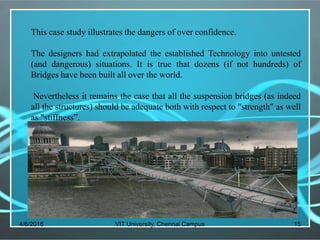
This case study illustrates the dangers of over confidence.
The designers had extrapolated the established Technology into untested
(and dangerous) situations. It is true that dozens (if not hundreds) of
Bridges have been built all over the world.
Nevertheless it remains the case that all the suspension bridges (as indeed
all the structures) should be adequate both with respect to "strength" as well
as "stiffness”.
4/6/2016 VIT University, Chennai Campus 16
DESIGN INADEQUACY
Cleddau Bridge, Milford Haven, (UK):
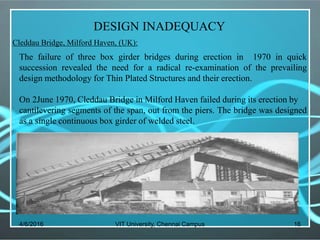
The failure of three box girder bridges during erection in 1970 in quick
succession revealed the need for a radical re-examination of the prevailing
design methodology for Thin Plated Structures and their erection.
On 2June 1970, Cleddau Bridge in Milford Haven failed during its erection by
cantilevering segments of the span, out from the piers. The bridge was designed
as a single continuous box girder of welded steel.
4/6/2016 VIT University, Chennai Campus 17
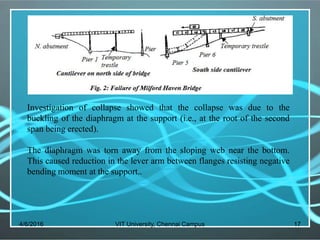
Investigation of collapse showed that the collapse was due to the
buckling of the diaphragm at the support (i.e., at the root of the second
span being erected).
The diaphragm was torn away from the sloping web near the bottom.
This caused reduction in the lever arm between flanges resisting negative
bending moment at the support..
4/6/2016 VIT University, Chennai Campus 18
POOR DETAILING
King's Bridge, Melbourne:
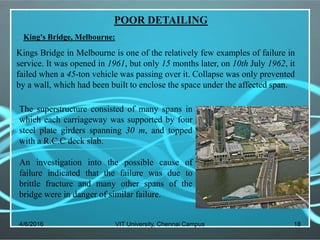
Kings Bridge in Melbourne is one of the relatively few examples of failure in
service. It was opened in 1961, but only 15 months later, on 10th July 1962, it
failed when a 45-ton vehicle was passing over it. Collapse was only prevented
by a wall, which had been built to enclose the space under the affected span.
The superstructure consisted of many spans in
which each carriageway was supported by four
steel plate girders spanning 30 m, and topped
with a R.C.C deck slab.
An investigation into the possible cause of
failure indicated that the failure was due to
brittle fracture and many other spans of the
bridge were in danger of similar failure.
4/6/2016 VIT University, Chennai Campus 19
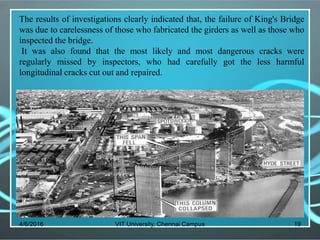
The results of investigations clearly indicated that, the failure of King's Bridge
was due to carelessness of those who fabricated the girders as well as those who
inspected the bridge.
It was also found that the most likely and most dangerous cracks were
regularly missed by inspectors, who had carefully got the less harmful
longitudinal cracks cut out and repaired.
4/6/2016 VIT University, Chennai Campus 20
INDIAN EXPERIENCE
Improper design leads to heavy restoration
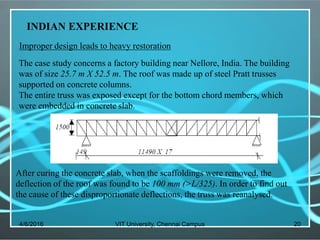
The case study concerns a factory building near Nellore, India. The building
was of size 25.7 m X 52.5 m. The roof was made up of steel Pratt trusses
supported on concrete columns.
The entire truss was exposed except for the bottom chord members, which
were embedded in concrete slab.
After curing the concrete slab, when the scaffoldings were removed, the
deflection of the roof was found to be 100 mm (>L/325). In order to find out
the cause of these disproportionate deflections, the truss was reanalysed.
4/6/2016 VIT University, Chennai Campus 21
From the analysis, it was found that most of the members of the roof truss
were not safe. After performing several analyses, it was concluded that in
the original design, the designer might have miscalculated the loads.
In India, industrial buildings were normally covered by asbestos cement
sheetings. Hence the original designer of the truss, due to his inexperience,
might have considered the truss to support Asbestos sheeting, instead of
heavier concrete slab.
Restoration of a factory building
A factory building located at about 100 km from Bombay collapsed during a
windstorm in 1994. The building was built using cold-formed channel
members.
The structure was provided with column bracings in every sixth bay.
However no gable end bracings were provided. Extra columns were
provided at the gable end to support the cladding.
4/6/2016 VIT University, Chennai Campus 22
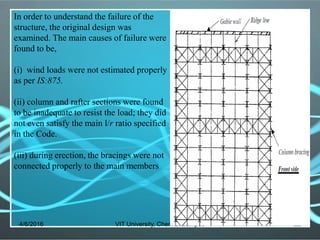
In order to understand the failure of the
structure, the original design was
examined. The main causes of failure were
found to be,
(i) wind loads were not estimated properly
as per IS:875.
(ii) column and rafter sections were found
to be inadequate to resist the load; they did
not even satisfy the main l/r ratio specified
in the Code.
(iii) during erection, the bracings were not
connected properly to the main members
4/6/2016 VIT University, Chennai Campus 23
REFERENCES
1. Petroski, H. “ Failure as a Source of Engineering Judgement: Case of John
Roebling”, Journal of Performance of Constructed Facilities, ASCE, vol 7, n2, Feb.
1993, 46-58.
2. Kagan, H. A., “ Common Causes of Collapse of Metal-Plate-Connected Wood Roof
Trusses”, Journal of Performance of Constructed Facilities, vol. 7, n4, Nov, 1993, pp.
225-233.LEARNING FROM FAILURES: CASE STUDIESVersion II 42 - {PAGE }
3. Morgenstern, J., “ The Fifty- Nine-Story Crisis”, Journal of Professional issues in
Engineering Education and Practice, vol. 123, n1, Jan.,19 97, pp. 23-29.
4. Delatte, N. J., “ Failure Case Studies and Ethics in Engineering mechanics Courses”,
Journal of Professional issues in Engineering Education and Practice, vol. 123, n1,
Jan.,1997, pp. 111-116.
6. Dias, W. P. S., “ Structural Failures and Design Philosophy”, The Structural
Engineer, vol. 72, n2, 18 Jan., 1994, pp. 25-29.
7. Petroski, H., “ Case Histories and the Study of Structural Failures”, Structural
Engineering International, April 1995, pp. 250-254.
9. Subramaniam, N., “ Rehabilitation of Steel Structures- Some Case Studies”,
Advanced Course on “ Design of Steel Skeletal Structures”, Dec 16-18, 1998, SERC,
4/6/2016 VIT University, Chennai Campus 24

Construction errors and their case studies

  • 1.
  • 2.
    Introduction • Construction andengineering practitioners have found it increasingly difficult to learn from their mistakes, particularly with regard to the prevention, identification and/or containment of design errors. • Design errors have been the root cause of numerous catastrophic accidents that have resulted in the death injury of workers and members of the public. • The classification of design errors provides the foundations to consider the appropriateness of strategies to contain and mitigate errors. 4/6/2016 VIT University, Chennai Campus 2
  • 3.
    • The enhancedfunctional requirements of such buildings have continued to challenge the designers and technological pressures have continued to grow. • Accidents prevention has become increasingly important aspect which could be a major cause of concern in the construction industry • Therefore we have to give some effort to identify and explore possible ways of preventing and controlling accidents should be sought after, • Hence we have to learn from these case study. 4/6/2016 VIT University, Chennai Campus 3
  • 4.
    4/6/2016 VIT University,Chennai Campus 4
  • 5.
    Construction Architectural Concept Consultation with Parties No Accordingto Requirements Yes Construction Inspection Structural Design Design of Services Design of Safety Systems According to IS code No Yes Acceptance
  • 6.
    The Cost ofError Construction Acceptance DesignArchitecture $ $1 $2 $ Unlimited
  • 7.
    Types of BuildingConstruction • Most building codes have 5 types of building construction. • Types :  Fire Resistive Construction  Non combustible Construction  Ordinary Construction  Heavy Timber  Frame Construction 4/6/2016 VIT University, Chennai Campus 7
  • 8.
    4/6/2016 VIT University,Chennai Campus 8
  • 9.
    4/6/2016 VIT University,Chennai Campus 9 Some structural failures are caused due to: (1)Poor communication between the various design professionals involved, e.g.: engineers involved in conceptual design and those involved in the supervision of execution of works. (2)Poor communication between the fabricators and erectors. . (3)Bad workmanship, which is often the result of failure to communicate the design decisions to the persons, involved in executing them. (4) Compromises in professional ethics and failure to appreciate the responsibility of the profession to the community at large could also result in catastrophic failures
  • 10.
    4/6/2016 VIT University,Chennai Campus 10 Common causes of structural failure are below:  lack of appropriate professional design and construction experience, especially when novel structures are needed. complexity of codes and specifications leading to misinterpretation and misapplication. unwarranted belief in calculations and in specified extreme loads and properties. inadequate preparation and review of contract and shop drawings. poor training of field inspectors. compressed design and/or construction time.
  • 11.
    Case studies  Poorconceptual design  Design inadequacy  Poor detailing  Poor judgement  Indian experience case studies
  • 12.
    POOR CONCEPTUAL DESIGN 4/6/2016VIT University, Chennai Campus 12 Tacoma Narrows Bridge: • The destruction of the Tacoma Narrows Bridge by aerodynamic forces subsequently revolutionised the thinking of structural engineers, on how wind loading could affect large slender structures. • In 1940, Tacoma Narrows Bridge was opened across Tacoma Narrows in Washington State. • On Nov 7, 1940, with a wind speed of about 60 km/h(well below the design wind speed), the bridge began twisting and oscillating violently. As a result the tie down cables intended to stiffen the bridge snapped, causing the entire structure to crash into the river below.
  • 13.
    4/6/2016 VIT University,Chennai Campus 13 The failure was indeed caused by a lack of proper understanding of aerodynamic forces and knowledge of torsional rigidity in the whole profession. It was not realised by the designers that the aerodynamic forces (which had proven disastrous in the past to much higher and shorter flexible suspension bridges) would affect a structure of such magnitude as the Tacoma Narrows Bridge, despite the fact that its flexibility was greatly in excess of that of any other long span suspension bridge. It is clearly dangerous to exceed the design paradigm without fully understanding the forces one is dealing with and the limitations of applicability of current design concepts.
  • 14.
    Millennium Bridge atLondon: 4/6/2016 VIT University, Chennai Campus 14 This 320m span Aluminium and Stainless Steel Bridge across the River Thames in London was opened on 10 June 2000 amidst a lot of fanfare. It is the first river crossing to be built in London, after Tower Bridge (completed in 1884) and links St. Paul's Cathedral (in the North Bank) and the new Tate Modern and Globe Theatre (in the South Bank).
  • 15.
    4/6/2016 VIT University,Chennai Campus 15 This case study illustrates the dangers of over confidence. The designers had extrapolated the established Technology into untested (and dangerous) situations. It is true that dozens (if not hundreds) of Bridges have been built all over the world. Nevertheless it remains the case that all the suspension bridges (as indeed all the structures) should be adequate both with respect to "strength" as well as "stiffness”.
  • 16.
    4/6/2016 VIT University,Chennai Campus 16 DESIGN INADEQUACY Cleddau Bridge, Milford Haven, (UK): The failure of three box girder bridges during erection in 1970 in quick succession revealed the need for a radical re-examination of the prevailing design methodology for Thin Plated Structures and their erection. On 2June 1970, Cleddau Bridge in Milford Haven failed during its erection by cantilevering segments of the span, out from the piers. The bridge was designed as a single continuous box girder of welded steel.
  • 17.
    4/6/2016 VIT University,Chennai Campus 17 Investigation of collapse showed that the collapse was due to the buckling of the diaphragm at the support (i.e., at the root of the second span being erected). The diaphragm was torn away from the sloping web near the bottom. This caused reduction in the lever arm between flanges resisting negative bending moment at the support..
  • 18.
    4/6/2016 VIT University,Chennai Campus 18 POOR DETAILING King's Bridge, Melbourne: Kings Bridge in Melbourne is one of the relatively few examples of failure in service. It was opened in 1961, but only 15 months later, on 10th July 1962, it failed when a 45-ton vehicle was passing over it. Collapse was only prevented by a wall, which had been built to enclose the space under the affected span. The superstructure consisted of many spans in which each carriageway was supported by four steel plate girders spanning 30 m, and topped with a R.C.C deck slab. An investigation into the possible cause of failure indicated that the failure was due to brittle fracture and many other spans of the bridge were in danger of similar failure.
  • 19.
    4/6/2016 VIT University,Chennai Campus 19 The results of investigations clearly indicated that, the failure of King's Bridge was due to carelessness of those who fabricated the girders as well as those who inspected the bridge. It was also found that the most likely and most dangerous cracks were regularly missed by inspectors, who had carefully got the less harmful longitudinal cracks cut out and repaired.
  • 20.
    4/6/2016 VIT University,Chennai Campus 20 INDIAN EXPERIENCE Improper design leads to heavy restoration The case study concerns a factory building near Nellore, India. The building was of size 25.7 m X 52.5 m. The roof was made up of steel Pratt trusses supported on concrete columns. The entire truss was exposed except for the bottom chord members, which were embedded in concrete slab. After curing the concrete slab, when the scaffoldings were removed, the deflection of the roof was found to be 100 mm (>L/325). In order to find out the cause of these disproportionate deflections, the truss was reanalysed.
  • 21.
    4/6/2016 VIT University,Chennai Campus 21 From the analysis, it was found that most of the members of the roof truss were not safe. After performing several analyses, it was concluded that in the original design, the designer might have miscalculated the loads. In India, industrial buildings were normally covered by asbestos cement sheetings. Hence the original designer of the truss, due to his inexperience, might have considered the truss to support Asbestos sheeting, instead of heavier concrete slab. Restoration of a factory building A factory building located at about 100 km from Bombay collapsed during a windstorm in 1994. The building was built using cold-formed channel members. The structure was provided with column bracings in every sixth bay. However no gable end bracings were provided. Extra columns were provided at the gable end to support the cladding.
  • 22.
    4/6/2016 VIT University,Chennai Campus 22 In order to understand the failure of the structure, the original design was examined. The main causes of failure were found to be, (i) wind loads were not estimated properly as per IS:875. (ii) column and rafter sections were found to be inadequate to resist the load; they did not even satisfy the main l/r ratio specified in the Code. (iii) during erection, the bracings were not connected properly to the main members
  • 23.
    4/6/2016 VIT University,Chennai Campus 23 REFERENCES 1. Petroski, H. “ Failure as a Source of Engineering Judgement: Case of John Roebling”, Journal of Performance of Constructed Facilities, ASCE, vol 7, n2, Feb. 1993, 46-58. 2. Kagan, H. A., “ Common Causes of Collapse of Metal-Plate-Connected Wood Roof Trusses”, Journal of Performance of Constructed Facilities, vol. 7, n4, Nov, 1993, pp. 225-233.LEARNING FROM FAILURES: CASE STUDIESVersion II 42 - {PAGE } 3. Morgenstern, J., “ The Fifty- Nine-Story Crisis”, Journal of Professional issues in Engineering Education and Practice, vol. 123, n1, Jan.,19 97, pp. 23-29. 4. Delatte, N. J., “ Failure Case Studies and Ethics in Engineering mechanics Courses”, Journal of Professional issues in Engineering Education and Practice, vol. 123, n1, Jan.,1997, pp. 111-116. 6. Dias, W. P. S., “ Structural Failures and Design Philosophy”, The Structural Engineer, vol. 72, n2, 18 Jan., 1994, pp. 25-29. 7. Petroski, H., “ Case Histories and the Study of Structural Failures”, Structural Engineering International, April 1995, pp. 250-254. 9. Subramaniam, N., “ Rehabilitation of Steel Structures- Some Case Studies”, Advanced Course on “ Design of Steel Skeletal Structures”, Dec 16-18, 1998, SERC,
  • 24.
    4/6/2016 VIT University,Chennai Campus 24