POST POLIO RESIDUAL
PALSY
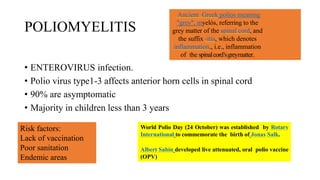
POLIOMYELITIS
• ENTEROVIRUS infection.
• Polio virus type1-3 affects anterior horn cells in spinal cord
• 90% are asymptomatic
• Majority in children less than 3 years
Risk factors:
Lack of vaccination
Poor sanitation
Endemic areas
Ancient Greek polios meaning
"grey", myelós, referring to the
grey matter of the spinal cord, and
the suffix -itis, which denotes
inflammation., i.e., inflammation
of the spinalcord’sgreymatter.
World Polio Day (24 October) was established by Rotary
International to commemorate the birth of Jonas Salk.
Albert Sabin developed live attenuated, oral polio vaccine
(OPV)
PATHOGENESIS
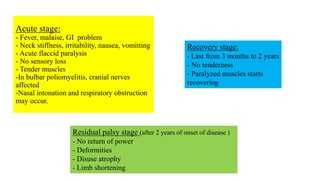
Acute stage:
- Fever, malaise, GI problem
- Neck stiffness, irritability, nausea, vomitting
- Acute flaccid paralysis
- No sensory loss
- Tender muscles
-In bulbar poliomyelitis, cranial nerves
affected
-Nasal intonation and respiratory obstruction
may occur.
Recovery stage:
- Last from 3 months to 2 years
- No tenderness
- Paralyzed muscles starts
recovering
Residual palsy stage (after 2 years of onset of disease )
- No return of power
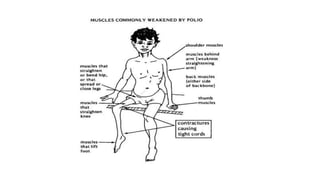
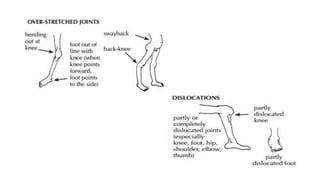
- Deformities
- Disuse atrophy
- Limb shortening
Why Progressive deformities in residual
phase ???
• Inaccessibility to medical care to majority of childrens have
led to large number of people with moderate to severe
deformities.
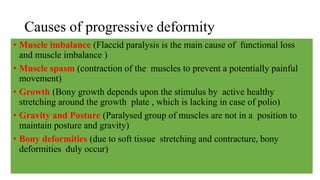
Causes of progressive deformity
• Muscle imbalance (Flaccid paralysis is the main cause of functional loss
and muscle imbalance )
• Muscle spasm (contraction of the muscles to prevent a potentially painful
movement)
• Growth (Bony growth depends upon the stimulus by active healthy
stretching around the growth plate , which is lacking in case of polio)
• Gravity and Posture (Paralysed group of muscles are not in a position to
maintain posture and gravity)
• Bony deformities (due to soft tissue stretching and contracture, bony
deformities duly occur)
Clinical assessment of a Polio Patient
Considerations:
Residual muscle power
Age of the patient
Severity of the deformities
Ambulatory status (GAIT)
Socioeconomic background
Radiographic examinations of the
joints are essential, both weight bearing
and non-weight bearing to know the
status of the joints (subluxation or
dislocation, stability of the joints )
Management
• To attain maximal recovery in individual muscles.
• Restoration and maintainence of normal range of joint motion
• Prevention of deformities
• Achievement of as good a physiological status of the
neuromusculoskeletal system
• PHYSICAL THERAPY
• SURGICAL TREATMENT
Principles in management
• Strengthening of the unaffected muscles, stretching of the shortened
muscles.
• Range of motion exercises of joints
• Appropriate use of orthosis and splints, gait and walking aids.
• Restoring muscle balance by tendon transfers.
• Adequate compensation for equalizing the leg length by modification in
the footwear.
• Stabilization of the joints by bony blocks/arthrodesis and soft tissue
plications.
• Limb length equalization by limb lengthening/ shortening.
Physical therapy
Stretching exercises and functional training:
• Increasing motor strength of muscle by active hypertrophy excercises.
• Preventing or correcting deformity by passive stretching.
• Achieve maximum functional activity.
Orthosis
• Support the patient and enable the patient to walk and increase
functional activity,
• Protect a weak muscle from overstretching,
• Prevent deformity and malposition
• Correct deformity by stretching certain groups of muscles that have
been contracted.
Surgical management
SOFT TISSUE PROCEDURE: (Improve muscle balance)
• Fasciotomy
• Capsulotomy
• Tendon transfers
BONY PROCEDURES:
• Osteotomies (to correct established deformities )
• Arthrodesis (Joint stabilisation)
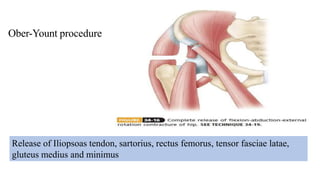
Ober-Yount procedure
Release of Iliopsoas tendon, sartorius, rectus femorus, tensor fasciae latae,
gluteus medius and minimus
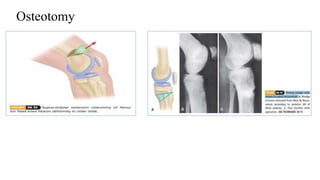
Osteotomy
Lloyd roberts technique of IT
oblique osteotomy
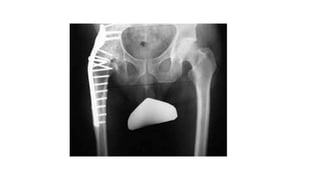
Osteotomy
Foot deformities
• Ankle fusion
• Hind foot lengthening
• Calcaneus deformity
• Triple arthrodesis
Thank you

Poliomyelitis

  • 1.
  • 2.
    POLIOMYELITIS • ENTEROVIRUS infection. •Polio virus type1-3 affects anterior horn cells in spinal cord • 90% are asymptomatic • Majority in children less than 3 years Risk factors: Lack of vaccination Poor sanitation Endemic areas Ancient Greek polios meaning "grey", myelós, referring to the grey matter of the spinal cord, and the suffix -itis, which denotes inflammation., i.e., inflammation of the spinalcord’sgreymatter. World Polio Day (24 October) was established by Rotary International to commemorate the birth of Jonas Salk. Albert Sabin developed live attenuated, oral polio vaccine (OPV)
  • 3.
  • 4.
    Acute stage: - Fever,malaise, GI problem - Neck stiffness, irritability, nausea, vomitting - Acute flaccid paralysis - No sensory loss - Tender muscles -In bulbar poliomyelitis, cranial nerves affected -Nasal intonation and respiratory obstruction may occur. Recovery stage: - Last from 3 months to 2 years - No tenderness - Paralyzed muscles starts recovering Residual palsy stage (after 2 years of onset of disease ) - No return of power - Deformities - Disuse atrophy - Limb shortening
  • 6.
    Why Progressive deformitiesin residual phase ??? • Inaccessibility to medical care to majority of childrens have led to large number of people with moderate to severe deformities.
  • 7.
    Causes of progressivedeformity • Muscle imbalance (Flaccid paralysis is the main cause of functional loss and muscle imbalance ) • Muscle spasm (contraction of the muscles to prevent a potentially painful movement) • Growth (Bony growth depends upon the stimulus by active healthy stretching around the growth plate , which is lacking in case of polio) • Gravity and Posture (Paralysed group of muscles are not in a position to maintain posture and gravity) • Bony deformities (due to soft tissue stretching and contracture, bony deformities duly occur)
  • 11.
    Clinical assessment ofa Polio Patient Considerations: Residual muscle power Age of the patient Severity of the deformities Ambulatory status (GAIT) Socioeconomic background Radiographic examinations of the joints are essential, both weight bearing and non-weight bearing to know the status of the joints (subluxation or dislocation, stability of the joints )
  • 12.
    Management • To attainmaximal recovery in individual muscles. • Restoration and maintainence of normal range of joint motion • Prevention of deformities • Achievement of as good a physiological status of the neuromusculoskeletal system • PHYSICAL THERAPY • SURGICAL TREATMENT
  • 13.
    Principles in management •Strengthening of the unaffected muscles, stretching of the shortened muscles. • Range of motion exercises of joints • Appropriate use of orthosis and splints, gait and walking aids. • Restoring muscle balance by tendon transfers. • Adequate compensation for equalizing the leg length by modification in the footwear. • Stabilization of the joints by bony blocks/arthrodesis and soft tissue plications. • Limb length equalization by limb lengthening/ shortening.
  • 14.
    Physical therapy Stretching exercisesand functional training: • Increasing motor strength of muscle by active hypertrophy excercises. • Preventing or correcting deformity by passive stretching. • Achieve maximum functional activity.
  • 15.
    Orthosis • Support thepatient and enable the patient to walk and increase functional activity, • Protect a weak muscle from overstretching, • Prevent deformity and malposition • Correct deformity by stretching certain groups of muscles that have been contracted.
  • 17.
    Surgical management SOFT TISSUEPROCEDURE: (Improve muscle balance) • Fasciotomy • Capsulotomy • Tendon transfers BONY PROCEDURES: • Osteotomies (to correct established deformities ) • Arthrodesis (Joint stabilisation)
  • 18.
    Ober-Yount procedure Release ofIliopsoas tendon, sartorius, rectus femorus, tensor fasciae latae, gluteus medius and minimus
  • 19.
    Osteotomy Lloyd roberts techniqueof IT oblique osteotomy
  • 20.
  • 22.
    Foot deformities • Anklefusion • Hind foot lengthening • Calcaneus deformity • Triple arthrodesis
  • 24.