POLIOMYELITIS
Submitted by – Group 1
Jeney Narzary
Neetu Bargayary
Puja Moorthy Basumartary
Inimika Boro
INTRODUCTION
Defintion –
Poliomyelitis is an infectious disease affecting the spinal cord and is epidemic and
endemic in nature.
It is commonly called “polio” and is caused by poliovirus.
Epidemiology –
• 10 million cases worldwide
• Common in warmer temperature countries
• More common in children
CAUSES
• The causative organism of poliomyelitis is an enterovirus, it primarily
attacks and destroys the anterior horn cells.
• There are 3 serotypes PV 1, 2, and 3.
• The predominant age group affected is children between the ages of
1-4 years, but theroretically no age is immune.
CLINICAL FEATURES
1) Preparalytic stage (1-3 days) –
• It is a prodormal stage
• Children and young adults are most commonly affected
• Sudden onset with fever and headache
• Stiffness of neck with pain in the back are the early symptoms
• Sore throat, cough and diarrhoea
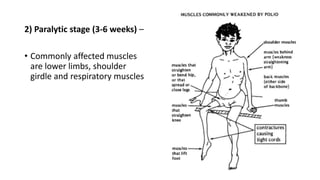
2) Paralytic stage (3-6 weeks) –
• Commonly affected muscles
are lower limbs, shoulder
girdle and respiratory muscles
• Pain in the affected limbs usually present with tenderness
• Child prefers sleeping position and cannot tolerate any change in the
position
• Deep tendon reflexes are lost
• Muscle wasting is prominent
• Pharyngeal paralysis leads to difficulty in swallowing, choking and
asphyxia
3) Convalescent stage (3 months) –
• It is the stage where there is true or actual paralysis
• The effects of these lesions can be described are –
 Spinal – Symmetrical flaccid paralysis
 Contractions and deformities are common due to gross muscular imbalance
DIAGNOSIS
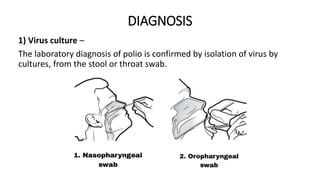
1) Virus culture –
The laboratory diagnosis of polio is confirmed by isolation of virus by
cultures, from the stool or throat swab.
2) Serologic test –
Acute and convalescent serum sample may be tested for rise in antibody titer
(antibodies to the poliovirus).
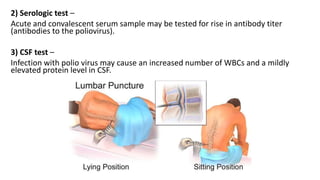
3) CSF test –
Infection with polio virus may cause an increased number of WBCs and a mildly
elevated protein level in CSF.
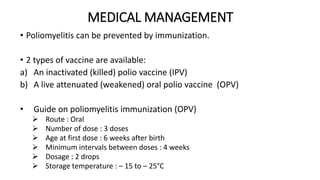
MEDICAL MANAGEMENT
• Poliomyelitis can be prevented by immunization.
• 2 types of vaccine are available:
a) An inactivated (killed) polio vaccine (IPV)
b) A live attenuated (weakened) oral polio vaccine (OPV)
• Guide on poliomyelitis immunization (OPV)
 Route : Oral
 Number of dose : 3 doses
 Age at first dose : 6 weeks after birth
 Minimum intervals between doses : 4 weeks
 Dosage : 2 drops
 Storage temperature : – 15 to – 25°C
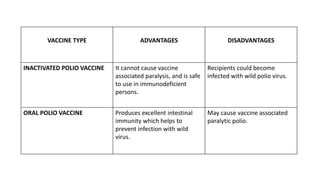
VACCINE TYPE ADVANTAGES DISADVANTAGES
INACTIVATED POLIO VACCINE It cannot cause vaccine
associated paralysis, and is safe
to use in immunodeficient
persons.
Recipients could become
infected with wild polio virus.
ORAL POLIO VACCINE Produces excellent intestinal
immunity which helps to
prevent infection with wild
virus.
May cause vaccine associated
paralytic polio.
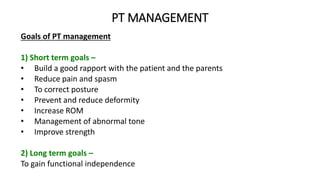
PT MANAGEMENT
Goals of PT management
1) Short term goals –
• Build a good rapport with the patient and the parents
• Reduce pain and spasm
• To correct posture
• Prevent and reduce deformity
• Increase ROM
• Management of abnormal tone
• Improve strength
2) Long term goals –
To gain functional independence
PT Management
1. Management in acute illness (4 weeks)
2 stages – (i) Preparalytic stage and (ii) Paralytic stage
1.1. Management in preparalytic stage
• Application of moist heat to the painful areas which should be
repeated in every 2-4 hours until the pain and spasm decreases
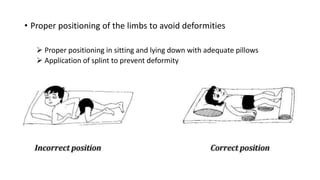
• Proper positioning of the limbs to avoid deformities
 Proper positioning in sitting and lying down with adequate pillows
 Application of splint to prevent deformity
• Proper ROM should be given every day to the affected limbs
• Educating the caregiver and the child to do normal activities such as
rolling, crawling, standing, playing and feeding himself/herself.
1.2. Management in paralytic stage
• When the paralysis of muscles take place the pain decreases
• During the period of 2-3 days the family members takes care of the
child in the following ways:
a) Continue to position the child’s body and limbs correctly
b) Continue to apply warm clothes as there is pain and spasm in the
muscles
c) As soon as the tenderness decreases the limbs should be moved
gently to their full ROM everyday either actively or passively
d) During this phase avoid surgical procedure, trauma and injection.
2. Management in recovery phase
• This phase begins 3 weeks after the acute illness & can last for 2 years.
• It is divided into 2 phases :
i. Early convalescence
ii. Late convalescence
2.1 Management in early convalescence (6 months)
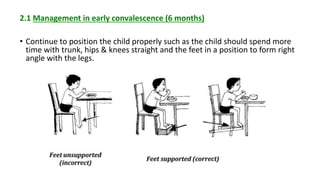
• Continue to position the child properly such as the child should spend more
time with trunk, hips & knees straight and the feet in a position to form right
angle with the legs.
• During night child should lie in supine or prone on a firm mattress.
• During day time the child can lie down with straightened hips & knees for a
short periods.
• Gentle ROM exercise to the limb either actively or passively as soon as the
pain subsided.
• If the child has muscle tightness, hold relax technique could be used.
• All the ROM exercises to all the limbs should be done eg. Flexion-extension,
abduction-adduction.
2.2 Management in late convalescence (2-6 years)
• In this phase resistive exercises are given to improve the strength with
the use of springs, sandbags, weight or dumbbells.
• Aerobic activities such as swimming , fast walking etc are given to
improve functional activities.
3. Management in residual phase (1 year – 18 months)
• The main aims of the PT management in this phase is to prevent
deformities and to promote child’s development.
• Special care should be taken –
a) Proper positioning of the body and limbs.
b) ROM exercises.
c) Encourage the child to do which are normal for his/her age group such
as self-care, play, helping in home activities and going to school.
d) Use of correct brace and splints to prevent deformities and
contractures.
e) Encourage the child in social activities.
4. Pre and Post-operative PT management for poliomyelitis
• Treatment of PT will depend on the surgical procedures.
• There are mainly three types of surgical procedures used to treat
poliomyelitis
a) Tendon transplantation.
b) Release of contracture.
c) Arthrodesis.
A) Pre-operative PT management
• Full ROM exercises to the affected joint.
• Isometric exercise and resistance exercise to the muscle which is
going to be transplanted.
• Adequate training program to the selected muscle for transplant.
• Proper strengthening of synergist muscle.
• Proper positioning of the limb to be operated.
B) Post-operative PT management
• Gentle PROM exercises followed by assisted exercises.
• Re-education by biofeedback and electrical stimulation.
• US or friction massage to mobilize the scar.
• Proper mobilization by doing passive stretching.
• Re-education and gait to avoid re-occurrence of contractures.
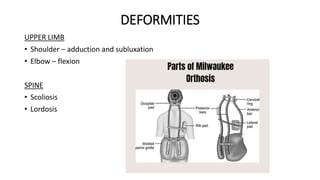
DEFORMITIES
UPPER LIMB
• Shoulder – adduction and subluxation
• Elbow – flexion
SPINE
• Scoliosis
• Lordosis
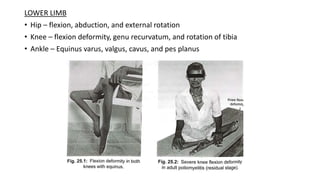
LOWER LIMB
• Hip – flexion, abduction, and external rotation
• Knee – flexion deformity, genu recurvatum, and rotation of tibia
• Ankle – Equinus varus, valgus, cavus, and pes planus
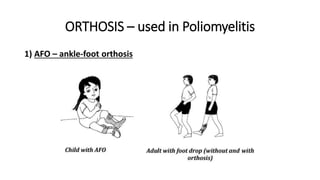
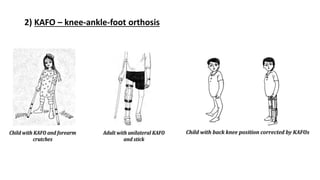
ORTHOSIS – used in Poliomyelitis
1) AFO – ankle-foot orthosis
2) KAFO – knee-ankle-foot orthosis
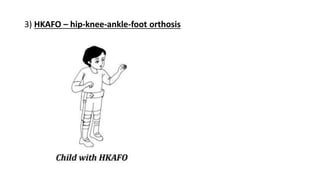
3) HKAFO – hip-knee-ankle-foot orthosis
Poliomyelitis.pptx

Poliomyelitis.pptx

  • 1.
    POLIOMYELITIS Submitted by –Group 1 Jeney Narzary Neetu Bargayary Puja Moorthy Basumartary Inimika Boro
  • 2.
    INTRODUCTION Defintion – Poliomyelitis isan infectious disease affecting the spinal cord and is epidemic and endemic in nature. It is commonly called “polio” and is caused by poliovirus. Epidemiology – • 10 million cases worldwide • Common in warmer temperature countries • More common in children
  • 3.
    CAUSES • The causativeorganism of poliomyelitis is an enterovirus, it primarily attacks and destroys the anterior horn cells. • There are 3 serotypes PV 1, 2, and 3. • The predominant age group affected is children between the ages of 1-4 years, but theroretically no age is immune.
  • 4.
    CLINICAL FEATURES 1) Preparalyticstage (1-3 days) – • It is a prodormal stage • Children and young adults are most commonly affected • Sudden onset with fever and headache • Stiffness of neck with pain in the back are the early symptoms • Sore throat, cough and diarrhoea
  • 5.
    2) Paralytic stage(3-6 weeks) – • Commonly affected muscles are lower limbs, shoulder girdle and respiratory muscles
  • 6.
    • Pain inthe affected limbs usually present with tenderness • Child prefers sleeping position and cannot tolerate any change in the position • Deep tendon reflexes are lost • Muscle wasting is prominent • Pharyngeal paralysis leads to difficulty in swallowing, choking and asphyxia
  • 7.
    3) Convalescent stage(3 months) – • It is the stage where there is true or actual paralysis • The effects of these lesions can be described are –  Spinal – Symmetrical flaccid paralysis  Contractions and deformities are common due to gross muscular imbalance
  • 8.
    DIAGNOSIS 1) Virus culture– The laboratory diagnosis of polio is confirmed by isolation of virus by cultures, from the stool or throat swab.
  • 9.
    2) Serologic test– Acute and convalescent serum sample may be tested for rise in antibody titer (antibodies to the poliovirus). 3) CSF test – Infection with polio virus may cause an increased number of WBCs and a mildly elevated protein level in CSF.
  • 10.
    MEDICAL MANAGEMENT • Poliomyelitiscan be prevented by immunization. • 2 types of vaccine are available: a) An inactivated (killed) polio vaccine (IPV) b) A live attenuated (weakened) oral polio vaccine (OPV) • Guide on poliomyelitis immunization (OPV)  Route : Oral  Number of dose : 3 doses  Age at first dose : 6 weeks after birth  Minimum intervals between doses : 4 weeks  Dosage : 2 drops  Storage temperature : – 15 to – 25°C
  • 11.
    VACCINE TYPE ADVANTAGESDISADVANTAGES INACTIVATED POLIO VACCINE It cannot cause vaccine associated paralysis, and is safe to use in immunodeficient persons. Recipients could become infected with wild polio virus. ORAL POLIO VACCINE Produces excellent intestinal immunity which helps to prevent infection with wild virus. May cause vaccine associated paralytic polio.
  • 12.
    PT MANAGEMENT Goals ofPT management 1) Short term goals – • Build a good rapport with the patient and the parents • Reduce pain and spasm • To correct posture • Prevent and reduce deformity • Increase ROM • Management of abnormal tone • Improve strength 2) Long term goals – To gain functional independence
  • 13.
    PT Management 1. Managementin acute illness (4 weeks) 2 stages – (i) Preparalytic stage and (ii) Paralytic stage 1.1. Management in preparalytic stage • Application of moist heat to the painful areas which should be repeated in every 2-4 hours until the pain and spasm decreases
  • 14.
    • Proper positioningof the limbs to avoid deformities  Proper positioning in sitting and lying down with adequate pillows  Application of splint to prevent deformity
  • 15.
    • Proper ROMshould be given every day to the affected limbs • Educating the caregiver and the child to do normal activities such as rolling, crawling, standing, playing and feeding himself/herself. 1.2. Management in paralytic stage • When the paralysis of muscles take place the pain decreases • During the period of 2-3 days the family members takes care of the child in the following ways:
  • 16.
    a) Continue toposition the child’s body and limbs correctly b) Continue to apply warm clothes as there is pain and spasm in the muscles c) As soon as the tenderness decreases the limbs should be moved gently to their full ROM everyday either actively or passively d) During this phase avoid surgical procedure, trauma and injection.
  • 17.
    2. Management inrecovery phase • This phase begins 3 weeks after the acute illness & can last for 2 years. • It is divided into 2 phases : i. Early convalescence ii. Late convalescence
  • 18.
    2.1 Management inearly convalescence (6 months) • Continue to position the child properly such as the child should spend more time with trunk, hips & knees straight and the feet in a position to form right angle with the legs.
  • 19.
    • During nightchild should lie in supine or prone on a firm mattress. • During day time the child can lie down with straightened hips & knees for a short periods. • Gentle ROM exercise to the limb either actively or passively as soon as the pain subsided. • If the child has muscle tightness, hold relax technique could be used. • All the ROM exercises to all the limbs should be done eg. Flexion-extension, abduction-adduction.
  • 20.
    2.2 Management inlate convalescence (2-6 years) • In this phase resistive exercises are given to improve the strength with the use of springs, sandbags, weight or dumbbells. • Aerobic activities such as swimming , fast walking etc are given to improve functional activities.
  • 21.
    3. Management inresidual phase (1 year – 18 months) • The main aims of the PT management in this phase is to prevent deformities and to promote child’s development. • Special care should be taken – a) Proper positioning of the body and limbs. b) ROM exercises. c) Encourage the child to do which are normal for his/her age group such as self-care, play, helping in home activities and going to school. d) Use of correct brace and splints to prevent deformities and contractures. e) Encourage the child in social activities.
  • 22.
    4. Pre andPost-operative PT management for poliomyelitis • Treatment of PT will depend on the surgical procedures. • There are mainly three types of surgical procedures used to treat poliomyelitis a) Tendon transplantation. b) Release of contracture. c) Arthrodesis.
  • 23.
    A) Pre-operative PTmanagement • Full ROM exercises to the affected joint. • Isometric exercise and resistance exercise to the muscle which is going to be transplanted. • Adequate training program to the selected muscle for transplant. • Proper strengthening of synergist muscle. • Proper positioning of the limb to be operated.
  • 24.
    B) Post-operative PTmanagement • Gentle PROM exercises followed by assisted exercises. • Re-education by biofeedback and electrical stimulation. • US or friction massage to mobilize the scar. • Proper mobilization by doing passive stretching. • Re-education and gait to avoid re-occurrence of contractures.
  • 25.
    DEFORMITIES UPPER LIMB • Shoulder– adduction and subluxation • Elbow – flexion SPINE • Scoliosis • Lordosis
  • 26.
    LOWER LIMB • Hip– flexion, abduction, and external rotation • Knee – flexion deformity, genu recurvatum, and rotation of tibia • Ankle – Equinus varus, valgus, cavus, and pes planus
  • 27.
    ORTHOSIS – usedin Poliomyelitis 1) AFO – ankle-foot orthosis
  • 28.
    2) KAFO –knee-ankle-foot orthosis
  • 29.
    3) HKAFO –hip-knee-ankle-foot orthosis