PRESENTATION ON
POLARISATION MAINTAINING FIBERS
UMANG RAMANI
Ph.D- I st sem
Department of Physics
IIT (BHU), VARANASI
POLARISATION
 Light is a type of electromagnetic wave. It consist of
oscillating electric and magnetic field. It’s properties can
be described by electric field although we can describe
it’s property by magnetic field.
 Unpolarized Light- A light in which electric vector of
vibration move in more then one direction is called
unpolarised light.
 Polarized Light- A light in which electric vector of
vibration move in a plane either parallel or perpendicular
to plane is called polarized light.
HOW TO ACHIEVE SINGLE PPOLARISATION
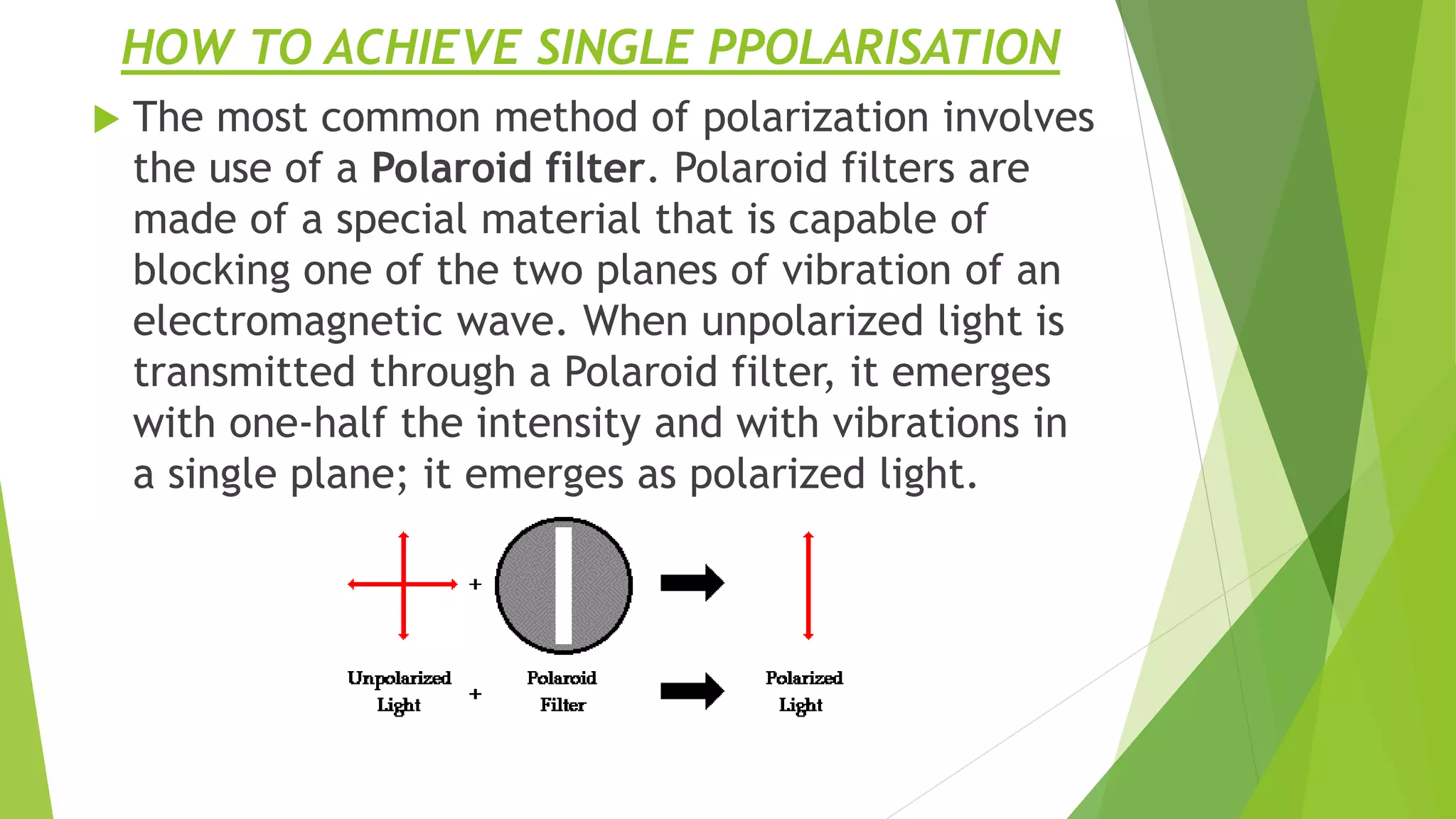
 The most common method of polarization involves
the use of a Polaroid filter. Polaroid filters are
made of a special material that is capable of
blocking one of the two planes of vibration of an
electromagnetic wave. When unpolarized light is
transmitted through a Polaroid filter, it emerges
with one-half the intensity and with vibrations in
a single plane; it emerges as polarized light.
POLARISATION MAINTAINING FIBER
HISTORY
 Before 1980, it was very difficult to use the polarization state in the
fiber, because of poor technology in controlling the polarization state in
the conventional single-mode fibers or the lack of available polarization-
maintaining fibers..
 After five years, the coherent optical-transmission systems proposed by
Okoshi and Yamamoto. Which were considered to be far future systems,
succeeded in transmitting over a distance of more than 200 km or at
gigabit rates.
 Also high-grade fiber sensors such as fiber-optic gyroscopes came to the
development stage. In all of these, systems control of the polarization
state is most important.
 Polarization-maintaining fibers are mainly classified into two categories,
Low-birefringent fibers and High-birefringent fibers.
BIREFRINGENCE
 Birefringence is the optical property of a material having
a refractive index that depends on the polarization and
propagation direction of light. The birefringence is often
quantified as the maximum difference between refractive
indices exhibited by the material.
 Birefringence is responsible for the phenomenon
of double refraction. When an unpolarized light is
incident on a birefringent material it is split into two
types of polarized rays one of these rays has polarization
in a direction perpendicular to the optical axis (ordinary
rays) and the other in the direction of the optical axis of
the medium (extraordinary rays).
HIGH BIREFRINGENT FIBER
 High-birefringent fibers where the linear
polarization state is forcedly maintained are
indispensable in coherent optical transmission
systems or polarization-dependent devices used in
an unstable environment or without a polarization
state controller. high-birefringent has the value of
B>10-5.
 In the HB fibers with B >10-5, there are two kinds
of fibers: Two-polarization fibers and Single-
polarization fibers. Two-polarization fibers are
conventionally called PM fibers.
• Single-polarization fibers have been successfully
demonstrated with bow-tie fibers , flat depressed-cladding
fibers and PANDA fibers utilizing the large difference of the
bending losses between the orthogonal modes.
• The crosstalk in the Single-polarization fiber becomes almost
constant, - 30 dB, and is independent of the fiber length
beyond 200 m, while the crosstalk in the Two-polarization
fiber degrades with fiber length due to the random mode
coupling.
 The internal birefringence of the HB fibers is produced by
the Geometrical effect of the core and the Stress effect
around the core.
 The optical losses of Geometrical effect types PM fibers
are generally high. The reason may be due to the large
refractive-index difference and imperfection of the core
shape.
 PM fibers with the Stress effect, called Stress-induced
birefringent fibers, such as Elliptical cladding fibers ,
PANDA fibers and BOW-tie fibers exhibit low optical
losses and low crosstalk by setting the buffer layer
between the core and the stress-applying parts.
POLARISATION MAINTAINING FIBER
• Polarization maintaining fiber (PM Fiber) is a special
type of single mode fiber.
• PM fiber faithfully preserve and transmit the
polarization state of the light that is launched into
it.
Polarization State in Fiber Optics
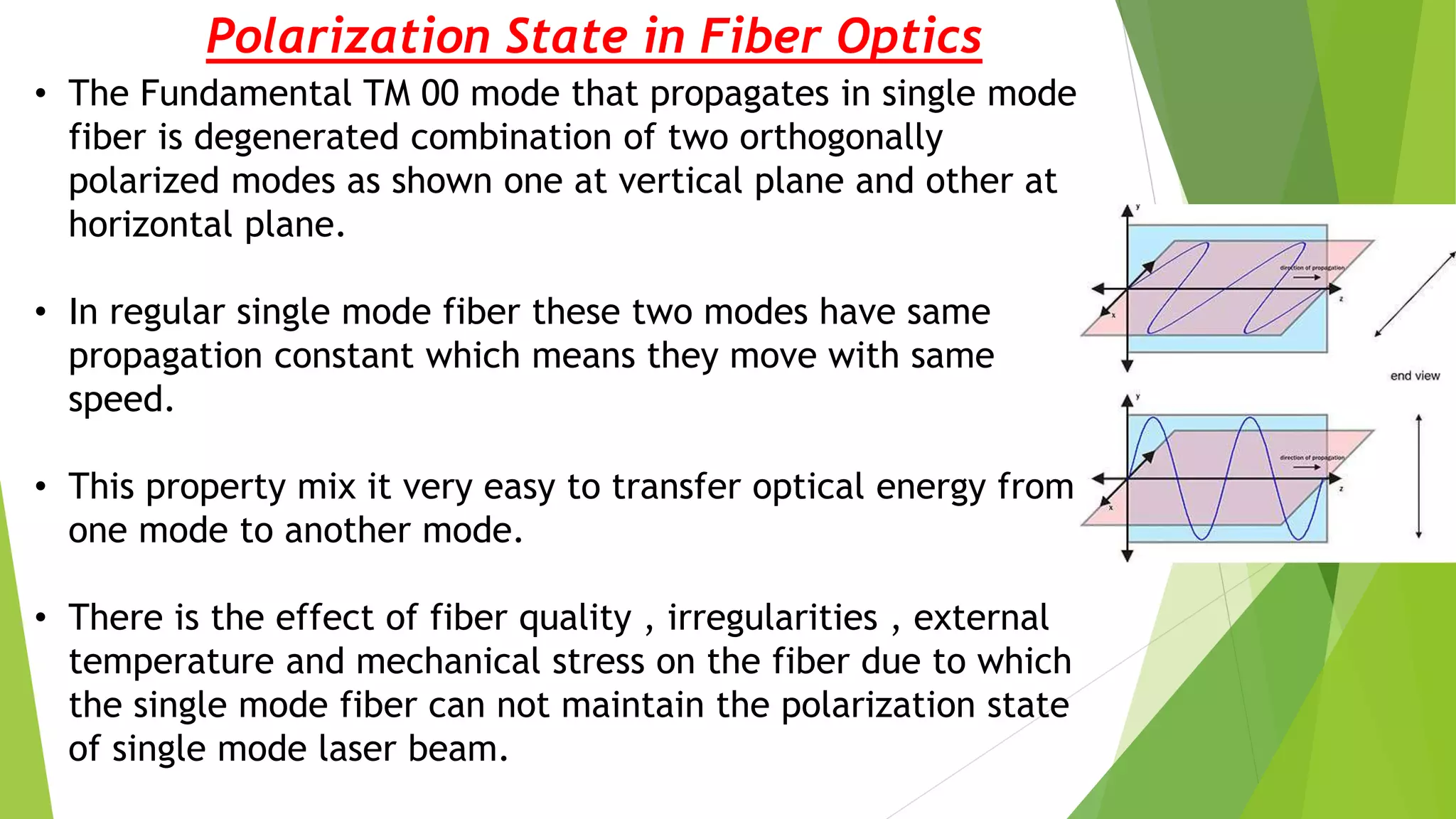
• The Fundamental TM 00 mode that propagates in single mode
fiber is degenerated combination of two orthogonally
polarized modes as shown one at vertical plane and other at
horizontal plane.
• In regular single mode fiber these two modes have same
propagation constant which means they move with same
speed.
• This property mix it very easy to transfer optical energy from
one mode to another mode.
• There is the effect of fiber quality , irregularities , external
temperature and mechanical stress on the fiber due to which
the single mode fiber can not maintain the polarization state
of single mode laser beam.
HOW PM FIBER WORKS
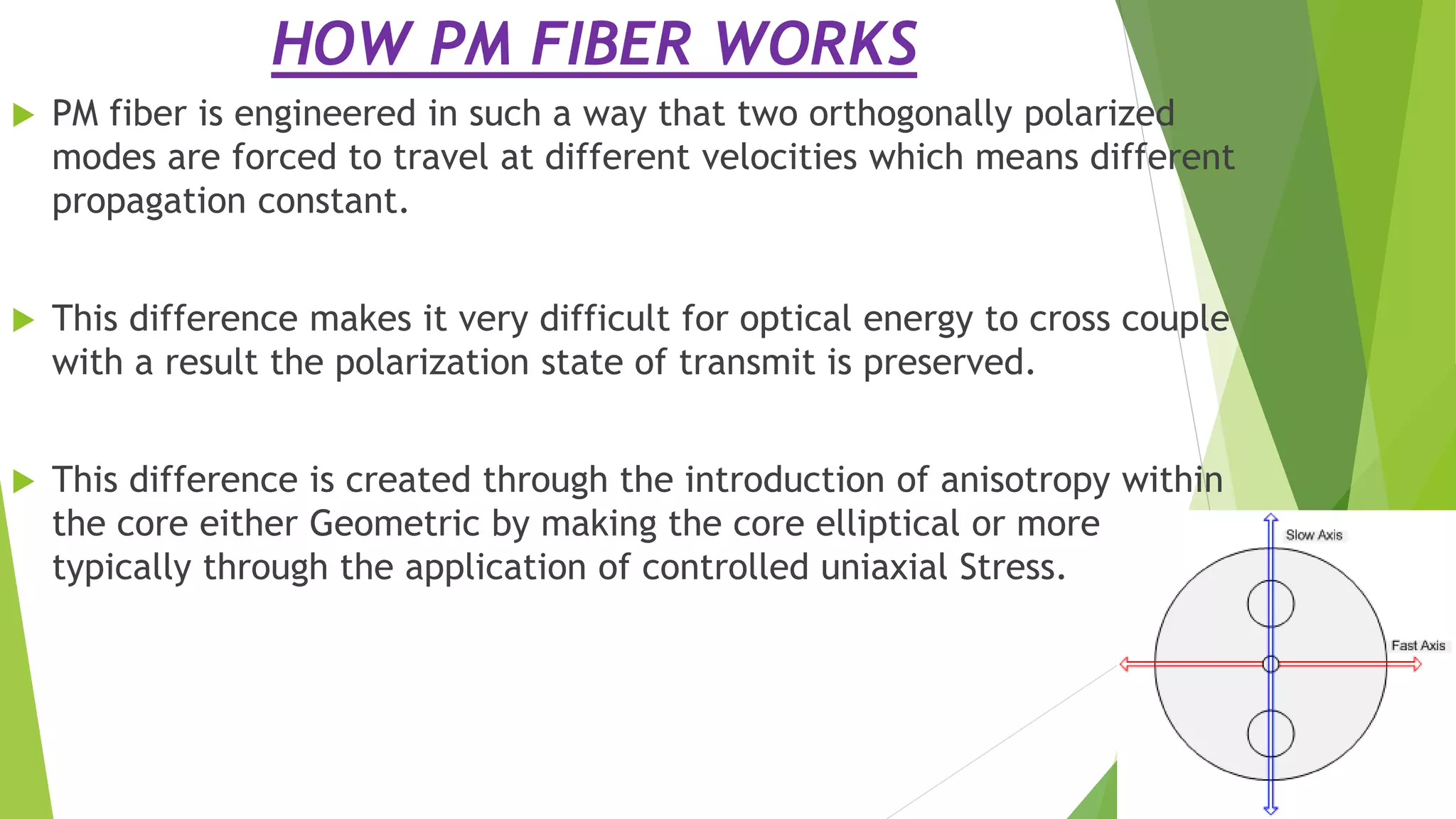
 PM fiber is engineered in such a way that two orthogonally polarized
modes are forced to travel at different velocities which means different
propagation constant.
 This difference makes it very difficult for optical energy to cross couple
with a result the polarization state of transmit is preserved.
 This difference is created through the introduction of anisotropy within
the core either Geometric by making the core elliptical or more
typically through the application of controlled uniaxial Stress.
PM Fibers Type
• The general approach to maintaining linear polarization in
single-mode fibers is to increase fiber birefringence so as to
reduce the power interchange between polarization modes.
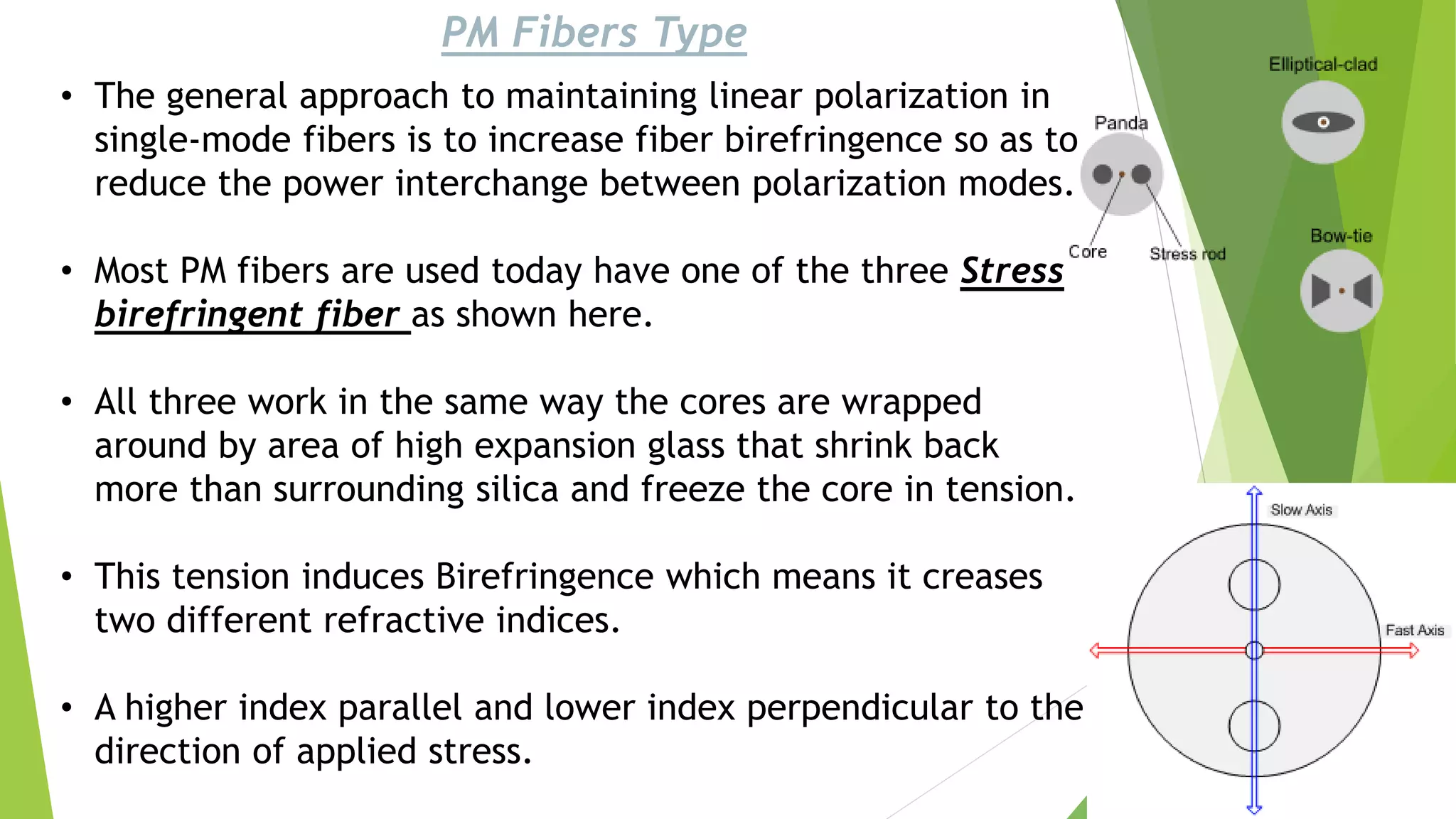
• Most PM fibers are used today have one of the three Stress
birefringent fiber as shown here.
• All three work in the same way the cores are wrapped
around by area of high expansion glass that shrink back
more than surrounding silica and freeze the core in tension.
• This tension induces Birefringence which means it creases
two different refractive indices.
• A higher index parallel and lower index perpendicular to the
direction of applied stress.
• When polarized light is launched along the slow axis it is forced to travel
lower velocity than if we had been launched along the fast axis and vice
versa.
• The cross coupling of light from one axis to other become very difficult
because it would require a perturbation capable of making significant
change in velocity of the transmitted light.
• The greater the applied stress the greater difference in propagation
constant as result the greater birefringence.
• In this way the polarization state of the light is remain fixed either the
fast axis direction or slow axis direction.
• The second type of PM fiber is known as
Form Birefringent Fiber.
• This type of fiber have highly elliptical core
however high level attenuation and a lack
of compatibility made the unsuitable for
telecom use.
• However they are used in some sensors
application.
PM Fiber Application
 Polarization-maintaining optical fibers are used in special applications,
such as in optics, sensing, interferometry and quantum key
distribution.
 They are also commonly used in telecommunications for the
connection between a source laser and a modulator, since the
modulator requires polarized light as input.
 They are rarely used for long-distance transmission, because PM fiber is
expensive and has higher attenuation than single mode fiber.
Polarisation maintaining fiber

Polarisation maintaining fiber

  • 1.
    PRESENTATION ON POLARISATION MAINTAININGFIBERS UMANG RAMANI Ph.D- I st sem Department of Physics IIT (BHU), VARANASI
  • 2.
    POLARISATION  Light isa type of electromagnetic wave. It consist of oscillating electric and magnetic field. It’s properties can be described by electric field although we can describe it’s property by magnetic field.  Unpolarized Light- A light in which electric vector of vibration move in more then one direction is called unpolarised light.  Polarized Light- A light in which electric vector of vibration move in a plane either parallel or perpendicular to plane is called polarized light.
  • 3.
    HOW TO ACHIEVESINGLE PPOLARISATION  The most common method of polarization involves the use of a Polaroid filter. Polaroid filters are made of a special material that is capable of blocking one of the two planes of vibration of an electromagnetic wave. When unpolarized light is transmitted through a Polaroid filter, it emerges with one-half the intensity and with vibrations in a single plane; it emerges as polarized light.
  • 4.
  • 5.
    HISTORY  Before 1980,it was very difficult to use the polarization state in the fiber, because of poor technology in controlling the polarization state in the conventional single-mode fibers or the lack of available polarization- maintaining fibers..  After five years, the coherent optical-transmission systems proposed by Okoshi and Yamamoto. Which were considered to be far future systems, succeeded in transmitting over a distance of more than 200 km or at gigabit rates.  Also high-grade fiber sensors such as fiber-optic gyroscopes came to the development stage. In all of these, systems control of the polarization state is most important.  Polarization-maintaining fibers are mainly classified into two categories, Low-birefringent fibers and High-birefringent fibers.
  • 6.
    BIREFRINGENCE  Birefringence isthe optical property of a material having a refractive index that depends on the polarization and propagation direction of light. The birefringence is often quantified as the maximum difference between refractive indices exhibited by the material.  Birefringence is responsible for the phenomenon of double refraction. When an unpolarized light is incident on a birefringent material it is split into two types of polarized rays one of these rays has polarization in a direction perpendicular to the optical axis (ordinary rays) and the other in the direction of the optical axis of the medium (extraordinary rays).
  • 7.
    HIGH BIREFRINGENT FIBER High-birefringent fibers where the linear polarization state is forcedly maintained are indispensable in coherent optical transmission systems or polarization-dependent devices used in an unstable environment or without a polarization state controller. high-birefringent has the value of B>10-5.  In the HB fibers with B >10-5, there are two kinds of fibers: Two-polarization fibers and Single- polarization fibers. Two-polarization fibers are conventionally called PM fibers.
  • 8.
    • Single-polarization fibershave been successfully demonstrated with bow-tie fibers , flat depressed-cladding fibers and PANDA fibers utilizing the large difference of the bending losses between the orthogonal modes. • The crosstalk in the Single-polarization fiber becomes almost constant, - 30 dB, and is independent of the fiber length beyond 200 m, while the crosstalk in the Two-polarization fiber degrades with fiber length due to the random mode coupling.
  • 9.
     The internalbirefringence of the HB fibers is produced by the Geometrical effect of the core and the Stress effect around the core.  The optical losses of Geometrical effect types PM fibers are generally high. The reason may be due to the large refractive-index difference and imperfection of the core shape.  PM fibers with the Stress effect, called Stress-induced birefringent fibers, such as Elliptical cladding fibers , PANDA fibers and BOW-tie fibers exhibit low optical losses and low crosstalk by setting the buffer layer between the core and the stress-applying parts.
  • 10.
    POLARISATION MAINTAINING FIBER •Polarization maintaining fiber (PM Fiber) is a special type of single mode fiber. • PM fiber faithfully preserve and transmit the polarization state of the light that is launched into it.
  • 11.
    Polarization State inFiber Optics • The Fundamental TM 00 mode that propagates in single mode fiber is degenerated combination of two orthogonally polarized modes as shown one at vertical plane and other at horizontal plane. • In regular single mode fiber these two modes have same propagation constant which means they move with same speed. • This property mix it very easy to transfer optical energy from one mode to another mode. • There is the effect of fiber quality , irregularities , external temperature and mechanical stress on the fiber due to which the single mode fiber can not maintain the polarization state of single mode laser beam.
  • 12.
    HOW PM FIBERWORKS  PM fiber is engineered in such a way that two orthogonally polarized modes are forced to travel at different velocities which means different propagation constant.  This difference makes it very difficult for optical energy to cross couple with a result the polarization state of transmit is preserved.  This difference is created through the introduction of anisotropy within the core either Geometric by making the core elliptical or more typically through the application of controlled uniaxial Stress.
  • 13.
    PM Fibers Type •The general approach to maintaining linear polarization in single-mode fibers is to increase fiber birefringence so as to reduce the power interchange between polarization modes. • Most PM fibers are used today have one of the three Stress birefringent fiber as shown here. • All three work in the same way the cores are wrapped around by area of high expansion glass that shrink back more than surrounding silica and freeze the core in tension. • This tension induces Birefringence which means it creases two different refractive indices. • A higher index parallel and lower index perpendicular to the direction of applied stress.
  • 14.
    • When polarizedlight is launched along the slow axis it is forced to travel lower velocity than if we had been launched along the fast axis and vice versa. • The cross coupling of light from one axis to other become very difficult because it would require a perturbation capable of making significant change in velocity of the transmitted light. • The greater the applied stress the greater difference in propagation constant as result the greater birefringence. • In this way the polarization state of the light is remain fixed either the fast axis direction or slow axis direction.
  • 15.
    • The secondtype of PM fiber is known as Form Birefringent Fiber. • This type of fiber have highly elliptical core however high level attenuation and a lack of compatibility made the unsuitable for telecom use. • However they are used in some sensors application.
  • 16.
    PM Fiber Application Polarization-maintaining optical fibers are used in special applications, such as in optics, sensing, interferometry and quantum key distribution.  They are also commonly used in telecommunications for the connection between a source laser and a modulator, since the modulator requires polarized light as input.  They are rarely used for long-distance transmission, because PM fiber is expensive and has higher attenuation than single mode fiber.