Point and Crossing
Made By :–
Akash patel(131040106018)
Guided By:
Prof. sadanand sadhu
GUJARAT POWER
ENGINEERING & RESEARCH
INSTITUTE
Points and Crossing
Points and crossings are provided to transfer trains from
one track to another:
 POINT (SWITCH): The device that is use to divert the wheels
 CROSSING: Gaps in the rail that enables the actual diversion
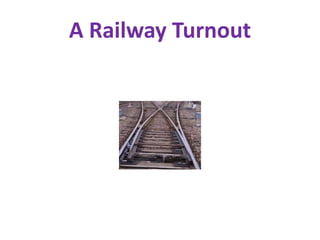
 TURNOUT: Complete set of points and crossing including the main (lead) rail:
1) LEFT HAND TURNOUT
2) RIGHT HAND TURNOUT
A Railway Turnout
Turn Out:
• Turnout: Turnout is the simplest combination
of point and crossing by operation of which
train is diverted to another track.
• A Turnout may be two type:
1. A right hand turnout
2. A left hand turnout
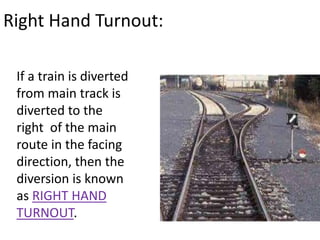
Right Hand Turnout:
If a train is diverted
from main track is
diverted to the
right of the main
route in the facing
direction, then the
diversion is known
as RIGHT HAND
TURNOUT.
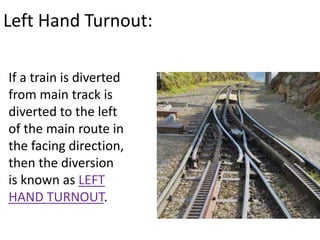
Left Hand Turnout:
If a train is diverted
from main track is
diverted to the left
of the main route in
the facing direction,
then the diversion
is known as LEFT
HAND TURNOUT.
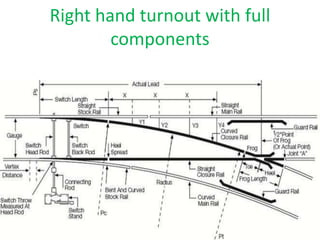
Right hand turnout with full
components
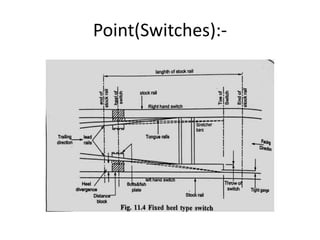
Point(Switches):-
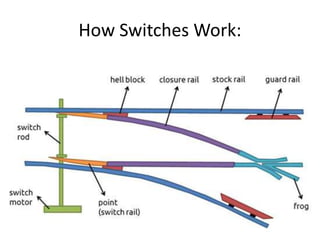
• Stock rail: It is the running rail against which a
tongue rail operates.
• Tongue rail: It is a tapered movable rail, made of
high carbon or manganese steel to withstand wear.
At this end, it is attached to a running rail. A tongue
rail is also called a switch rail.
• Heel Block: These blocks are inserted between the
heel of the tongue rail and stock rail. These are
made of C.I. and are used to provide a clear gap for
the wheel flange.
• Switch tie plate: This is provided below the slide
chairs at the toe. There are two butt straps at the
ends to ensure the definite location of slide chair
and hence of the rails. Standard sections are
25×1.25 cm for BG and 22.5×0.9 cm for MG.
• Stretcher bar: The toes of both the tongue rails are
connected together by means of stretcher bars, so
that each tongue moves through the same distance
or gap while changing the points. Generally two or
three bars are used near the toe.
How Switches Work:
Types Of Switches:
• There are two types of switches:
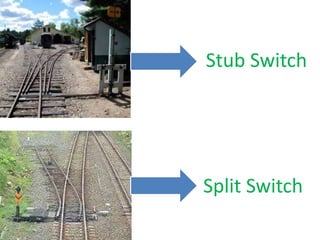
1. Stub switch
2. Split switch
• Split switch are of two types:
a. Loose heel type
b. Fixed heel type
Stub Switch
Split Switch
CROSSINGS:
• A Crossing is a device which provide two
flangeways through which the wheels of the flanges
may move, when two rails intersect each other at
an angle.
• Types of crossings:
Based on shape of crossing:
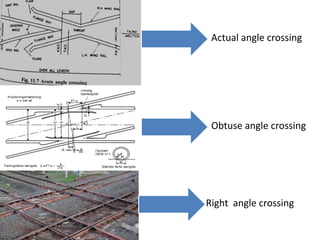
1. Actual angle crossing
2. obtuse angle crossing
3. Right angle crossing
Based on assembly of
crossing:
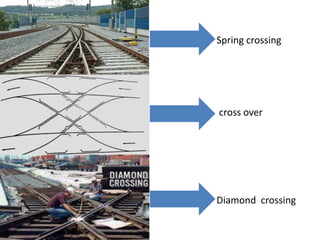
1. Spring crossing
2. Cross crossing
3. Diamond crossing
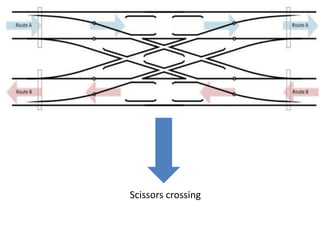
4. Scissors crossing
5. Ladder track or
gathering line
Actual angle crossing
Obtuse angle crossing
Right angle crossing
Spring crossing
cross over
Diamond crossing
Scissors crossing

Points and crossing

  • 1.
    Point and Crossing MadeBy :– Akash patel(131040106018) Guided By: Prof. sadanand sadhu GUJARAT POWER ENGINEERING & RESEARCH INSTITUTE
  • 2.
    Points and Crossing Pointsand crossings are provided to transfer trains from one track to another:  POINT (SWITCH): The device that is use to divert the wheels  CROSSING: Gaps in the rail that enables the actual diversion  TURNOUT: Complete set of points and crossing including the main (lead) rail: 1) LEFT HAND TURNOUT 2) RIGHT HAND TURNOUT
  • 3.
  • 4.
    Turn Out: • Turnout:Turnout is the simplest combination of point and crossing by operation of which train is diverted to another track. • A Turnout may be two type: 1. A right hand turnout 2. A left hand turnout
  • 5.
    Right Hand Turnout: Ifa train is diverted from main track is diverted to the right of the main route in the facing direction, then the diversion is known as RIGHT HAND TURNOUT.
  • 6.
    Left Hand Turnout: Ifa train is diverted from main track is diverted to the left of the main route in the facing direction, then the diversion is known as LEFT HAND TURNOUT.
  • 7.
    Right hand turnoutwith full components
  • 8.
  • 9.
    • Stock rail:It is the running rail against which a tongue rail operates. • Tongue rail: It is a tapered movable rail, made of high carbon or manganese steel to withstand wear. At this end, it is attached to a running rail. A tongue rail is also called a switch rail. • Heel Block: These blocks are inserted between the heel of the tongue rail and stock rail. These are made of C.I. and are used to provide a clear gap for the wheel flange.
  • 10.
    • Switch tieplate: This is provided below the slide chairs at the toe. There are two butt straps at the ends to ensure the definite location of slide chair and hence of the rails. Standard sections are 25×1.25 cm for BG and 22.5×0.9 cm for MG. • Stretcher bar: The toes of both the tongue rails are connected together by means of stretcher bars, so that each tongue moves through the same distance or gap while changing the points. Generally two or three bars are used near the toe.
  • 11.
  • 12.
    Types Of Switches: •There are two types of switches: 1. Stub switch 2. Split switch • Split switch are of two types: a. Loose heel type b. Fixed heel type
  • 13.
  • 14.
    CROSSINGS: • A Crossingis a device which provide two flangeways through which the wheels of the flanges may move, when two rails intersect each other at an angle.
  • 15.
    • Types ofcrossings: Based on shape of crossing: 1. Actual angle crossing 2. obtuse angle crossing 3. Right angle crossing Based on assembly of crossing: 1. Spring crossing 2. Cross crossing 3. Diamond crossing 4. Scissors crossing 5. Ladder track or gathering line
  • 16.
    Actual angle crossing Obtuseangle crossing Right angle crossing
  • 17.
  • 18.