7/14/2021 1
SUBMITTED BY- SUNIL KUMAR MEENA
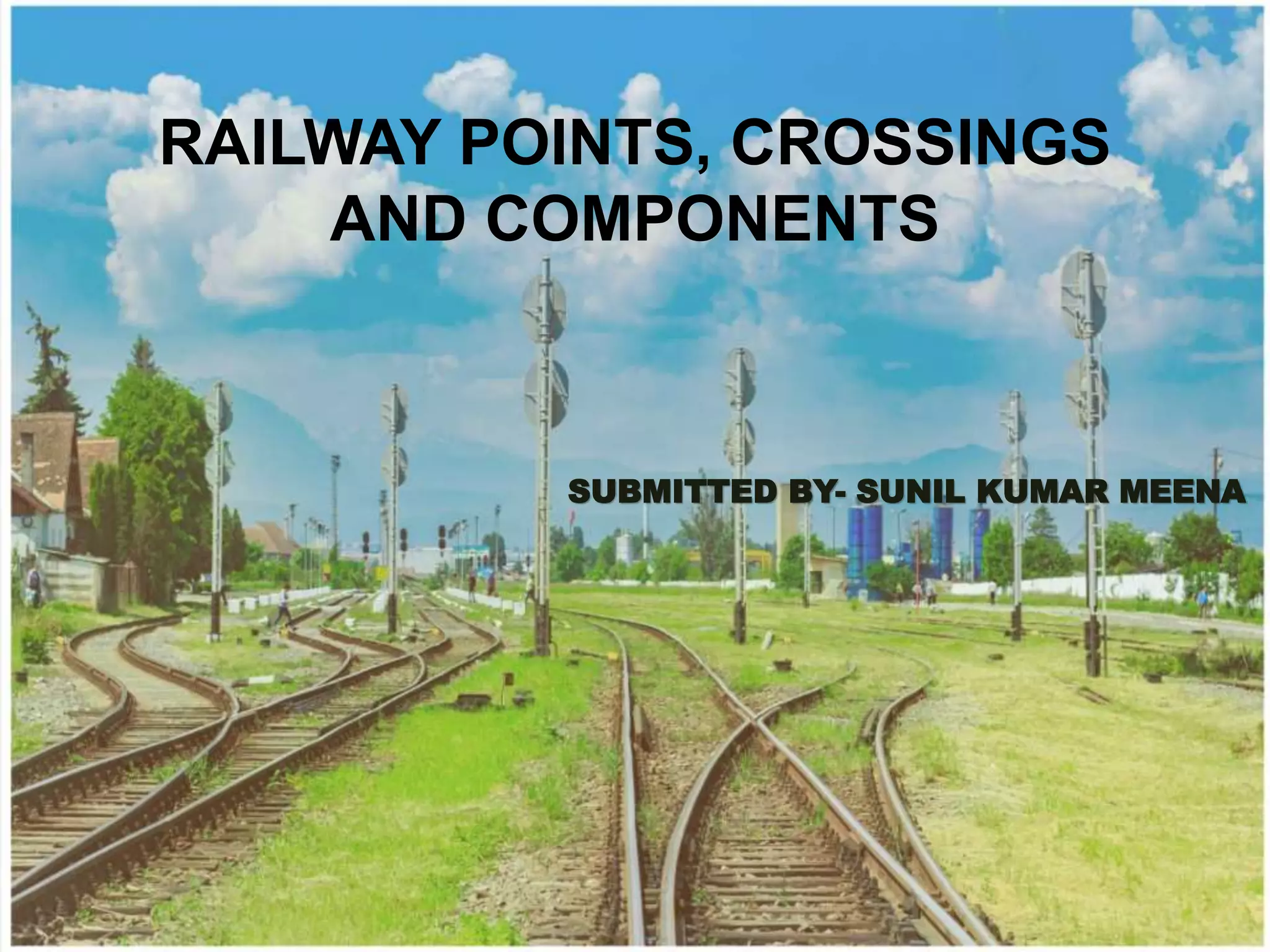
RAILWAY POINTS, CROSSINGS
AND COMPONENTS
 Point and its components
 Crossing and its components
 Junction Station and its components
 Flag station and its components
 Hump Yard and its components
7/14/2021 2
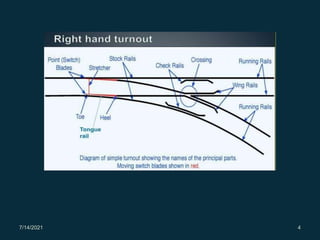
• A pair of tongue rail with their stock rails are termed aspoints.
• Points, crossings, turnouts, cross-overs and such related terms
are contrivances or arrangements by which different routs
either parallel or diverging are and afford the means for trains
to move from one route to another.
• The points or switches aid in diverting the vehicles and the
crossings provide gaps in the rails so as to help the flanged
wheels to roll over them.
7/14/2021 3
7/14/2021 4
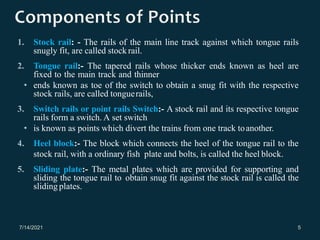
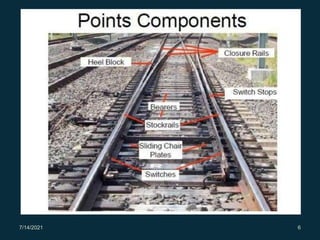
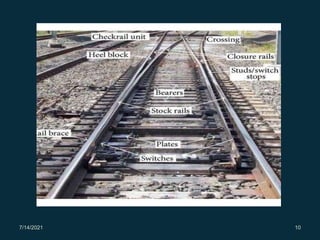
1. Stock rail: - The rails of the main line track against which tongue rails
snugly fit, are called stockrail.
2. Tongue rail:- The tapered rails whose thicker ends known as heel are
fixed to the main track and thinner
• ends known as toe of the switch to obtain a snug fit with the respective
stock rails, are called tonguerails,
3. Switch rails or point rails Switch:- A stock rail and its respective tongue
rails form a switch. A set switch
• is known as points which divert the trains from one track toanother.
4. Heel block:- The block which connects the heel of the tongue rail to the
stock rail, with a ordinary fish plate and bolts, is called the heel block.
5. Sliding plate:- The metal plates which are provided for supporting and
sliding the tongue rail to obtain snug fit against the stock rail is called the
sliding plates.
7/14/2021 5
7/14/2021 6
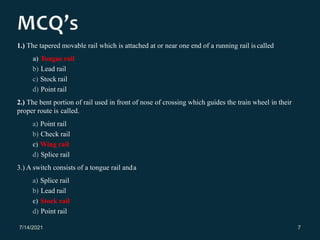
1.) The tapered movable rail which is attached at or near one end of a running rail is called
a) Tongue rail
b) Lead rail
c) Stock rail
d) Point rail
2.) The bent portion of rail used in front of nose of crossing which guides the train wheel in their
proper route is called.
a) Point rail
b) Check rail
c) Wing rail
d) Splice rail
3.) A switch consists of a tongue rail anda
a) Splice rail
b) Lead rail
c) Stock rail
d) Point rail
7/14/2021 7
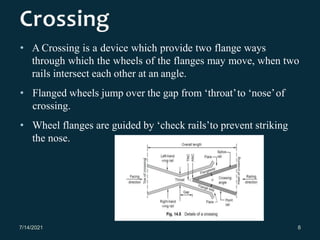
• A Crossing is a device which provide two flange ways
through which the wheels of the flanges may move, when two
rails intersect each other at an angle.
• Flanged wheels jump over the gap from ‘throat’to ‘nose’of
crossing.
• Wheel flanges are guided by ‘check rails’to prevent striking
the nose.
7/14/2021 8
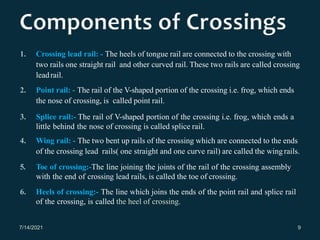
1. Crossing lead rail: - The heels of tongue rail are connected to the crossing with
two rails one straight rail and other curved rail. These two rails are called crossing
leadrail.
2. Point rail: - The rail of the V-shaped portion of the crossing i.e. frog, which ends
the nose of crossing, is called point rail.
3. Splice rail:- The rail of V-shaped portion of the crossing i.e. frog, which ends a
little behind the nose of crossing is called splice rail.
4. Wing rail: - The two bent up rails of the crossing which are connected to the ends
of the crossing lead rails( one straight and one curve rail) are called the wing rails.
5. Toe of crossing:-The line joining the joints of the rail of the crossing assembly
with the end of crossing lead rails, is called the toe of crossing.
6. Heels of crossing:- The line which joins the ends of the point rail and splice rail
of the crossing, is called the heel of crossing.
7/14/2021 9
7/14/2021 10
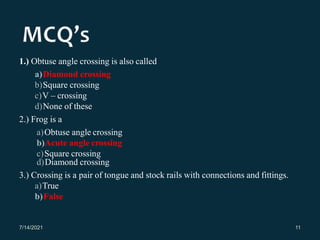
1.) Obtuse angle crossing is also called
a)Diamond crossing
b)Square crossing
c)V – crossing
d)None of these
2.) Frog is a
a)Obtuse angle crossing
b)Acute angle crossing
c)Square crossing
d)Diamond crossing
3.) Crossing is a pair of tongue and stock rails with connections and fittings.
a)True
b)False
7/14/2021 11
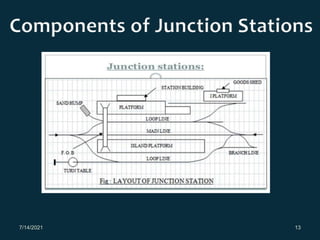
• A junction, is a place at which two or more rail routes
converge or diverge. This implies a physical connection
between the tracks of the two routes and signaling.
• Junctions are important for rail systems, their installation into a
rail system can expand route capacity , and have a powerful
impact upon time performance.
7/14/2021 12
7/14/2021 13
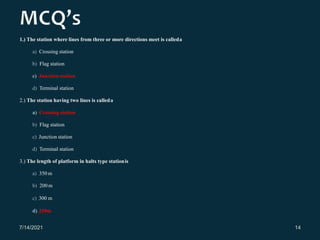
1.) The station where lines from three or more directions meet is calleda
a) Crossing station
b) Flag station
c) Junction station
d) Terminal station
2.) The station having two lines is calleda
a) Crossing station
b) Flag station
c) Junction station
d) Terminal station
3.) The length of platform in halts type stationis
a) 350 m
b) 200m
c) 300 m
d) 250m
7/14/2021 14
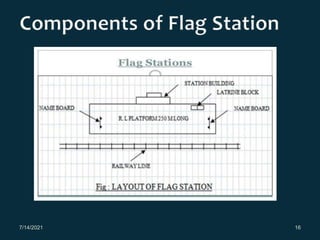
• Flag stations describes a stopping point at which trains stop
only on an as-need or request basis that is only if there are
passengers to be picked up or dropped off.
• These stations have no overtaking or crossing facilities and
arrangements to control the movement of trains. These
stations have buildings, staff and telegraph facilities.
• Some of the flag stations have sidings also in the form of
loops.
7/14/2021 15
7/14/2021 16
1.) From the following there are not a block station.
a) A-class
b) D-class
c) B-class
d) C-class
2.) Which signal is the first stop signal in A-class station?
a) Warner signal
b) Starter signal
c) Home signal
d) Outer signal
3.) The station at which a railway line or one of its branches terminates or continuity of a line stops, is known as
a) Junction station
b) Terminal station
c) Non junction station
d) Flag Station
7/14/2021 17
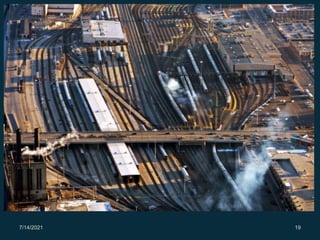
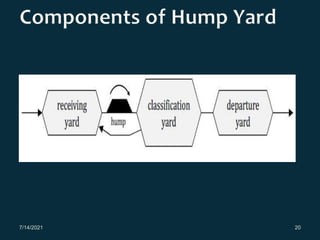
 Hump-yard: - These are the largest and most effective
classification yards, with the largest shunting capacity—
often several thousand cars a day.
• The heart of these yards is the hump: a lead track on a hill
(hump) that an engine pushes the cars over.
• Single cars, or some coupled cars in a block, are uncoupled
just before or at the crest of the hump, and roll by gravity onto
their destination tracks.
7/14/2021 18
7/14/2021 19
7/14/2021 20
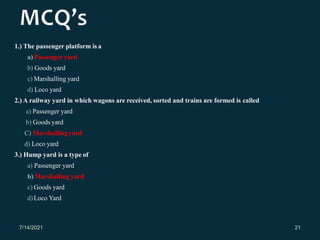
1.) The passenger platform is a
a) Passenger yard
b) Goods yard
c) Marshalling yard
d) Loco yard
2.) A railway yard in which wagons are received, sorted and trains are formed is called
a) Passenger yard
b) Goods yard
C) Marshallingyard
d) Loco yard
3.) Hump yard is a type of
a) Passenger yard
b) Marshalling yard
c) Goods yard
d)Loco Yard
7/14/2021 21
7/14/2021 22
THANK YOU

Railway points, crossings and components

  • 1.
    7/14/2021 1 SUBMITTED BY-SUNIL KUMAR MEENA RAILWAY POINTS, CROSSINGS AND COMPONENTS
  • 2.
     Point andits components  Crossing and its components  Junction Station and its components  Flag station and its components  Hump Yard and its components 7/14/2021 2
  • 3.
    • A pairof tongue rail with their stock rails are termed aspoints. • Points, crossings, turnouts, cross-overs and such related terms are contrivances or arrangements by which different routs either parallel or diverging are and afford the means for trains to move from one route to another. • The points or switches aid in diverting the vehicles and the crossings provide gaps in the rails so as to help the flanged wheels to roll over them. 7/14/2021 3
  • 4.
  • 5.
    1. Stock rail:- The rails of the main line track against which tongue rails snugly fit, are called stockrail. 2. Tongue rail:- The tapered rails whose thicker ends known as heel are fixed to the main track and thinner • ends known as toe of the switch to obtain a snug fit with the respective stock rails, are called tonguerails, 3. Switch rails or point rails Switch:- A stock rail and its respective tongue rails form a switch. A set switch • is known as points which divert the trains from one track toanother. 4. Heel block:- The block which connects the heel of the tongue rail to the stock rail, with a ordinary fish plate and bolts, is called the heel block. 5. Sliding plate:- The metal plates which are provided for supporting and sliding the tongue rail to obtain snug fit against the stock rail is called the sliding plates. 7/14/2021 5
  • 6.
  • 7.
    1.) The taperedmovable rail which is attached at or near one end of a running rail is called a) Tongue rail b) Lead rail c) Stock rail d) Point rail 2.) The bent portion of rail used in front of nose of crossing which guides the train wheel in their proper route is called. a) Point rail b) Check rail c) Wing rail d) Splice rail 3.) A switch consists of a tongue rail anda a) Splice rail b) Lead rail c) Stock rail d) Point rail 7/14/2021 7
  • 8.
    • A Crossingis a device which provide two flange ways through which the wheels of the flanges may move, when two rails intersect each other at an angle. • Flanged wheels jump over the gap from ‘throat’to ‘nose’of crossing. • Wheel flanges are guided by ‘check rails’to prevent striking the nose. 7/14/2021 8
  • 9.
    1. Crossing leadrail: - The heels of tongue rail are connected to the crossing with two rails one straight rail and other curved rail. These two rails are called crossing leadrail. 2. Point rail: - The rail of the V-shaped portion of the crossing i.e. frog, which ends the nose of crossing, is called point rail. 3. Splice rail:- The rail of V-shaped portion of the crossing i.e. frog, which ends a little behind the nose of crossing is called splice rail. 4. Wing rail: - The two bent up rails of the crossing which are connected to the ends of the crossing lead rails( one straight and one curve rail) are called the wing rails. 5. Toe of crossing:-The line joining the joints of the rail of the crossing assembly with the end of crossing lead rails, is called the toe of crossing. 6. Heels of crossing:- The line which joins the ends of the point rail and splice rail of the crossing, is called the heel of crossing. 7/14/2021 9
  • 10.
  • 11.
    1.) Obtuse anglecrossing is also called a)Diamond crossing b)Square crossing c)V – crossing d)None of these 2.) Frog is a a)Obtuse angle crossing b)Acute angle crossing c)Square crossing d)Diamond crossing 3.) Crossing is a pair of tongue and stock rails with connections and fittings. a)True b)False 7/14/2021 11
  • 12.
    • A junction,is a place at which two or more rail routes converge or diverge. This implies a physical connection between the tracks of the two routes and signaling. • Junctions are important for rail systems, their installation into a rail system can expand route capacity , and have a powerful impact upon time performance. 7/14/2021 12
  • 13.
  • 14.
    1.) The stationwhere lines from three or more directions meet is calleda a) Crossing station b) Flag station c) Junction station d) Terminal station 2.) The station having two lines is calleda a) Crossing station b) Flag station c) Junction station d) Terminal station 3.) The length of platform in halts type stationis a) 350 m b) 200m c) 300 m d) 250m 7/14/2021 14
  • 15.
    • Flag stationsdescribes a stopping point at which trains stop only on an as-need or request basis that is only if there are passengers to be picked up or dropped off. • These stations have no overtaking or crossing facilities and arrangements to control the movement of trains. These stations have buildings, staff and telegraph facilities. • Some of the flag stations have sidings also in the form of loops. 7/14/2021 15
  • 16.
  • 17.
    1.) From thefollowing there are not a block station. a) A-class b) D-class c) B-class d) C-class 2.) Which signal is the first stop signal in A-class station? a) Warner signal b) Starter signal c) Home signal d) Outer signal 3.) The station at which a railway line or one of its branches terminates or continuity of a line stops, is known as a) Junction station b) Terminal station c) Non junction station d) Flag Station 7/14/2021 17
  • 18.
     Hump-yard: -These are the largest and most effective classification yards, with the largest shunting capacity— often several thousand cars a day. • The heart of these yards is the hump: a lead track on a hill (hump) that an engine pushes the cars over. • Single cars, or some coupled cars in a block, are uncoupled just before or at the crest of the hump, and roll by gravity onto their destination tracks. 7/14/2021 18
  • 19.
  • 20.
  • 21.
    1.) The passengerplatform is a a) Passenger yard b) Goods yard c) Marshalling yard d) Loco yard 2.) A railway yard in which wagons are received, sorted and trains are formed is called a) Passenger yard b) Goods yard C) Marshallingyard d) Loco yard 3.) Hump yard is a type of a) Passenger yard b) Marshalling yard c) Goods yard d)Loco Yard 7/14/2021 21
  • 22.