Topic 5. Points and Crossings- Turnouts
RAILWAY ENGINEERING
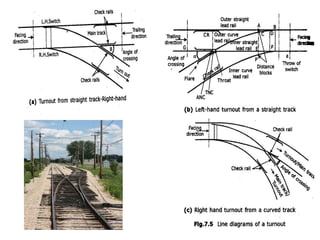
Turnouts
Definition:
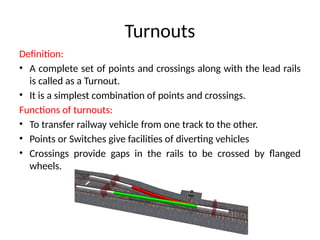
• A complete set of points and crossings along with the lead rails
is called as a Turnout.
• It is a simplest combination of points and crossings.
Functions of turnouts:
• To transfer railway vehicle from one track to the other.
• Points or Switches give facilities of diverting vehicles
• Crossings provide gaps in the rails to be crossed by flanged
wheels.
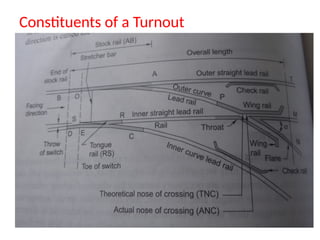
Constituents of a Turnout
Turnouts: Components
• A pair of points or switches
• A pair of stock rails
• Two Check rails
• Four Lead rails
• Switch- tie-plate/ Gauge-tie-chair and crossing- tie-plate
• Studs or stops
• Bearing plates, Slide chains, Stretcher bars
• Rods, Cranks, Levers
• Crossings or ‘V’ piece
• Wing rails
• Locking system- locking box, lock bar, plunger bar
Turnouts: Important Terminologies
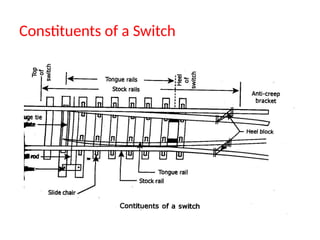
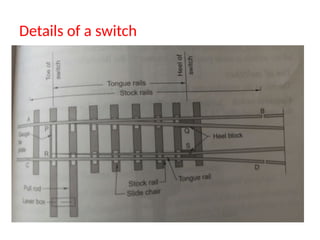
• Tongue Rails: It tapers like a tongue and lies between two stock rails.
They are connected by stretcher bars. It enables both tongue rails to
move through same distance and maintain a gap. This gap is known as
‘Throw of switch’.
• Stock Rails: Main rails of the track. It is a running rail. Tongue rail is
attached to it.
• Switch: A pair of tongue rails with necessary connections (without
stock rail)
• Points: A pair of tongue rails and stock rails with necessary
connections
• Heel of Switch: An imaginary point on the gauge line midway
between end of lead rail and switch rail.
• Switch Length: The length between toe of switch rail to heel of switch.
Turnouts: Important Terminologies
• Throw of Switch: It is the distance through which the toe of the tongue rail
moves sideways( with heel of tongue rail as the centre of rotation) to
provide a path for the desired direction over in the turnout. i.e., A clear gap
between tongue rail and stock rail at the toe of switch.
The adopted values are:
9.5 cm – BG; 8.9 cm – MG and NG
General value: 11.4 cm
• Tongue Length: The free length of tongue rail from toe to the end of the
tongue rail. It depends upon the value of switch angle.
Long tongue length- increases the overall length of turnout tongue
Short tongue rail – increases the angle of switch
Minimum Length of tongue rail,
S= R tan α/2
Where S- theoretical length of the tongue rail
R- radius of the curve at turnout in m
Α- angle of crossing
Turnouts: Important Terminologies
• Theoretical Toe of switch: It is the point of intersection of the gauge lines of
tongue rail at its toe when extended and stock rail.
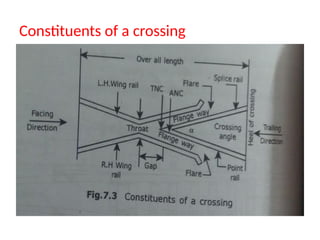
• Theoretical Nose of Crossing(TNC): It is the point of intersection of gauge
lines of main line and turnout line of a crossing . It is used as a reference
point.
• Actual Nose of Crossing(ANC): It is not possible in practice to maintain a line
in tracks exactly at TNC. Therefore, a short length is cutoff to give certain
thickness to a nose. This point is called ANC.
• Left/ Right Hand Turnout: Turnout is called left hand or right hand according
to how the rolling stock is diverted to the left or right of the main line.
• Left/ Right Hand Switches: Those are termed as left hand or right hand
switches depending upon left or right when seen from the facing direction
i.e., stand at the points and look towards the crossing.
Turnouts: Important Terminologies
• Facing Direction: If someone stands at toe of switch and looks
towards the crossing, then the direction is called ‘Facing Direction’.
• Trailing Direction: If someone stands at the crossing and looks
towards the switches, then the direction is called ‘Trailing Direction’.
• Facing points of Turnout: They are those where trains pass over the
switches first and then they pass over the crossing.
• Trailing points of Turnouts: They are those on the opposite side of
facing points in which the trains pass over the crossing first and
then over the switches
Turnouts: Track Junctions
Track Junctions: They are formed by combination of points
and crossings.
Types:
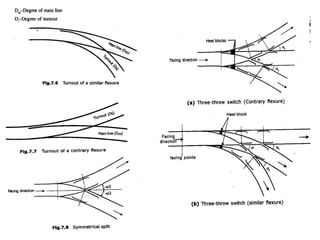
• Turnout from straight track
• Turnout of similar Flexure
• Turnout of Contrary Flexure
• Symmetrical split
• Three throw switch
• Double turnouts
• Cross overs
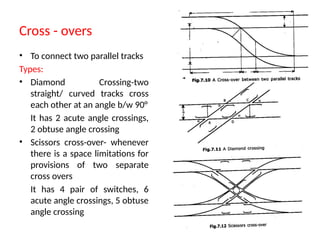
Cross - overs
• To connect two parallel tracks
Types:
• Diamond Crossing-two
straight/ curved tracks cross
each other at an angle b/w 90°
It has 2 acute angle crossings,
2 obtuse angle crossing
• Scissors cross-over- whenever
there is a space limitations for
provisions of two separate
cross overs
It has 4 pair of switches, 6
acute angle crossings, 5 obtuse
angle crossing
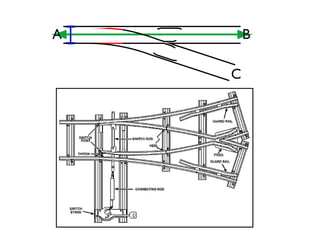
Points and Crossings
Definition:
• Points, Crossings, Turnouts, Cross-overs and such related
terms are contrivances or arrangements by which different
routes either parallel or diverging are connected and afford
the means for trains to move from one route to another.
• It also helps in Marshalling and Shunting works in station
yards.
Points and Crossings:
• They are the arrangements by which different routes are
connected.
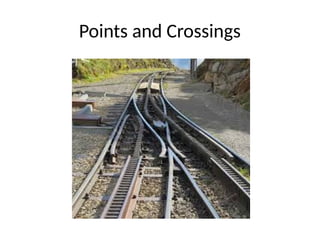
Points and Crossings
Constituents of a Switch
Details of a switch
Points or Switches
Types of Switches:
1. Stub Switch:
No separate tongue rail is provided. Instead, some portion of
the track is moved from one side to another.
2. Split Switch:
a) Loose Heal type: The switch or tongue rail finishes at the
heel of the switch. This enables a free end of the tongue.
b) Fixed Heal type: The tongue rail does not end at the heal
of the switch but extends further. The tongue rail is
rigidly connected to stock rail at the heal.
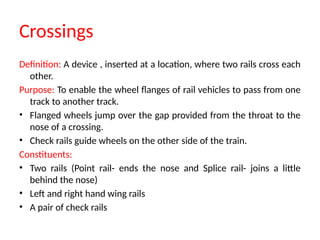
Crossings
Definition: A device , inserted at a location, where two rails cross each
other.
Purpose: To enable the wheel flanges of rail vehicles to pass from one
track to another track.
• Flanged wheels jump over the gap provided from the throat to the
nose of a crossing.
• Check rails guide wheels on the other side of the train.
Constituents:
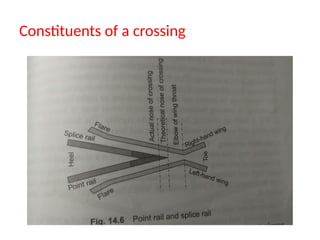
• Two rails (Point rail- ends the nose and Splice rail- joins a little
behind the nose)
• Left and right hand wing rails
• A pair of check rails
Constituents of a crossing
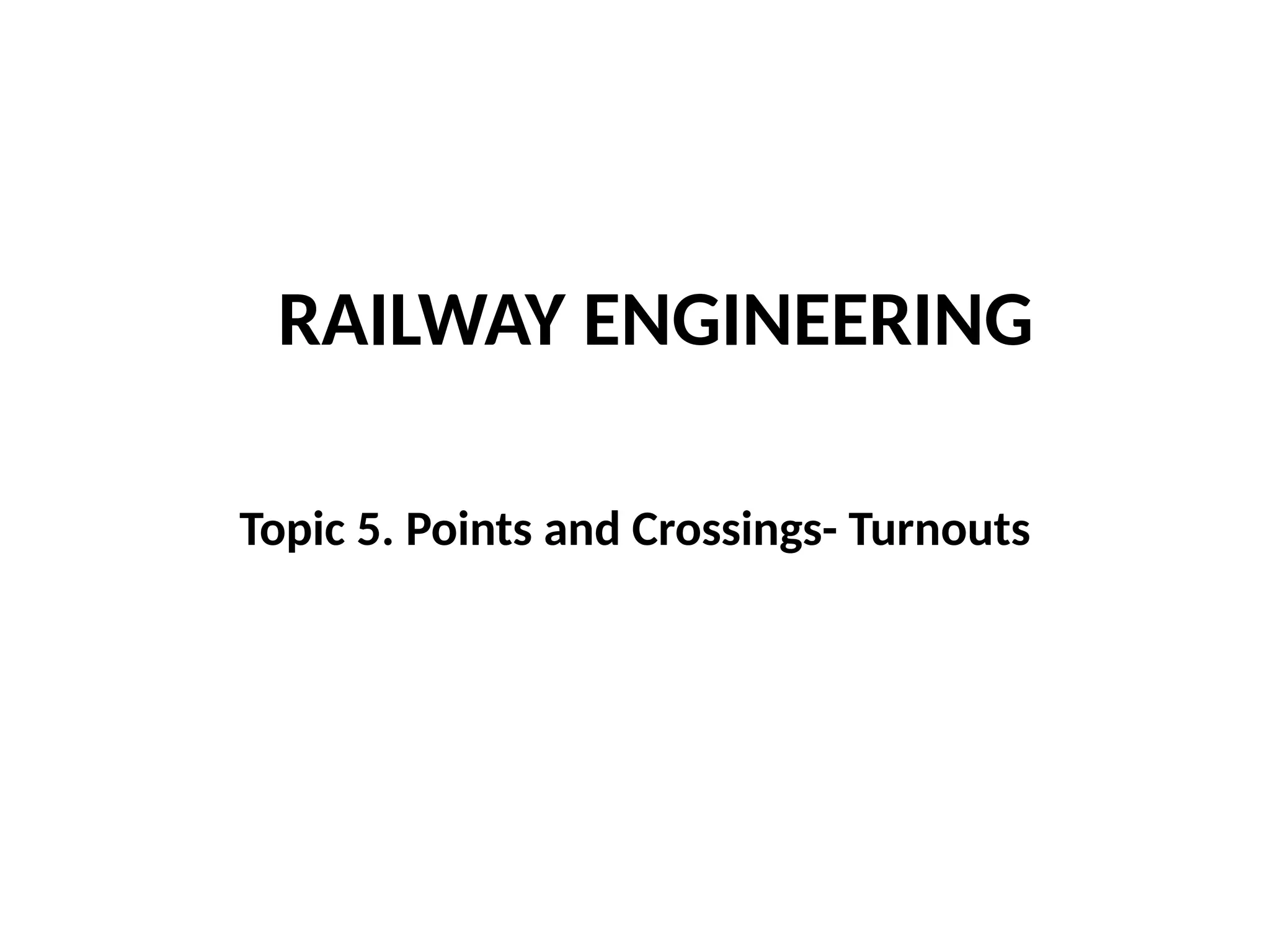
Methods of laying sleepers below points and
crossings
• Perpendicular to the
track
Methods:
• Through sleepers
• Inter-locked sleepers

5. Points and Crossings.pptx

  • 1.
    Topic 5. Pointsand Crossings- Turnouts RAILWAY ENGINEERING
  • 2.
    Turnouts Definition: • A completeset of points and crossings along with the lead rails is called as a Turnout. • It is a simplest combination of points and crossings. Functions of turnouts: • To transfer railway vehicle from one track to the other. • Points or Switches give facilities of diverting vehicles • Crossings provide gaps in the rails to be crossed by flanged wheels.
  • 3.
  • 4.
    Turnouts: Components • Apair of points or switches • A pair of stock rails • Two Check rails • Four Lead rails • Switch- tie-plate/ Gauge-tie-chair and crossing- tie-plate • Studs or stops • Bearing plates, Slide chains, Stretcher bars • Rods, Cranks, Levers • Crossings or ‘V’ piece • Wing rails • Locking system- locking box, lock bar, plunger bar
  • 5.
    Turnouts: Important Terminologies •Tongue Rails: It tapers like a tongue and lies between two stock rails. They are connected by stretcher bars. It enables both tongue rails to move through same distance and maintain a gap. This gap is known as ‘Throw of switch’. • Stock Rails: Main rails of the track. It is a running rail. Tongue rail is attached to it. • Switch: A pair of tongue rails with necessary connections (without stock rail) • Points: A pair of tongue rails and stock rails with necessary connections • Heel of Switch: An imaginary point on the gauge line midway between end of lead rail and switch rail. • Switch Length: The length between toe of switch rail to heel of switch.
  • 6.
    Turnouts: Important Terminologies •Throw of Switch: It is the distance through which the toe of the tongue rail moves sideways( with heel of tongue rail as the centre of rotation) to provide a path for the desired direction over in the turnout. i.e., A clear gap between tongue rail and stock rail at the toe of switch. The adopted values are: 9.5 cm – BG; 8.9 cm – MG and NG General value: 11.4 cm • Tongue Length: The free length of tongue rail from toe to the end of the tongue rail. It depends upon the value of switch angle. Long tongue length- increases the overall length of turnout tongue Short tongue rail – increases the angle of switch Minimum Length of tongue rail, S= R tan α/2 Where S- theoretical length of the tongue rail R- radius of the curve at turnout in m Α- angle of crossing
  • 7.
    Turnouts: Important Terminologies •Theoretical Toe of switch: It is the point of intersection of the gauge lines of tongue rail at its toe when extended and stock rail. • Theoretical Nose of Crossing(TNC): It is the point of intersection of gauge lines of main line and turnout line of a crossing . It is used as a reference point. • Actual Nose of Crossing(ANC): It is not possible in practice to maintain a line in tracks exactly at TNC. Therefore, a short length is cutoff to give certain thickness to a nose. This point is called ANC. • Left/ Right Hand Turnout: Turnout is called left hand or right hand according to how the rolling stock is diverted to the left or right of the main line. • Left/ Right Hand Switches: Those are termed as left hand or right hand switches depending upon left or right when seen from the facing direction i.e., stand at the points and look towards the crossing.
  • 8.
    Turnouts: Important Terminologies •Facing Direction: If someone stands at toe of switch and looks towards the crossing, then the direction is called ‘Facing Direction’. • Trailing Direction: If someone stands at the crossing and looks towards the switches, then the direction is called ‘Trailing Direction’. • Facing points of Turnout: They are those where trains pass over the switches first and then they pass over the crossing. • Trailing points of Turnouts: They are those on the opposite side of facing points in which the trains pass over the crossing first and then over the switches
  • 9.
    Turnouts: Track Junctions TrackJunctions: They are formed by combination of points and crossings. Types: • Turnout from straight track • Turnout of similar Flexure • Turnout of Contrary Flexure • Symmetrical split • Three throw switch • Double turnouts • Cross overs
  • 12.
    Cross - overs •To connect two parallel tracks Types: • Diamond Crossing-two straight/ curved tracks cross each other at an angle b/w 90° It has 2 acute angle crossings, 2 obtuse angle crossing • Scissors cross-over- whenever there is a space limitations for provisions of two separate cross overs It has 4 pair of switches, 6 acute angle crossings, 5 obtuse angle crossing
  • 13.
    Points and Crossings Definition: •Points, Crossings, Turnouts, Cross-overs and such related terms are contrivances or arrangements by which different routes either parallel or diverging are connected and afford the means for trains to move from one route to another. • It also helps in Marshalling and Shunting works in station yards. Points and Crossings: • They are the arrangements by which different routes are connected.
  • 14.
  • 16.
  • 17.
  • 18.
    Points or Switches Typesof Switches: 1. Stub Switch: No separate tongue rail is provided. Instead, some portion of the track is moved from one side to another. 2. Split Switch: a) Loose Heal type: The switch or tongue rail finishes at the heel of the switch. This enables a free end of the tongue. b) Fixed Heal type: The tongue rail does not end at the heal of the switch but extends further. The tongue rail is rigidly connected to stock rail at the heal.
  • 19.
    Crossings Definition: A device, inserted at a location, where two rails cross each other. Purpose: To enable the wheel flanges of rail vehicles to pass from one track to another track. • Flanged wheels jump over the gap provided from the throat to the nose of a crossing. • Check rails guide wheels on the other side of the train. Constituents: • Two rails (Point rail- ends the nose and Splice rail- joins a little behind the nose) • Left and right hand wing rails • A pair of check rails
  • 20.
  • 21.
  • 22.
    Methods of layingsleepers below points and crossings • Perpendicular to the track Methods: • Through sleepers • Inter-locked sleepers

Editor's Notes