PROCUREMENT & CONTRACT MANAGEMENT
Presented By : Irfan Ghalib
Director – SCM
Dt : 30th May
2023
SEQUENCE
 Procurement
 Defining Contract
 Contract Management
 Stages of Contract Management Process
2
OBJECTIVES
 To highlight the processes preceding contract award such as
procurement planning, selection of contractors etc.
 To focus on the Contract Management activities carried out
during the period from the award of contract to contract
completion
3
WHAT IS PROCUREMENT ?
 Procurement is acquiring goods/services from an outside source
 The process to obtain products or services from market supply in
order to smoothly run the production and business activities
 The act of sourcing and purchasing goods, services, or raw
materials for a business from vendors or suppliers
4
OUT SOURCING – A DECISION
 Fixed and recurrent costs reduction considerations
 To focus on core business
 To access and get benefit of skills and technologies
 To acquire flexibility in operations
 To increase accountability
5
WHAT IS A CONTRACT ?
 An agreement between two or more parties creating obligations
enforceable or otherwise recognizable as law
 For a contract to be enforceable, the parties must agree on the
same terms, conditions, and subject matter
 Contracts must be clearly written communicating the terms and
conditions/obligations/promises
 The terms, conditions, and obligations must be consistent
6
CONTRACT MANAGEMENT
Contract management is part of the Procurement Process,
 That enables both parties to meet their obligations in order to
deliver the objectives required from the contract
 Building a good working relationship between customer & provider
 Art and science of managing a contractual agreement during the
contracting process
7
CONTRACT MANAGEMENT
 Managing contracts as a part of legal documentation of forging
work relationships with customers, vendors, or even partners.
 Negotiating the terms and conditions in contracts
 Certifying compliance with the terms and conditions
 Documenting and agreeing on any changes by both the parties
8
CONTRACT MANAGEMENT
 Systematic and efficient planning, execution, monitoring, and
evaluation of contracts
 An approach to optimize performance and managing risks
 To ensure that both parties fulfill their contractual obligations
 To deliver the ultimate goal of achieving value for money (vfm)
 A key driver to achieving results on the ground
9
OBJECTIVES OF CONTRACT MANAGEMENT
 To ensure product/service is sold at an agreed-upon price
 To assess whether product/service conforms to specified quality
standards
 To ensure product/service is delivered timely, at the right place,
and correct quantity
 To ensure that vendor management is cost-effective
10
CONTRACT MANAGEMENT PROCESS
 Procurement planning: determining what to procure and when
 Solicitation planning: documenting product requirements and
identifying potential sources
 Solicitation: obtaining quotations, bids, offers, or proposals
 Source selection: choosing from among potential vendors
 Contract administration: managing the relationship with the vendor
 Contract close-out: completion and settlement of the contract
11
12
PLAN PROCUREMENTS
Procurement planning involves identifying the production needs
best met by using products or services from market, deciding
 Whether to procure
 How to procure
 What to procure
 How much to procure
 When to procure
13
PLAN PROCUREMENTS
 Defining the requirement
 Development of the procurement statement of work,
specifications, and work breakdown structure
 Laying out the major milestones and the timing/schedule
 Cost estimating, including life-cycle costing
14
PLAN PROCUREMENTS
 Determining whether qualified sellers exist
 Identifying the source selection criteria
 listing of possible project/procurement risks Developing a
procurement plan
 Developing a procurement plan
 Obtaining authorization and approval to proceed
15
PROCUREMENT RISKS
 Technical: Specifications open to misinterpretation, vague wording
 Delivery Schedule: Unrealistic delivery time
 Warranty : Technology/nonstandard solutions
 Resources: Availability, skill levels, inadequacies
 Financial: L/C , Payment plans, inflation, currency exchange, bonds
 Force majeure: Permits/licenses, political stability, legislation
16
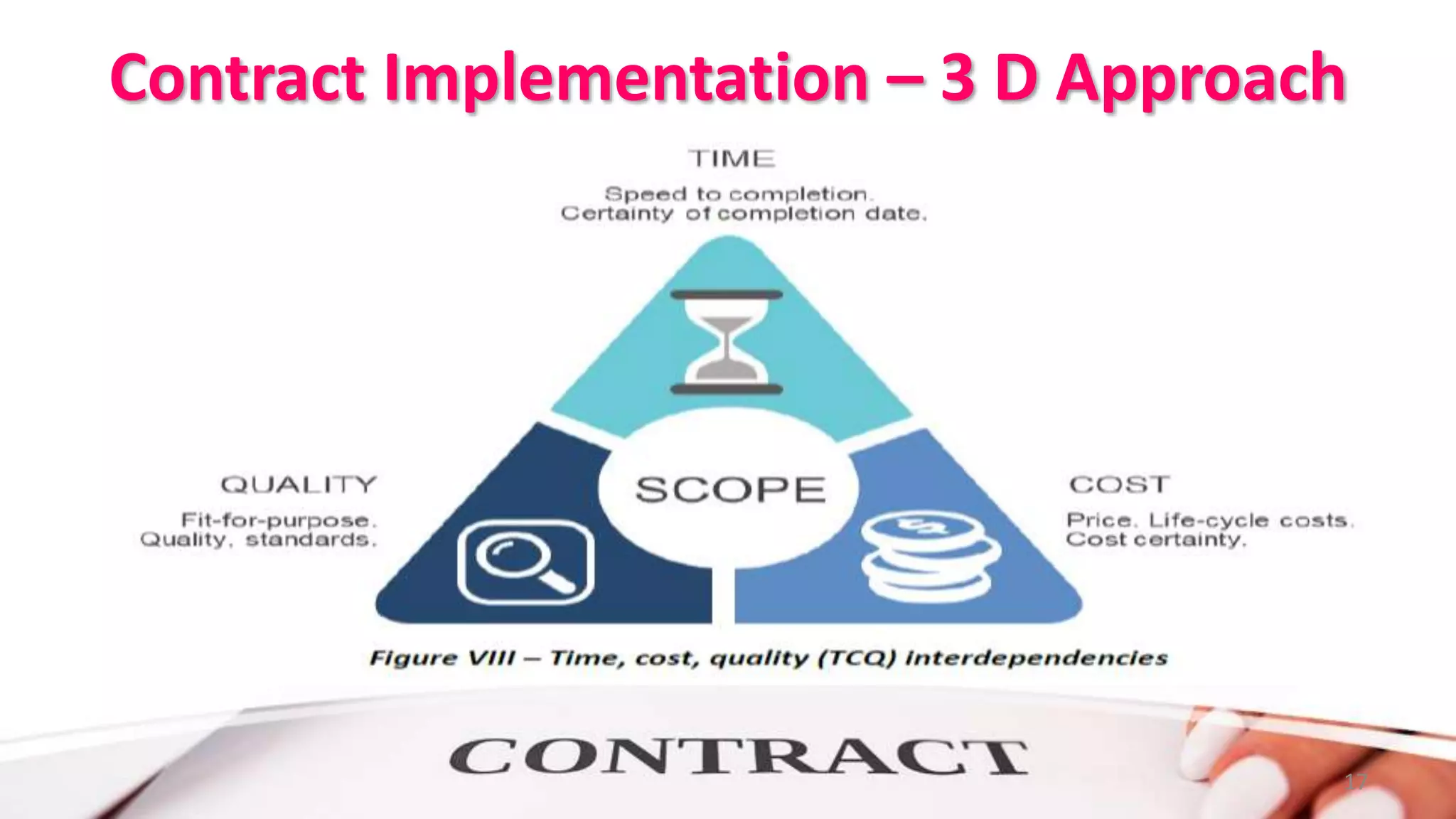
Contract Implementation – 3 D Approach
17
CONDUCTING THE PROCUREMENT
 Evaluating/confirming specifications
 Confirming qualified sources
 past performance of sources
 Producing the solicitation package
18
SOLICITATION PACKAGE
 Bid documents standardized
 Listing of qualified vendors
 Proposal evaluation criteria
 How change requests will be managed
 Supplier payment plan
19
PROPOSAL EVALUATION SCORING
 Understanding of the requirements
 Overall bid price
 Technical superiority
 Management capability
 Previous performance
 Financial strength & Production capacity
20
REQUEST SELLER RESPONSES
 Advertising: Sealed bids, no negotiations
 Negotiation
 Request for information (RFI)
 Request for quotation (RFQ)
 Request for proposal (RFP)
 Invitation for bids (IFB) & Small purchases
21
SELECTING APPROPRIATE SELLERS
 Evaluation criteria: time, cost, expected management team of the
project, and previous performance history
 Contract award strategy: price-based/best-value
 Perform a complete price/cost analysis
 A negotiation process
 Major factors of negotiations
22
CONTRACT SELECTION CRITEREA
 Overall degree of cost and schedule risk
 Type and complexity of requirement (technical risk)
 Extent of price competition
 Urgency of the requirements & Performance period
 Contractor’s responsibility (and risk) & Concurrent contracts,
Extent of subcontracting
23
CONTRACTUAL ARRANGEMENTS
 Fixed price or lump sum
 Fixed price with re-determination
 Fixed price with economic price adjustment
 Cost and cost sharing
 Fixed price for services, material, and labor
24
CONTRACT ADMINISTRATION
 Contract maintenance and change control with cost monitoring
 Ordering and payment procedures
 Management reporting
 All parties understand who does what, when, and how
 The contract documentation reflects the arrangement, and
changes to it carefully controlled
25
CONTRACT ADMINISTRATION FUNCTIONS
 Change management & Specification interpretation
 Adherence to quality requirements & Inspections and audits
 Warranties
 Performance reporting, and Contractor performance Report Card
 Records management
26
TYPICAL CAUSES OF CONTRACT CHANGES
 Defective specification with impossibility of performance
 Erroneous interpretation of contract and Over inspection of work
 Acceleration of performance
 Failure to cooperate
 Improperly exercised options
27
WAIVERS
 Breach of contract
 Claims administration
 Resolution of disputes
 Payment schedules
 Project termination
28
REASONS FOR TERMINATION
 Elimination of the requirement due to Technological advances
 Budgetary changes
 Default due to contractor’s actions
 Failure to make delivery on scheduled date
 Failure to perform any other provisions of the contract
29
CONTRACT CLOSURE
 Documented verification of the output duly accepted by the buyer
 Debriefing the seller on their overall performance
 Documenting seller’s performance as reference
 Identifying room for improvement on future contracts
 Archiving necessary documentation &
 Identifying best practices
30
31
32

PROCUREMENT & CONTRACT MANAGEMENT.pptx

  • 1.
    PROCUREMENT & CONTRACTMANAGEMENT Presented By : Irfan Ghalib Director – SCM Dt : 30th May 2023
  • 2.
    SEQUENCE  Procurement  DefiningContract  Contract Management  Stages of Contract Management Process 2
  • 3.
    OBJECTIVES  To highlightthe processes preceding contract award such as procurement planning, selection of contractors etc.  To focus on the Contract Management activities carried out during the period from the award of contract to contract completion 3
  • 4.
    WHAT IS PROCUREMENT?  Procurement is acquiring goods/services from an outside source  The process to obtain products or services from market supply in order to smoothly run the production and business activities  The act of sourcing and purchasing goods, services, or raw materials for a business from vendors or suppliers 4
  • 5.
    OUT SOURCING –A DECISION  Fixed and recurrent costs reduction considerations  To focus on core business  To access and get benefit of skills and technologies  To acquire flexibility in operations  To increase accountability 5
  • 6.
    WHAT IS ACONTRACT ?  An agreement between two or more parties creating obligations enforceable or otherwise recognizable as law  For a contract to be enforceable, the parties must agree on the same terms, conditions, and subject matter  Contracts must be clearly written communicating the terms and conditions/obligations/promises  The terms, conditions, and obligations must be consistent 6
  • 7.
    CONTRACT MANAGEMENT Contract managementis part of the Procurement Process,  That enables both parties to meet their obligations in order to deliver the objectives required from the contract  Building a good working relationship between customer & provider  Art and science of managing a contractual agreement during the contracting process 7
  • 8.
    CONTRACT MANAGEMENT  Managingcontracts as a part of legal documentation of forging work relationships with customers, vendors, or even partners.  Negotiating the terms and conditions in contracts  Certifying compliance with the terms and conditions  Documenting and agreeing on any changes by both the parties 8
  • 9.
    CONTRACT MANAGEMENT  Systematicand efficient planning, execution, monitoring, and evaluation of contracts  An approach to optimize performance and managing risks  To ensure that both parties fulfill their contractual obligations  To deliver the ultimate goal of achieving value for money (vfm)  A key driver to achieving results on the ground 9
  • 10.
    OBJECTIVES OF CONTRACTMANAGEMENT  To ensure product/service is sold at an agreed-upon price  To assess whether product/service conforms to specified quality standards  To ensure product/service is delivered timely, at the right place, and correct quantity  To ensure that vendor management is cost-effective 10
  • 11.
    CONTRACT MANAGEMENT PROCESS Procurement planning: determining what to procure and when  Solicitation planning: documenting product requirements and identifying potential sources  Solicitation: obtaining quotations, bids, offers, or proposals  Source selection: choosing from among potential vendors  Contract administration: managing the relationship with the vendor  Contract close-out: completion and settlement of the contract 11
  • 12.
  • 13.
    PLAN PROCUREMENTS Procurement planninginvolves identifying the production needs best met by using products or services from market, deciding  Whether to procure  How to procure  What to procure  How much to procure  When to procure 13
  • 14.
    PLAN PROCUREMENTS  Definingthe requirement  Development of the procurement statement of work, specifications, and work breakdown structure  Laying out the major milestones and the timing/schedule  Cost estimating, including life-cycle costing 14
  • 15.
    PLAN PROCUREMENTS  Determiningwhether qualified sellers exist  Identifying the source selection criteria  listing of possible project/procurement risks Developing a procurement plan  Developing a procurement plan  Obtaining authorization and approval to proceed 15
  • 16.
    PROCUREMENT RISKS  Technical:Specifications open to misinterpretation, vague wording  Delivery Schedule: Unrealistic delivery time  Warranty : Technology/nonstandard solutions  Resources: Availability, skill levels, inadequacies  Financial: L/C , Payment plans, inflation, currency exchange, bonds  Force majeure: Permits/licenses, political stability, legislation 16
  • 17.
  • 18.
    CONDUCTING THE PROCUREMENT Evaluating/confirming specifications  Confirming qualified sources  past performance of sources  Producing the solicitation package 18
  • 19.
    SOLICITATION PACKAGE  Biddocuments standardized  Listing of qualified vendors  Proposal evaluation criteria  How change requests will be managed  Supplier payment plan 19
  • 20.
    PROPOSAL EVALUATION SCORING Understanding of the requirements  Overall bid price  Technical superiority  Management capability  Previous performance  Financial strength & Production capacity 20
  • 21.
    REQUEST SELLER RESPONSES Advertising: Sealed bids, no negotiations  Negotiation  Request for information (RFI)  Request for quotation (RFQ)  Request for proposal (RFP)  Invitation for bids (IFB) & Small purchases 21
  • 22.
    SELECTING APPROPRIATE SELLERS Evaluation criteria: time, cost, expected management team of the project, and previous performance history  Contract award strategy: price-based/best-value  Perform a complete price/cost analysis  A negotiation process  Major factors of negotiations 22
  • 23.
    CONTRACT SELECTION CRITEREA Overall degree of cost and schedule risk  Type and complexity of requirement (technical risk)  Extent of price competition  Urgency of the requirements & Performance period  Contractor’s responsibility (and risk) & Concurrent contracts, Extent of subcontracting 23
  • 24.
    CONTRACTUAL ARRANGEMENTS  Fixedprice or lump sum  Fixed price with re-determination  Fixed price with economic price adjustment  Cost and cost sharing  Fixed price for services, material, and labor 24
  • 25.
    CONTRACT ADMINISTRATION  Contractmaintenance and change control with cost monitoring  Ordering and payment procedures  Management reporting  All parties understand who does what, when, and how  The contract documentation reflects the arrangement, and changes to it carefully controlled 25
  • 26.
    CONTRACT ADMINISTRATION FUNCTIONS Change management & Specification interpretation  Adherence to quality requirements & Inspections and audits  Warranties  Performance reporting, and Contractor performance Report Card  Records management 26
  • 27.
    TYPICAL CAUSES OFCONTRACT CHANGES  Defective specification with impossibility of performance  Erroneous interpretation of contract and Over inspection of work  Acceleration of performance  Failure to cooperate  Improperly exercised options 27
  • 28.
    WAIVERS  Breach ofcontract  Claims administration  Resolution of disputes  Payment schedules  Project termination 28
  • 29.
    REASONS FOR TERMINATION Elimination of the requirement due to Technological advances  Budgetary changes  Default due to contractor’s actions  Failure to make delivery on scheduled date  Failure to perform any other provisions of the contract 29
  • 30.
    CONTRACT CLOSURE  Documentedverification of the output duly accepted by the buyer  Debriefing the seller on their overall performance  Documenting seller’s performance as reference  Identifying room for improvement on future contracts  Archiving necessary documentation &  Identifying best practices 30
  • 31.
  • 32.