IT Project
Procurement Management
What’s Procurement ?
Buying
Goods & Services
from external Organizations
Goods Services
Computers Internet
Tables Electricity
Books Security
Routers Cleaning
Cables Water Supply
Stationary Web Hosting
Building Material CCTV Fixing
Vehicles Computer Equipment
Maintenance
Outsourcing
• Acquiring Human Resources from external
organizations
Who provides these goods & Services?
• Suppliers
• Vendors
• Contractors
• Sellers
• Sub contractors
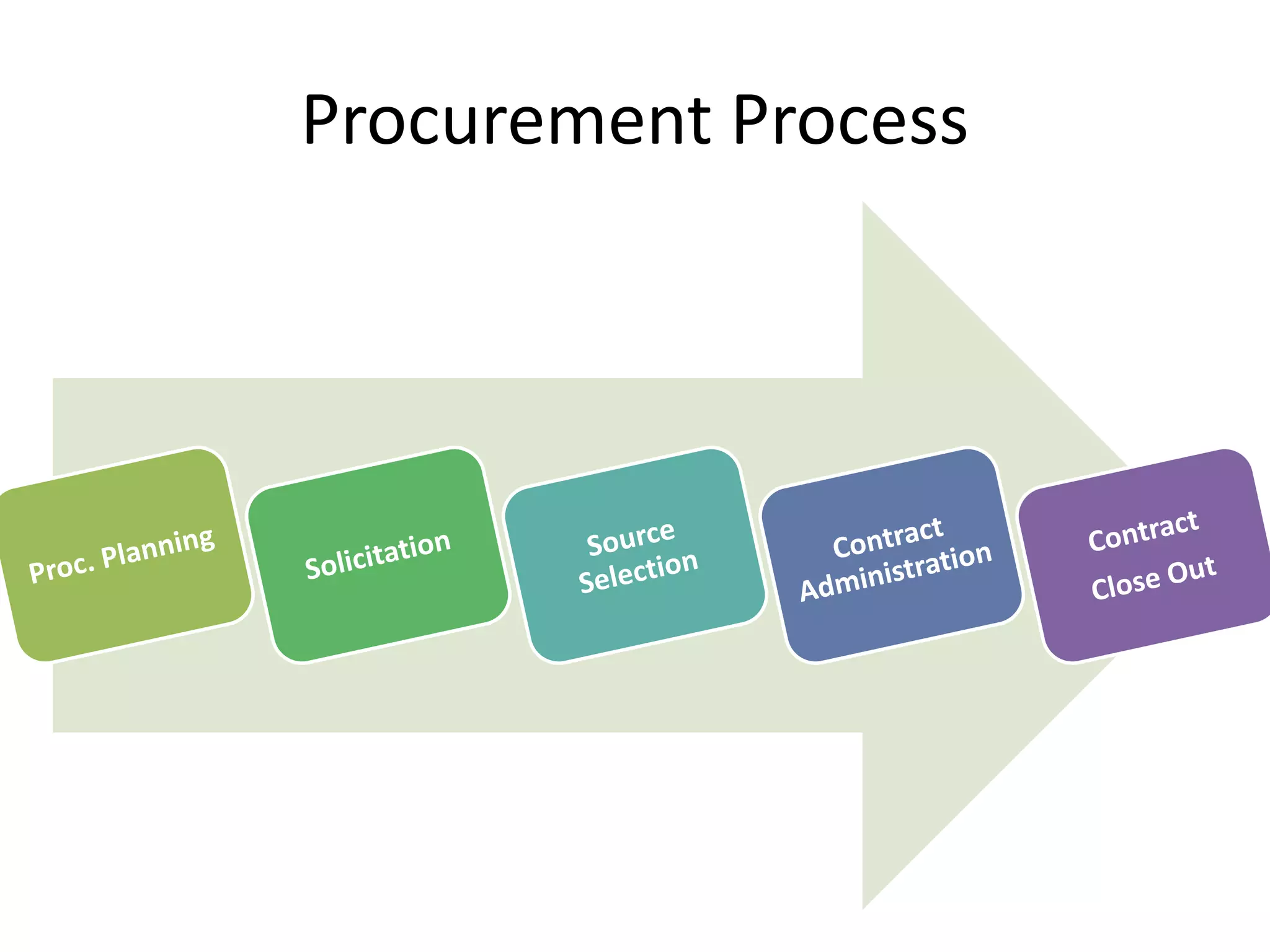
Procurement Process
Procurement Planning
Deciding what to procure / When &
How , by whom
* Make / Buy Analysis
Eg : Buying an Off the shelf software ? Or
Develop a bespoke software ?
1
Off the Shelf Bespoke
Advantages •Less Expensive to buy
than develop
• Saves Development Time
• Less no of Errors
identified / high accuracy
• less amount of Testing
needed
• Added maintenance
support
•Maximize user satisfaction
• Modifications can be
done
• ensure confidentiality
•Completely caters to
business functions
•Versions can be released
Disadvantages •Modifications are not
usually possible
• unwanted features may
exist
•Might not cater to all
business functions
•Standards may be
different
•More expensive
•Takes time to develop /
test
•Can have errors at the
beginning
•Less support and guidance
provided as a standard
Make – Buy Analysis
Eg : Assume that you can rent a machine for
$800 per day. To purchase the item the cost is
$12000 PLUS a daily operational cost of $400.
Whats the minimum duration the machine
must be used , so that the buying would be
more beneficial than leasing.
Answer
12000 + 400d = C ------- 1
800d = C -------- 2
As 1 = 2
12000 + 400 d = 800 d
d = 12000/400 = 30
The machine should be used for at least 30 days ,
for purchasing to be beneficial.
Solicitation
• Process of finding potential suppliers
Eg :
Advertising procurement notices
RFP notices
Call for tenders / Quotations
2
• Quotation : go for least price
• Proposal : different approaches to meet
customers needs
• Tender : goes for the lowest price
Source Selection
• Evaluate sellers
• The facilities given by them
• Choose the best seller
• Eg : weighted averaging model
3
Example
Weight Dialog Weighted
Score
Etisalat Weighted
Score
Bandwidth 15% 100
mbps
15% * 100 50 mbps 15% * 50
Network
Coverage
25% 70% in
SL
25% *
70%
80% in SL 25% * 80%
Rental 50% 300 50% * -
300
800 50% *- 800
Data Use 10% 20GB 10% * 20 10GB 10% * 10
Total ?? ??
* Highest weighted average indicate the best service
Contract Administration
• Prepare Contracts
• Manage relationships with suppliers
• Making necessary updates to contracts
(revising)
• Renewal of contracts
4
Contract Close-out
Payments settled
Open items settled
Sign off contract
Close the contract / renew the contract
Pay / settle necessary compensation / damages
5
Types of Contracts
Fixed price
• Pays the
initially
agreed cost
• Suits well
designed
products or
services
Cost
reimbursable
• Pays the
actual cost
spent
• Suits for new
, risky ,
experimental
products
Unit pricing
• Pay per unit
Time and
Material Costs
• Pay fixed
price + time
based rate
• Initial Capital
+ hourly
payment for
repair
Fixed Price Contracts
• Pays the fixed total price
• Good for reliable contracts
• 2 types
– Fixed Price
– Fixed Price + Incentive
1. Fixed Price Contracts : Only pays the fixed fee, No
incentives
2. Fixed Price + Incentive
fixed amount + Additional amount (conditional)
Example : for 30 chairs , buyer pays 50000 plus
additional incentive of 3000 for delivering
goods ahead of schedule
Total cost = 50000 + 3000 = 53000
Cost Reimbursable Contracts
• Cost Plus Incentive Fee (CPIF)
• Cost Plus Fixed Fee ( CPFF)
• Cost Plus Percentage of Cost ( CPPC)
Cost + Incentive Fee (CPIF)
Actual Cost + Fixed Incentive+ Incentive Bonus
Example : a project expects 100000 for a
contract but the actual cost is 80000. The
contract agrees to pay a 10000 supplier fee &
an incentive bonus of 15% for saving cost.
Calculate the cost of contract
Actual Cost + Fixed Incentive+ Incentive Bonus
Cost = 80000 + 10000 + (20000 * 15%)
Cost = 93000/=
Cost Plus Fixed Fee ( CPFF)
• Buyer has to pay only the allowable
performance cost + fixed incentive
Cost = Allowable p. cost + Incentive based on
agreed cost
A project expects 100000 and a fee of 10% of
expected cost. If the project spends 120000,
calculate contract cost
Cost = Allowable p. cost + Incentive
Cost = 120000 + (100000 * 10%)
Cost = 130000
Cost plus Percentage of Cost ( CPPC)
Cost = Allowable P. Cost + Incentive based on
Actual cost
For the above example ,
A project expects 100000 and a fee of 10% of
expected cost. If the project spends 120000,
calculate contact cost
Cost = Allowable P. Cost + Incentive based on
Actual cost
Cost = 120000 + (120000 * 10%)
Cost = 132 000
This kind of contracts are prohibited in some
countries.
Procurement Management

Procurement Management

  • 1.
  • 2.
    What’s Procurement ? Buying Goods& Services from external Organizations
  • 3.
    Goods Services Computers Internet TablesElectricity Books Security Routers Cleaning Cables Water Supply Stationary Web Hosting Building Material CCTV Fixing Vehicles Computer Equipment Maintenance
  • 4.
    Outsourcing • Acquiring HumanResources from external organizations
  • 5.
    Who provides thesegoods & Services? • Suppliers • Vendors • Contractors • Sellers • Sub contractors
  • 6.
  • 7.
    Procurement Planning Deciding whatto procure / When & How , by whom * Make / Buy Analysis Eg : Buying an Off the shelf software ? Or Develop a bespoke software ? 1
  • 8.
    Off the ShelfBespoke Advantages •Less Expensive to buy than develop • Saves Development Time • Less no of Errors identified / high accuracy • less amount of Testing needed • Added maintenance support •Maximize user satisfaction • Modifications can be done • ensure confidentiality •Completely caters to business functions •Versions can be released Disadvantages •Modifications are not usually possible • unwanted features may exist •Might not cater to all business functions •Standards may be different •More expensive •Takes time to develop / test •Can have errors at the beginning •Less support and guidance provided as a standard
  • 9.
    Make – BuyAnalysis Eg : Assume that you can rent a machine for $800 per day. To purchase the item the cost is $12000 PLUS a daily operational cost of $400. Whats the minimum duration the machine must be used , so that the buying would be more beneficial than leasing.
  • 10.
    Answer 12000 + 400d= C ------- 1 800d = C -------- 2 As 1 = 2 12000 + 400 d = 800 d d = 12000/400 = 30 The machine should be used for at least 30 days , for purchasing to be beneficial.
  • 11.
    Solicitation • Process offinding potential suppliers Eg : Advertising procurement notices RFP notices Call for tenders / Quotations 2
  • 12.
    • Quotation :go for least price • Proposal : different approaches to meet customers needs • Tender : goes for the lowest price
  • 13.
    Source Selection • Evaluatesellers • The facilities given by them • Choose the best seller • Eg : weighted averaging model 3
  • 14.
    Example Weight Dialog Weighted Score EtisalatWeighted Score Bandwidth 15% 100 mbps 15% * 100 50 mbps 15% * 50 Network Coverage 25% 70% in SL 25% * 70% 80% in SL 25% * 80% Rental 50% 300 50% * - 300 800 50% *- 800 Data Use 10% 20GB 10% * 20 10GB 10% * 10 Total ?? ?? * Highest weighted average indicate the best service
  • 15.
    Contract Administration • PrepareContracts • Manage relationships with suppliers • Making necessary updates to contracts (revising) • Renewal of contracts 4
  • 16.
    Contract Close-out Payments settled Openitems settled Sign off contract Close the contract / renew the contract Pay / settle necessary compensation / damages 5
  • 17.
    Types of Contracts Fixedprice • Pays the initially agreed cost • Suits well designed products or services Cost reimbursable • Pays the actual cost spent • Suits for new , risky , experimental products Unit pricing • Pay per unit Time and Material Costs • Pay fixed price + time based rate • Initial Capital + hourly payment for repair
  • 18.
    Fixed Price Contracts •Pays the fixed total price • Good for reliable contracts • 2 types – Fixed Price – Fixed Price + Incentive 1. Fixed Price Contracts : Only pays the fixed fee, No incentives
  • 19.
    2. Fixed Price+ Incentive fixed amount + Additional amount (conditional) Example : for 30 chairs , buyer pays 50000 plus additional incentive of 3000 for delivering goods ahead of schedule Total cost = 50000 + 3000 = 53000
  • 20.
    Cost Reimbursable Contracts •Cost Plus Incentive Fee (CPIF) • Cost Plus Fixed Fee ( CPFF) • Cost Plus Percentage of Cost ( CPPC)
  • 21.
    Cost + IncentiveFee (CPIF) Actual Cost + Fixed Incentive+ Incentive Bonus Example : a project expects 100000 for a contract but the actual cost is 80000. The contract agrees to pay a 10000 supplier fee & an incentive bonus of 15% for saving cost. Calculate the cost of contract
  • 22.
    Actual Cost +Fixed Incentive+ Incentive Bonus Cost = 80000 + 10000 + (20000 * 15%) Cost = 93000/=
  • 23.
    Cost Plus FixedFee ( CPFF) • Buyer has to pay only the allowable performance cost + fixed incentive Cost = Allowable p. cost + Incentive based on agreed cost A project expects 100000 and a fee of 10% of expected cost. If the project spends 120000, calculate contract cost
  • 24.
    Cost = Allowablep. cost + Incentive Cost = 120000 + (100000 * 10%) Cost = 130000
  • 25.
    Cost plus Percentageof Cost ( CPPC) Cost = Allowable P. Cost + Incentive based on Actual cost For the above example , A project expects 100000 and a fee of 10% of expected cost. If the project spends 120000, calculate contact cost
  • 26.
    Cost = AllowableP. Cost + Incentive based on Actual cost Cost = 120000 + (120000 * 10%) Cost = 132 000 This kind of contracts are prohibited in some countries.