1
Plumber’s Hand Tools
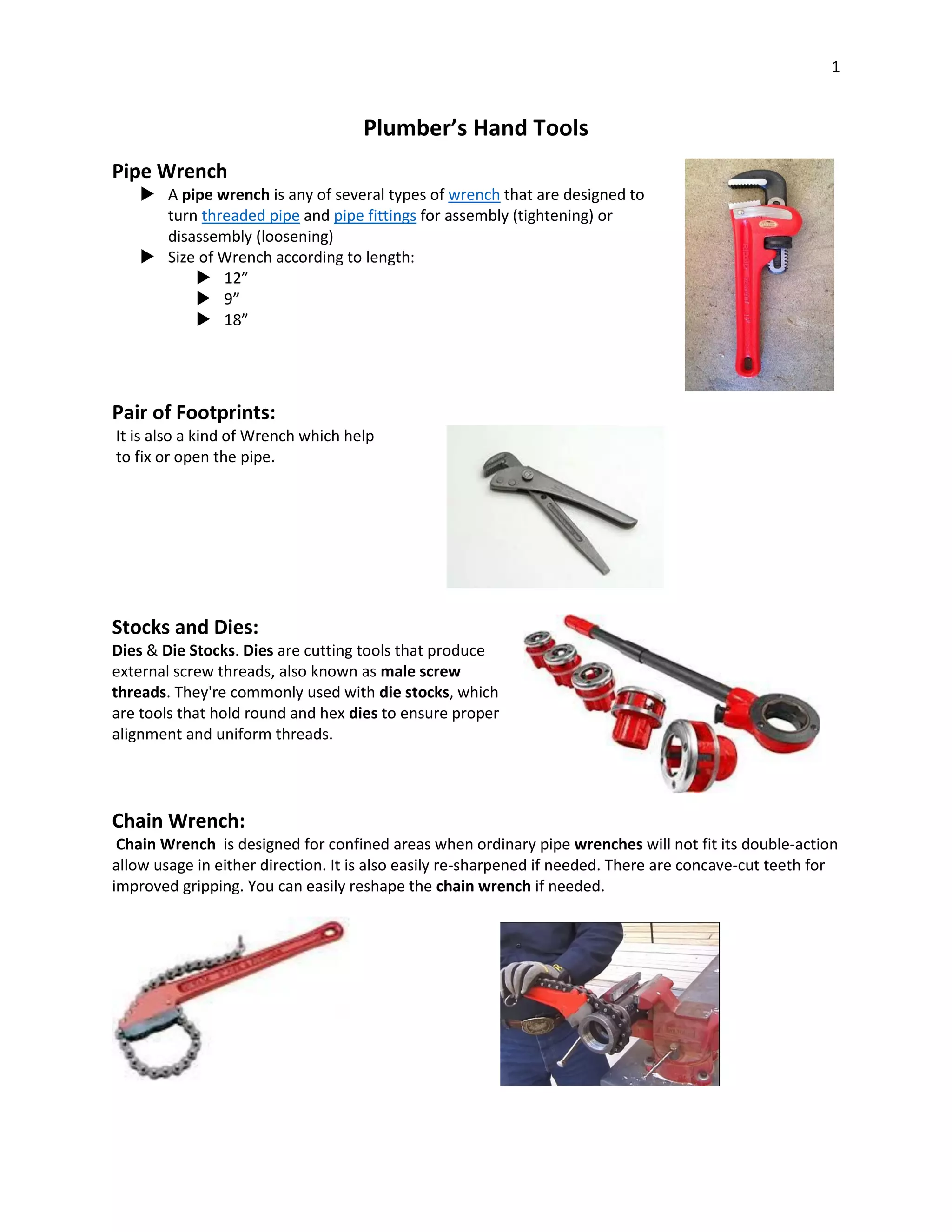
Pipe Wrench
 A pipe wrench is any of several types of wrench that are designed to
turn threaded pipe and pipe fittings for assembly (tightening) or
disassembly (loosening)
 Size of Wrench according to length:
 12”
 9”
 18”
Pair of Footprints:
It is also a kind of Wrench which help
to fix or open the pipe.
Stocks and Dies:
Dies & Die Stocks. Dies are cutting tools that produce
external screw threads, also known as male screw
threads. They're commonly used with die stocks, which
are tools that hold round and hex dies to ensure proper
alignment and uniform threads.
Chain Wrench:
Chain Wrench is designed for confined areas when ordinary pipe wrenches will not fit its double-action
allow usage in either direction. It is also easily re-sharpened if needed. There are concave-cut teeth for
improved gripping. You can easily reshape the chain wrench if needed.
2
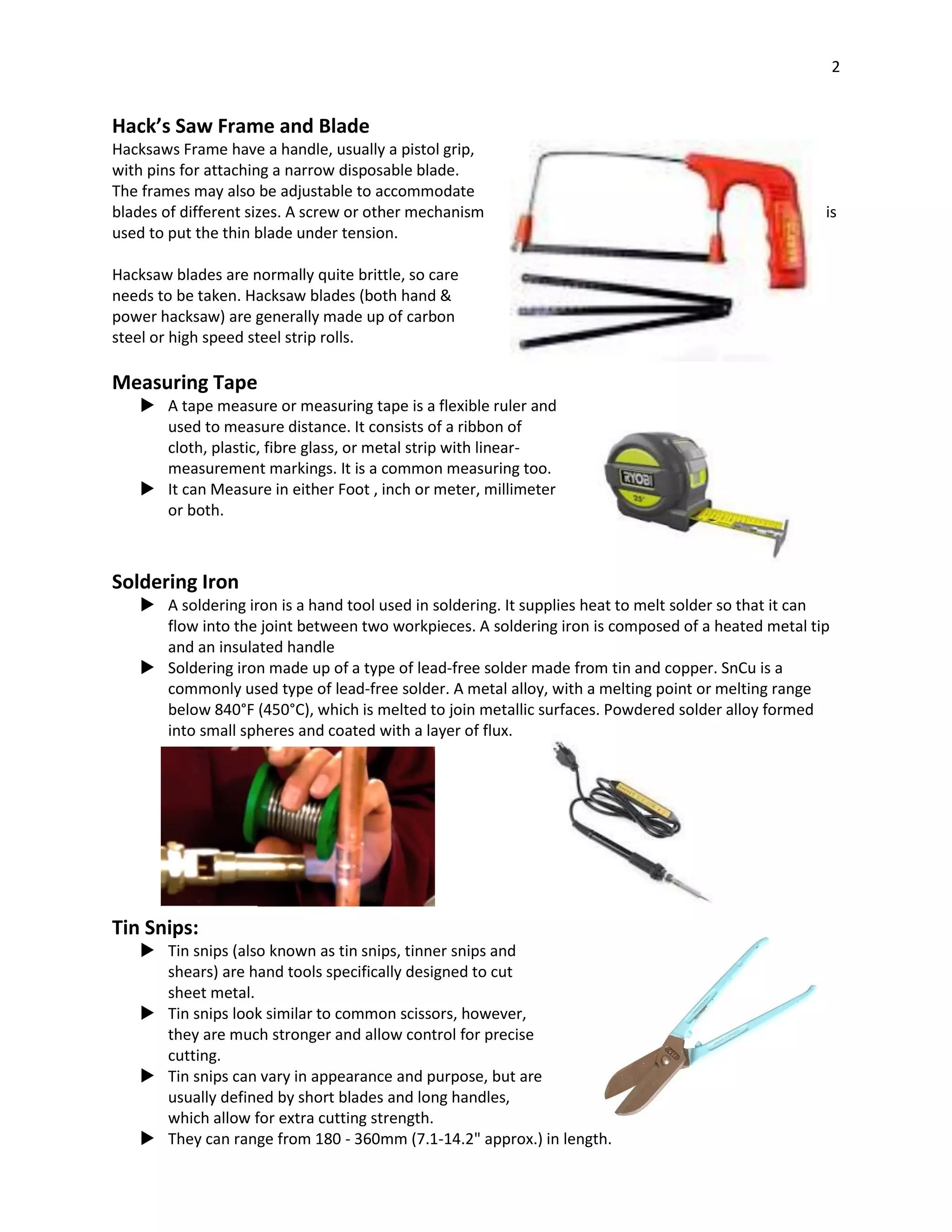
Hack’s Saw Frame and Blade
Hacksaws Frame have a handle, usually a pistol grip,
with pins for attaching a narrow disposable blade.
The frames may also be adjustable to accommodate
blades of different sizes. A screw or other mechanism is
used to put the thin blade under tension.
Hacksaw blades are normally quite brittle, so care
needs to be taken. Hacksaw blades (both hand &
power hacksaw) are generally made up of carbon
steel or high speed steel strip rolls.
Measuring Tape
 A tape measure or measuring tape is a flexible ruler and
used to measure distance. It consists of a ribbon of
cloth, plastic, fibre glass, or metal strip with linear-
measurement markings. It is a common measuring too.
 It can Measure in either Foot , inch or meter, millimeter
or both.
Soldering Iron
 A soldering iron is a hand tool used in soldering. It supplies heat to melt solder so that it can
flow into the joint between two workpieces. A soldering iron is composed of a heated metal tip
and an insulated handle
 Soldering iron made up of a type of lead-free solder made from tin and copper. SnCu is a
commonly used type of lead-free solder. A metal alloy, with a melting point or melting range
below 840°F (450°C), which is melted to join metallic surfaces. Powdered solder alloy formed
into small spheres and coated with a layer of flux.
Tin Snips:
 Tin snips (also known as tin snips, tinner snips and
shears) are hand tools specifically designed to cut
sheet metal.
 Tin snips look similar to common scissors, however,
they are much stronger and allow control for precise
cutting.
 Tin snips can vary in appearance and purpose, but are
usually defined by short blades and long handles,
which allow for extra cutting strength.
 They can range from 180 - 360mm (7.1-14.2" approx.) in length.
3
Rasp/ Filer
 A rasp is coarse form of file[1]
used for coarsely shaping
wood or other material. Typically a hand tool, it consists
of a generally tapered rectangular, round, or half-round
sectioned bar of case hardened steel with distinct,
individually cut teeth.[1]
A narrow, pointed tang is
common at one end, to which a handle may be fitted. It
may also known as filer.
Caulking iron
 a tool, rather like a chisel, used to caulk a ship
 A chisel is a tool with a characteristically shaped cutting edge (such that wood chisels have lent
part of their name to a particular grind) of blade on its end, for carving or cutting a hard material
such as wood, stone, or metal by hand, struck with a mallet, or mechanical power.[1]
The handle
and blade of some types of chisel are made of metal or of wood with a sharp edge in it
Adjustable wrench up to 12 long
 A wrench is a tool for turning nuts or bolts. It is made up of
steel.
 Adjustable wrench have moveable Jaw, which make it
adjustable to various size of nuts.. A heavy type of
adjustable wrench is monkey wrench which shows in figure
beside.
4
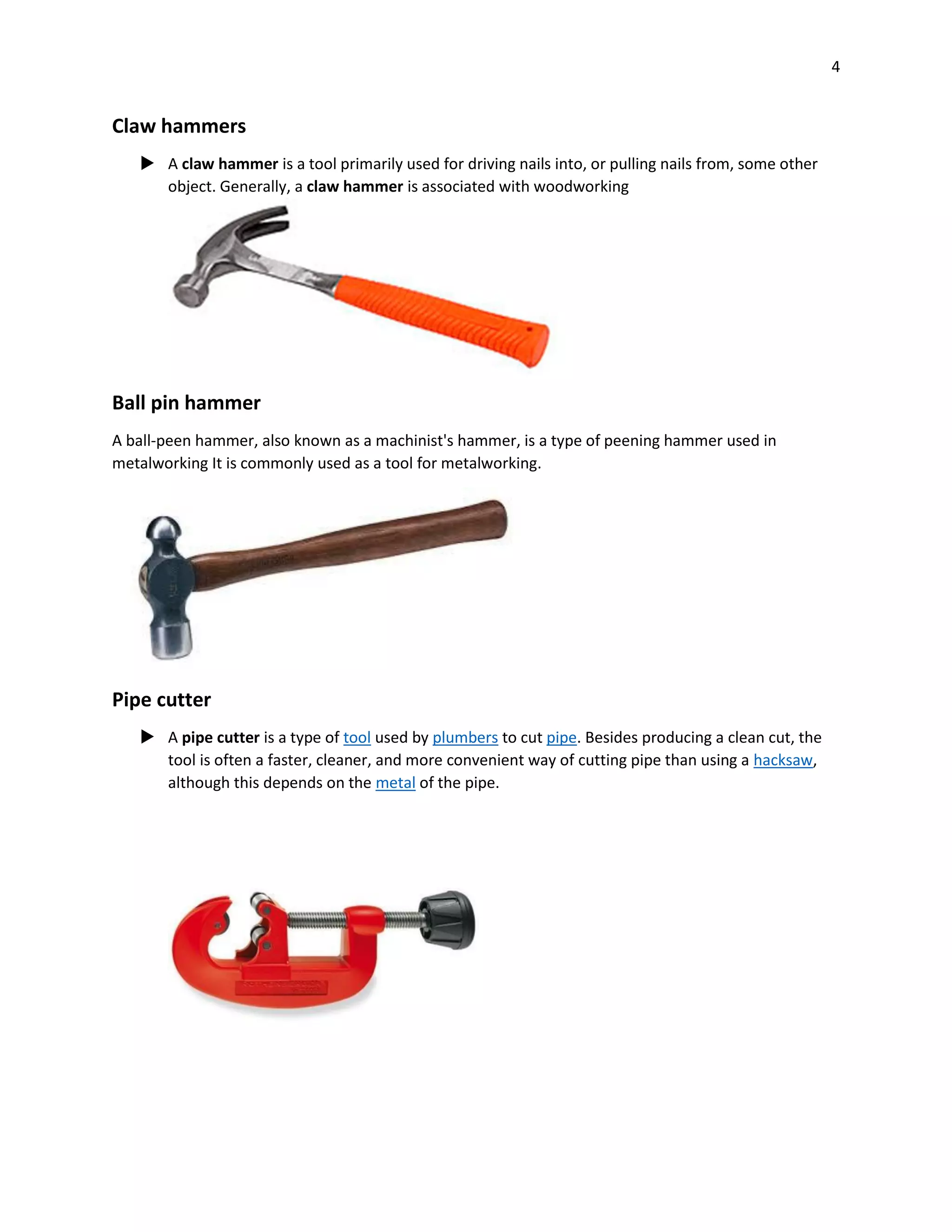
Claw hammers
 A claw hammer is a tool primarily used for driving nails into, or pulling nails from, some other
object. Generally, a claw hammer is associated with woodworking
Ball pin hammer
A ball-peen hammer, also known as a machinist's hammer, is a type of peening hammer used in
metalworking It is commonly used as a tool for metalworking.
Pipe cutter
 A pipe cutter is a type of tool used by plumbers to cut pipe. Besides producing a clean cut, the
tool is often a faster, cleaner, and more convenient way of cutting pipe than using a hacksaw,
although this depends on the metal of the pipe.
5
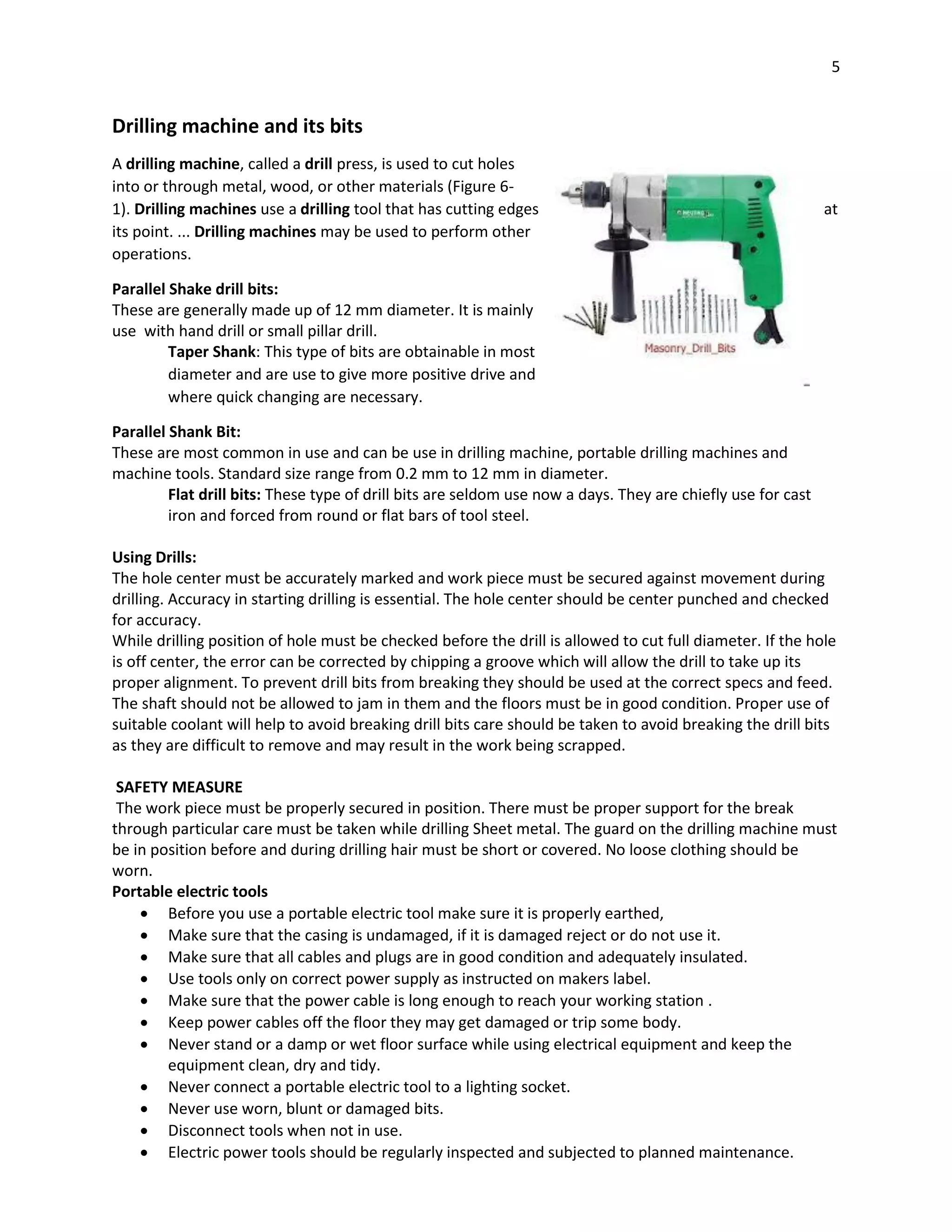
Drilling machine and its bits
A drilling machine, called a drill press, is used to cut holes
into or through metal, wood, or other materials (Figure 6-
1). Drilling machines use a drilling tool that has cutting edges at
its point. ... Drilling machines may be used to perform other
operations.
Parallel Shake drill bits:
These are generally made up of 12 mm diameter. It is mainly
use with hand drill or small pillar drill.
Taper Shank: This type of bits are obtainable in most
diameter and are use to give more positive drive and
where quick changing are necessary.
Parallel Shank Bit:
These are most common in use and can be use in drilling machine, portable drilling machines and
machine tools. Standard size range from 0.2 mm to 12 mm in diameter.
Flat drill bits: These type of drill bits are seldom use now a days. They are chiefly use for cast
iron and forced from round or flat bars of tool steel.
Using Drills:
The hole center must be accurately marked and work piece must be secured against movement during
drilling. Accuracy in starting drilling is essential. The hole center should be center punched and checked
for accuracy.
While drilling position of hole must be checked before the drill is allowed to cut full diameter. If the hole
is off center, the error can be corrected by chipping a groove which will allow the drill to take up its
proper alignment. To prevent drill bits from breaking they should be used at the correct specs and feed.
The shaft should not be allowed to jam in them and the floors must be in good condition. Proper use of
suitable coolant will help to avoid breaking drill bits care should be taken to avoid breaking the drill bits
as they are difficult to remove and may result in the work being scrapped.
SAFETY MEASURE
The work piece must be properly secured in position. There must be proper support for the break
through particular care must be taken while drilling Sheet metal. The guard on the drilling machine must
be in position before and during drilling hair must be short or covered. No loose clothing should be
worn.
Portable electric tools
 Before you use a portable electric tool make sure it is properly earthed,
 Make sure that the casing is undamaged, if it is damaged reject or do not use it.
 Make sure that all cables and plugs are in good condition and adequately insulated.
 Use tools only on correct power supply as instructed on makers label.
 Make sure that the power cable is long enough to reach your working station .
 Keep power cables off the floor they may get damaged or trip some body.
 Never stand or a damp or wet floor surface while using electrical equipment and keep the
equipment clean, dry and tidy.
 Never connect a portable electric tool to a lighting socket.
 Never use worn, blunt or damaged bits.
 Disconnect tools when not in use.
 Electric power tools should be regularly inspected and subjected to planned maintenance.
6
Spanners of various size
It is kind of a tool with a shaped opening or jaws for gripping and turning a nut or bolt
Bench vice
 A vise (American English) or vice (British English) is
a mechanical apparatus used to secure an object
to allow work to be performed on it. Vises have
two parallel jaws, one fixed and the other
movable, threaded in and out by
a screw and lever.
Folding rulers metallic/ Steel
 A ruler, sometimes called a rule or line gauge, is a
device used in geometry and technical drawing,
as well as the engineering and construction
industries, to measure or draw straight lines
 Folding rules, sometimes called zig-zag rules or
jointed rules, are a series of two or more
smaller rule strips joined with hinges. These rules
can be folded together to be carried easily, or
used in confined spaces.
Try Squire
 A try square is a woodworking or a
metalworking tool used for marking
and measuring a piece of wood. The
square refers to the tool's primary use
of measuring the accuracy of a right
angle; to try a surface is to check its
straightness or correspondence to an
adjoining surface.
7
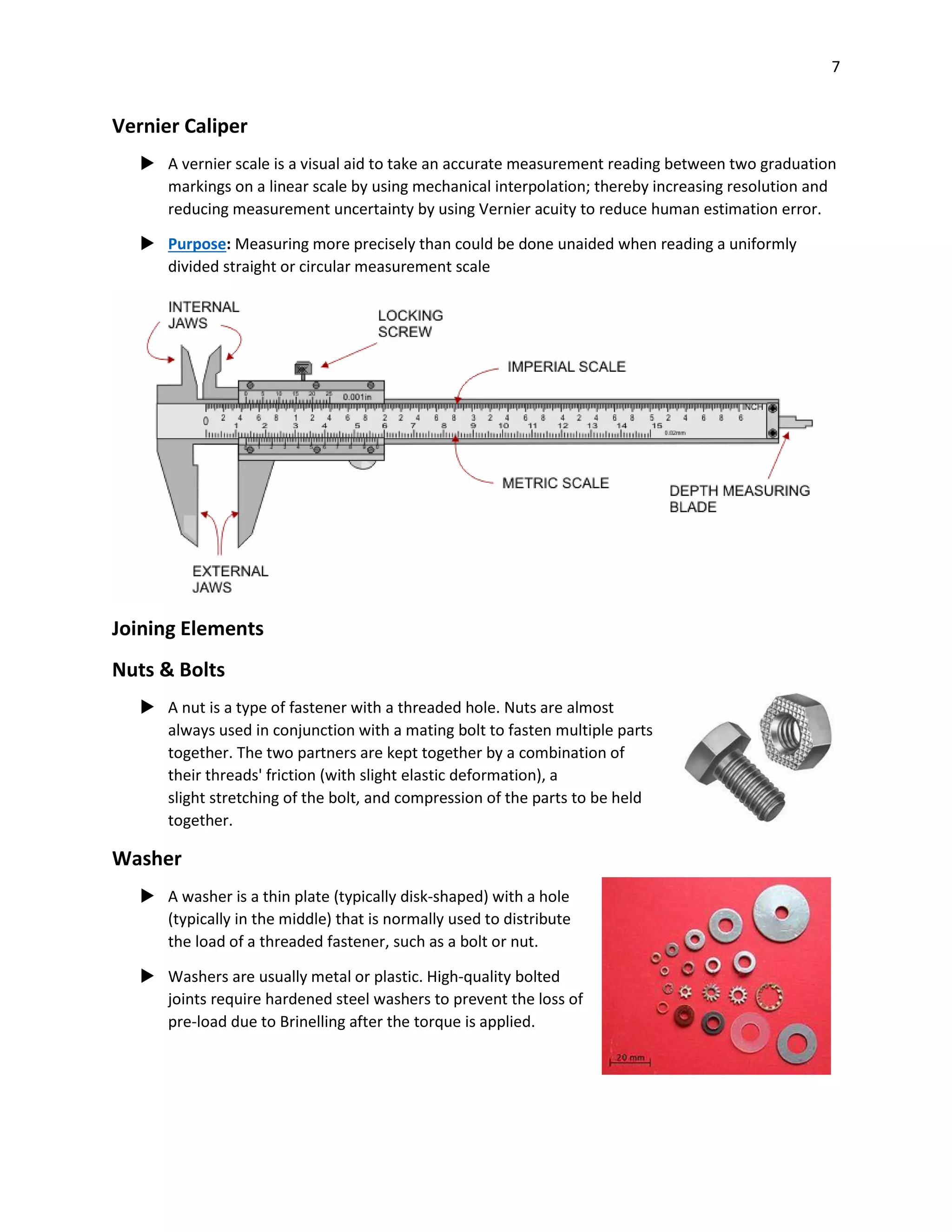
Vernier Caliper
 A vernier scale is a visual aid to take an accurate measurement reading between two graduation
markings on a linear scale by using mechanical interpolation; thereby increasing resolution and
reducing measurement uncertainty by using Vernier acuity to reduce human estimation error.
 Purpose: Measuring more precisely than could be done unaided when reading a uniformly
divided straight or circular measurement scale
Joining Elements
Nuts & Bolts
 A nut is a type of fastener with a threaded hole. Nuts are almost
always used in conjunction with a mating bolt to fasten multiple parts
together. The two partners are kept together by a combination of
their threads' friction (with slight elastic deformation), a
slight stretching of the bolt, and compression of the parts to be held
together.
Washer
 A washer is a thin plate (typically disk-shaped) with a hole
(typically in the middle) that is normally used to distribute
the load of a threaded fastener, such as a bolt or nut.
 Washers are usually metal or plastic. High-quality bolted
joints require hardened steel washers to prevent the loss of
pre-load due to Brinelling after the torque is applied.
8
Screws
 A screw is a type of fastener, in some ways
similar to a bolt (see Differentiation between
bolt and screw below), typically made of metal,
and characterized by a helical ridge, known as
a male thread (external thread). Screws are used
to fasten materials by digging in and wedging
into a material when turned, while the thread
cuts grooves in the fastened material that may
help pull fastened materials together and
prevent pull-out.
Rivets
 A rivet is a permanent mechanical fastener. Before being installed, a rivet consists of a
smooth cylindrical shaft with a head on one end. The end opposite to the head is called the tail.
On installation, the rivet is placed in a punched or drilled hole, and the tail is upset,
or bucked (i.e., deformed), so that it expands to about 1.5 times the original shaft diameter,
holding the rivet in place.
Jute
 Jute is a long, soft, shiny vegetable fiber that can be
spun into coarse, strong threads. It is produced
primarily from plants in the genus Corchorus.
Pipe Tape
 Thread seal tape (also known as PTFE tape, Teflon
tape, or plumber's tape) is
a polytetrafluoroethylene (PTFE) film tape
commonly used in plumbing for sealing pipe
threads.
9
Joining Element- Lead
 Most of us know that lead is bad
so it’s hard to fathom the
possibility of there being lead in
the water. In fact, lead is one of
the best studied toxic-
substances and we know more
about the negative health
effects than almost any other
chemical. This abundance of
information however is
unfortunately due to lead’s
predominate use throughout
history starting in the Roman
Empire and extending through
the 1990s.
 It had also used as joining element of pipes and protect from leakage.
 Lead is a soft, malleable, ductile (drawn out into a thin wire) and heavy metal. It initially has a
bluish-white color that tarnishes to a dull gray color when exposed to air. It is corrosion resistant
and when melted into a liquid has a shiny chrome-silver look.

Plumbers hand tools

  • 1.
    1 Plumber’s Hand Tools PipeWrench  A pipe wrench is any of several types of wrench that are designed to turn threaded pipe and pipe fittings for assembly (tightening) or disassembly (loosening)  Size of Wrench according to length:  12”  9”  18” Pair of Footprints: It is also a kind of Wrench which help to fix or open the pipe. Stocks and Dies: Dies & Die Stocks. Dies are cutting tools that produce external screw threads, also known as male screw threads. They're commonly used with die stocks, which are tools that hold round and hex dies to ensure proper alignment and uniform threads. Chain Wrench: Chain Wrench is designed for confined areas when ordinary pipe wrenches will not fit its double-action allow usage in either direction. It is also easily re-sharpened if needed. There are concave-cut teeth for improved gripping. You can easily reshape the chain wrench if needed.
  • 2.
    2 Hack’s Saw Frameand Blade Hacksaws Frame have a handle, usually a pistol grip, with pins for attaching a narrow disposable blade. The frames may also be adjustable to accommodate blades of different sizes. A screw or other mechanism is used to put the thin blade under tension. Hacksaw blades are normally quite brittle, so care needs to be taken. Hacksaw blades (both hand & power hacksaw) are generally made up of carbon steel or high speed steel strip rolls. Measuring Tape  A tape measure or measuring tape is a flexible ruler and used to measure distance. It consists of a ribbon of cloth, plastic, fibre glass, or metal strip with linear- measurement markings. It is a common measuring too.  It can Measure in either Foot , inch or meter, millimeter or both. Soldering Iron  A soldering iron is a hand tool used in soldering. It supplies heat to melt solder so that it can flow into the joint between two workpieces. A soldering iron is composed of a heated metal tip and an insulated handle  Soldering iron made up of a type of lead-free solder made from tin and copper. SnCu is a commonly used type of lead-free solder. A metal alloy, with a melting point or melting range below 840°F (450°C), which is melted to join metallic surfaces. Powdered solder alloy formed into small spheres and coated with a layer of flux. Tin Snips:  Tin snips (also known as tin snips, tinner snips and shears) are hand tools specifically designed to cut sheet metal.  Tin snips look similar to common scissors, however, they are much stronger and allow control for precise cutting.  Tin snips can vary in appearance and purpose, but are usually defined by short blades and long handles, which allow for extra cutting strength.  They can range from 180 - 360mm (7.1-14.2" approx.) in length.
  • 3.
    3 Rasp/ Filer  Arasp is coarse form of file[1] used for coarsely shaping wood or other material. Typically a hand tool, it consists of a generally tapered rectangular, round, or half-round sectioned bar of case hardened steel with distinct, individually cut teeth.[1] A narrow, pointed tang is common at one end, to which a handle may be fitted. It may also known as filer. Caulking iron  a tool, rather like a chisel, used to caulk a ship  A chisel is a tool with a characteristically shaped cutting edge (such that wood chisels have lent part of their name to a particular grind) of blade on its end, for carving or cutting a hard material such as wood, stone, or metal by hand, struck with a mallet, or mechanical power.[1] The handle and blade of some types of chisel are made of metal or of wood with a sharp edge in it Adjustable wrench up to 12 long  A wrench is a tool for turning nuts or bolts. It is made up of steel.  Adjustable wrench have moveable Jaw, which make it adjustable to various size of nuts.. A heavy type of adjustable wrench is monkey wrench which shows in figure beside.
  • 4.
    4 Claw hammers  Aclaw hammer is a tool primarily used for driving nails into, or pulling nails from, some other object. Generally, a claw hammer is associated with woodworking Ball pin hammer A ball-peen hammer, also known as a machinist's hammer, is a type of peening hammer used in metalworking It is commonly used as a tool for metalworking. Pipe cutter  A pipe cutter is a type of tool used by plumbers to cut pipe. Besides producing a clean cut, the tool is often a faster, cleaner, and more convenient way of cutting pipe than using a hacksaw, although this depends on the metal of the pipe.
  • 5.
    5 Drilling machine andits bits A drilling machine, called a drill press, is used to cut holes into or through metal, wood, or other materials (Figure 6- 1). Drilling machines use a drilling tool that has cutting edges at its point. ... Drilling machines may be used to perform other operations. Parallel Shake drill bits: These are generally made up of 12 mm diameter. It is mainly use with hand drill or small pillar drill. Taper Shank: This type of bits are obtainable in most diameter and are use to give more positive drive and where quick changing are necessary. Parallel Shank Bit: These are most common in use and can be use in drilling machine, portable drilling machines and machine tools. Standard size range from 0.2 mm to 12 mm in diameter. Flat drill bits: These type of drill bits are seldom use now a days. They are chiefly use for cast iron and forced from round or flat bars of tool steel. Using Drills: The hole center must be accurately marked and work piece must be secured against movement during drilling. Accuracy in starting drilling is essential. The hole center should be center punched and checked for accuracy. While drilling position of hole must be checked before the drill is allowed to cut full diameter. If the hole is off center, the error can be corrected by chipping a groove which will allow the drill to take up its proper alignment. To prevent drill bits from breaking they should be used at the correct specs and feed. The shaft should not be allowed to jam in them and the floors must be in good condition. Proper use of suitable coolant will help to avoid breaking drill bits care should be taken to avoid breaking the drill bits as they are difficult to remove and may result in the work being scrapped. SAFETY MEASURE The work piece must be properly secured in position. There must be proper support for the break through particular care must be taken while drilling Sheet metal. The guard on the drilling machine must be in position before and during drilling hair must be short or covered. No loose clothing should be worn. Portable electric tools  Before you use a portable electric tool make sure it is properly earthed,  Make sure that the casing is undamaged, if it is damaged reject or do not use it.  Make sure that all cables and plugs are in good condition and adequately insulated.  Use tools only on correct power supply as instructed on makers label.  Make sure that the power cable is long enough to reach your working station .  Keep power cables off the floor they may get damaged or trip some body.  Never stand or a damp or wet floor surface while using electrical equipment and keep the equipment clean, dry and tidy.  Never connect a portable electric tool to a lighting socket.  Never use worn, blunt or damaged bits.  Disconnect tools when not in use.  Electric power tools should be regularly inspected and subjected to planned maintenance.
  • 6.
    6 Spanners of varioussize It is kind of a tool with a shaped opening or jaws for gripping and turning a nut or bolt Bench vice  A vise (American English) or vice (British English) is a mechanical apparatus used to secure an object to allow work to be performed on it. Vises have two parallel jaws, one fixed and the other movable, threaded in and out by a screw and lever. Folding rulers metallic/ Steel  A ruler, sometimes called a rule or line gauge, is a device used in geometry and technical drawing, as well as the engineering and construction industries, to measure or draw straight lines  Folding rules, sometimes called zig-zag rules or jointed rules, are a series of two or more smaller rule strips joined with hinges. These rules can be folded together to be carried easily, or used in confined spaces. Try Squire  A try square is a woodworking or a metalworking tool used for marking and measuring a piece of wood. The square refers to the tool's primary use of measuring the accuracy of a right angle; to try a surface is to check its straightness or correspondence to an adjoining surface.
  • 7.
    7 Vernier Caliper  Avernier scale is a visual aid to take an accurate measurement reading between two graduation markings on a linear scale by using mechanical interpolation; thereby increasing resolution and reducing measurement uncertainty by using Vernier acuity to reduce human estimation error.  Purpose: Measuring more precisely than could be done unaided when reading a uniformly divided straight or circular measurement scale Joining Elements Nuts & Bolts  A nut is a type of fastener with a threaded hole. Nuts are almost always used in conjunction with a mating bolt to fasten multiple parts together. The two partners are kept together by a combination of their threads' friction (with slight elastic deformation), a slight stretching of the bolt, and compression of the parts to be held together. Washer  A washer is a thin plate (typically disk-shaped) with a hole (typically in the middle) that is normally used to distribute the load of a threaded fastener, such as a bolt or nut.  Washers are usually metal or plastic. High-quality bolted joints require hardened steel washers to prevent the loss of pre-load due to Brinelling after the torque is applied.
  • 8.
    8 Screws  A screwis a type of fastener, in some ways similar to a bolt (see Differentiation between bolt and screw below), typically made of metal, and characterized by a helical ridge, known as a male thread (external thread). Screws are used to fasten materials by digging in and wedging into a material when turned, while the thread cuts grooves in the fastened material that may help pull fastened materials together and prevent pull-out. Rivets  A rivet is a permanent mechanical fastener. Before being installed, a rivet consists of a smooth cylindrical shaft with a head on one end. The end opposite to the head is called the tail. On installation, the rivet is placed in a punched or drilled hole, and the tail is upset, or bucked (i.e., deformed), so that it expands to about 1.5 times the original shaft diameter, holding the rivet in place. Jute  Jute is a long, soft, shiny vegetable fiber that can be spun into coarse, strong threads. It is produced primarily from plants in the genus Corchorus. Pipe Tape  Thread seal tape (also known as PTFE tape, Teflon tape, or plumber's tape) is a polytetrafluoroethylene (PTFE) film tape commonly used in plumbing for sealing pipe threads.
  • 9.
    9 Joining Element- Lead Most of us know that lead is bad so it’s hard to fathom the possibility of there being lead in the water. In fact, lead is one of the best studied toxic- substances and we know more about the negative health effects than almost any other chemical. This abundance of information however is unfortunately due to lead’s predominate use throughout history starting in the Roman Empire and extending through the 1990s.  It had also used as joining element of pipes and protect from leakage.  Lead is a soft, malleable, ductile (drawn out into a thin wire) and heavy metal. It initially has a bluish-white color that tarnishes to a dull gray color when exposed to air. It is corrosion resistant and when melted into a liquid has a shiny chrome-silver look.