Bench Fitting Tools
Lecture
Industrial Tool Usage
 Two categories
Hand tools
1. Cutting tools
2. Non cutting tools
Machine tools
 Importance of hand tools should not be
overlooked
Classes of Hand Tools
 Cutting Tools
Used to separate, part, trim, or divide
parts
Include saws, grinders, files, and etc.
Classes of Hand Tools
Noncutting Tools
Used basically for holding, forming,
assembling, reassembling, destroying, or
dismantling parts
Include vices, hammers, screwdrivers,
wrenches, pliers, and etc.
Bench Fitting Shop
Fitting is the process of assembling
various parts manufactured in the
machine shop.
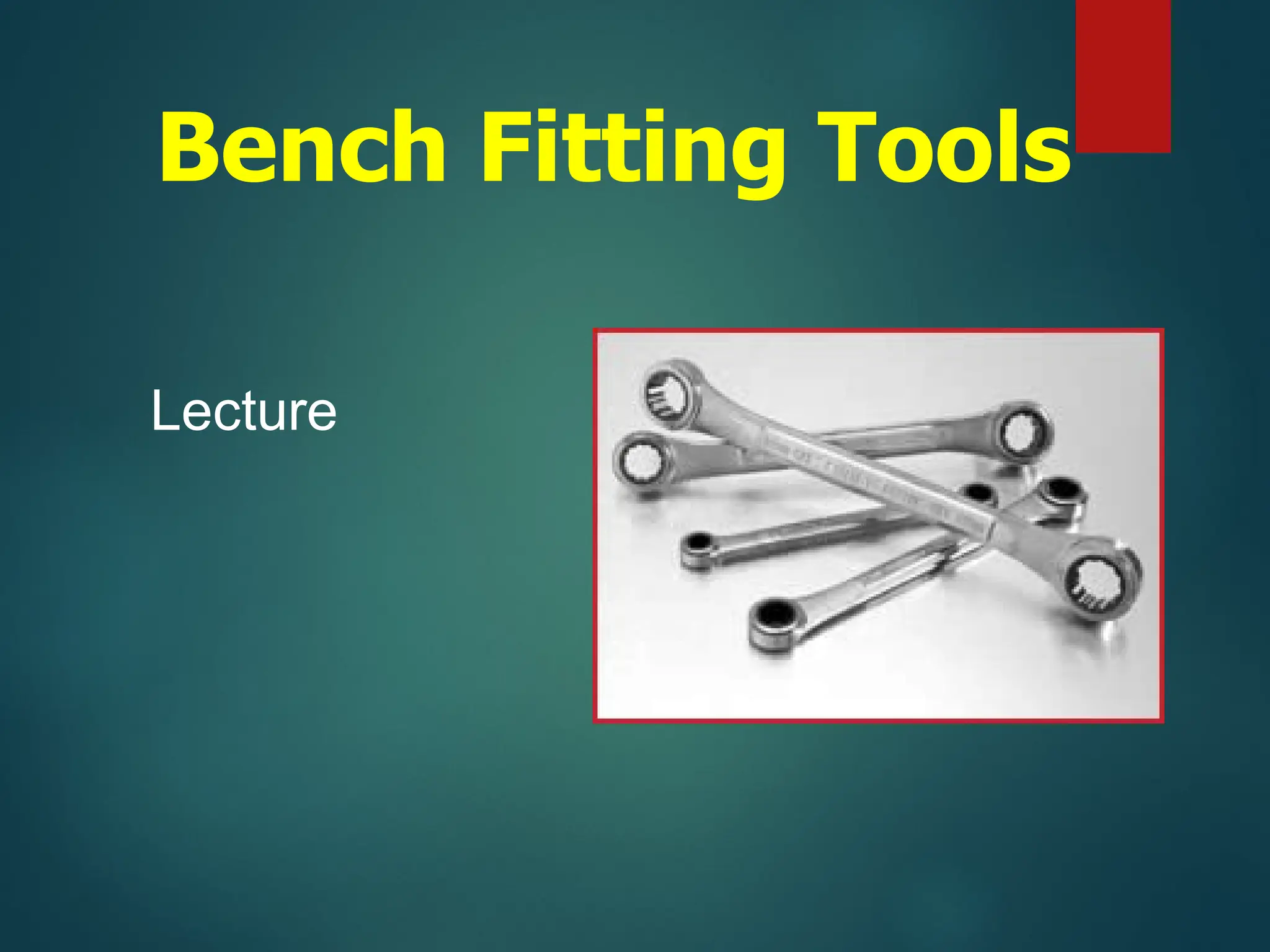
Bench Fitting Tools
Tools used in Fitting shop
1.Measuring tools
2.Marking tools
3.Holding tools
4.Striking tools
5.Loosening and tightening tools
6.Cutting tools
7.Threading tools
Measuring Tools
Measuring Tools
 Steel Rule
 Vernier Caliper
 Measuring Tape
 Thread Pitch Gauge
 Feeler Gauge
 Try Square
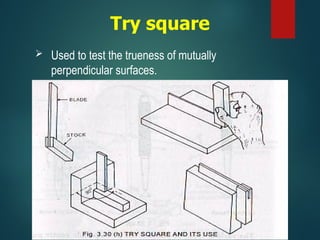
Try square
 Used to test the trueness of mutually
perpendicular surfaces.
Marking Tools
Marking Tools
Marking is the process of layout of sizes on
work piece. The following tools are used in
marking out operations.
1. Scriber
2. Punch
3. Divider
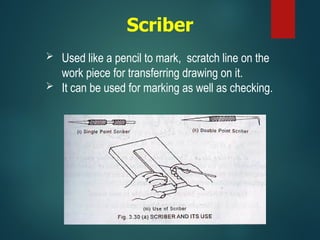
Scriber
 Used like a pencil to mark, scratch line on the
work piece for transferring drawing on it.
 It can be used for marking as well as checking.
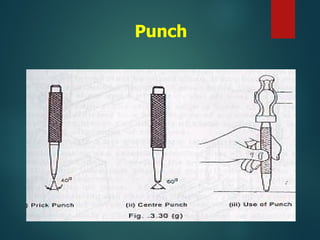
Punch
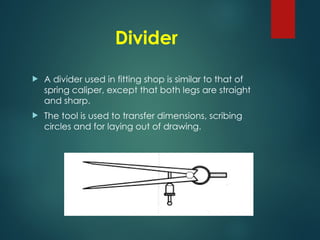
Divider
 A divider used in fitting shop is similar to that of
spring caliper, except that both legs are straight
and sharp.
 The tool is used to transfer dimensions, scribing
circles and for laying out of drawing.
Holding Tools
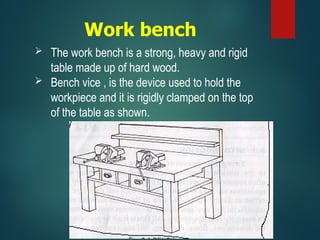
Work bench
 The work bench is a strong, heavy and rigid
table made up of hard wood.
 Bench vice , is the device used to hold the
workpiece and it is rigidly clamped on the top
of the table as shown.
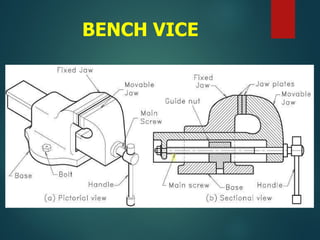
Bench Vice
 Also Called Machinist’s Vice
 Used to hold small work securely for sawing,
filing, polishing, drilling, reaming, and tapping
 It consists of one moveable and one fixed jaw.
 The jaws are opened upto required length, job
is placed in the two jaws and is fully tightened
with handle.
BENCH VICE
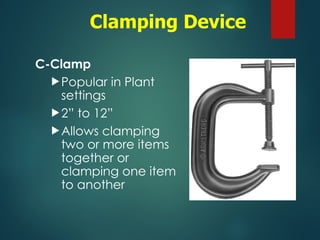
Clamping Device
C-Clamp
Popular in Plant
settings
2” to 12”
Allows clamping
two or more items
together or
clamping one item
to another
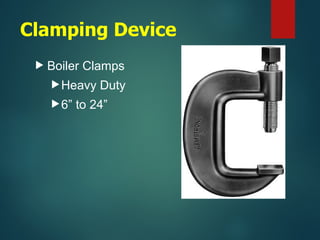
Clamping Device
 Boiler Clamps
Heavy Duty
6” to 24”
Striking Tools
Striking Tools
 These are used for striking purposes like
punching, chipping, marking, bending,
straightening and riveting
 Hammer is basic striking tool
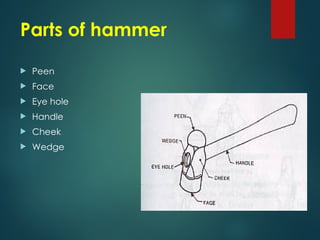
Parts of hammer
 Peen
 Face
 Eye hole
 Handle
 Cheek
 Wedge
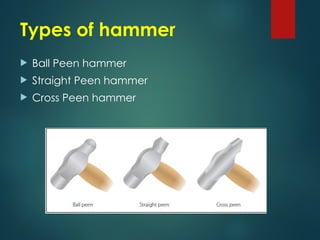
Types of hammer
 Ball Peen hammer
 Straight Peen hammer
 Cross Peen hammer
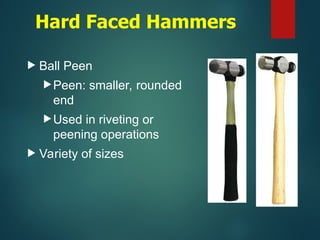
Hard Faced Hammers
 Ball Peen
Peen: smaller, rounded
end
Used in riveting or
peening operations
 Variety of sizes
Shop
Tools
and
Techniques
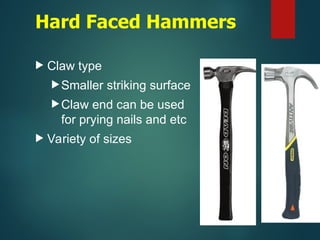
Hard Faced Hammers
 Claw type
Smaller striking surface
Claw end can be used
for prying nails and etc
 Variety of sizes
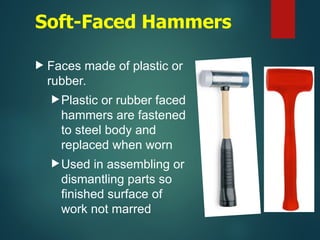
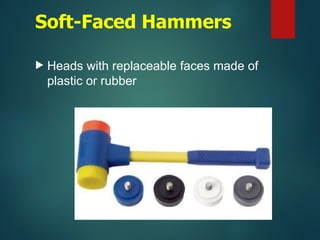
Soft-Faced Hammers
 Faces made of plastic or
rubber.
Plastic or rubber faced
hammers are fastened
to steel body and
replaced when worn
Used in assembling or
dismantling parts so
finished surface of
work not marred
Soft-Faced Hammers
 Heads with replaceable faces made of
plastic or rubber
Loosening and Tightening tools
Screwdrivers
 Two most common types
Standard or flat blade
Phillips
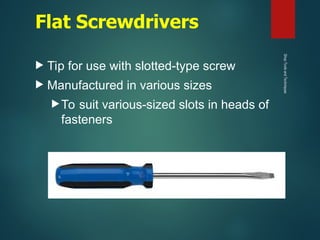
Flat Screwdrivers
 Tip for use with slotted-type screw
 Manufactured in various sizes
To suit various-sized slots in heads of
fasteners
Shop
Tools
and
Techniques
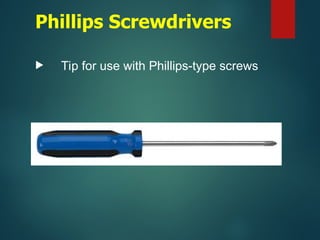
Phillips Screwdrivers
 Tip for use with Phillips-type screws
Spanners
 Many types used in machine shop work
 Each suited for specific purpose
 Name derived from use, shape, or
construction
 Most available in both inch and metric
measuring systems
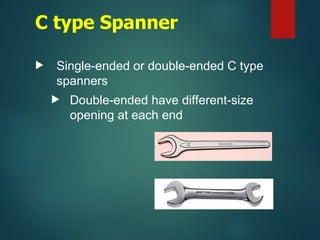
C type Spanner
 Single-ended or double-ended C type
spanners
 Double-ended have different-size
opening at each end
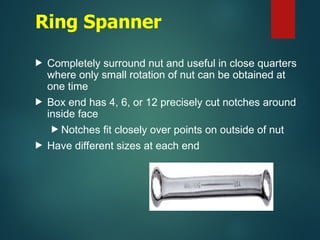
Ring Spanner
 Completely surround nut and useful in close quarters
where only small rotation of nut can be obtained at
one time
 Box end has 4, 6, or 12 precisely cut notches around
inside face
 Notches fit closely over points on outside of nut
 Have different sizes at each end
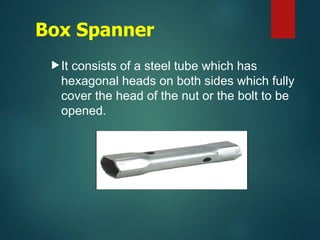
Box Spanner
It consists of a steel tube which has
hexagonal heads on both sides which fully
cover the head of the nut or the bolt to be
opened.
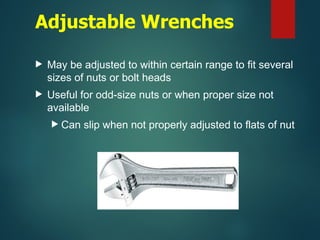
Adjustable Wrenches
 May be adjusted to within certain range to fit several
sizes of nuts or bolt heads
 Useful for odd-size nuts or when proper size not
available
 Can slip when not properly adjusted to flats of nut
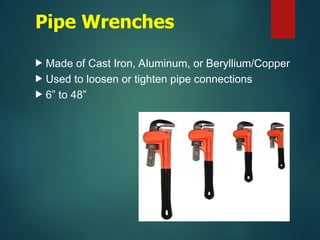
Pipe Wrenches
 Made of Cast Iron, Aluminum, or Beryllium/Copper
 Used to loosen or tighten pipe connections
 6” to 48”
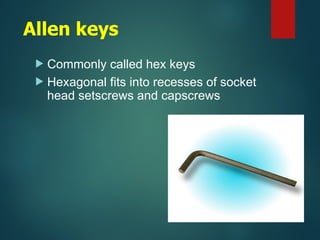
Allen keys
 Commonly called hex keys
 Hexagonal fits into recesses of socket
head setscrews and capscrews
Pliers
 Useful for gripping and holding small parts
for certain machining operations or when
assembling parts
 Many types and sizes
 Names by shape, function or construction
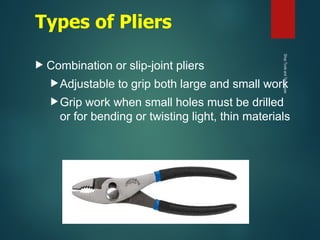
Types of Pliers
 Combination or slip-joint pliers
Adjustable to grip both large and small work
Grip work when small holes must be drilled
or for bending or twisting light, thin materials
Shop
Tools
and
Techniques
Types of Pliers
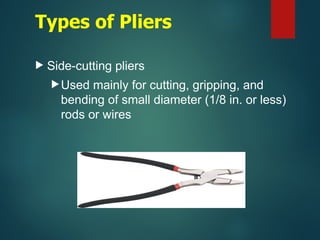
 Side-cutting pliers
Used mainly for cutting, gripping, and
bending of small diameter (1/8 in. or less)
rods or wires
Types of Pliers
 Needle-nose pliers
Available in both straight- and bent-nose
types
Useful for holding very small parts,
positioning them in hard-to-get-at places
and bending wire
Cutting Tools
Cutting Tools
Often necessary to perform certain metal-
cutting operations at bench or on job
Common tools
Hacksaws
Files
Chisels
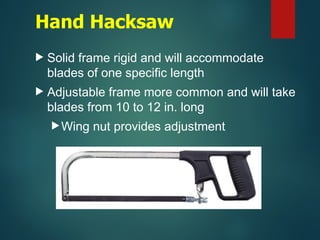
Hand Hacksaw
 Solid frame rigid and will accommodate
blades of one specific length
 Adjustable frame more common and will take
blades from 10 to 12 in. long
Wing nut provides adjustment
Files
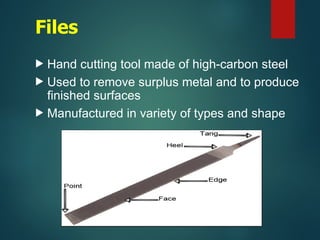
 Hand cutting tool made of high-carbon steel
 Used to remove surplus metal and to produce
finished surfaces
 Manufactured in variety of types and shape
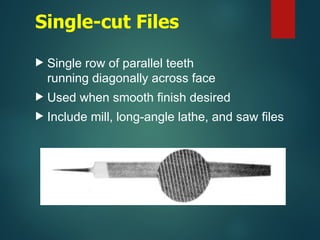
Single-cut Files
 Single row of parallel teeth
running diagonally across face
 Used when smooth finish desired
 Include mill, long-angle lathe, and saw files
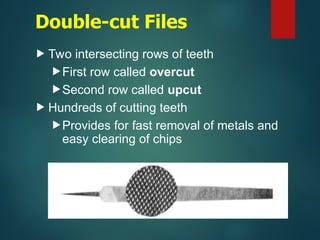
Double-cut Files
 Two intersecting rows of teeth
First row called overcut
Second row called upcut
 Hundreds of cutting teeth
Provides for fast removal of metals and
easy clearing of chips
Machinist Files
 Types most commonly used in shop
• Flat
• Round
• Half-round
• Square
• Triangle
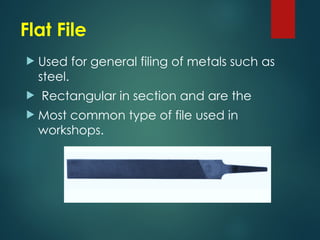
Flat File
 Used for general filing of metals such as
steel.
 Rectangular in section and are the
 Most common type of file used in
workshops.
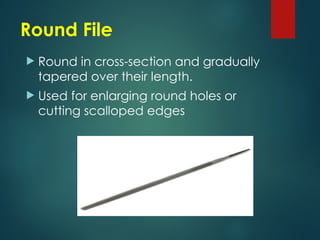
Round File
 Round in cross-section and gradually
tapered over their length.
 Used for enlarging round holes or
cutting scalloped edges
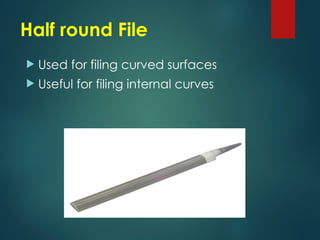
Half round File
 Used for filing curved surfaces
 Useful for filing internal curves
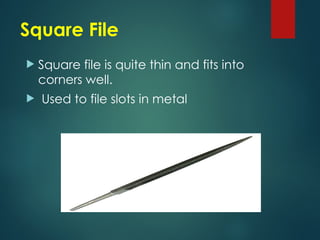
Square File
 Square file is quite thin and fits into
corners well.
 Used to file slots in metal
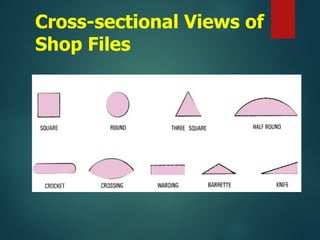
Cross-sectional Views of
Shop Files
Filing Methods
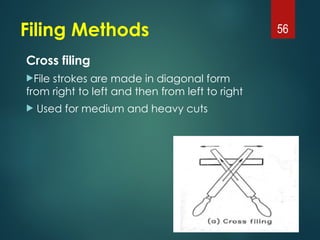
Cross filing
File strokes are made in diagonal form
from right to left and then from left to right
 Used for medium and heavy cuts
56
Filing Methods
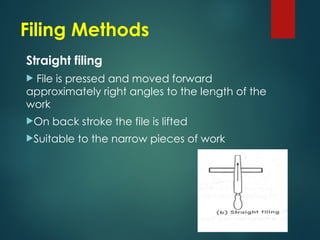
Straight filing
 File is pressed and moved forward
approximately right angles to the length of the
work
On back stroke the file is lifted
Suitable to the narrow pieces of work
Filing Methods
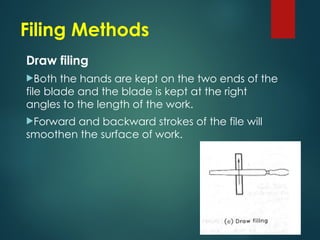
Draw filing
Both the hands are kept on the two ends of the
file blade and the blade is kept at the right
angles to the length of the work.
Forward and backward strokes of the file will
smoothen the surface of work.
Care of Files
1. Do not store files where they rub together
 Don’t throw into drawer with other files
2. Never use file as pry of hammer
3. Do not knock file on vise or other metallic
object to clean it
 Use brush or file card
4. Apply pressure only on forward stroke
Chisel
 Chisels are used to cut or chip off
metal from work piece.
 Two types of chisel
1. Flat chisel
2. Cross cut chisel
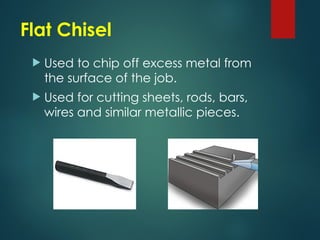
Flat Chisel
 Used to chip off excess metal from
the surface of the job.
 Used for cutting sheets, rods, bars,
wires and similar metallic pieces.
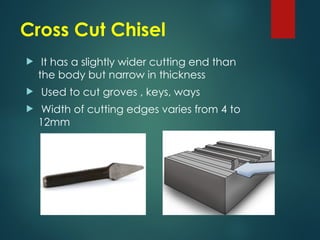
Cross Cut Chisel
 It has a slightly wider cutting end than
the body but narrow in thickness
 Used to cut groves , keys, ways
 Width of cutting edges varies from 4 to
12mm
Threading Tools
Threading Tools
 Tap is used to cut internal threads
on a hole drilled to the core
diameter of the thread.
 Die is used to cut threads on a
round bar of a metal, such as the
threads on a bolt.
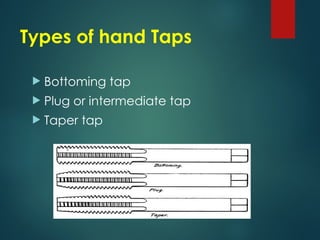
Types of hand Taps
 Bottoming tap
 Plug or intermediate tap
 Taper tap
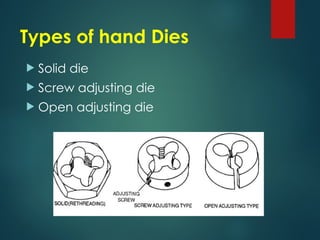
Types of hand Dies
 Solid die
 Screw adjusting die
 Open adjusting die
Bench_fitting_tool_mechanical_workshop.ppt

  • 1.
  • 2.
    Industrial Tool Usage Two categories Hand tools 1. Cutting tools 2. Non cutting tools Machine tools  Importance of hand tools should not be overlooked
  • 3.
    Classes of HandTools  Cutting Tools Used to separate, part, trim, or divide parts Include saws, grinders, files, and etc.
  • 4.
    Classes of HandTools Noncutting Tools Used basically for holding, forming, assembling, reassembling, destroying, or dismantling parts Include vices, hammers, screwdrivers, wrenches, pliers, and etc.
  • 5.
    Bench Fitting Shop Fittingis the process of assembling various parts manufactured in the machine shop.
  • 6.
    Bench Fitting Tools Toolsused in Fitting shop 1.Measuring tools 2.Marking tools 3.Holding tools 4.Striking tools 5.Loosening and tightening tools 6.Cutting tools 7.Threading tools
  • 7.
  • 8.
    Measuring Tools  SteelRule  Vernier Caliper  Measuring Tape  Thread Pitch Gauge  Feeler Gauge  Try Square
  • 9.
    Try square  Usedto test the trueness of mutually perpendicular surfaces.
  • 10.
  • 11.
    Marking Tools Marking isthe process of layout of sizes on work piece. The following tools are used in marking out operations. 1. Scriber 2. Punch 3. Divider
  • 12.
    Scriber  Used likea pencil to mark, scratch line on the work piece for transferring drawing on it.  It can be used for marking as well as checking.
  • 13.
  • 14.
    Divider  A dividerused in fitting shop is similar to that of spring caliper, except that both legs are straight and sharp.  The tool is used to transfer dimensions, scribing circles and for laying out of drawing.
  • 15.
  • 16.
    Work bench  Thework bench is a strong, heavy and rigid table made up of hard wood.  Bench vice , is the device used to hold the workpiece and it is rigidly clamped on the top of the table as shown.
  • 17.
    Bench Vice  AlsoCalled Machinist’s Vice  Used to hold small work securely for sawing, filing, polishing, drilling, reaming, and tapping  It consists of one moveable and one fixed jaw.  The jaws are opened upto required length, job is placed in the two jaws and is fully tightened with handle.
  • 18.
  • 19.
    Clamping Device C-Clamp Popular inPlant settings 2” to 12” Allows clamping two or more items together or clamping one item to another
  • 20.
    Clamping Device  BoilerClamps Heavy Duty 6” to 24”
  • 21.
  • 22.
    Striking Tools  Theseare used for striking purposes like punching, chipping, marking, bending, straightening and riveting  Hammer is basic striking tool
  • 23.
    Parts of hammer Peen  Face  Eye hole  Handle  Cheek  Wedge
  • 24.
    Types of hammer Ball Peen hammer  Straight Peen hammer  Cross Peen hammer
  • 25.
    Hard Faced Hammers Ball Peen Peen: smaller, rounded end Used in riveting or peening operations  Variety of sizes Shop Tools and Techniques
  • 26.
    Hard Faced Hammers Claw type Smaller striking surface Claw end can be used for prying nails and etc  Variety of sizes
  • 27.
    Soft-Faced Hammers  Facesmade of plastic or rubber. Plastic or rubber faced hammers are fastened to steel body and replaced when worn Used in assembling or dismantling parts so finished surface of work not marred
  • 28.
    Soft-Faced Hammers  Headswith replaceable faces made of plastic or rubber
  • 29.
  • 30.
    Screwdrivers  Two mostcommon types Standard or flat blade Phillips
  • 31.
    Flat Screwdrivers  Tipfor use with slotted-type screw  Manufactured in various sizes To suit various-sized slots in heads of fasteners Shop Tools and Techniques
  • 32.
    Phillips Screwdrivers  Tipfor use with Phillips-type screws
  • 33.
    Spanners  Many typesused in machine shop work  Each suited for specific purpose  Name derived from use, shape, or construction  Most available in both inch and metric measuring systems
  • 34.
    C type Spanner Single-ended or double-ended C type spanners  Double-ended have different-size opening at each end
  • 35.
    Ring Spanner  Completelysurround nut and useful in close quarters where only small rotation of nut can be obtained at one time  Box end has 4, 6, or 12 precisely cut notches around inside face  Notches fit closely over points on outside of nut  Have different sizes at each end
  • 36.
    Box Spanner It consistsof a steel tube which has hexagonal heads on both sides which fully cover the head of the nut or the bolt to be opened.
  • 37.
    Adjustable Wrenches  Maybe adjusted to within certain range to fit several sizes of nuts or bolt heads  Useful for odd-size nuts or when proper size not available  Can slip when not properly adjusted to flats of nut
  • 38.
    Pipe Wrenches  Madeof Cast Iron, Aluminum, or Beryllium/Copper  Used to loosen or tighten pipe connections  6” to 48”
  • 39.
    Allen keys  Commonlycalled hex keys  Hexagonal fits into recesses of socket head setscrews and capscrews
  • 40.
    Pliers  Useful forgripping and holding small parts for certain machining operations or when assembling parts  Many types and sizes  Names by shape, function or construction
  • 41.
    Types of Pliers Combination or slip-joint pliers Adjustable to grip both large and small work Grip work when small holes must be drilled or for bending or twisting light, thin materials Shop Tools and Techniques
  • 42.
    Types of Pliers Side-cutting pliers Used mainly for cutting, gripping, and bending of small diameter (1/8 in. or less) rods or wires
  • 43.
    Types of Pliers Needle-nose pliers Available in both straight- and bent-nose types Useful for holding very small parts, positioning them in hard-to-get-at places and bending wire
  • 44.
  • 45.
    Cutting Tools Often necessaryto perform certain metal- cutting operations at bench or on job Common tools Hacksaws Files Chisels
  • 46.
    Hand Hacksaw  Solidframe rigid and will accommodate blades of one specific length  Adjustable frame more common and will take blades from 10 to 12 in. long Wing nut provides adjustment
  • 47.
    Files  Hand cuttingtool made of high-carbon steel  Used to remove surplus metal and to produce finished surfaces  Manufactured in variety of types and shape
  • 48.
    Single-cut Files  Singlerow of parallel teeth running diagonally across face  Used when smooth finish desired  Include mill, long-angle lathe, and saw files
  • 49.
    Double-cut Files  Twointersecting rows of teeth First row called overcut Second row called upcut  Hundreds of cutting teeth Provides for fast removal of metals and easy clearing of chips
  • 50.
    Machinist Files  Typesmost commonly used in shop • Flat • Round • Half-round • Square • Triangle
  • 51.
    Flat File  Usedfor general filing of metals such as steel.  Rectangular in section and are the  Most common type of file used in workshops.
  • 52.
    Round File  Roundin cross-section and gradually tapered over their length.  Used for enlarging round holes or cutting scalloped edges
  • 53.
    Half round File Used for filing curved surfaces  Useful for filing internal curves
  • 54.
    Square File  Squarefile is quite thin and fits into corners well.  Used to file slots in metal
  • 55.
  • 56.
    Filing Methods Cross filing Filestrokes are made in diagonal form from right to left and then from left to right  Used for medium and heavy cuts 56
  • 57.
    Filing Methods Straight filing File is pressed and moved forward approximately right angles to the length of the work On back stroke the file is lifted Suitable to the narrow pieces of work
  • 58.
    Filing Methods Draw filing Boththe hands are kept on the two ends of the file blade and the blade is kept at the right angles to the length of the work. Forward and backward strokes of the file will smoothen the surface of work.
  • 59.
    Care of Files 1.Do not store files where they rub together  Don’t throw into drawer with other files 2. Never use file as pry of hammer 3. Do not knock file on vise or other metallic object to clean it  Use brush or file card 4. Apply pressure only on forward stroke
  • 60.
    Chisel  Chisels areused to cut or chip off metal from work piece.  Two types of chisel 1. Flat chisel 2. Cross cut chisel
  • 61.
    Flat Chisel  Usedto chip off excess metal from the surface of the job.  Used for cutting sheets, rods, bars, wires and similar metallic pieces.
  • 62.
    Cross Cut Chisel It has a slightly wider cutting end than the body but narrow in thickness  Used to cut groves , keys, ways  Width of cutting edges varies from 4 to 12mm
  • 63.
  • 64.
    Threading Tools  Tapis used to cut internal threads on a hole drilled to the core diameter of the thread.  Die is used to cut threads on a round bar of a metal, such as the threads on a bolt.
  • 65.
    Types of handTaps  Bottoming tap  Plug or intermediate tap  Taper tap
  • 66.
    Types of handDies  Solid die  Screw adjusting die  Open adjusting die