SHIELDED METAL ARC
WELDING
BASIC HAND TOOLS
Classificatio
ns of Hand
tools
1. Measuring Tools
2. Cutting Tools
3. Driving Tools
4. Holding Tools
5. Boring Tools
6. Markings Tools
7. Crimping Tools
8. Testing Tools
9. Stripping Tools
1. MEASURING TOOLS
• Measuring tools are those that used for
checking the length, width or thickness of
an objects for the shape of objects things
like the flatness, straightness, roundness
or squareness. Below are some of the
measuring tools that can be found in a
tool room and commonly used in SMAW
activities:
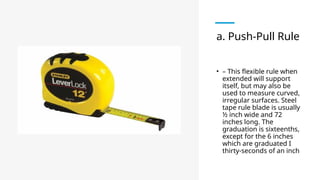
a. Push-Pull Rule
• – This flexible rule when
extended will support
itself, but may also be
used to measure curved,
irregular surfaces. Steel
tape rule blade is usually
½ inch wide and 72
inches long. The
graduation is sixteenths,
except for the 6 inches
which are graduated I
thirty-seconds of an inch
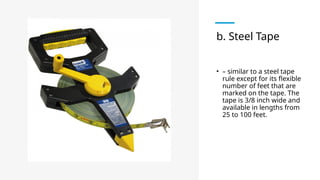
b. Steel Tape
• – similar to a steel tape
rule except for its flexible
number of feet that are
marked on the tape. The
tape is 3/8 inch wide and
available in lengths from
25 to 100 feet.
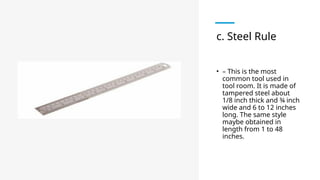
c. Steel Rule
• – This is the most
common tool used in
tool room. It is made of
tampered steel about
1/8 inch thick and ¾ inch
wide and 6 to 12 inches
long. The same style
maybe obtained in
length from 1 to 48
inches.
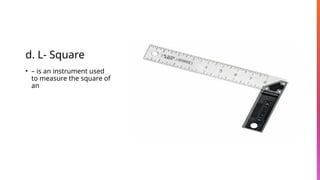
d. L- Square
• – is an instrument used
to measure the square of
an
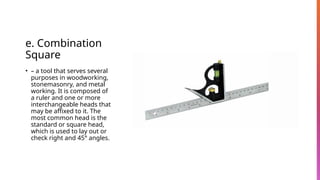
e. Combination
Square
• – a tool that serves several
purposes in woodworking,
stonemasonry, and metal
working. It is composed of
a ruler and one or more
interchangeable heads that
may be affixed to it. The
most common head is the
standard or square head,
which is used to lay out or
check right and 45° angles.
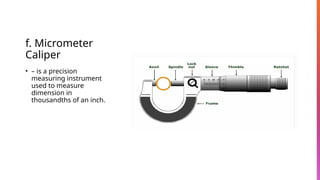
f. Micrometer
Caliper
• – is a precision
measuring instrument
used to measure
dimension in
thousandths of an inch.
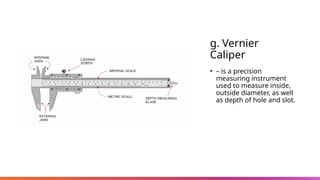
g. Vernier
Caliper
• – is a precision
measuring instrument
used to measure inside,
outside diameter, as well
as depth of hole and slot.
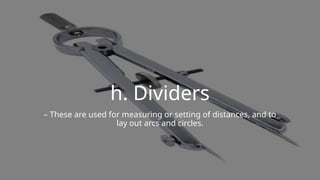
h. Dividers
– These are used for measuring or setting of distances, and to
lay out arcs and circles.
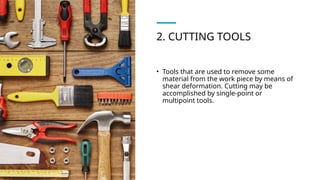
2. CUTTING TOOLS
• Tools that are used to remove some
material from the work piece by means of
shear deformation. Cutting may be
accomplished by single-point or
multipoint tools.
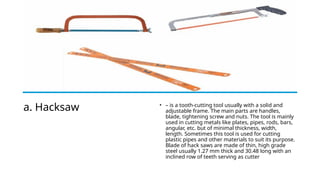
a. Hacksaw • – is a tooth-cutting tool usually with a solid and
adjustable frame. The main parts are handles,
blade, tightening screw and nuts. The tool is mainly
used in cutting metals like plates, pipes, rods, bars,
angular, etc. but of minimal thickness, width,
length. Sometimes this tool is used for cutting
plastic pipes and other materials to suit its purpose.
Blade of hack saws are made of thin, high grade
steel usually 1.27 mm thick and 30.48 long with an
inclined row of teeth serving as cutter
3. DRIVING TOOLS
• Any tool used to push (drive) object
into another object. Their general
purpose is to connect two pieces of
metal or objects together, reshape
to fit the desired output, or to
connect metal to another material.
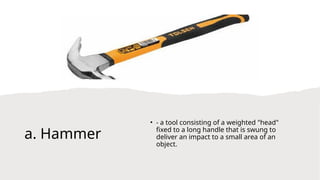
a. Hammer
• - a tool consisting of a weighted "head"
fixed to a long handle that is swung to
deliver an impact to a small area of an
object.
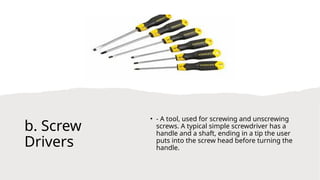
b. Screw
Drivers
• - A tool, used for screwing and unscrewing
screws. A typical simple screwdriver has a
handle and a shaft, ending in a tip the user
puts into the screw head before turning the
handle.
4. HOLDING
TOOLS
• Tools that are used to firmly holds any
material together. Each holding tool is
different but the common principles
between them is that they all secure a piece
of material when your working with it..
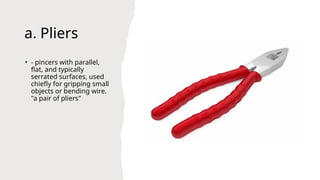
a. Pliers
• - pincers with parallel,
flat, and typically
serrated surfaces, used
chiefly for gripping small
objects or bending wire.
"a pair of pliers"
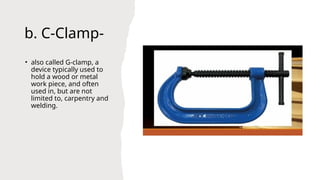
b. C-Clamp-
• also called G-clamp, a
device typically used to
hold a wood or metal
work piece, and often
used in, but are not
limited to, carpentry and
welding.
5. BORING
TOOLS
• Tools that are used to
make or enlarge a hole
that has already made
(or cast) by means of a
single-point cutting tool
(or of a boring head.
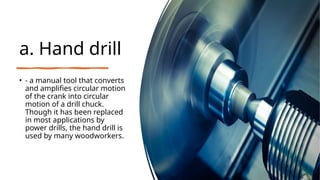
a. Hand drill
• - a manual tool that converts
and amplifies circular motion
of the crank into circular
motion of a drill chuck.
Though it has been replaced
in most applications by
power drills, the hand drill is
used by many woodworkers.
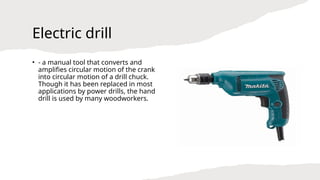
Electric drill
• - a manual tool that converts and
amplifies circular motion of the crank
into circular motion of a drill chuck.
Though it has been replaced in most
applications by power drills, the hand
drill is used by many woodworkers.
6.
MARKING
TOOLS
• Tools that are use to transfer
all the little notations that
appear on your pattern, the
ones that tell you where to
cut, fold, sew, or place
adjoining pieces. It tells the
pattern instructions, work
together with these notations
on how to manipulate each
pattern piece.
a. Lead Pencil
- a pencil of graphite enclosed in wood.
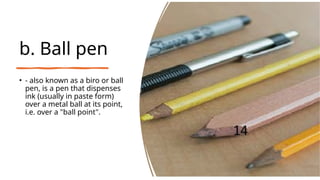
b. Ball pen
• - also known as a biro or ball
pen, is a pen that dispenses
ink (usually in paste form)
over a metal ball at its point,
i.e. over a "ball point".
7.
CRIMPING
TOOLS
• Any device used to conjoin two pieces
of metal by deforming one or both of
them to hold each other called crimp
like affixing a connector to the end of
a cable.
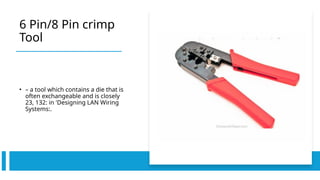
6 Pin/8 Pin crimp
Tool
• – a tool which contains a die that is
often exchangeable and is closely
23, 132: in 'Designing LAN Wiring
Systems:.
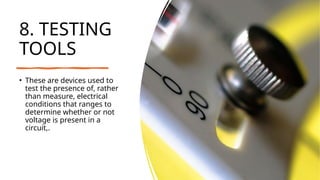
8. TESTING
TOOLS
• These are devices used to
test the presence of, rather
than measure, electrical
conditions that ranges to
determine whether or not
voltage is present in a
circuit,.
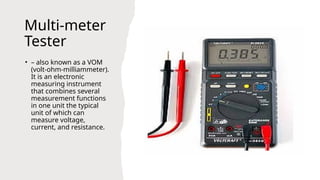
Multi-meter
Tester
• – also known as a VOM
(volt-ohm-milliammeter).
It is an electronic
measuring instrument
that combines several
measurement functions
in one unit the typical
unit of which can
measure voltage,
current, and resistance.
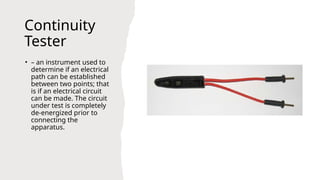
Continuity
Tester
• – an instrument used to
determine if an electrical
path can be established
between two points; that
is if an electrical circuit
can be made. The circuit
under test is completely
de-energized prior to
connecting the
apparatus.
9. STRIPPING TOOLS
• Are tools that are designed with stripping holes to make one or
more defined conductor cuts. Pliers with circular cutting holes are
only suitable for stripping the cross-section they are designed for.
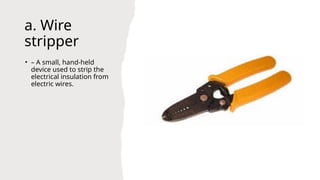
a. Wire
stripper
• – A small, hand-held
device used to strip the
electrical insulation from
electric wires.
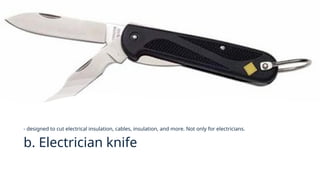
b. Electrician knife
- designed to cut electrical insulation, cables, insulation, and more. Not only for electricians.

wk 1 basic hand tools SMAW Grade 9/10.pptx

  • 1.
  • 2.
    Classificatio ns of Hand tools 1.Measuring Tools 2. Cutting Tools 3. Driving Tools 4. Holding Tools 5. Boring Tools 6. Markings Tools 7. Crimping Tools 8. Testing Tools 9. Stripping Tools
  • 3.
    1. MEASURING TOOLS •Measuring tools are those that used for checking the length, width or thickness of an objects for the shape of objects things like the flatness, straightness, roundness or squareness. Below are some of the measuring tools that can be found in a tool room and commonly used in SMAW activities:
  • 4.
    a. Push-Pull Rule •– This flexible rule when extended will support itself, but may also be used to measure curved, irregular surfaces. Steel tape rule blade is usually ½ inch wide and 72 inches long. The graduation is sixteenths, except for the 6 inches which are graduated I thirty-seconds of an inch
  • 5.
    b. Steel Tape •– similar to a steel tape rule except for its flexible number of feet that are marked on the tape. The tape is 3/8 inch wide and available in lengths from 25 to 100 feet.
  • 6.
    c. Steel Rule •– This is the most common tool used in tool room. It is made of tampered steel about 1/8 inch thick and ¾ inch wide and 6 to 12 inches long. The same style maybe obtained in length from 1 to 48 inches.
  • 7.
    d. L- Square •– is an instrument used to measure the square of an
  • 8.
    e. Combination Square • –a tool that serves several purposes in woodworking, stonemasonry, and metal working. It is composed of a ruler and one or more interchangeable heads that may be affixed to it. The most common head is the standard or square head, which is used to lay out or check right and 45° angles.
  • 9.
    f. Micrometer Caliper • –is a precision measuring instrument used to measure dimension in thousandths of an inch.
  • 10.
    g. Vernier Caliper • –is a precision measuring instrument used to measure inside, outside diameter, as well as depth of hole and slot.
  • 11.
    h. Dividers – Theseare used for measuring or setting of distances, and to lay out arcs and circles.
  • 12.
    2. CUTTING TOOLS •Tools that are used to remove some material from the work piece by means of shear deformation. Cutting may be accomplished by single-point or multipoint tools.
  • 13.
    a. Hacksaw •– is a tooth-cutting tool usually with a solid and adjustable frame. The main parts are handles, blade, tightening screw and nuts. The tool is mainly used in cutting metals like plates, pipes, rods, bars, angular, etc. but of minimal thickness, width, length. Sometimes this tool is used for cutting plastic pipes and other materials to suit its purpose. Blade of hack saws are made of thin, high grade steel usually 1.27 mm thick and 30.48 long with an inclined row of teeth serving as cutter
  • 14.
    3. DRIVING TOOLS •Any tool used to push (drive) object into another object. Their general purpose is to connect two pieces of metal or objects together, reshape to fit the desired output, or to connect metal to another material.
  • 15.
    a. Hammer • -a tool consisting of a weighted "head" fixed to a long handle that is swung to deliver an impact to a small area of an object.
  • 16.
    b. Screw Drivers • -A tool, used for screwing and unscrewing screws. A typical simple screwdriver has a handle and a shaft, ending in a tip the user puts into the screw head before turning the handle.
  • 17.
    4. HOLDING TOOLS • Toolsthat are used to firmly holds any material together. Each holding tool is different but the common principles between them is that they all secure a piece of material when your working with it..
  • 18.
    a. Pliers • -pincers with parallel, flat, and typically serrated surfaces, used chiefly for gripping small objects or bending wire. "a pair of pliers"
  • 19.
    b. C-Clamp- • alsocalled G-clamp, a device typically used to hold a wood or metal work piece, and often used in, but are not limited to, carpentry and welding.
  • 20.
    5. BORING TOOLS • Toolsthat are used to make or enlarge a hole that has already made (or cast) by means of a single-point cutting tool (or of a boring head.
  • 21.
    a. Hand drill •- a manual tool that converts and amplifies circular motion of the crank into circular motion of a drill chuck. Though it has been replaced in most applications by power drills, the hand drill is used by many woodworkers.
  • 22.
    Electric drill • -a manual tool that converts and amplifies circular motion of the crank into circular motion of a drill chuck. Though it has been replaced in most applications by power drills, the hand drill is used by many woodworkers.
  • 23.
    6. MARKING TOOLS • Tools thatare use to transfer all the little notations that appear on your pattern, the ones that tell you where to cut, fold, sew, or place adjoining pieces. It tells the pattern instructions, work together with these notations on how to manipulate each pattern piece.
  • 24.
    a. Lead Pencil -a pencil of graphite enclosed in wood.
  • 25.
    b. Ball pen •- also known as a biro or ball pen, is a pen that dispenses ink (usually in paste form) over a metal ball at its point, i.e. over a "ball point".
  • 26.
    7. CRIMPING TOOLS • Any deviceused to conjoin two pieces of metal by deforming one or both of them to hold each other called crimp like affixing a connector to the end of a cable.
  • 27.
    6 Pin/8 Pincrimp Tool • – a tool which contains a die that is often exchangeable and is closely 23, 132: in 'Designing LAN Wiring Systems:.
  • 28.
    8. TESTING TOOLS • Theseare devices used to test the presence of, rather than measure, electrical conditions that ranges to determine whether or not voltage is present in a circuit,.
  • 29.
    Multi-meter Tester • – alsoknown as a VOM (volt-ohm-milliammeter). It is an electronic measuring instrument that combines several measurement functions in one unit the typical unit of which can measure voltage, current, and resistance.
  • 30.
    Continuity Tester • – aninstrument used to determine if an electrical path can be established between two points; that is if an electrical circuit can be made. The circuit under test is completely de-energized prior to connecting the apparatus.
  • 31.
    9. STRIPPING TOOLS •Are tools that are designed with stripping holes to make one or more defined conductor cuts. Pliers with circular cutting holes are only suitable for stripping the cross-section they are designed for.
  • 32.
    a. Wire stripper • –A small, hand-held device used to strip the electrical insulation from electric wires.
  • 33.
    b. Electrician knife -designed to cut electrical insulation, cables, insulation, and more. Not only for electricians.