CARPENTRY
is the skill of creating furniture or other objects from wood
using specialist carpentry tools and techniques, training is
usually through apprenticeship.
Common Carpentry Tools
• TOOLS are defined as implements used to modify raw
materials for human use. Tools can be considered as
extension of the hand thereby increasing its speed,
power, and accuracy. From the early age up to the
present generation, tools can be considered as man’s
partner in his struggle for survival. Knowing the different
tools and equipment and their uses, facilitate work
activities and project making and it helps every student to
save time and effort in performing different tasks in
woodworking. Tools are classified according to their uses.
Measuring Tools:
• These are tools used for
laying out measurements.
The following tools are
included in this group:
1. Bench rule - This is one-
piece rule made of one-or
two-foot lenght. It is
commonly used for general
measurement in school
shop.
• 2. Two-foot four folding
rule - This is generally
used in measuring short
distances. It is also used
as a protractor with the aid
of a table. It is made of
four folds connected by
three hinges that are 6
inches apart.
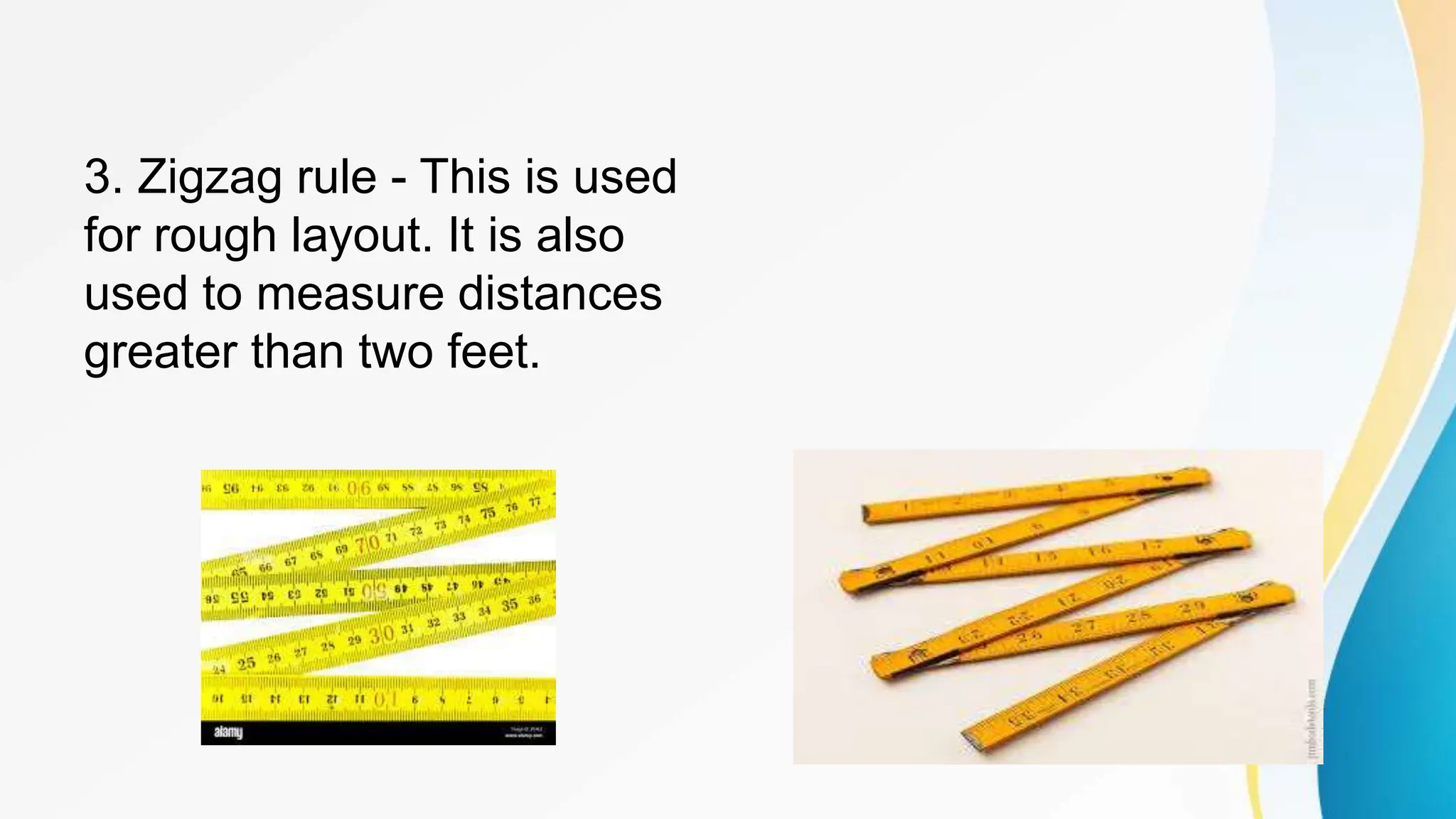
3. Zigzag rule - This is used
for rough layout. It is also
used to measure distances
greater than two feet.
4. Pull-push tape rule - This
is use to measure longer
distances. It is available
from one meter to 50 meters
long.
5. Slide Caliper rule - This is
special tool used to measure
the outside diameter of
cylindrical objects.
Graduation of an
inch
TESTING TOOLS:
These tools are used to test
the squareness of a corner,
the end of an edge, the
flatness of a surface, or the
straightness of an edge.
1. Try Square - This used for
squaring and testing smaller
work.
2. Combination Square - is
similar in appearance with
try square only that the head
can slide and clamp it at any
desired distance of the
blade. It is also provided
with a miter and level guide.
3. Miter Square - is a square
with blades permanently set
at 45 degrees.
4. Steel Square - This is
sometimes called the
carpenter’s square or the
framing square. It is used
effectively on various
framing works.
Parts:
Tounge is the shorter and
narrower part.
Body is the longer and wider
part of the square.
5. Sliding T-bevel - This is a
special square used to lay
out angles of different
degrees and to test miter
joints.
6. Plumb Bob - This is a tool
used to check straightness
of posts, studs, and the like.
7. Level - is used for both
guiding and testing the work
to a vertical or horizontal
position.
8. Miter box is a device used
as guide of the hand saw in
cutting objects to form a
miter joint.
EDGE CUTTING TOOLS
These are the tools having
thin, sharp edges and are
used for cutting
lumber/wood. The different
edge-cutting tools are
planes, chisels,
spokeshaves, and adzes.
1. PLANES - These are tools for shaping wood. They are used
to flatten, reduce the thickness of, and impart a smooth surface
to a rough piece of lumber or timber.
Kinds of planes:
1a. Jack plane
1b. Smooth plane
1c. Block plane
1d. Fore plane
1f. Jointer plane
1g. Wooden plane
Kinds of Planes
1a. Jack plane - This is the
most useful plane because
of its convenient size and is
used for planing pieces of
wood that need to have
straight edges and surface.
With the lenght of 35-40 cm.
1b. Smooth plane - This is
used for smoothening a
lumber surface flat and
cleaning up flushed-framed
work, chamfers, and
rounding edges. The lenght
is 15cm-30cm.
1c. Block plane - This is a
plane having a single-iron
plane blade that is placed
with the beveled side up. It
is used for planing end
grain. Five and one-half
inches in lenght.
1d. Fore plane - This is used
for planing large surfaces of
wood with the lenght of
55cm-60cm. Its lenght
enables to skim off high
spots as it bridges low spots,
delivering a levelled surface
ready for the smoothing
plane.
1e. Jointer plane - This is
used for straightening long
and uneven surface of
wood. The size is 70cm-
75cm. long.
1g. Wooden plane
Parts of Jack Plane
2. SPOKESHAVE
This is used for curved
surfaces that cannot be
done with a circular plane.
2 kinds of spokeshave:
2a. Concave spokeshave
2b. Convex spokeshave
2a. Convex Spokeshave - this
is use for flat surface and
curves.
2b. Concave Spokeshave - this is
used in concave curves surfaces
of wood.
3. Chisels - These are
indespebsable tools used
in carpentry. They are one
of the most abuse tools.
They are constantly used
for prying, opening cases,
as screwdriver, or an
opener.
Types of Chisel:
3a. Paring chisel
3b. Firming chisel
3a. Paring chisel - This is
light duty tool used to plane long
surfaces parallel with the grain of
wood.
3b. Firming chisel -
This is a heavy tool
adapted to withstand
severe strain, as in framing
work and where deep cuts
are necessary.
3c. Framing chisel - This has a
very heavy and strong blade
used in rough carpentry work like
shipbuilding.
Parts of chisel
LINING/MARKING
TOOLS
These tools are classifed according to
the kind of work they are to perform, are
used for marking or drawing lines.
Kinds:
1. Pencil
2. Scratch awl
3. Scriber
4. Compass
5. Divider
6. Marking gauge
7. Chalk line
Pencil
• This is used in marking
rough work.
Scratch awl
This is used in drawing lines
and marking off points in
measuring.
Scriber
This is used in marking fine
work. It is made of hardened
steel with a sharp point
designed to mark fine lines.
Compass
is a tool used to describe an
arc or circle.
Divider
is used in dividing distances
into equal parts from an arc,
circumferences including
straight lines.
Marking gauge
This is a tool most
appropriate in marking lines
parallel with the edges of the
wood.
Parts of marking gauge
Chalk Line and Reel
This is used for marking very
rough work.
Toothed Cutting Tools
In Carpentry Work, the
toothed cutting tools are of
utmost importance due to its
versatility in service and
demand. Toothed cutting
tools are classified as:
1. Saws
2. Files
3. Sandpaper
SAW
This is a tool that uses a hard
blade, wire, or chain with a
toothed edge to cut through
softer materials.
Kinds of Saw:
1a. Cross cut saw
1b. Rip saw
1c. Back saw
1d. Dovetail saw
1e. Compass saw
1f. Coping saw
1g. Keyhole saw
1a. Crosscut saw - is a saw
used for cutting across the
grain of wood. The teeth of a
crosscut saw look like a
series of knife point.
Rip saw - is a hand saw
used for sawing along the
grain of wood. The teeth of a
rip saw look like a chisel
gang.
Back saw - is used for
making accurate cuts on the
line in wood. Its teeth
resemble the cross cut saw
teeth, but this saw differs in
design.
Dovetail saw - is used for
cutting very fine work in
wood.
Compass saw - used to cut
curves of very small radii
and other such curves
because of its exceptionally
narrow point and sufficiently
heavy blade.
Coping saw - is used for
cutting curved shapes on
thin pieces of board.
Keyhole saw -is similar to a
compass saw, it is used to
cut small, irregular curves. It
is shorter than a compass
saw.
Buck or Wood saw - is a hand-
powered frame saw similar to bow
saw and generally used with a
sawbuck[1] to cut logs or firewood
to length (bucking). Modern
bucksaws usually have a metal
frame ("H" or "C"-shaped) and a
removable blade with coarse teeth
held in tension by the frame.
Lightweight portable or foldable
models used for camping or back-
packing are also available. It is
often referred to as a bow saw in
the North American hardware
Hack saw - is a fine-toothed
saw with a blade under tension
in a frame, used for cutting
materials such as metal. Hand-
held hacksaws consits of a
metal arch with a handle,
usually with a pistol grip, with
pins for attaching a narrow
disposable blade. A screw or
other mechanism is used to put
the thin blade under tension.
The blade can be mounted with
the teeth facing toward or away
from the handle, resulting in
Driving/Fastening Tools
These are tools used to
fixed or connect parts of the
work together with nails,
screws, bolts, etc.
Types of Driving Tools:
1. Hammer
2. Screw driver
3. Wrench
Hammers - are tools
consisting of a solid head
set crosswise on a handle.
a. Claw Hammer - is used
for driving and pulling out
nails. The claw is used to
extract nails and straighten
bended nails.
Ball-peen hammer - used to
make dents in metal as well
as to expand.
Riveting hammer - is used to
flatten the ends of rivets.
The head is square to the
face, while back of the head
is shape like wedge aligned
with the handle.
Cross peen hammer - This
type of hammer is used for
starting small nails held
between fingers. It is a
square-headed hammer with
a leveled wedge-like edge.
Mallet - is made of rubber,
plastic, or wood and should
be used in preference over a
steel hammer for driving
chisels with wooden handle.
2. Screw Drivers - These are
used for fastening screws.
Types of Screw Drivers:
2a. Phillips-head screw
driver
2b. Plain screw driver
Phillips-head screw driver -
is used for driving screws
with recessed heads.
Plain screw driver - This is
used to install slotted head
screw. The size of the tool
recons on the lenght and
diameter of the blade.
Parts of screw driver
Wrenches - are the tools
with handle and a jaw which
may be fitted to the head of
a nut used to tighten or
loosen bolts. Wrench is
classified as either plain,
socket, or adjustable.
Double End Type Plain
wrench
Combination plain wrench
Adjustable Wrench
Back wrench
Socket wrench
Holding Tools
These are tools used for
holding metal or compounds
while working.
Kinds of Holding Tools:
1. C-clamp - this resembles the
letter “C”. It is tool made of
steel with a jaw and a
thumbscrew. The screw works
across the open part of the “C”.
The size of the clamp is
measured by the width of the
piece that can be clamped in it.
2. Bar clamp - is used for
giving up large surfaces,
edge to edge, and for
clamping parts together
when assembling projects.
3. Hand Screw Clamp - is
used for giving stock face to
face or for clamping together
any work within the range of
the clamp jaws. It is about
6”-20”.
Vise - is used to hold pieces
of wood while they are being
shaped.
Machinist vise - is an all-
metal vise with a continous
screw. The single parallel
guide is at the lower part of
the screw. It is bolted to the
bench or to the table top
instead of the side.
Bench vise
A solid bench vise is like an extra
set of very strong hands, and having one
can actually improve your work: As long
as it's attached to a sturdy workbench, a
bench vise will hold a workpiece in a still
and relatively vibration free state and
help you make smoother saw cuts, more
steady plane strokes, or even get your
sanding done faster.
Even though many woodworkers would
rate a bench vise as an indispensable
tool, it's an easy one to put off buying.
You can get by reasonably well with an
arrangement of handscrew clamps and c-
clamps for a while
Boring and Drilling Tools
• BORING TOOLS
• These are especially designed to make hole in wood. The
different types boring tools are auger, drill, gimlet,
expansive bit, and brad awl.
1. Auger Brace - is used for
boringholes on wood with a
diameter ranging from 1/2” .
Augers that are provided
with a shank are commonly
called bits.This woodworking
hand tools are obviously
used for boring & drilling
holes into wood for a variety
of purposes, and driving
screws.
Auger brace and Bit parts:
2. Hand Drill and bit-This is
used for boring holes either
in wood or metal. The tool
that holds the drill is called
hand drill.
3. Gimlet - This is used for
boring holes by hand
pressure classified as twist
and plain.
.
4. Expansive bit - This bit is
adjustable to any size
between 22 to 75 mm in
diameter.
5. Bradawl - This is a small
tool used for punching or
piercing small holes. It is
generally used in starting a
nail or screw into hardwood.
6. Hollow Auger is intended
for external boring or
turning.
7.
Spoke Pointers cuts a conical hole. It is similar with the auger only that the cutter is lengthwise.
8. Counter Sink is used to
enlarge a conical hole at the
sur face of wood.
9. Nail set - is used to help
the hammer drive the nail
completely into the wood.
Sharpening Tools
Experienced carpenters
know the importance of
sharpening tools in
carpentry operations. Sharp
tools assure the worker in
accomplishing a refined
quality work. For the
amateur worker, too much
can’t be written on the
subject of sharpening tools
and methods of sharpening.
If an expert carpenter cannot
produce good work with dull
tools, what more can be
1. Grind stone
2. Oil stone
3. Whetstone
1. Grind stone - is a flat disc,
solid stone usually of
sandstone mounted on a
shaft used for sharpening,
shaping, or polishing metal
by turning.
Oil stone - this is used after
grinding operation to
achieve a smooth and keen
edge of the tools. Oil is the
lubricatingmedium.
Whet stone - is a natural or
artificial stone used for
sharpening cutting edge
tools when moistened with
water.
Equipment/Machines
In most cases, woodworking machines are operated by electricity and are classifed according to
use. These equipment are used for boring, cutting, forming, and plaining.
1. Portable electric drill
2. Portable electric saw
3. Electric drill press
4. Portable electric jig saw
5. Portable electric sander
6. Portable electric planer
7. Portable hand router
8. Electric wood lathe
machine
9. Electric Band Saw
1. Portable Electric Drill -
This equipment is handy and
the drill bit can be changed
to desired size. It is used to
bore a hole on a surface of
the wood on a desired size.
This type of tools needs
regular maintenance to
prolong the life of the drill.
2. Portable Electric
Saw/Circular saw - is a
handy power tool for
construction work. It is very
effective tool in the
construction of framework
particularly on angular cuts
for stair, jacks and truss
members.
3. Electric Drill Press - is
also a power driven rotary
tool for driving drill, bits, plug
cutters, and many auxiliary
attachments such as mortise
chisels, grinding wheels and
shaper cutters. The speed of
the drill press varies from
300 to 700 rpm. The speed
however, is controlled by
shifting the drive belt on a
set of cone pulleys operating
on the principles of wheel
4. Portable Electric Jig Saw/saber saw -
when using jig saw always wear safety
goggles and a dust mask. Long should be
tied back. Makes sure to start the saw
before cutting into the wood to prevent the
blade from snapping. Also keep the power
cable behind the saw to prevent it getting
tangled of possibly cut. Be sure that the
hands are kept out away to avoid accidents.
It is a heavy-duty type all purpose saw
designed for construction work. It holds a
saber blade from 8cm. to 30cm. long and
cuts flush to avertical or horizontal surface.
5. Portable Electric Sander
- is a power driven abrading tool
classified into three types:
5a. Belt sander
5b. Disk sander
5c. Finishing sander
5a. Belt Sander - a coated
abrasive belt is run over a
pad guided by an idler and
driving drum.
5b. Electric Disk Sander - A
coated abrasive disk rotates
on a motor spindle.
5c. Electric Finishing Sander
- A coated abrasive strip
fitted over a pressure pad is
powered in an orbital or in-
line oscillating motion.
6. Portable Electric Planer
- is a power driven rotating
edge cutting tool. The full
width knives or blade are set
equidistant along the
circumference of the cutter
head that rotates at a speed
of 3600 to 7200 rpm. The
planer blade cut under the
principle of a continous set
of cutting wedges.
7. Portable Hand Router -
is a power driven rotary
shaping tool revolving at a
spindle speed of 5000 to
2700 rpm scraping under the
principle of continous set of
cutting wedges. Hand router
is to moldings, rout cut
grains for inlay and cut
dovetails etc.
How to used
Portable Hand
Router
8. Wood Lathe
Machine - is
classified as powered
rotary driving tool. The
lathe is used to rotate
the material for
shaping, sanding or
polishing. It is also
used as holding jig for
fluting, roughing and
drilling holes.
9. Electric Band Saw - is a
power driven endless toothed
hand cutting tool. It is more
extensively used and preferred
than the circular saw for heavy-
duty work. The preference of
band saw over the circular saw is
due to the savings realized in the
wood cut. It was designed as a
thin strip of tempered flexible belt
with rip teeth filed on one edge
and run around two pulleys at a
speed from 900 to 1500 meter
per minute.
Safety Practices when Working
Performing activities or
doing a project in Carpentry
can be both fun and
satisfying. Any accomplished
project can add to your
experience since it can help
develop your values and
work habits.
The following are some tips
to consider while performing
woodworking activities or
making projects.
1. All work done in the shop
must have the teacher’s
approval and supervision.
2.Use only the proper tools
for a specific job to produce
quality output.
3. Wear protective clothing
such as an apron.
4. It is essential to to use
protective device.
5. Keep the floor clear of
cutting materials and others.
6. In cutting any material, follow
a simple practice like--measure
the material twice and cut once
only.
7. Get permission from your
teacher each time you need to
use a machine.
8. Do not use a machine or tool
until your teacher has shown
you how to use it correctly.
9. Turn off the machine after
using it.
10. Always check the condition
11. Do not play with sharp
cutting tools.
12. Avoid using dull or
broken tools.
13. Avoid throwing tools at
anybody.
14. Lastly, do not try to do
anything which you think you
are not capable of doing.
CHAPTER 2: WOOD
Wood is that fibrous
substance which composes
the trunk and branches of a
tree that lies between the
pitch and the bark. More
specifically, wood is defined
as the lignified water
conducting, strengthening
and storage tissues of
branches, stem and roots of
trees. The trunk is cut down
into timber, sawn into
smaller size, lumber, and
smoothened into a piece of
Properties of Wood as
Building Material
1. Strong Material
2. Durable
3. Light in weight
4. Ease of working and
fastening
5. With artistic and natural
beauty
LUMBER
Lumber may be classified into softwood or
hardwood. Softwood comes from evergreen
or needle-bearing trees. These are called
conifers because many of them bear cones.
Hardwood comes from broad-leafed trees that
shed their leaves at the end of the growing
season.
Plywood is constructed by gluing together a
number of layers of wood with the grain
direction turned at right angles in successive
layers.
Plywood can be secured in thickness of 1/8 to
more than 1" with the common Sizes being
1/4", 3/8", 1/2", "5/8", and “3/4." A standard
panel size is 4 feet wide by 8 feet long.
Specifications of lumber that are prepared
and sold according to the size and
smoothness description are as follows:
2. S2S:S4S- These are planed or dressed
lumber of which the number connotes the
number of smooth sides such that S2S means
smooth on two sides and S4S is smooth on
four sides.
3. Timber - This is a piece of lumber five
inches or larger in its smallest dimension.
4. Plank - This is a wide piece of lumber from
two to five inches thick.
5. Board - This board is a piece of lumber less
than 1½ inches thick and at least 4 inches
wide.
6. K.D. - Kiln dried
7. RL-Rough lumber with specific
measurement
8. T&G - Tongue and groove on the edge of
the wood
PARTS of the CROSS SECTION of a TREE TRUNK
1. PITH - this is the center or a heart of a tree trunk
and often decays in the over mature tree.
2. Heartwood - This is a matured and fully
developed wood. It is darker, harder, and more
durable than sapwood. It is a part of the tree
suitable for structures.
3. Bark - This is the corky outer covering of the tree
having two parts: (a) cortex is the thicker, outer
part; (b) bast or the thin inner part.
4. Medullary rays - These are rows of cells running
radially from the cambium layer.
5. Sapwood, also called alburnum, outer, living
layers of the secondary wood of trees, which
engage in transport of water and minerals to the
crown of the tree. The cells therefore contain more
water and lack the deposits of darkly staining
chemical substances commonly found in
heartwood.
6. Cambium, plural Cambiums, orCambia, in
Phloem is the living tissue in vascular plants that
transports the soluble organic compounds made
during photosynthesis and known as
photosynthates, in particular the sugar sucrose,
to parts of the plant where needed. This
transport process is called translocation.
The vascular system is comprised of two main
types of tissue: the xylem and the phloem. The
xylem distributes water and dissolved minerals
upward through the plant, from the roots to the
leaves. The phloem carries food downward from
the leaves to the roots.
Growth ring, in a cross section of the stem of a
woody plant, the increment of wood added
during a single growth period. In temperate
regions the growth period is usually one year, in
which case the growth ring may be called an
“annual ring.” In tropical regions, growth rings
may not be discernible or are not annual.
Xylem and phloem facilitate
the transportation of water,
minerals and food
throughout the plant. Xylem
carries water and minerals
from the roots to the leaves.
Whereas, phloem carries the
food prepared by the leaves
to different parts of the plant.
LUMBER
Lumbers are sold in a
common unit of measure
which is the "board foot." In
buying the lumber, the
computation is done by the
number of board foot not by
the number of pieces you
will buy. The measurement
is specified according to its
length, thickness, and width.
The formulas on how to compute for the board
feet are as follows:
1. If the length is given in feet:
board feet = number of pieces x thickness
(inches) x width (inches) X length (feet)
12
Example: Compute for the board feet of 4
pieces 1 inch thick, 12 inches wide, and 12 feet
long S4S lumber.
2. If the lenght is given in linear or running
inches:
board feet = number of pieces x thickness(“) x
width(“) x lenght(“)
144
Board Feet of a Log
How to Determining Board Foot in a Round Log
The total net board foot in a round log is computed using
the following formula:
Board Foot = (D-4)² x L
16
Where: D= The smaller diameter of the log in inches
L = Length of the log in feet
4 and 16 are constant value in the formula for slab
reduction.
Example:
D = 24”
L = 18’
Board Foot = (24 - 4)2 x 18
16
= (20)2 x 18
16
= 450 bd.ft.
COMMON WOOD JOINTS
Joinery is the process of putting together
the parts of a piece of work. There are
many types of wood joints for furniture
and cabinet work. However, the joints that
are describe in this lesson are the basic
ones for beginners.
Kinds of Wood Joints:
1. Butt Joint - This is the simplest and
easiest to make of all the wood joints. It is
used in simple box construction. The end
of one member is joined or butted to the
face or edge of another member and held
together by nails, screws, or with
corrugated metal fastener.
2. Miter joint - This is a joint
where the ends to be joined
together at 45 degrees. Miter
joints are butted together at the
end and held by a nail or by a
corrugated metal at the back.
3. Dado joint - This is a joint in
which the end of one member
is fitted into a recess cut across
the face of another member. It
is one of the strongest joints. It
is used in drawer construction,
Wood.......
4. Rabbet joint - This is
similar to the dado joint. The
end of one member is fitted
into a recess cut across the
surface of the other member
at its end. The difference
between a dado joint and a
rabbet joint is that in the
abbet joint, the pieces are
joined together at the end. It
is commonly sed in making
5. Lap joint - This is another
simple and commonly used
joint. It is called lap joint
because ½/ of the thickness of
each member is removed from
the part where they are to be
joined. They are the end lap
joint, the middle lap joint, and
the cross lap joint.
6. Mortise and tenon joint - This
is a joint in which one member
is prepared with a rectangular
hollow called mortise to the
other end of the other member
shaped to fit into the mortise.
Parts of the Project Plan
Name of the Project:___ Year and Section:______
Date Started:_________ Date Finished:_________
I. Purpose of the Project: The project to be made has its definite pupose. Sate briefly the
reasons why you desire to make the project.
1.__________________________
2.__________________________
3.__________________________
II. Tools and Equipment:
____________________________
____________________________
____________________________
____________________________
Parts of.........
III. Working Drawing: Sketch
of the project with exact
dimension.
III. Working Drawing: Sketch of the project with exact dimension.
Parts of..........
IV. Bills of Materials:
Names of the materials
needed should be listed
together with the needed
quantity, their descriptions,
unit cost, and the total cost.
These include the number of
pieces of wood bought,
hardware, abrasive,
adhesives, and finishing
material including their
Materia
l
Quantit
y
Descrip
tion
Unit
Cost
Toatal
Cost
Parts of...............
V. Procdure: This shall be a
guide in doing the step-by-
step procedure to finish the
project systemically.
VI. Evalauation of the
Project: This is where you
will rate the finoshed project.
Every student and teacher
must know how a finished
project will be assessed. You
can used rubrics,
scorecards, and checklists in
evaluating your project.

CARPENTRY-module-2nd-sem-ind.-arts-2-2.pptx

  • 1.
    CARPENTRY is the skillof creating furniture or other objects from wood using specialist carpentry tools and techniques, training is usually through apprenticeship.
  • 2.
    Common Carpentry Tools •TOOLS are defined as implements used to modify raw materials for human use. Tools can be considered as extension of the hand thereby increasing its speed, power, and accuracy. From the early age up to the present generation, tools can be considered as man’s partner in his struggle for survival. Knowing the different tools and equipment and their uses, facilitate work activities and project making and it helps every student to save time and effort in performing different tasks in woodworking. Tools are classified according to their uses.
  • 3.
    Measuring Tools: • Theseare tools used for laying out measurements. The following tools are included in this group: 1. Bench rule - This is one- piece rule made of one-or two-foot lenght. It is commonly used for general measurement in school shop.
  • 4.
    • 2. Two-footfour folding rule - This is generally used in measuring short distances. It is also used as a protractor with the aid of a table. It is made of four folds connected by three hinges that are 6 inches apart.
  • 5.
    3. Zigzag rule- This is used for rough layout. It is also used to measure distances greater than two feet.
  • 6.
    4. Pull-push taperule - This is use to measure longer distances. It is available from one meter to 50 meters long.
  • 7.
    5. Slide Caliperrule - This is special tool used to measure the outside diameter of cylindrical objects.
  • 8.
  • 9.
    TESTING TOOLS: These toolsare used to test the squareness of a corner, the end of an edge, the flatness of a surface, or the straightness of an edge. 1. Try Square - This used for squaring and testing smaller work.
  • 10.
    2. Combination Square- is similar in appearance with try square only that the head can slide and clamp it at any desired distance of the blade. It is also provided with a miter and level guide.
  • 11.
    3. Miter Square- is a square with blades permanently set at 45 degrees.
  • 12.
    4. Steel Square- This is sometimes called the carpenter’s square or the framing square. It is used effectively on various framing works. Parts: Tounge is the shorter and narrower part. Body is the longer and wider part of the square.
  • 13.
    5. Sliding T-bevel- This is a special square used to lay out angles of different degrees and to test miter joints.
  • 14.
    6. Plumb Bob- This is a tool used to check straightness of posts, studs, and the like.
  • 15.
    7. Level -is used for both guiding and testing the work to a vertical or horizontal position.
  • 16.
    8. Miter boxis a device used as guide of the hand saw in cutting objects to form a miter joint.
  • 17.
    EDGE CUTTING TOOLS Theseare the tools having thin, sharp edges and are used for cutting lumber/wood. The different edge-cutting tools are planes, chisels, spokeshaves, and adzes.
  • 18.
    1. PLANES -These are tools for shaping wood. They are used to flatten, reduce the thickness of, and impart a smooth surface to a rough piece of lumber or timber. Kinds of planes: 1a. Jack plane 1b. Smooth plane 1c. Block plane 1d. Fore plane 1f. Jointer plane 1g. Wooden plane
  • 19.
    Kinds of Planes 1a.Jack plane - This is the most useful plane because of its convenient size and is used for planing pieces of wood that need to have straight edges and surface. With the lenght of 35-40 cm.
  • 20.
    1b. Smooth plane- This is used for smoothening a lumber surface flat and cleaning up flushed-framed work, chamfers, and rounding edges. The lenght is 15cm-30cm.
  • 21.
    1c. Block plane- This is a plane having a single-iron plane blade that is placed with the beveled side up. It is used for planing end grain. Five and one-half inches in lenght.
  • 22.
    1d. Fore plane- This is used for planing large surfaces of wood with the lenght of 55cm-60cm. Its lenght enables to skim off high spots as it bridges low spots, delivering a levelled surface ready for the smoothing plane.
  • 23.
    1e. Jointer plane- This is used for straightening long and uneven surface of wood. The size is 70cm- 75cm. long.
  • 24.
  • 25.
  • 26.
    2. SPOKESHAVE This isused for curved surfaces that cannot be done with a circular plane. 2 kinds of spokeshave: 2a. Concave spokeshave 2b. Convex spokeshave
  • 27.
    2a. Convex Spokeshave- this is use for flat surface and curves.
  • 28.
    2b. Concave Spokeshave- this is used in concave curves surfaces of wood.
  • 29.
    3. Chisels -These are indespebsable tools used in carpentry. They are one of the most abuse tools. They are constantly used for prying, opening cases, as screwdriver, or an opener. Types of Chisel: 3a. Paring chisel 3b. Firming chisel
  • 30.
    3a. Paring chisel- This is light duty tool used to plane long surfaces parallel with the grain of wood.
  • 31.
    3b. Firming chisel- This is a heavy tool adapted to withstand severe strain, as in framing work and where deep cuts are necessary.
  • 32.
    3c. Framing chisel- This has a very heavy and strong blade used in rough carpentry work like shipbuilding.
  • 33.
  • 34.
    LINING/MARKING TOOLS These tools areclassifed according to the kind of work they are to perform, are used for marking or drawing lines. Kinds: 1. Pencil 2. Scratch awl 3. Scriber 4. Compass 5. Divider 6. Marking gauge 7. Chalk line
  • 35.
    Pencil • This isused in marking rough work.
  • 36.
    Scratch awl This isused in drawing lines and marking off points in measuring.
  • 37.
    Scriber This is usedin marking fine work. It is made of hardened steel with a sharp point designed to mark fine lines.
  • 38.
    Compass is a toolused to describe an arc or circle.
  • 39.
    Divider is used individing distances into equal parts from an arc, circumferences including straight lines.
  • 40.
    Marking gauge This isa tool most appropriate in marking lines parallel with the edges of the wood.
  • 41.
  • 42.
    Chalk Line andReel This is used for marking very rough work.
  • 43.
    Toothed Cutting Tools InCarpentry Work, the toothed cutting tools are of utmost importance due to its versatility in service and demand. Toothed cutting tools are classified as: 1. Saws 2. Files 3. Sandpaper
  • 44.
    SAW This is atool that uses a hard blade, wire, or chain with a toothed edge to cut through softer materials. Kinds of Saw: 1a. Cross cut saw 1b. Rip saw 1c. Back saw 1d. Dovetail saw 1e. Compass saw 1f. Coping saw 1g. Keyhole saw
  • 45.
    1a. Crosscut saw- is a saw used for cutting across the grain of wood. The teeth of a crosscut saw look like a series of knife point.
  • 46.
    Rip saw -is a hand saw used for sawing along the grain of wood. The teeth of a rip saw look like a chisel gang.
  • 47.
    Back saw -is used for making accurate cuts on the line in wood. Its teeth resemble the cross cut saw teeth, but this saw differs in design.
  • 48.
    Dovetail saw -is used for cutting very fine work in wood.
  • 49.
    Compass saw -used to cut curves of very small radii and other such curves because of its exceptionally narrow point and sufficiently heavy blade.
  • 50.
    Coping saw -is used for cutting curved shapes on thin pieces of board.
  • 51.
    Keyhole saw -issimilar to a compass saw, it is used to cut small, irregular curves. It is shorter than a compass saw.
  • 52.
    Buck or Woodsaw - is a hand- powered frame saw similar to bow saw and generally used with a sawbuck[1] to cut logs or firewood to length (bucking). Modern bucksaws usually have a metal frame ("H" or "C"-shaped) and a removable blade with coarse teeth held in tension by the frame. Lightweight portable or foldable models used for camping or back- packing are also available. It is often referred to as a bow saw in the North American hardware
  • 53.
    Hack saw -is a fine-toothed saw with a blade under tension in a frame, used for cutting materials such as metal. Hand- held hacksaws consits of a metal arch with a handle, usually with a pistol grip, with pins for attaching a narrow disposable blade. A screw or other mechanism is used to put the thin blade under tension. The blade can be mounted with the teeth facing toward or away from the handle, resulting in
  • 54.
    Driving/Fastening Tools These aretools used to fixed or connect parts of the work together with nails, screws, bolts, etc. Types of Driving Tools: 1. Hammer 2. Screw driver 3. Wrench
  • 55.
    Hammers - aretools consisting of a solid head set crosswise on a handle. a. Claw Hammer - is used for driving and pulling out nails. The claw is used to extract nails and straighten bended nails.
  • 56.
    Ball-peen hammer -used to make dents in metal as well as to expand.
  • 57.
    Riveting hammer -is used to flatten the ends of rivets. The head is square to the face, while back of the head is shape like wedge aligned with the handle.
  • 58.
    Cross peen hammer- This type of hammer is used for starting small nails held between fingers. It is a square-headed hammer with a leveled wedge-like edge.
  • 59.
    Mallet - ismade of rubber, plastic, or wood and should be used in preference over a steel hammer for driving chisels with wooden handle.
  • 60.
    2. Screw Drivers- These are used for fastening screws. Types of Screw Drivers: 2a. Phillips-head screw driver 2b. Plain screw driver
  • 61.
    Phillips-head screw driver- is used for driving screws with recessed heads.
  • 62.
    Plain screw driver- This is used to install slotted head screw. The size of the tool recons on the lenght and diameter of the blade.
  • 63.
  • 64.
    Wrenches - arethe tools with handle and a jaw which may be fitted to the head of a nut used to tighten or loosen bolts. Wrench is classified as either plain, socket, or adjustable. Double End Type Plain wrench
  • 65.
  • 66.
  • 67.
  • 68.
  • 69.
    Holding Tools These aretools used for holding metal or compounds while working. Kinds of Holding Tools: 1. C-clamp - this resembles the letter “C”. It is tool made of steel with a jaw and a thumbscrew. The screw works across the open part of the “C”. The size of the clamp is measured by the width of the piece that can be clamped in it.
  • 70.
    2. Bar clamp- is used for giving up large surfaces, edge to edge, and for clamping parts together when assembling projects.
  • 71.
    3. Hand ScrewClamp - is used for giving stock face to face or for clamping together any work within the range of the clamp jaws. It is about 6”-20”.
  • 72.
    Vise - isused to hold pieces of wood while they are being shaped.
  • 73.
    Machinist vise -is an all- metal vise with a continous screw. The single parallel guide is at the lower part of the screw. It is bolted to the bench or to the table top instead of the side.
  • 74.
  • 75.
    A solid benchvise is like an extra set of very strong hands, and having one can actually improve your work: As long as it's attached to a sturdy workbench, a bench vise will hold a workpiece in a still and relatively vibration free state and help you make smoother saw cuts, more steady plane strokes, or even get your sanding done faster. Even though many woodworkers would rate a bench vise as an indispensable tool, it's an easy one to put off buying. You can get by reasonably well with an arrangement of handscrew clamps and c- clamps for a while
  • 76.
    Boring and DrillingTools • BORING TOOLS • These are especially designed to make hole in wood. The different types boring tools are auger, drill, gimlet, expansive bit, and brad awl.
  • 77.
    1. Auger Brace- is used for boringholes on wood with a diameter ranging from 1/2” . Augers that are provided with a shank are commonly called bits.This woodworking hand tools are obviously used for boring & drilling holes into wood for a variety of purposes, and driving screws.
  • 78.
    Auger brace andBit parts:
  • 79.
    2. Hand Drilland bit-This is used for boring holes either in wood or metal. The tool that holds the drill is called hand drill.
  • 80.
    3. Gimlet -This is used for boring holes by hand pressure classified as twist and plain. .
  • 81.
    4. Expansive bit- This bit is adjustable to any size between 22 to 75 mm in diameter.
  • 82.
    5. Bradawl -This is a small tool used for punching or piercing small holes. It is generally used in starting a nail or screw into hardwood.
  • 83.
    6. Hollow Augeris intended for external boring or turning.
  • 84.
    7. Spoke Pointers cutsa conical hole. It is similar with the auger only that the cutter is lengthwise.
  • 85.
    8. Counter Sinkis used to enlarge a conical hole at the sur face of wood.
  • 86.
    9. Nail set- is used to help the hammer drive the nail completely into the wood.
  • 87.
    Sharpening Tools Experienced carpenters knowthe importance of sharpening tools in carpentry operations. Sharp tools assure the worker in accomplishing a refined quality work. For the amateur worker, too much can’t be written on the subject of sharpening tools and methods of sharpening. If an expert carpenter cannot produce good work with dull tools, what more can be
  • 88.
    1. Grind stone 2.Oil stone 3. Whetstone 1. Grind stone - is a flat disc, solid stone usually of sandstone mounted on a shaft used for sharpening, shaping, or polishing metal by turning.
  • 89.
    Oil stone -this is used after grinding operation to achieve a smooth and keen edge of the tools. Oil is the lubricatingmedium.
  • 90.
    Whet stone -is a natural or artificial stone used for sharpening cutting edge tools when moistened with water.
  • 91.
    Equipment/Machines In most cases,woodworking machines are operated by electricity and are classifed according to use. These equipment are used for boring, cutting, forming, and plaining. 1. Portable electric drill 2. Portable electric saw 3. Electric drill press 4. Portable electric jig saw 5. Portable electric sander 6. Portable electric planer 7. Portable hand router 8. Electric wood lathe machine 9. Electric Band Saw
  • 92.
    1. Portable ElectricDrill - This equipment is handy and the drill bit can be changed to desired size. It is used to bore a hole on a surface of the wood on a desired size. This type of tools needs regular maintenance to prolong the life of the drill.
  • 93.
    2. Portable Electric Saw/Circularsaw - is a handy power tool for construction work. It is very effective tool in the construction of framework particularly on angular cuts for stair, jacks and truss members.
  • 94.
    3. Electric DrillPress - is also a power driven rotary tool for driving drill, bits, plug cutters, and many auxiliary attachments such as mortise chisels, grinding wheels and shaper cutters. The speed of the drill press varies from 300 to 700 rpm. The speed however, is controlled by shifting the drive belt on a set of cone pulleys operating on the principles of wheel
  • 95.
    4. Portable ElectricJig Saw/saber saw - when using jig saw always wear safety goggles and a dust mask. Long should be tied back. Makes sure to start the saw before cutting into the wood to prevent the blade from snapping. Also keep the power cable behind the saw to prevent it getting tangled of possibly cut. Be sure that the hands are kept out away to avoid accidents. It is a heavy-duty type all purpose saw designed for construction work. It holds a saber blade from 8cm. to 30cm. long and cuts flush to avertical or horizontal surface.
  • 96.
    5. Portable ElectricSander - is a power driven abrading tool classified into three types: 5a. Belt sander 5b. Disk sander 5c. Finishing sander
  • 97.
    5a. Belt Sander- a coated abrasive belt is run over a pad guided by an idler and driving drum.
  • 98.
    5b. Electric DiskSander - A coated abrasive disk rotates on a motor spindle.
  • 99.
    5c. Electric FinishingSander - A coated abrasive strip fitted over a pressure pad is powered in an orbital or in- line oscillating motion.
  • 100.
    6. Portable ElectricPlaner - is a power driven rotating edge cutting tool. The full width knives or blade are set equidistant along the circumference of the cutter head that rotates at a speed of 3600 to 7200 rpm. The planer blade cut under the principle of a continous set of cutting wedges.
  • 101.
    7. Portable HandRouter - is a power driven rotary shaping tool revolving at a spindle speed of 5000 to 2700 rpm scraping under the principle of continous set of cutting wedges. Hand router is to moldings, rout cut grains for inlay and cut dovetails etc.
  • 102.
  • 103.
    8. Wood Lathe Machine- is classified as powered rotary driving tool. The lathe is used to rotate the material for shaping, sanding or polishing. It is also used as holding jig for fluting, roughing and drilling holes.
  • 104.
    9. Electric BandSaw - is a power driven endless toothed hand cutting tool. It is more extensively used and preferred than the circular saw for heavy- duty work. The preference of band saw over the circular saw is due to the savings realized in the wood cut. It was designed as a thin strip of tempered flexible belt with rip teeth filed on one edge and run around two pulleys at a speed from 900 to 1500 meter per minute.
  • 106.
    Safety Practices whenWorking Performing activities or doing a project in Carpentry can be both fun and satisfying. Any accomplished project can add to your experience since it can help develop your values and work habits. The following are some tips to consider while performing woodworking activities or making projects. 1. All work done in the shop must have the teacher’s approval and supervision. 2.Use only the proper tools for a specific job to produce quality output. 3. Wear protective clothing such as an apron. 4. It is essential to to use protective device. 5. Keep the floor clear of cutting materials and others.
  • 107.
    6. In cuttingany material, follow a simple practice like--measure the material twice and cut once only. 7. Get permission from your teacher each time you need to use a machine. 8. Do not use a machine or tool until your teacher has shown you how to use it correctly. 9. Turn off the machine after using it. 10. Always check the condition 11. Do not play with sharp cutting tools. 12. Avoid using dull or broken tools. 13. Avoid throwing tools at anybody. 14. Lastly, do not try to do anything which you think you are not capable of doing.
  • 108.
    CHAPTER 2: WOOD Woodis that fibrous substance which composes the trunk and branches of a tree that lies between the pitch and the bark. More specifically, wood is defined as the lignified water conducting, strengthening and storage tissues of branches, stem and roots of trees. The trunk is cut down into timber, sawn into smaller size, lumber, and smoothened into a piece of Properties of Wood as Building Material 1. Strong Material 2. Durable 3. Light in weight 4. Ease of working and fastening 5. With artistic and natural beauty
  • 109.
    LUMBER Lumber may beclassified into softwood or hardwood. Softwood comes from evergreen or needle-bearing trees. These are called conifers because many of them bear cones. Hardwood comes from broad-leafed trees that shed their leaves at the end of the growing season. Plywood is constructed by gluing together a number of layers of wood with the grain direction turned at right angles in successive layers. Plywood can be secured in thickness of 1/8 to more than 1" with the common Sizes being 1/4", 3/8", 1/2", "5/8", and “3/4." A standard panel size is 4 feet wide by 8 feet long. Specifications of lumber that are prepared and sold according to the size and smoothness description are as follows: 2. S2S:S4S- These are planed or dressed lumber of which the number connotes the number of smooth sides such that S2S means smooth on two sides and S4S is smooth on four sides. 3. Timber - This is a piece of lumber five inches or larger in its smallest dimension. 4. Plank - This is a wide piece of lumber from two to five inches thick. 5. Board - This board is a piece of lumber less than 1½ inches thick and at least 4 inches wide. 6. K.D. - Kiln dried 7. RL-Rough lumber with specific measurement 8. T&G - Tongue and groove on the edge of the wood
  • 110.
    PARTS of theCROSS SECTION of a TREE TRUNK 1. PITH - this is the center or a heart of a tree trunk and often decays in the over mature tree. 2. Heartwood - This is a matured and fully developed wood. It is darker, harder, and more durable than sapwood. It is a part of the tree suitable for structures. 3. Bark - This is the corky outer covering of the tree having two parts: (a) cortex is the thicker, outer part; (b) bast or the thin inner part. 4. Medullary rays - These are rows of cells running radially from the cambium layer. 5. Sapwood, also called alburnum, outer, living layers of the secondary wood of trees, which engage in transport of water and minerals to the crown of the tree. The cells therefore contain more water and lack the deposits of darkly staining chemical substances commonly found in heartwood. 6. Cambium, plural Cambiums, orCambia, in
  • 111.
    Phloem is theliving tissue in vascular plants that transports the soluble organic compounds made during photosynthesis and known as photosynthates, in particular the sugar sucrose, to parts of the plant where needed. This transport process is called translocation. The vascular system is comprised of two main types of tissue: the xylem and the phloem. The xylem distributes water and dissolved minerals upward through the plant, from the roots to the leaves. The phloem carries food downward from the leaves to the roots. Growth ring, in a cross section of the stem of a woody plant, the increment of wood added during a single growth period. In temperate regions the growth period is usually one year, in which case the growth ring may be called an “annual ring.” In tropical regions, growth rings may not be discernible or are not annual. Xylem and phloem facilitate the transportation of water, minerals and food throughout the plant. Xylem carries water and minerals from the roots to the leaves. Whereas, phloem carries the food prepared by the leaves to different parts of the plant.
  • 112.
    LUMBER Lumbers are soldin a common unit of measure which is the "board foot." In buying the lumber, the computation is done by the number of board foot not by the number of pieces you will buy. The measurement is specified according to its length, thickness, and width. The formulas on how to compute for the board feet are as follows: 1. If the length is given in feet: board feet = number of pieces x thickness (inches) x width (inches) X length (feet) 12 Example: Compute for the board feet of 4 pieces 1 inch thick, 12 inches wide, and 12 feet long S4S lumber. 2. If the lenght is given in linear or running inches: board feet = number of pieces x thickness(“) x width(“) x lenght(“) 144
  • 113.
    Board Feet ofa Log How to Determining Board Foot in a Round Log The total net board foot in a round log is computed using the following formula: Board Foot = (D-4)² x L 16 Where: D= The smaller diameter of the log in inches L = Length of the log in feet 4 and 16 are constant value in the formula for slab reduction. Example: D = 24” L = 18’ Board Foot = (24 - 4)2 x 18 16 = (20)2 x 18 16 = 450 bd.ft.
  • 114.
    COMMON WOOD JOINTS Joineryis the process of putting together the parts of a piece of work. There are many types of wood joints for furniture and cabinet work. However, the joints that are describe in this lesson are the basic ones for beginners. Kinds of Wood Joints: 1. Butt Joint - This is the simplest and easiest to make of all the wood joints. It is used in simple box construction. The end of one member is joined or butted to the face or edge of another member and held together by nails, screws, or with corrugated metal fastener. 2. Miter joint - This is a joint where the ends to be joined together at 45 degrees. Miter joints are butted together at the end and held by a nail or by a corrugated metal at the back. 3. Dado joint - This is a joint in which the end of one member is fitted into a recess cut across the face of another member. It is one of the strongest joints. It is used in drawer construction,
  • 115.
    Wood....... 4. Rabbet joint- This is similar to the dado joint. The end of one member is fitted into a recess cut across the surface of the other member at its end. The difference between a dado joint and a rabbet joint is that in the abbet joint, the pieces are joined together at the end. It is commonly sed in making 5. Lap joint - This is another simple and commonly used joint. It is called lap joint because ½/ of the thickness of each member is removed from the part where they are to be joined. They are the end lap joint, the middle lap joint, and the cross lap joint. 6. Mortise and tenon joint - This is a joint in which one member is prepared with a rectangular hollow called mortise to the other end of the other member shaped to fit into the mortise.
  • 116.
    Parts of theProject Plan Name of the Project:___ Year and Section:______ Date Started:_________ Date Finished:_________ I. Purpose of the Project: The project to be made has its definite pupose. Sate briefly the reasons why you desire to make the project. 1.__________________________ 2.__________________________ 3.__________________________ II. Tools and Equipment: ____________________________ ____________________________ ____________________________ ____________________________
  • 117.
    Parts of......... III. WorkingDrawing: Sketch of the project with exact dimension. III. Working Drawing: Sketch of the project with exact dimension.
  • 118.
    Parts of.......... IV. Billsof Materials: Names of the materials needed should be listed together with the needed quantity, their descriptions, unit cost, and the total cost. These include the number of pieces of wood bought, hardware, abrasive, adhesives, and finishing material including their Materia l Quantit y Descrip tion Unit Cost Toatal Cost
  • 119.
    Parts of............... V. Procdure:This shall be a guide in doing the step-by- step procedure to finish the project systemically. VI. Evalauation of the Project: This is where you will rate the finoshed project. Every student and teacher must know how a finished project will be assessed. You can used rubrics, scorecards, and checklists in evaluating your project.