SURGERY
EMPYEMA THORACIS
DR. CHONGO SHAPI (BSc. HB, MBChB)
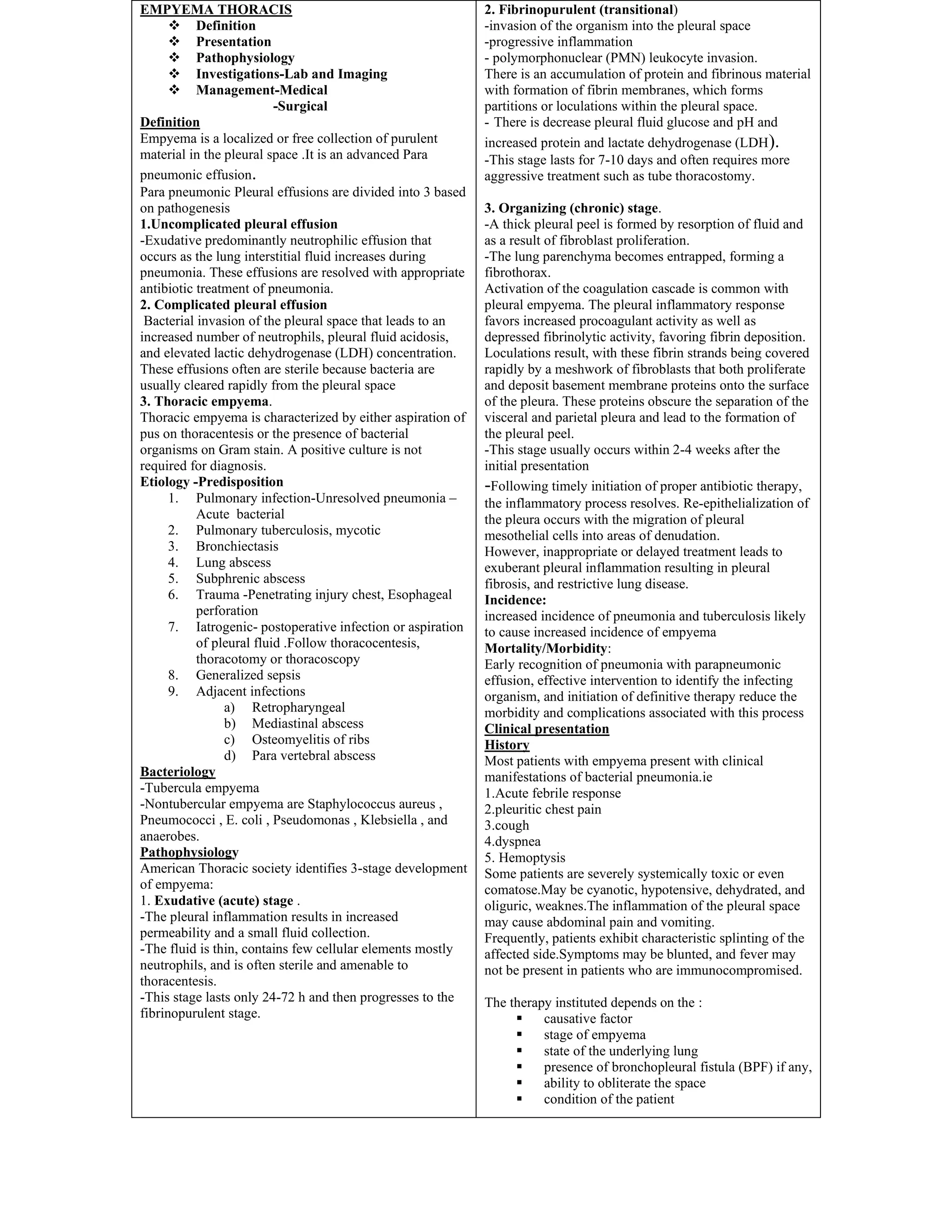
EMPYEMA THORACIS
❖ Definition
❖ Presentation
❖ Pathophysiology
❖ Investigations-Lab and Imaging
❖ Management-Medical
-Surgical
Definition
Empyema is a localized or free collection of purulent
material in the pleural space .It is an advanced Para
pneumonic effusion.
Para pneumonic Pleural effusions are divided into 3 based
on pathogenesis
1.Uncomplicated pleural effusion
-Exudative predominantly neutrophilic effusion that
occurs as the lung interstitial fluid increases during
pneumonia. These effusions are resolved with appropriate
antibiotic treatment of pneumonia.
2. Complicated pleural effusion
Bacterial invasion of the pleural space that leads to an
increased number of neutrophils, pleural fluid acidosis,
and elevated lactic dehydrogenase (LDH) concentration.
These effusions often are sterile because bacteria are
usually cleared rapidly from the pleural space
3. Thoracic empyema.
Thoracic empyema is characterized by either aspiration of
pus on thoracentesis or the presence of bacterial
organisms on Gram stain. A positive culture is not
required for diagnosis.
Etiology -Predisposition
1. Pulmonary infection-Unresolved pneumonia –
Acute bacterial
2. Pulmonary tuberculosis, mycotic
3. Bronchiectasis
4. Lung abscess
5. Subphrenic abscess
6. Trauma -Penetrating injury chest, Esophageal
perforation
7. Iatrogenic- postoperative infection or aspiration
of pleural fluid .Follow thoracocentesis,
thoracotomy or thoracoscopy
8. Generalized sepsis
9. Adjacent infections
a) Retropharyngeal
b) Mediastinal abscess
c) Osteomyelitis of ribs
d) Para vertebral abscess
Bacteriology
-Tubercula empyema
-Nontubercular empyema are Staphylococcus aureus ,
Pneumococci , E. coli , Pseudomonas , Klebsiella , and
anaerobes.
Pathophysiology
American Thoracic society identifies 3-stage development
of empyema:
1. Exudative (acute) stage .
-The pleural inflammation results in increased
permeability and a small fluid collection.
-The fluid is thin, contains few cellular elements mostly
neutrophils, and is often sterile and amenable to
thoracentesis.
-This stage lasts only 24-72 h and then progresses to the
fibrinopurulent stage.
2. Fibrinopurulent (transitional)
-invasion of the organism into the pleural space
-progressive inflammation
- polymorphonuclear (PMN) leukocyte invasion.
There is an accumulation of protein and fibrinous material
with formation of fibrin membranes, which forms
partitions or loculations within the pleural space.
- There is decrease pleural fluid glucose and pH and
increased protein and lactate dehydrogenase (LDH).
-This stage lasts for 7-10 days and often requires more
aggressive treatment such as tube thoracostomy.
3. Organizing (chronic) stage.
-A thick pleural peel is formed by resorption of fluid and
as a result of fibroblast proliferation.
-The lung parenchyma becomes entrapped, forming a
fibrothorax.
Activation of the coagulation cascade is common with
pleural empyema. The pleural inflammatory response
favors increased procoagulant activity as well as
depressed fibrinolytic activity, favoring fibrin deposition.
Loculations result, with these fibrin strands being covered
rapidly by a meshwork of fibroblasts that both proliferate
and deposit basement membrane proteins onto the surface
of the pleura. These proteins obscure the separation of the
visceral and parietal pleura and lead to the formation of
the pleural peel.
-This stage usually occurs within 2-4 weeks after the
initial presentation
-Following timely initiation of proper antibiotic therapy,
the inflammatory process resolves. Re-epithelialization of
the pleura occurs with the migration of pleural
mesothelial cells into areas of denudation.
However, inappropriate or delayed treatment leads to
exuberant pleural inflammation resulting in pleural
fibrosis, and restrictive lung disease.
Incidence:
increased incidence of pneumonia and tuberculosis likely
to cause increased incidence of empyema
Mortality/Morbidity:
Early recognition of pneumonia with parapneumonic
effusion, effective intervention to identify the infecting
organism, and initiation of definitive therapy reduce the
morbidity and complications associated with this process
Clinical presentation
History
Most patients with empyema present with clinical
manifestations of bacterial pneumonia.ie
1.Acute febrile response
2.pleuritic chest pain
3.cough
4.dyspnea
5. Hemoptysis
Some patients are severely systemically toxic or even
comatose.May be cyanotic, hypotensive, dehydrated, and
oliguric, weaknes.The inflammation of the pleural space
may cause abdominal pain and vomiting.
Frequently, patients exhibit characteristic splinting of the
affected side.Symptoms may be blunted, and fever may
not be present in patients who are immunocompromised.
The therapy instituted depends on the :
▪ causative factor
▪ stage of empyema
▪ state of the underlying lung
▪ presence of bronchopleural fistula (BPF) if any,
▪ ability to obliterate the space
▪ condition of the patient
Physical
Features of pleural effusion in the chest crackles, dcreased
air entry and stony dullness
Cyanosis,dehydration and hypotensive in toxic patiens
Differential diagnosis
Heart Failure, Congestive
Hemothorax
Nephrotic Syndrome
Pleural Effusion
Pulmonary Infarction
Pulmonary Sequestration
Pulmonary abscess
INVESTIGATIONS
Laboratory
1.FBC
2.Thoracocentesis done and fluid sent for:
NB Performing thoracentesis before the initiation of
antibiotics increases the diagnostic yield of the fluid
cultures and allows for more specific antimicrobial
therapy
a)WBC counts usually >15000/dl WBC & differential
count predominantly PMN’S
b)Gram stain and AFB
c)Culture and sensitivity Bacterial, mycobacterial, and
fungal cultures
d) Pleural fluid latex agglutination
e) Biochemistry Glucose, LDH, pH, protein, amylase,
lipid stain or triglycerides,
Treatment should be initiated on the basis of the clinical
course and should not wait for above tests.
Pleural fluid latex agglutination [or counter
immunoelectrophoresis (CIE) for specific bacteria] may
be helpful if the cause of the infection cannot be
ascertained from culture results
3.Blood cultures
4.Sputum –AFB, cultures and Radionuclotide studies
Imaging
1. CXR-Fetures of pleural effusion as obliteration of
costo-phrenic angle and fluid level plus diffuse opacity.
Severe effusion may show displacement of the
mediastinum to the contralateral hemithorax as well as
scoliosis
2. Ultrasound for septation of fluids.
3. Complex fluid collections, chest CT imaging has
emerged as the study of choice.
Chest CT imaging can be used to detect and define pleural
fluid and image the airways, guide interventional
procedures, and discriminate between pleural fluid and
chest consolidation.
MANAGEMENT
-Medical
-Surgical
-Combination of both medical and surgical mx is often
employed.
-The objectives of treatment are to
a) Control infection
b) Drainage of the purulent fluid
c) Eradication of the sac to prevent chronicity and
allow re-expansion of the affected lung to restore
function
The treatment needs to be individualized and it depends
on the available clinical, radiological, and laboratory
evidence.
Medical care
General measures include:
-Increase in the protein and fluid intake.
-Physiotherapy and breathing exercises will help in early
re-expansion of the lung following evacuation of the
fluid.
-NSAIDS
Antibiotics
An empiric selection of the most appropriate antibiotics is
necessary before result of culture and sensitivity.
Base the choice on the most common pathogens causing
pneumonia for the patient's age and geographic location
and history.
The patient receives 10-14 days of intravenous antibiotics
and receives treatment until he or she is afebrile, off
supplemental oxygen, and appropriately responding to
therapy. Followed by oral antibiotics for 1-3 weeks
1.Thoracentesis
Thoracentesis may provide, both significant diagnostic
information and therapeutic relief for parapneumonic
effusions.
In cases of streptococcal infection, the pus is very thin
and the volume is also small, with fluid pH above 7.2,
glucose above 40 mg/dl and with LDH levels below 1000
IU/l. In such cases, only a diagnostic needle aspiration
suffices.
In cases tubercular etiology, the antitubercular
chemotherapy started and the pus in the pleural space
aspirated through a wide-bore needle.
A 6-month course with 4+2 drugs or a 9-month course
with 3 drugs is recommended. The treatment may be
required for a longer time in cases with associated Pott's
spine.
2.Tube thoracostomy
Chest tube drainage with an underwater seal is done for
cases in stage 2.
Diagnostic thoracentesis and chest tube drainage are
effective therapy in more than 50% of patients.
Prompt drainage of a free-flowing effusion prevents the
development of loculations and a fibrous peel.
If the fluid is not free flowing, further radiological
imaging may be required.
3.Interventional radiology
The U/S or CT-Scan guided placement of small-bore
catheters, specifically directed to the loculated pleural
fluid collections, has helped to facilitate drainage.
Radiologists can lyse adhesions directly using imaging
during the tube placement. Interventional radiologists
have used fibrinolytics such as urokinase, streptokinase,
and tissue plasminogen activator (TPA) in complicated
empyemas with loculations and ameliorated fibrous peel
formation and fibrin deposition.
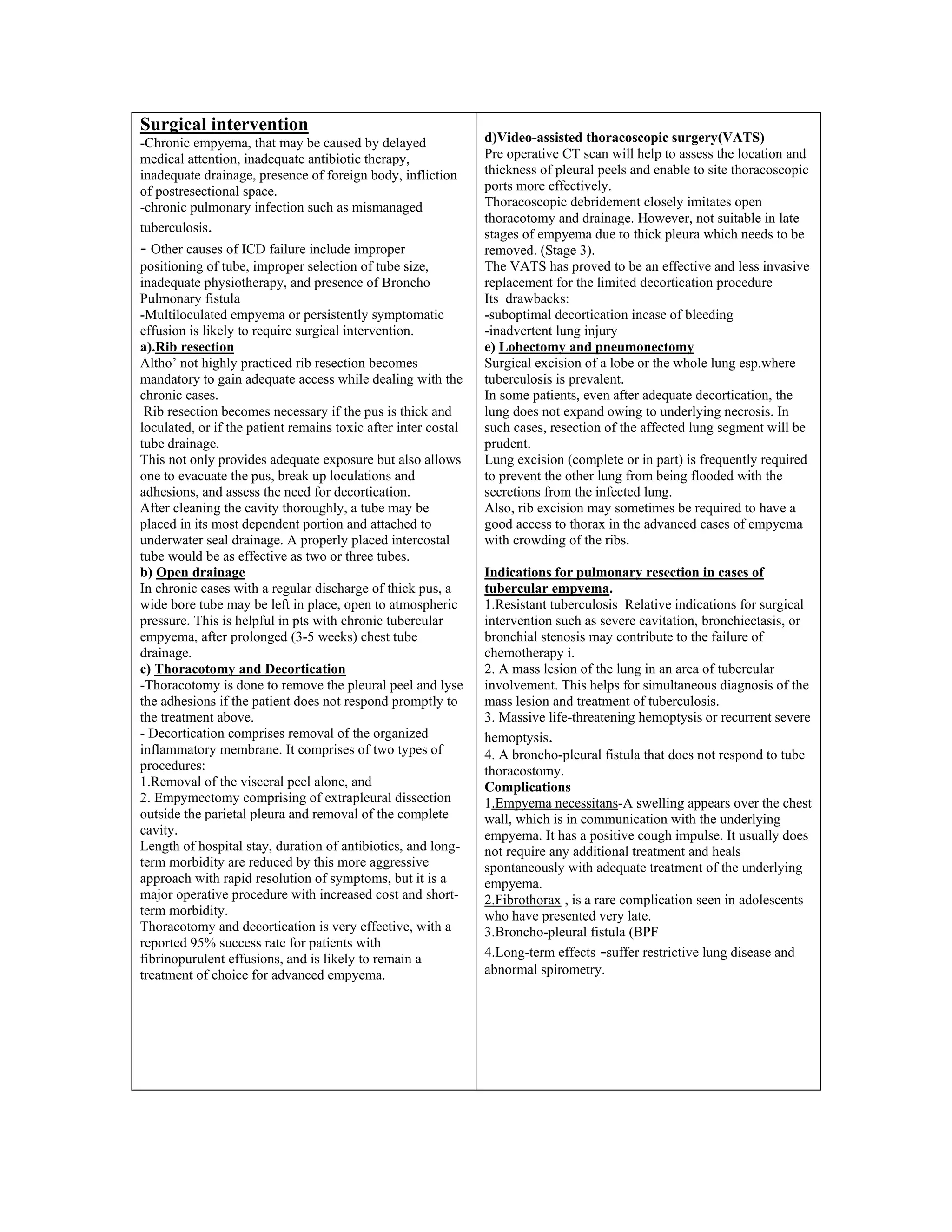
Surgical intervention
-Chronic empyema, that may be caused by delayed
medical attention, inadequate antibiotic therapy,
inadequate drainage, presence of foreign body, infliction
of postresectional space.
-chronic pulmonary infection such as mismanaged
tuberculosis.
- Other causes of ICD failure include improper
positioning of tube, improper selection of tube size,
inadequate physiotherapy, and presence of Broncho
Pulmonary fistula
-Multiloculated empyema or persistently symptomatic
effusion is likely to require surgical intervention.
a).Rib resection
Altho’ not highly practiced rib resection becomes
mandatory to gain adequate access while dealing with the
chronic cases.
Rib resection becomes necessary if the pus is thick and
loculated, or if the patient remains toxic after inter costal
tube drainage.
This not only provides adequate exposure but also allows
one to evacuate the pus, break up loculations and
adhesions, and assess the need for decortication.
After cleaning the cavity thoroughly, a tube may be
placed in its most dependent portion and attached to
underwater seal drainage. A properly placed intercostal
tube would be as effective as two or three tubes.
b) Open drainage
In chronic cases with a regular discharge of thick pus, a
wide bore tube may be left in place, open to atmospheric
pressure. This is helpful in pts with chronic tubercular
empyema, after prolonged (3-5 weeks) chest tube
drainage.
c) Thoracotomy and Decortication
-Thoracotomy is done to remove the pleural peel and lyse
the adhesions if the patient does not respond promptly to
the treatment above.
- Decortication comprises removal of the organized
inflammatory membrane. It comprises of two types of
procedures:
1.Removal of the visceral peel alone, and
2. Empymectomy comprising of extrapleural dissection
outside the parietal pleura and removal of the complete
cavity.
Length of hospital stay, duration of antibiotics, and long-
term morbidity are reduced by this more aggressive
approach with rapid resolution of symptoms, but it is a
major operative procedure with increased cost and short-
term morbidity.
Thoracotomy and decortication is very effective, with a
reported 95% success rate for patients with
fibrinopurulent effusions, and is likely to remain a
treatment of choice for advanced empyema.
d)Video-assisted thoracoscopic surgery(VATS)
Pre operative CT scan will help to assess the location and
thickness of pleural peels and enable to site thoracoscopic
ports more effectively.
Thoracoscopic debridement closely imitates open
thoracotomy and drainage. However, not suitable in late
stages of empyema due to thick pleura which needs to be
removed. (Stage 3).
The VATS has proved to be an effective and less invasive
replacement for the limited decortication procedure
Its drawbacks:
-suboptimal decortication incase of bleeding
-inadvertent lung injury
e) Lobectomy and pneumonectomy
Surgical excision of a lobe or the whole lung esp.where
tuberculosis is prevalent.
In some patients, even after adequate decortication, the
lung does not expand owing to underlying necrosis. In
such cases, resection of the affected lung segment will be
prudent.
Lung excision (complete or in part) is frequently required
to prevent the other lung from being flooded with the
secretions from the infected lung.
Also, rib excision may sometimes be required to have a
good access to thorax in the advanced cases of empyema
with crowding of the ribs.
Indications for pulmonary resection in cases of
tubercular empyema.
1.Resistant tuberculosis Relative indications for surgical
intervention such as severe cavitation, bronchiectasis, or
bronchial stenosis may contribute to the failure of
chemotherapy i.
2. A mass lesion of the lung in an area of tubercular
involvement. This helps for simultaneous diagnosis of the
mass lesion and treatment of tuberculosis.
3. Massive life-threatening hemoptysis or recurrent severe
hemoptysis.
4. A broncho-pleural fistula that does not respond to tube
thoracostomy.
Complications
1.Empyema necessitans-A swelling appears over the chest
wall, which is in communication with the underlying
empyema. It has a positive cough impulse. It usually does
not require any additional treatment and heals
spontaneously with adequate treatment of the underlying
empyema.
2.Fibrothorax , is a rare complication seen in adolescents
who have presented very late.
3.Broncho-pleural fistula (BPF
4.Long-term effects -suffer restrictive lung disease and
abnormal spirometry.
EMPYEMA THORACIS.pdf

EMPYEMA THORACIS.pdf

  • 1.
  • 3.
    EMPYEMA THORACIS ❖ Definition ❖Presentation ❖ Pathophysiology ❖ Investigations-Lab and Imaging ❖ Management-Medical -Surgical Definition Empyema is a localized or free collection of purulent material in the pleural space .It is an advanced Para pneumonic effusion. Para pneumonic Pleural effusions are divided into 3 based on pathogenesis 1.Uncomplicated pleural effusion -Exudative predominantly neutrophilic effusion that occurs as the lung interstitial fluid increases during pneumonia. These effusions are resolved with appropriate antibiotic treatment of pneumonia. 2. Complicated pleural effusion Bacterial invasion of the pleural space that leads to an increased number of neutrophils, pleural fluid acidosis, and elevated lactic dehydrogenase (LDH) concentration. These effusions often are sterile because bacteria are usually cleared rapidly from the pleural space 3. Thoracic empyema. Thoracic empyema is characterized by either aspiration of pus on thoracentesis or the presence of bacterial organisms on Gram stain. A positive culture is not required for diagnosis. Etiology -Predisposition 1. Pulmonary infection-Unresolved pneumonia – Acute bacterial 2. Pulmonary tuberculosis, mycotic 3. Bronchiectasis 4. Lung abscess 5. Subphrenic abscess 6. Trauma -Penetrating injury chest, Esophageal perforation 7. Iatrogenic- postoperative infection or aspiration of pleural fluid .Follow thoracocentesis, thoracotomy or thoracoscopy 8. Generalized sepsis 9. Adjacent infections a) Retropharyngeal b) Mediastinal abscess c) Osteomyelitis of ribs d) Para vertebral abscess Bacteriology -Tubercula empyema -Nontubercular empyema are Staphylococcus aureus , Pneumococci , E. coli , Pseudomonas , Klebsiella , and anaerobes. Pathophysiology American Thoracic society identifies 3-stage development of empyema: 1. Exudative (acute) stage . -The pleural inflammation results in increased permeability and a small fluid collection. -The fluid is thin, contains few cellular elements mostly neutrophils, and is often sterile and amenable to thoracentesis. -This stage lasts only 24-72 h and then progresses to the fibrinopurulent stage. 2. Fibrinopurulent (transitional) -invasion of the organism into the pleural space -progressive inflammation - polymorphonuclear (PMN) leukocyte invasion. There is an accumulation of protein and fibrinous material with formation of fibrin membranes, which forms partitions or loculations within the pleural space. - There is decrease pleural fluid glucose and pH and increased protein and lactate dehydrogenase (LDH). -This stage lasts for 7-10 days and often requires more aggressive treatment such as tube thoracostomy. 3. Organizing (chronic) stage. -A thick pleural peel is formed by resorption of fluid and as a result of fibroblast proliferation. -The lung parenchyma becomes entrapped, forming a fibrothorax. Activation of the coagulation cascade is common with pleural empyema. The pleural inflammatory response favors increased procoagulant activity as well as depressed fibrinolytic activity, favoring fibrin deposition. Loculations result, with these fibrin strands being covered rapidly by a meshwork of fibroblasts that both proliferate and deposit basement membrane proteins onto the surface of the pleura. These proteins obscure the separation of the visceral and parietal pleura and lead to the formation of the pleural peel. -This stage usually occurs within 2-4 weeks after the initial presentation -Following timely initiation of proper antibiotic therapy, the inflammatory process resolves. Re-epithelialization of the pleura occurs with the migration of pleural mesothelial cells into areas of denudation. However, inappropriate or delayed treatment leads to exuberant pleural inflammation resulting in pleural fibrosis, and restrictive lung disease. Incidence: increased incidence of pneumonia and tuberculosis likely to cause increased incidence of empyema Mortality/Morbidity: Early recognition of pneumonia with parapneumonic effusion, effective intervention to identify the infecting organism, and initiation of definitive therapy reduce the morbidity and complications associated with this process Clinical presentation History Most patients with empyema present with clinical manifestations of bacterial pneumonia.ie 1.Acute febrile response 2.pleuritic chest pain 3.cough 4.dyspnea 5. Hemoptysis Some patients are severely systemically toxic or even comatose.May be cyanotic, hypotensive, dehydrated, and oliguric, weaknes.The inflammation of the pleural space may cause abdominal pain and vomiting. Frequently, patients exhibit characteristic splinting of the affected side.Symptoms may be blunted, and fever may not be present in patients who are immunocompromised. The therapy instituted depends on the : ▪ causative factor ▪ stage of empyema ▪ state of the underlying lung ▪ presence of bronchopleural fistula (BPF) if any, ▪ ability to obliterate the space ▪ condition of the patient
  • 4.
    Physical Features of pleuraleffusion in the chest crackles, dcreased air entry and stony dullness Cyanosis,dehydration and hypotensive in toxic patiens Differential diagnosis Heart Failure, Congestive Hemothorax Nephrotic Syndrome Pleural Effusion Pulmonary Infarction Pulmonary Sequestration Pulmonary abscess INVESTIGATIONS Laboratory 1.FBC 2.Thoracocentesis done and fluid sent for: NB Performing thoracentesis before the initiation of antibiotics increases the diagnostic yield of the fluid cultures and allows for more specific antimicrobial therapy a)WBC counts usually >15000/dl WBC & differential count predominantly PMN’S b)Gram stain and AFB c)Culture and sensitivity Bacterial, mycobacterial, and fungal cultures d) Pleural fluid latex agglutination e) Biochemistry Glucose, LDH, pH, protein, amylase, lipid stain or triglycerides, Treatment should be initiated on the basis of the clinical course and should not wait for above tests. Pleural fluid latex agglutination [or counter immunoelectrophoresis (CIE) for specific bacteria] may be helpful if the cause of the infection cannot be ascertained from culture results 3.Blood cultures 4.Sputum –AFB, cultures and Radionuclotide studies Imaging 1. CXR-Fetures of pleural effusion as obliteration of costo-phrenic angle and fluid level plus diffuse opacity. Severe effusion may show displacement of the mediastinum to the contralateral hemithorax as well as scoliosis 2. Ultrasound for septation of fluids. 3. Complex fluid collections, chest CT imaging has emerged as the study of choice. Chest CT imaging can be used to detect and define pleural fluid and image the airways, guide interventional procedures, and discriminate between pleural fluid and chest consolidation. MANAGEMENT -Medical -Surgical -Combination of both medical and surgical mx is often employed. -The objectives of treatment are to a) Control infection b) Drainage of the purulent fluid c) Eradication of the sac to prevent chronicity and allow re-expansion of the affected lung to restore function The treatment needs to be individualized and it depends on the available clinical, radiological, and laboratory evidence. Medical care General measures include: -Increase in the protein and fluid intake. -Physiotherapy and breathing exercises will help in early re-expansion of the lung following evacuation of the fluid. -NSAIDS Antibiotics An empiric selection of the most appropriate antibiotics is necessary before result of culture and sensitivity. Base the choice on the most common pathogens causing pneumonia for the patient's age and geographic location and history. The patient receives 10-14 days of intravenous antibiotics and receives treatment until he or she is afebrile, off supplemental oxygen, and appropriately responding to therapy. Followed by oral antibiotics for 1-3 weeks 1.Thoracentesis Thoracentesis may provide, both significant diagnostic information and therapeutic relief for parapneumonic effusions. In cases of streptococcal infection, the pus is very thin and the volume is also small, with fluid pH above 7.2, glucose above 40 mg/dl and with LDH levels below 1000 IU/l. In such cases, only a diagnostic needle aspiration suffices. In cases tubercular etiology, the antitubercular chemotherapy started and the pus in the pleural space aspirated through a wide-bore needle. A 6-month course with 4+2 drugs or a 9-month course with 3 drugs is recommended. The treatment may be required for a longer time in cases with associated Pott's spine. 2.Tube thoracostomy Chest tube drainage with an underwater seal is done for cases in stage 2. Diagnostic thoracentesis and chest tube drainage are effective therapy in more than 50% of patients. Prompt drainage of a free-flowing effusion prevents the development of loculations and a fibrous peel. If the fluid is not free flowing, further radiological imaging may be required. 3.Interventional radiology The U/S or CT-Scan guided placement of small-bore catheters, specifically directed to the loculated pleural fluid collections, has helped to facilitate drainage. Radiologists can lyse adhesions directly using imaging during the tube placement. Interventional radiologists have used fibrinolytics such as urokinase, streptokinase, and tissue plasminogen activator (TPA) in complicated empyemas with loculations and ameliorated fibrous peel formation and fibrin deposition.
  • 5.
    Surgical intervention -Chronic empyema,that may be caused by delayed medical attention, inadequate antibiotic therapy, inadequate drainage, presence of foreign body, infliction of postresectional space. -chronic pulmonary infection such as mismanaged tuberculosis. - Other causes of ICD failure include improper positioning of tube, improper selection of tube size, inadequate physiotherapy, and presence of Broncho Pulmonary fistula -Multiloculated empyema or persistently symptomatic effusion is likely to require surgical intervention. a).Rib resection Altho’ not highly practiced rib resection becomes mandatory to gain adequate access while dealing with the chronic cases. Rib resection becomes necessary if the pus is thick and loculated, or if the patient remains toxic after inter costal tube drainage. This not only provides adequate exposure but also allows one to evacuate the pus, break up loculations and adhesions, and assess the need for decortication. After cleaning the cavity thoroughly, a tube may be placed in its most dependent portion and attached to underwater seal drainage. A properly placed intercostal tube would be as effective as two or three tubes. b) Open drainage In chronic cases with a regular discharge of thick pus, a wide bore tube may be left in place, open to atmospheric pressure. This is helpful in pts with chronic tubercular empyema, after prolonged (3-5 weeks) chest tube drainage. c) Thoracotomy and Decortication -Thoracotomy is done to remove the pleural peel and lyse the adhesions if the patient does not respond promptly to the treatment above. - Decortication comprises removal of the organized inflammatory membrane. It comprises of two types of procedures: 1.Removal of the visceral peel alone, and 2. Empymectomy comprising of extrapleural dissection outside the parietal pleura and removal of the complete cavity. Length of hospital stay, duration of antibiotics, and long- term morbidity are reduced by this more aggressive approach with rapid resolution of symptoms, but it is a major operative procedure with increased cost and short- term morbidity. Thoracotomy and decortication is very effective, with a reported 95% success rate for patients with fibrinopurulent effusions, and is likely to remain a treatment of choice for advanced empyema. d)Video-assisted thoracoscopic surgery(VATS) Pre operative CT scan will help to assess the location and thickness of pleural peels and enable to site thoracoscopic ports more effectively. Thoracoscopic debridement closely imitates open thoracotomy and drainage. However, not suitable in late stages of empyema due to thick pleura which needs to be removed. (Stage 3). The VATS has proved to be an effective and less invasive replacement for the limited decortication procedure Its drawbacks: -suboptimal decortication incase of bleeding -inadvertent lung injury e) Lobectomy and pneumonectomy Surgical excision of a lobe or the whole lung esp.where tuberculosis is prevalent. In some patients, even after adequate decortication, the lung does not expand owing to underlying necrosis. In such cases, resection of the affected lung segment will be prudent. Lung excision (complete or in part) is frequently required to prevent the other lung from being flooded with the secretions from the infected lung. Also, rib excision may sometimes be required to have a good access to thorax in the advanced cases of empyema with crowding of the ribs. Indications for pulmonary resection in cases of tubercular empyema. 1.Resistant tuberculosis Relative indications for surgical intervention such as severe cavitation, bronchiectasis, or bronchial stenosis may contribute to the failure of chemotherapy i. 2. A mass lesion of the lung in an area of tubercular involvement. This helps for simultaneous diagnosis of the mass lesion and treatment of tuberculosis. 3. Massive life-threatening hemoptysis or recurrent severe hemoptysis. 4. A broncho-pleural fistula that does not respond to tube thoracostomy. Complications 1.Empyema necessitans-A swelling appears over the chest wall, which is in communication with the underlying empyema. It has a positive cough impulse. It usually does not require any additional treatment and heals spontaneously with adequate treatment of the underlying empyema. 2.Fibrothorax , is a rare complication seen in adolescents who have presented very late. 3.Broncho-pleural fistula (BPF 4.Long-term effects -suffer restrictive lung disease and abnormal spirometry.