BRONCHIAL
ASTHMA
Presenter
AMANDEEP KAUR
NURSING TUTOR
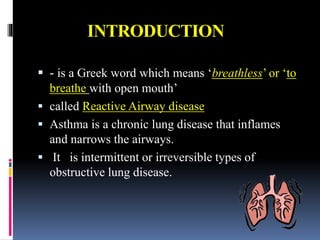
INTRODUCTION
 - is a Greek word which means ‘breathless’ or ‘to
breathe with open mouth’
 called Reactive Airway disease
 Asthma is a chronic lung disease that inflames
and narrows the airways.
 It is intermittent or irreversible types of
obstructive lung disease.
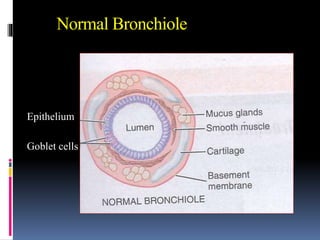
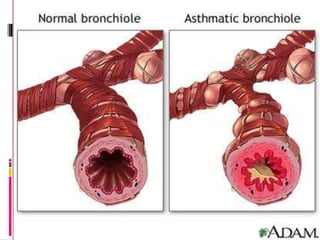
Normal Bronchiole
Epithelium
Goblet cells
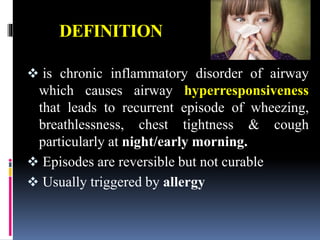
DEFINITION
 is chronic inflammatory disorder of airway
which causes airway hyperresponsiveness
that leads to recurrent episode of wheezing,
breathlessness, chest tightness & cough
particularly at night/early morning.
 Episodes are reversible but not curable
 Usually triggered by allergy
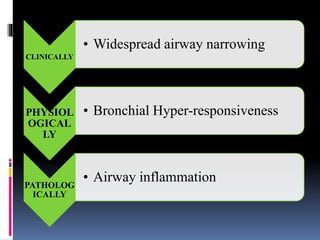
CLINICALLY
• Widespread airway narrowing
PHYSIOL
OGICAL
LY
• Bronchial Hyper-responsiveness
PATHOLOG
ICALLY
• Airway inflammation
INCIDENCES
WORLD
- it affects 300 million people
-10-12% =adults
-15% =children
INDIA
- it affects 2.5 crore people/year
- it causes 4000 deaths/year
GENDER
childhood = common in boys
after puberty = common in girls
RISK FACTORS
 Host factors
Age and sex
Racial and ethnic factors
Genetic polymorphisms
Other Atopic Conditions
Obesity
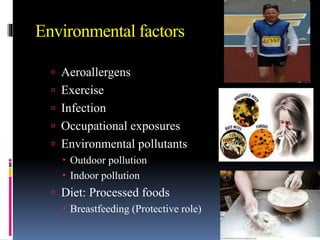
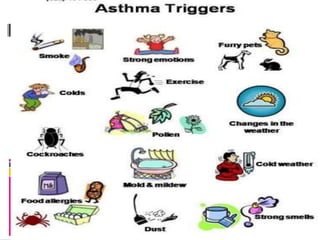
Environmental factors
 Aeroallergens
 Exercise
 Infection
 Occupational exposures
 Environmental pollutants
 Outdoor pollution
 Indoor pollution
 Diet: Processed foods
 Breastfeeding (Protective role)
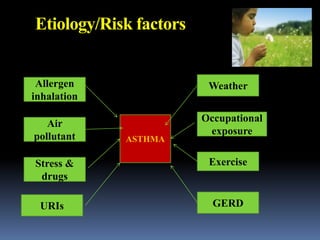
Etiology/Risk factors
ASTHMA
Allergen
inhalation
Air
pollutant
URIs
Weather
Stress &
drugs
Occupational
exposure
Exercise
GERD
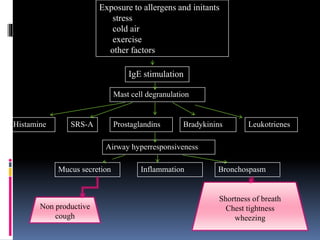
Exposure to allergens and initants
stress
cold air
exercise
other factors
IgE stimulation
Mast cell degranulation
Histamine ProstaglandinsSRS-A Bradykinins Leukotrienes
Airway hyperresponsiveness
Mucus secretion BronchospasmInflammation
Non productive
cough
Shortness of breath
Chest tightness
wheezing
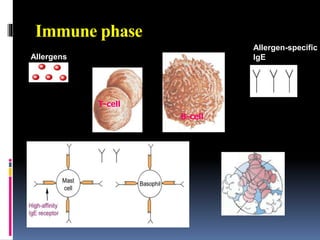
Immune phase
Allergens
T-cell
B-cell
Allergen-specific
IgE
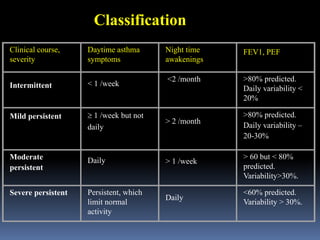
Clinical course,
severity
Daytime asthma
symptoms
Night time
awakenings
FEV1, PEF
Intermittent < 1 /week
<2 /month >80% predicted.
Daily variability <
20%
Mild persistent  1 /week but not
daily
> 2 /month
>80% predicted.
Daily variability –
20-30%
Moderate
persistent
Daily > 1 /week
> 60 but < 80%
predicted.
Variability>30%.
Severe persistent Persistent, which
limit normal
activity
Daily
<60% predicted.
Variability > 30%.
Classification
Classification
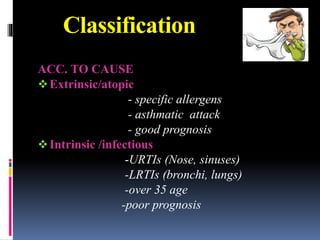
ACC. TO CAUSE
Extrinsic/atopic
- specific allergens
- asthmatic attack
- good prognosis
Intrinsic /infectious
-URTIs (Nose, sinuses)
-LRTIs (bronchi, lungs)
-over 35 age
-poor prognosis
Classification
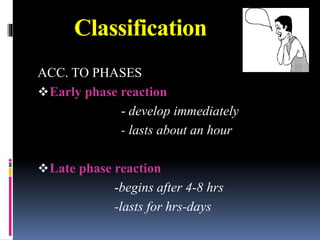
ACC. TO PHASES
Early phase reaction
- develop immediately
- lasts about an hour
Late phase reaction
-begins after 4-8 hrs
-lasts for hrs-days
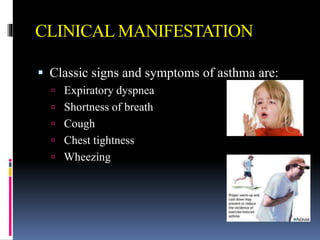
CLINICAL MANIFESTATION
 Classic signs and symptoms of asthma are:
 Expiratory dyspnea
 Shortness of breath
 Cough
 Chest tightness
 Wheezing
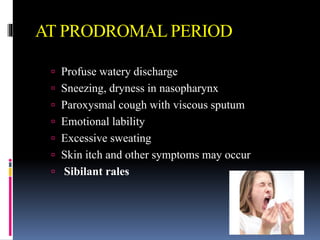
AT PRODROMAL PERIOD
 Profuse watery discharge
 Sneezing, dryness in nasopharynx
 Paroxysmal cough with viscous sputum
 Emotional lability
 Excessive sweating
 Skin itch and other symptoms may occur
 Sibilant rales
At the peak of exacerbation there are:
 Expiratory dyspnea
 Poorly productive cough
 Cyanotic skin
 Hyper expansion of thorax with use of all
accessory muscles during breathing
 At auscultation: diminished breath sounds, sibilant
rales, prolonged breathing-out, tachycardia.
 in severe exacerbations: the signs of right-
sided heart failure (distended neck veins),
overload of right heart chambers on ECG
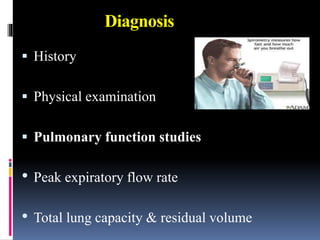
Diagnosis
 History
 Physical examination
 Pulmonary function studies
• Peak expiratory flow rate
• Total lung capacity & residual volume
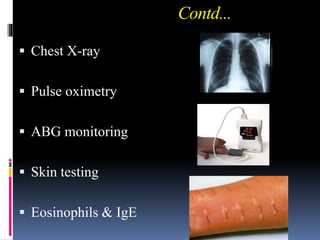
 Chest X-ray
 Pulse oximetry
 ABG monitoring
 Skin testing
 Eosinophils & IgE
Contd...
Prevention
Essential component of asthma care is avoidance
 Avoiding triggers (Effective Environmental Control)
 Avoid things that accumulate dust in the bedroom.
 Precautions while cleaning the house
 Wash the sheets and blankets weekly
 Avoid fumes from wood burning, sprays and strong
odours
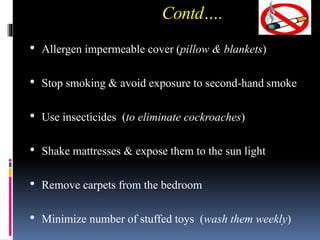
Contd….
• Allergen impermeable cover (pillow & blankets)
• Stop smoking & avoid exposure to second-hand smoke
• Use insecticides (to eliminate cockroaches)
• Shake mattresses & expose them to the sun light
• Remove carpets from the bedroom
• Minimize number of stuffed toys (wash them weekly)
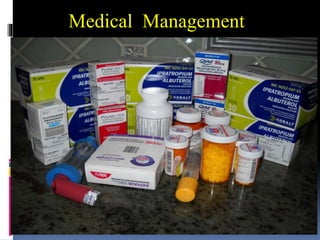
Medical Management
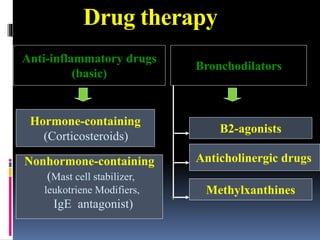
Drug therapy
Anti-inflammatory drugs
(basic)
Bronchodilators
Hormone-containing
(Corticosteroids)
Nonhormone-containing
(Mast cell stabilizer,
leukotriene Modifiers,
IgE antagonist)
Anticholinergic drugs
B2-agonists
Methylxanthines
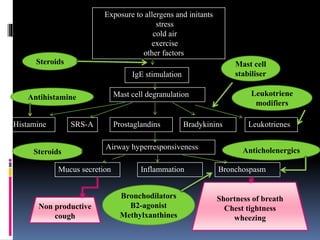
Exposure to allergens and initants
stress
cold air
exercise
other factors
IgE stimulation
Mast cell degranulation
Histamine ProstaglandinsSRS-A Bradykinins Leukotrienes
Airway hyperresponsiveness
Mucus secretion BronchospasmInflammation
Steroids
Antihistamine
Mast cell
stabiliser
Leukotriene
modifiers
Non productive
cough
Shortness of breath
Chest tightness
wheezing
Steroids
Bronchodilators
B2-agonist
Methylxanthines
Anticholenergics
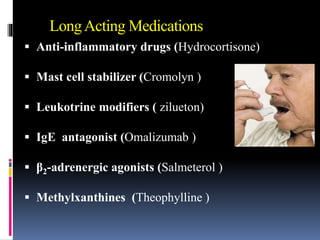
LongActing Medications
 Anti-inflammatory drugs (Hydrocortisone)
 Mast cell stabilizer (Cromolyn )
 Leukotrine modifiers ( zilueton)
 IgE antagonist (Omalizumab )
 β2-adrenergic agonists (Salmeterol )
 Methylxanthines (Theophylline )
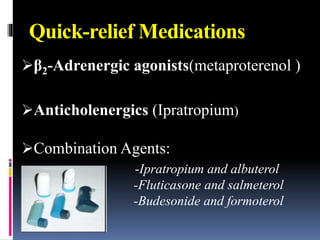
Quick-relief Medications
β2-Adrenergic agonists(metaproterenol )
Anticholenergics (Ipratropium)
Combination Agents:
-Ipratropium and albuterol
-Fluticasone and salmeterol
-Budesonide and formoterol
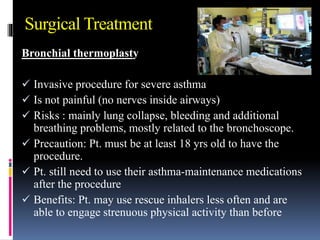
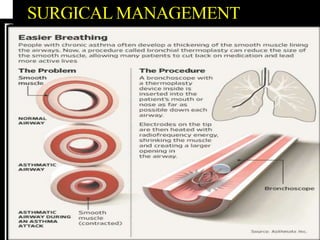
Bronchial thermoplasty
 Invasive procedure for severe asthma
 Is not painful (no nerves inside airways)
 Risks : mainly lung collapse, bleeding and additional
breathing problems, mostly related to the bronchoscope.
 Precaution: Pt. must be at least 18 yrs old to have the
procedure.
 Pt. still need to use their asthma-maintenance medications
after the procedure
 Benefits: Pt. may use rescue inhalers less often and are
able to engage strenuous physical activity than before
Surgical Treatment
SURGICAL MANAGEMENT
Complications
 Pneumothorax
 Pneumomediastinum
 Atelectasis
 Pneumonia
 Status asthmaticus
Status asthmaticus
 It is a severe form of asthma in which
the airway obstruction is unresponsive
to usual drug therapy.
Status asthmaticus
 Very severe
 Life threatening
 Refractory to t/t
 Respiratory failure
 ICU monitoring (ventilator assist)
Causes
 Viral illness/infection
 Aspirin, NASIDS aspiration in aspirin sensitive patients.
 Emotional stress
 Allergens & Pollutants
 Beta blockers
 Aspiration of gastric content/acid.
 Discontinuation of therapy
Clinical Features
 Increased airway resistance
 Tachypnea, labored respiration with increased
efforts on exhalation (Hyperinflation).
 Suprasternal retractions, use of accessory
muscles of respiration.
 Diminished breath sounds, decreased ability to
speak in phrases or sentences.
 Anxiety, irritability, fatigue, headache,
impaired mental functioning, hypoxemia,
diaphoresis
 Resp. acidosis
Conti….
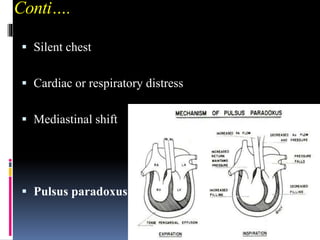
 Silent chest
 Cardiac or respiratory distress
 Mediastinal shift
 Pulsus paradoxus
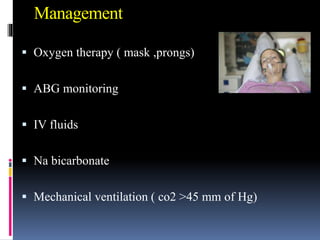
Management
 Oxygen therapy ( mask ,prongs)
 ABG monitoring
 IV fluids
 Na bicarbonate
 Mechanical ventilation ( co2 >45 mm of Hg)
NURSING
MANAGEMENT
Assessment-
 It involves obtaining information about current
symptoms as well as previous disease
manifestations.
 Assist with diagnostic tests, pulmonary function
tests and skin testing as well as general health
assessment.
 Obtain data about assessment of how asthma
impacts the patient’s everyday activities and self
concept as well as patient and family’s adherence
to prescribed therapy and their personal treatment
goals.
Nursing Diagnosis
 Ineffective breathing pattern related to impaired
exhalation and anxiety as evidenced by patient’s
breathing pattern.
 Ineffective airway clearance related to increased
production of secretions and bronchospasm as evidenced
by clear mucus/secretions in the airway/tube.
 Impaired gas exchange related to air trapping as
evidenced by SpO2 level of patient.
 Knowledge deficit related to use of inhaled and nebulized
medications as evidenced by patient’s way of taking
medication.
Ineffective breathing pattern related to
impaired exhalation and anxiety
 Assessment
-resp rate & depth
-shortness of breath
-pursed lip breathing, nasal flaring
-sternal & intercostal retractions
-prolonged expiration
 fowler position and oxygen
 Asthma medications
 Monitor ABG and oxygen saturation
Ineffective airway clearance related to increased
production of secretions and bronchospasm
 Assess the airway ( may need suctioning)
 Sputum (color & consistency )
 cough effectively
 oral fluids ( secretions & replace fluids)
 Postural drainage, percussion ,vibration (thick
secretions)
 Oral care
 Medication ( step care)
Impaired gas exchange related to air trapping
 lung sounds /hour (gas exchange )
 Cyanosis (skin and mucous membrane )
 pulse oximetry (oxygen saturation levels)
 Administer oxygen (oxygen saturation)
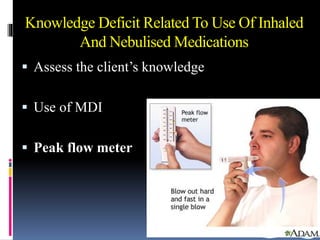
Knowledge Deficit Related To Use Of Inhaled
And Nebulised Medications
 Assess the client’s knowledge
 Use of MDI
 Peak flow meter
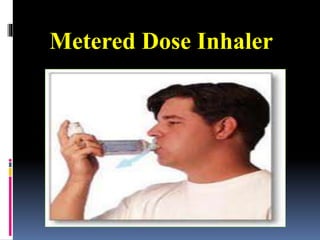
Metered Dose Inhaler
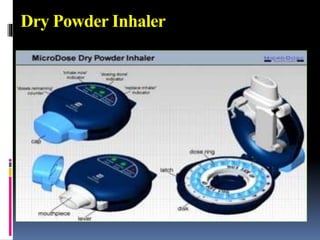
Dry Powder Inhaler
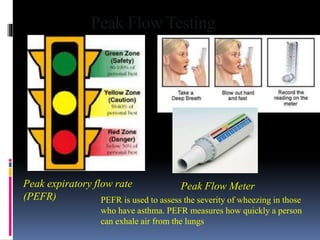
Peak Flow Testing
Peak Flow Meter
PEFR is used to assess the severity of wheezing in those
who have asthma. PEFR measures how quickly a person
can exhale air from the lungs
Peak expiratory flow rate
(PEFR)
References
 Black JM, Hawks JH. Medical surgical nursing:
clinical management for positive outcomes. 8th ed.
New Delhi: Elsevier; 2010.p.1570-1580.(vol2).
 Nettina SM. Lippincott manual of nursing
practice.9th ed. New Delhi: Wolters kluwer;
2010.p.1019-1025.
 Bucher L, Lewis SL, Heitkemper MM, Dirksen SR.
Lewis’s medical surgical nursing. 7th ed. New Delhi:
Elsevier; 2011.p.609-630.
Asthma ppt

Asthma ppt

  • 1.
  • 2.
    INTRODUCTION  - isa Greek word which means ‘breathless’ or ‘to breathe with open mouth’  called Reactive Airway disease  Asthma is a chronic lung disease that inflames and narrows the airways.  It is intermittent or irreversible types of obstructive lung disease.
  • 3.
  • 4.
    DEFINITION  is chronicinflammatory disorder of airway which causes airway hyperresponsiveness that leads to recurrent episode of wheezing, breathlessness, chest tightness & cough particularly at night/early morning.  Episodes are reversible but not curable  Usually triggered by allergy
  • 5.
    CLINICALLY • Widespread airwaynarrowing PHYSIOL OGICAL LY • Bronchial Hyper-responsiveness PATHOLOG ICALLY • Airway inflammation
  • 7.
    INCIDENCES WORLD - it affects300 million people -10-12% =adults -15% =children INDIA - it affects 2.5 crore people/year - it causes 4000 deaths/year GENDER childhood = common in boys after puberty = common in girls
  • 8.
    RISK FACTORS  Hostfactors Age and sex Racial and ethnic factors Genetic polymorphisms Other Atopic Conditions Obesity
  • 9.
    Environmental factors  Aeroallergens Exercise  Infection  Occupational exposures  Environmental pollutants  Outdoor pollution  Indoor pollution  Diet: Processed foods  Breastfeeding (Protective role)
  • 11.
  • 12.
    Exposure to allergensand initants stress cold air exercise other factors IgE stimulation Mast cell degranulation Histamine ProstaglandinsSRS-A Bradykinins Leukotrienes Airway hyperresponsiveness Mucus secretion BronchospasmInflammation Non productive cough Shortness of breath Chest tightness wheezing
  • 13.
  • 14.
    Clinical course, severity Daytime asthma symptoms Nighttime awakenings FEV1, PEF Intermittent < 1 /week <2 /month >80% predicted. Daily variability < 20% Mild persistent  1 /week but not daily > 2 /month >80% predicted. Daily variability – 20-30% Moderate persistent Daily > 1 /week > 60 but < 80% predicted. Variability>30%. Severe persistent Persistent, which limit normal activity Daily <60% predicted. Variability > 30%. Classification
  • 15.
    Classification ACC. TO CAUSE Extrinsic/atopic -specific allergens - asthmatic attack - good prognosis Intrinsic /infectious -URTIs (Nose, sinuses) -LRTIs (bronchi, lungs) -over 35 age -poor prognosis
  • 16.
    Classification ACC. TO PHASES Earlyphase reaction - develop immediately - lasts about an hour Late phase reaction -begins after 4-8 hrs -lasts for hrs-days
  • 17.
    CLINICAL MANIFESTATION  Classicsigns and symptoms of asthma are:  Expiratory dyspnea  Shortness of breath  Cough  Chest tightness  Wheezing
  • 18.
    AT PRODROMAL PERIOD Profuse watery discharge  Sneezing, dryness in nasopharynx  Paroxysmal cough with viscous sputum  Emotional lability  Excessive sweating  Skin itch and other symptoms may occur  Sibilant rales
  • 19.
    At the peakof exacerbation there are:  Expiratory dyspnea  Poorly productive cough  Cyanotic skin  Hyper expansion of thorax with use of all accessory muscles during breathing  At auscultation: diminished breath sounds, sibilant rales, prolonged breathing-out, tachycardia.  in severe exacerbations: the signs of right- sided heart failure (distended neck veins), overload of right heart chambers on ECG
  • 20.
    Diagnosis  History  Physicalexamination  Pulmonary function studies • Peak expiratory flow rate • Total lung capacity & residual volume
  • 21.
     Chest X-ray Pulse oximetry  ABG monitoring  Skin testing  Eosinophils & IgE Contd...
  • 22.
    Prevention Essential component ofasthma care is avoidance  Avoiding triggers (Effective Environmental Control)  Avoid things that accumulate dust in the bedroom.  Precautions while cleaning the house  Wash the sheets and blankets weekly  Avoid fumes from wood burning, sprays and strong odours
  • 23.
    Contd…. • Allergen impermeablecover (pillow & blankets) • Stop smoking & avoid exposure to second-hand smoke • Use insecticides (to eliminate cockroaches) • Shake mattresses & expose them to the sun light • Remove carpets from the bedroom • Minimize number of stuffed toys (wash them weekly)
  • 24.
  • 25.
    Drug therapy Anti-inflammatory drugs (basic) Bronchodilators Hormone-containing (Corticosteroids) Nonhormone-containing (Mastcell stabilizer, leukotriene Modifiers, IgE antagonist) Anticholinergic drugs B2-agonists Methylxanthines
  • 26.
    Exposure to allergensand initants stress cold air exercise other factors IgE stimulation Mast cell degranulation Histamine ProstaglandinsSRS-A Bradykinins Leukotrienes Airway hyperresponsiveness Mucus secretion BronchospasmInflammation Steroids Antihistamine Mast cell stabiliser Leukotriene modifiers Non productive cough Shortness of breath Chest tightness wheezing Steroids Bronchodilators B2-agonist Methylxanthines Anticholenergics
  • 27.
    LongActing Medications  Anti-inflammatorydrugs (Hydrocortisone)  Mast cell stabilizer (Cromolyn )  Leukotrine modifiers ( zilueton)  IgE antagonist (Omalizumab )  β2-adrenergic agonists (Salmeterol )  Methylxanthines (Theophylline )
  • 28.
    Quick-relief Medications β2-Adrenergic agonists(metaproterenol) Anticholenergics (Ipratropium) Combination Agents: -Ipratropium and albuterol -Fluticasone and salmeterol -Budesonide and formoterol
  • 29.
    Bronchial thermoplasty  Invasiveprocedure for severe asthma  Is not painful (no nerves inside airways)  Risks : mainly lung collapse, bleeding and additional breathing problems, mostly related to the bronchoscope.  Precaution: Pt. must be at least 18 yrs old to have the procedure.  Pt. still need to use their asthma-maintenance medications after the procedure  Benefits: Pt. may use rescue inhalers less often and are able to engage strenuous physical activity than before Surgical Treatment
  • 30.
  • 31.
    Complications  Pneumothorax  Pneumomediastinum Atelectasis  Pneumonia  Status asthmaticus
  • 32.
    Status asthmaticus  Itis a severe form of asthma in which the airway obstruction is unresponsive to usual drug therapy.
  • 33.
    Status asthmaticus  Verysevere  Life threatening  Refractory to t/t  Respiratory failure  ICU monitoring (ventilator assist)
  • 34.
    Causes  Viral illness/infection Aspirin, NASIDS aspiration in aspirin sensitive patients.  Emotional stress  Allergens & Pollutants  Beta blockers  Aspiration of gastric content/acid.  Discontinuation of therapy
  • 35.
    Clinical Features  Increasedairway resistance  Tachypnea, labored respiration with increased efforts on exhalation (Hyperinflation).  Suprasternal retractions, use of accessory muscles of respiration.  Diminished breath sounds, decreased ability to speak in phrases or sentences.  Anxiety, irritability, fatigue, headache, impaired mental functioning, hypoxemia, diaphoresis  Resp. acidosis
  • 36.
    Conti….  Silent chest Cardiac or respiratory distress  Mediastinal shift  Pulsus paradoxus
  • 37.
    Management  Oxygen therapy( mask ,prongs)  ABG monitoring  IV fluids  Na bicarbonate  Mechanical ventilation ( co2 >45 mm of Hg)
  • 38.
  • 39.
    Assessment-  It involvesobtaining information about current symptoms as well as previous disease manifestations.  Assist with diagnostic tests, pulmonary function tests and skin testing as well as general health assessment.  Obtain data about assessment of how asthma impacts the patient’s everyday activities and self concept as well as patient and family’s adherence to prescribed therapy and their personal treatment goals.
  • 40.

    Nursing Diagnosis  Ineffectivebreathing pattern related to impaired exhalation and anxiety as evidenced by patient’s breathing pattern.  Ineffective airway clearance related to increased production of secretions and bronchospasm as evidenced by clear mucus/secretions in the airway/tube.  Impaired gas exchange related to air trapping as evidenced by SpO2 level of patient.  Knowledge deficit related to use of inhaled and nebulized medications as evidenced by patient’s way of taking medication.
  • 41.
    Ineffective breathing patternrelated to impaired exhalation and anxiety  Assessment -resp rate & depth -shortness of breath -pursed lip breathing, nasal flaring -sternal & intercostal retractions -prolonged expiration  fowler position and oxygen  Asthma medications  Monitor ABG and oxygen saturation
  • 42.
    Ineffective airway clearancerelated to increased production of secretions and bronchospasm  Assess the airway ( may need suctioning)  Sputum (color & consistency )  cough effectively  oral fluids ( secretions & replace fluids)  Postural drainage, percussion ,vibration (thick secretions)  Oral care  Medication ( step care)
  • 43.
    Impaired gas exchangerelated to air trapping  lung sounds /hour (gas exchange )  Cyanosis (skin and mucous membrane )  pulse oximetry (oxygen saturation levels)  Administer oxygen (oxygen saturation)
  • 44.
    Knowledge Deficit RelatedTo Use Of Inhaled And Nebulised Medications  Assess the client’s knowledge  Use of MDI  Peak flow meter
  • 45.
  • 46.
  • 47.
    Peak Flow Testing PeakFlow Meter PEFR is used to assess the severity of wheezing in those who have asthma. PEFR measures how quickly a person can exhale air from the lungs Peak expiratory flow rate (PEFR)
  • 50.
    References  Black JM,Hawks JH. Medical surgical nursing: clinical management for positive outcomes. 8th ed. New Delhi: Elsevier; 2010.p.1570-1580.(vol2).  Nettina SM. Lippincott manual of nursing practice.9th ed. New Delhi: Wolters kluwer; 2010.p.1019-1025.  Bucher L, Lewis SL, Heitkemper MM, Dirksen SR. Lewis’s medical surgical nursing. 7th ed. New Delhi: Elsevier; 2011.p.609-630.