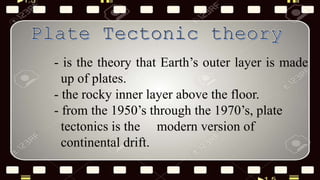
- is the theory that Earth’s outer layer is made
up of plates.
- the rocky inner layer above the floor.
- from the 1950’s through the 1970’s, plate
tectonics is the modern version of
continental drift.
- German climatologist and
geophysicist who, in 1915, published
as expanded version of his 1912
book The Origin of Continents and
Oceans.
- He suggested that all the major
continents formed one giant
supercontinent, called PANGEA.
- 200 million years ago, PANGEA
began to rift.
- Oceans filled the areas between these
new sub-continents.
- The land masses continued to move
apart, riding on separate plates, until
they reached the positions they
currently occupy.
- What drives plate tectonics? NOT
KNOWN.
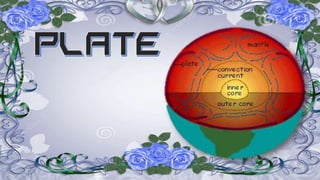
- One theory said that convection
within the Earth's mantle pushes the
plates;
- in much the same way that air heated
by your body rises upward and is
deflected sideways when it reaches
the ceiling.
- Another theory is that gravity
is pulling the older, colder, and
thus heavier ocean floor with
more force than the newer,
lighter seafloor.
- the region where plate meet. The
plates may either collide, move away from
each other or slip/slide past each other
- Divergent
Boundaries
- Convergent
Boundaries
- Collisional
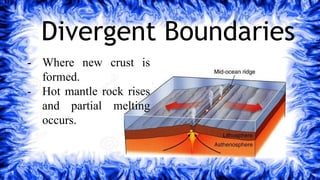
Divergent Boundaries
- Where new crust is
formed.
- Hot mantle rock rises
and partial melting
occurs.
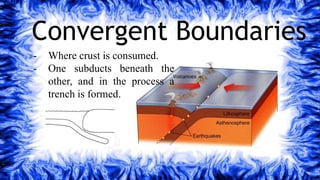
Convergent Boundaries
- Where crust is consumed.
- One subducts beneath the
other, and in the process a
trench is formed.
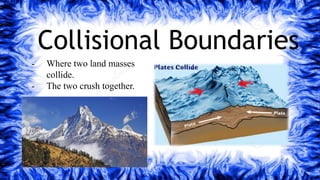
- Where two land masses
collide.
- The two crush together.
Collisional Boundaries
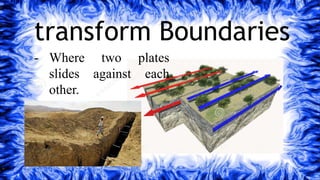
- Where two plates
slides against each
other.
transform Boundaries
Mariana Plate
Philippine Sea Plate
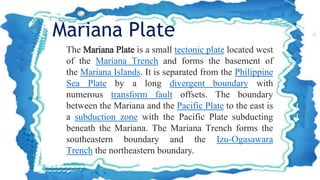
The Mariana Plate is a small tectonic plate located west
of the Mariana Trench and forms the basement of
the Mariana Islands. It is separated from the Philippine
Sea Plate by a long divergent boundary with
numerous transform fault offsets. The boundary
between the Mariana and the Pacific Plate to the east is
a subduction zone with the Pacific Plate subducting
beneath the Mariana. The Mariana Trench forms the
southeastern boundary and the Izu-Ogasawara
Trench the northeastern boundary.
Mariana Plate
Type Minor
Approx. Area 360,000 km2[1]
Movement1 north-west
Speed1 39-51mm/year
Features
Mariana Islands, Mariana
Trench
o The Philippine Mobile Belt is a complex portion of the
tectonic boundary between the Eurasian Plate and
the Philippine Sea Plate, comprising most of the
country of the Philippines.
o It includes two subduction zones, the Manila Trench to
the west and the Philippine Trench to the east, as well
as the Philippine Fault System.
o Within the Belt, a number of crustal blocks or
microplates which have been sheared off the adjoining
major plates are undergoing massive deformation.
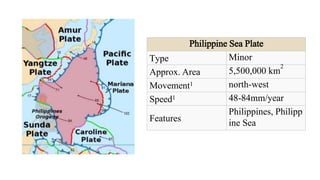
Philippine Sea Plate
Type Minor
Approx. Area 5,500,000 km
2
Movement1 north-west
Speed1 48-84mm/year
Features
Philippines, Philipp
ine Sea
Plate tectonic ppt

Plate tectonic ppt

  • 2.
    - is thetheory that Earth’s outer layer is made up of plates. - the rocky inner layer above the floor. - from the 1950’s through the 1970’s, plate tectonics is the modern version of continental drift.
  • 4.
    - German climatologistand geophysicist who, in 1915, published as expanded version of his 1912 book The Origin of Continents and Oceans. - He suggested that all the major continents formed one giant supercontinent, called PANGEA. - 200 million years ago, PANGEA began to rift.
  • 5.
    - Oceans filledthe areas between these new sub-continents. - The land masses continued to move apart, riding on separate plates, until they reached the positions they currently occupy. - What drives plate tectonics? NOT KNOWN.
  • 6.
    - One theorysaid that convection within the Earth's mantle pushes the plates; - in much the same way that air heated by your body rises upward and is deflected sideways when it reaches the ceiling.
  • 7.
    - Another theoryis that gravity is pulling the older, colder, and thus heavier ocean floor with more force than the newer, lighter seafloor.
  • 8.
    - the regionwhere plate meet. The plates may either collide, move away from each other or slip/slide past each other
  • 9.
  • 10.
    Divergent Boundaries - Wherenew crust is formed. - Hot mantle rock rises and partial melting occurs.
  • 11.
    Convergent Boundaries - Wherecrust is consumed. - One subducts beneath the other, and in the process a trench is formed.
  • 12.
    - Where twoland masses collide. - The two crush together. Collisional Boundaries
  • 13.
    - Where twoplates slides against each other. transform Boundaries
  • 15.
  • 16.
    The Mariana Plateis a small tectonic plate located west of the Mariana Trench and forms the basement of the Mariana Islands. It is separated from the Philippine Sea Plate by a long divergent boundary with numerous transform fault offsets. The boundary between the Mariana and the Pacific Plate to the east is a subduction zone with the Pacific Plate subducting beneath the Mariana. The Mariana Trench forms the southeastern boundary and the Izu-Ogasawara Trench the northeastern boundary. Mariana Plate
  • 17.
    Type Minor Approx. Area360,000 km2[1] Movement1 north-west Speed1 39-51mm/year Features Mariana Islands, Mariana Trench
  • 18.
    o The PhilippineMobile Belt is a complex portion of the tectonic boundary between the Eurasian Plate and the Philippine Sea Plate, comprising most of the country of the Philippines. o It includes two subduction zones, the Manila Trench to the west and the Philippine Trench to the east, as well as the Philippine Fault System. o Within the Belt, a number of crustal blocks or microplates which have been sheared off the adjoining major plates are undergoing massive deformation. Philippine Sea Plate
  • 19.
    Philippine Sea Plate TypeMinor Approx. Area 5,500,000 km 2 Movement1 north-west Speed1 48-84mm/year Features Philippines, Philipp ine Sea

Editor's Notes

  • #3 -which have moved throughout the earth’s history. - It explains the how and why, volcanoes, earthquakes, and mountains as well as how, long ago, similar animals could have lived at the same time on what are new widely separated continents.
  • #5 Initiated by heat building up underneath the vast continent, around. . . - so, these continents are still on the move today.
  • #8 Whatever drives the continents, plate tectonic act. takes place at four types of boundaries.
  • #11 As the plates move apart, magma wells up to fill the space between them and this is why divergent plate boundaries are the sites of volcanic activities. - As magma cools, it produces rocks that becomes an oceanic rocks.
  • #12 The heavier oceanic crust sinks below the lighter continental crust. - Convergent plate boundaries are often the sites of major volcanoes.
  • #13 They crumple and fold. The result is a mountain range.
  • #14 Ex. San Andreas fault, California. Let’s watch a short video, it includes here the four types of boundaries.
  • #15 Now, let’s discover the plates here in the phil’s.