Plate Tectonics
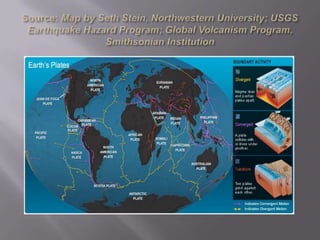
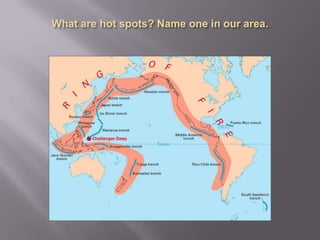
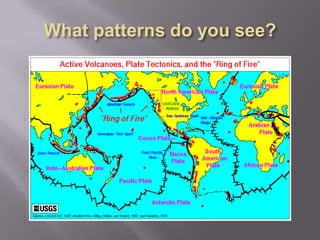
Source: Map by Seth Stein, Northwestern University; USGS Earthquake Hazard Program; Global Volcanism Program, Smithsonian Institution
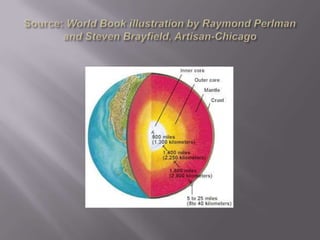
The Core	Inner Core = solid and 5X density of surface rockOuter Core = partially molten materialRotates few 1/10ths of degrees faster than the mantle each year
Source: World Book illustration by Raymond Perlman and Steven Brayfield, Artisan-Chicago
The MantleMantle = 70% earth’s  volumeDenser and cooler than core and magnesium-iron silicatesSolid with weak areasWarmer/less dense material floats to surface and cooler/more dense sinks downCrust is a cold, rigid outer layerBoundary between crust and mantle = moho
Differences between continental and oceanic crustsContinental crust light and averages 25 miles thick and mainly granite rockSodium, potassium, aluminum, and silicaOceanic crust is more dense and averages 4.3 miles and mainly basaltIron, magnesium, and calcium
How is the lithosphere and asthenosphere different? (both part of mantle)Lithosphere is strong and rigid = crust and upper mantle (plate tectonics)Ocean floor lithosphere reaches max age at 80 million years old or 62 milesContinental lithosphere varies from 62-124 miles thick
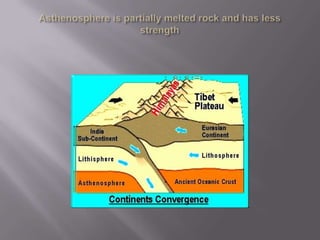
Asthenosphere is partially melted rock and has less strength
What is Pangaea?Part of Wegener’s theory of continental drift (i.e. single supercontinent)Suess theory was that S. American continents jointed into single continentCalled GondwanalandPortions of the continents were assumed to have sunk to form oceansWegener’s theory focused on spinning of earth as force that broke up continentsLaurasia is a name for the N. Continents America and EurasiaBased on the way continents fit and older mountain ranges and rock similarities500 million year cycle of assembling and disassembling land masses
See how plates separatedhttp://www.divediscover.whoi.edu/tectonics/pangea-animation.htmlhttp://pubs.usgs.gov/gip/dynamic/historical.htmlhttp://www.youtube.com/watch?v=ft-dP2D7QM4
Plate Tectonics then and nowAlfred Wegener  Theory in 1920’s of continental driftBruce Heezen and Marie Tharp 1947 to 1965 mapped ocean floorHarry Hess in 1960’s convection cell theory
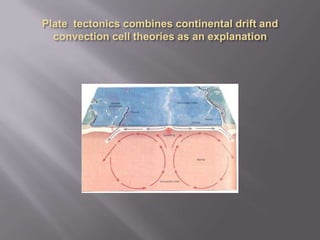
Plate  tectonics combines continental drift and convection cell theories as an explanation
Hess in 1960’s suggested that earth made up of convection cells of heat rising to surface of lithosphere and then cooling becoming dense and sinking back to the bottom of the mantleConfirmation of upper and lower mantle convection cells since thenWhole Mantle Convection Model – where upper and lower mantle have movement of magma
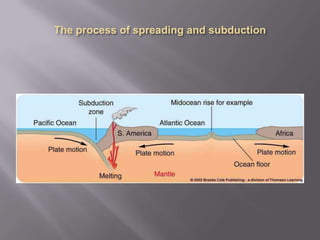
Ridges along ocean floor where magma flows outward and where mantle expandsLithosphere that is old, cool and dense sinks at deep sided ocean trenchesIn reality not all trenches are where lithosphere is sinkingIn some cases sediment carried off continent fills trenches such as NW coastLateral movement of lithosphere from convection cells produces seafloor spreading or spreading centersSubduction zones mark areas of descending lithosphere
The process of spreading and subduction
Evidence for Crustal motionEpicenters found in areas of spreading and subductionWhen heat flow was measured at epicenters hottest where young material created and coolest where older material resides
Magnetic WanderingMagnetic evidence also reveals information about earth’s historyEarth’s magnetic field has many challenges when studiedDifficult to work in polar regions, daily alterations and magnetic stormsRecently N. and S. poles have been moving NW
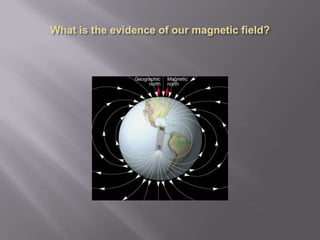
Earths magnetic field consists of invisible lines parallel to earth’s surfaceCompass needle aligns it’s self with these linesAs needle approaches poles it will point up or down parallel to dipping lines of magnetismMagnetite acts like small magnet and is found in basalt magma in oceansMagnetite grains align themselves with current magnetic forces at the time of magma cooling
Paleomagnetism studies fossil magnetismDuring last 76 million years there have been 170 magnetic reversals of the polesPresent magnetic orientation has existed for 710,000 yearsSee Figure 3.14 for age of ocean floor in relation to spreading at ridgesPolar Wandering Curve is the study of fossil magnetism in continental rocks of different ages and in order to create a plot of location of historic north magnetic pole
What is the evidence of our magnetic field?
“Magnetic Storm” http://www.youtube.com/watch?v=pZhttp://vids.myspace.com/index.cfm?fuseaction=vids.individual&videoid=19298183
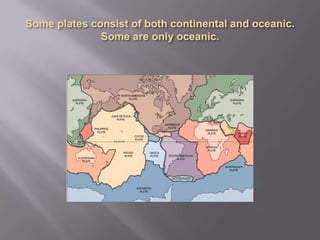
Now you know the mechanisms that cause the mantle to move and the evidence. What can the crust tell us?Lithosphere is fragmented into 7 different plates that move in relation to each other on top of the asthenosphereSome plates like Pacific consist entirely of oceanic plate but most have a combination of continental and oceanic plateAs plates interact with one another they create active volcanic zones
Some plates consist of both continental and oceanic. Some are only oceanic.
Divergent boundariesRising magma makes crust move upward and thins outRift valley is formed with active volcanismShallow linear sea formedMature ocean basinSee Figure 3.23 for divergent boundariesThe Red Sea  and Gulf of Aden between Africa and the Arabian Peninsula
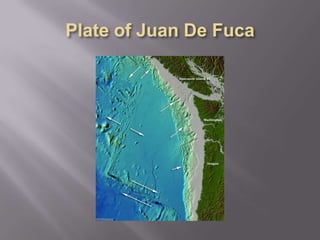
Transform boundariesTransform boundaries separate the segments of ridge systemFracture Zone = fossil faults along active transformation zonesNo movement or earth quake activity along fracture zonesBoundary between N. America and Pacific plate long transform faultSee Figure 3.29 for transformation boundaries along West Coast at the Juan de Fuca plate
Plate of Juan De Fuca
Convergent boundariesSubduction and sinking of one plate over another into mantleUsually along ocean trenchAlso associated with volcanic and earthquake activityOceanic lithosphere able to subduct more readily due to densityOceanic lithosphere more dense than continentalSee three types of convergent boundaries on Figure 3.30
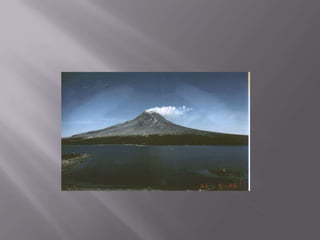
Magma begins at 60-100 miles downOcean-Continent convergence magma must rise through continentMixed basalt and granite produces andesiteAndesite volcanic eruptions are explosive due to high concentration of volatiles (gases) and silicon dioxide
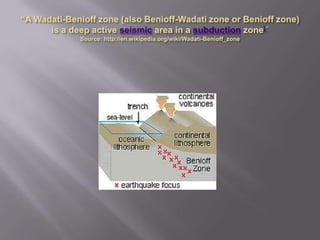
“A Wadati-Benioff zone (also Benioff-Wadati zone or Benioff zone) is a deep active seismic area in a subduction zone[“Source: http://en.wikipedia.org/wiki/Wadati-Benioff_zone
Continent-Continent convergent zones the end result of closing ocean basinContinent crust buckles, fractures and thickensAlps and Himalayas mountains continent-continent convergent zones
Continental margins What is a trailing or passive margin?Passive margins begin at divergent plate boundariesThese margins are broad and shallow such as East Coast USWhat is a leading or active margin?NW coastMargins narrow and deep with trenches and volcanic activity
N. America 1.8 million years old and combination of 4-5 older continentsTerranes = island systems, seamounts, volcanoes, parts of other continental land masses25% N. America formed from Terranes (i.e. Alaska from S. 70 million yrs ago and E. Coast island arc connected to Europe) 
How fast do plates spread per year?Mid-Atlantic Ridge is slow spreading due to steep profile and deep valley2.5-3 cm per yr spreading rateEast Pacific Ridge is faster due to gentler slope and shallow vallies8-13 cm per yr spreading rateAverage spreading rate is 5 cm per yrSpreading is not uniform
Rate increases with volcanic activityEruptions estimated every 50-100 yrs along fast spreading areaWhile every 5000-10,000 along slow spreading areasIceland only land mass lying on mid-ocean ridge/riftVolcanic activity began in 1975 and widened 5 m of ridge
What are hot spots? Name one in our area.
Areas of isolated volcanic activity40 I.D. around globeWhere hot magma from deep in mantle surfacesCan be over land (i.e. Yellowstone) or sea (i.e. Hawaiian Islands)As crust moves West creates new islands = Hawaiian Islands Youngest most active and oldest seamount
What patterns do you see?
Research projects1979 Alvin made 24 dives into mid Atlantic rift (8000 ft)Surprise was large communities of animals around areas of hydrothermal vents“Lost City” older vent system 9 miles from mid-Atlantic RidgeOlder systems emitting carbonate and magnesium rich mineralsCommunities of extremophiles found!
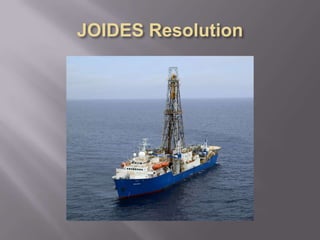
Deep sea drilling has many challengesKeeping a fixed position over drill site requires small propellers mounted on bow and stern of boatGlomar Challenger retired in 1983 after drilling 1092 holes in 624 sites1985 JOIDES Resolution with single pipe 27,000 ft longConfirmed the thickness and location to ridges revealed age of crust
JOIDES Resolution
Happy Halloween!

Plate tectonicsslideshow

  • 1.
  • 2.
    Source: Map bySeth Stein, Northwestern University; USGS Earthquake Hazard Program; Global Volcanism Program, Smithsonian Institution
  • 3.
    The Core Inner Core= solid and 5X density of surface rockOuter Core = partially molten materialRotates few 1/10ths of degrees faster than the mantle each year
  • 4.
    Source: World Bookillustration by Raymond Perlman and Steven Brayfield, Artisan-Chicago
  • 5.
    The MantleMantle =70% earth’s volumeDenser and cooler than core and magnesium-iron silicatesSolid with weak areasWarmer/less dense material floats to surface and cooler/more dense sinks downCrust is a cold, rigid outer layerBoundary between crust and mantle = moho
  • 6.
    Differences between continentaland oceanic crustsContinental crust light and averages 25 miles thick and mainly granite rockSodium, potassium, aluminum, and silicaOceanic crust is more dense and averages 4.3 miles and mainly basaltIron, magnesium, and calcium
  • 7.
    How is thelithosphere and asthenosphere different? (both part of mantle)Lithosphere is strong and rigid = crust and upper mantle (plate tectonics)Ocean floor lithosphere reaches max age at 80 million years old or 62 milesContinental lithosphere varies from 62-124 miles thick
  • 8.
    Asthenosphere is partiallymelted rock and has less strength
  • 9.
    What is Pangaea?Partof Wegener’s theory of continental drift (i.e. single supercontinent)Suess theory was that S. American continents jointed into single continentCalled GondwanalandPortions of the continents were assumed to have sunk to form oceansWegener’s theory focused on spinning of earth as force that broke up continentsLaurasia is a name for the N. Continents America and EurasiaBased on the way continents fit and older mountain ranges and rock similarities500 million year cycle of assembling and disassembling land masses
  • 10.
    See how platesseparatedhttp://www.divediscover.whoi.edu/tectonics/pangea-animation.htmlhttp://pubs.usgs.gov/gip/dynamic/historical.htmlhttp://www.youtube.com/watch?v=ft-dP2D7QM4
  • 11.
    Plate Tectonics thenand nowAlfred Wegener Theory in 1920’s of continental driftBruce Heezen and Marie Tharp 1947 to 1965 mapped ocean floorHarry Hess in 1960’s convection cell theory
  • 12.
    Plate tectonicscombines continental drift and convection cell theories as an explanation
  • 13.
    Hess in 1960’ssuggested that earth made up of convection cells of heat rising to surface of lithosphere and then cooling becoming dense and sinking back to the bottom of the mantleConfirmation of upper and lower mantle convection cells since thenWhole Mantle Convection Model – where upper and lower mantle have movement of magma
  • 14.
    Ridges along oceanfloor where magma flows outward and where mantle expandsLithosphere that is old, cool and dense sinks at deep sided ocean trenchesIn reality not all trenches are where lithosphere is sinkingIn some cases sediment carried off continent fills trenches such as NW coastLateral movement of lithosphere from convection cells produces seafloor spreading or spreading centersSubduction zones mark areas of descending lithosphere
  • 15.
    The process ofspreading and subduction
  • 16.
    Evidence for CrustalmotionEpicenters found in areas of spreading and subductionWhen heat flow was measured at epicenters hottest where young material created and coolest where older material resides
  • 17.
    Magnetic WanderingMagnetic evidencealso reveals information about earth’s historyEarth’s magnetic field has many challenges when studiedDifficult to work in polar regions, daily alterations and magnetic stormsRecently N. and S. poles have been moving NW
  • 18.
    Earths magnetic fieldconsists of invisible lines parallel to earth’s surfaceCompass needle aligns it’s self with these linesAs needle approaches poles it will point up or down parallel to dipping lines of magnetismMagnetite acts like small magnet and is found in basalt magma in oceansMagnetite grains align themselves with current magnetic forces at the time of magma cooling
  • 19.
    Paleomagnetism studies fossilmagnetismDuring last 76 million years there have been 170 magnetic reversals of the polesPresent magnetic orientation has existed for 710,000 yearsSee Figure 3.14 for age of ocean floor in relation to spreading at ridgesPolar Wandering Curve is the study of fossil magnetism in continental rocks of different ages and in order to create a plot of location of historic north magnetic pole
  • 20.
    What is theevidence of our magnetic field?
  • 21.
  • 22.
    Now you knowthe mechanisms that cause the mantle to move and the evidence. What can the crust tell us?Lithosphere is fragmented into 7 different plates that move in relation to each other on top of the asthenosphereSome plates like Pacific consist entirely of oceanic plate but most have a combination of continental and oceanic plateAs plates interact with one another they create active volcanic zones
  • 23.
    Some plates consistof both continental and oceanic. Some are only oceanic.
  • 24.
    Divergent boundariesRising magmamakes crust move upward and thins outRift valley is formed with active volcanismShallow linear sea formedMature ocean basinSee Figure 3.23 for divergent boundariesThe Red Sea and Gulf of Aden between Africa and the Arabian Peninsula
  • 25.
    Transform boundariesTransform boundariesseparate the segments of ridge systemFracture Zone = fossil faults along active transformation zonesNo movement or earth quake activity along fracture zonesBoundary between N. America and Pacific plate long transform faultSee Figure 3.29 for transformation boundaries along West Coast at the Juan de Fuca plate
  • 26.
  • 27.
    Convergent boundariesSubduction andsinking of one plate over another into mantleUsually along ocean trenchAlso associated with volcanic and earthquake activityOceanic lithosphere able to subduct more readily due to densityOceanic lithosphere more dense than continentalSee three types of convergent boundaries on Figure 3.30
  • 28.
    Magma begins at60-100 miles downOcean-Continent convergence magma must rise through continentMixed basalt and granite produces andesiteAndesite volcanic eruptions are explosive due to high concentration of volatiles (gases) and silicon dioxide
  • 30.
    “A Wadati-Benioff zone(also Benioff-Wadati zone or Benioff zone) is a deep active seismic area in a subduction zone[“Source: http://en.wikipedia.org/wiki/Wadati-Benioff_zone
  • 31.
    Continent-Continent convergent zonesthe end result of closing ocean basinContinent crust buckles, fractures and thickensAlps and Himalayas mountains continent-continent convergent zones
  • 32.
    Continental margins Whatis a trailing or passive margin?Passive margins begin at divergent plate boundariesThese margins are broad and shallow such as East Coast USWhat is a leading or active margin?NW coastMargins narrow and deep with trenches and volcanic activity
  • 33.
    N. America 1.8million years old and combination of 4-5 older continentsTerranes = island systems, seamounts, volcanoes, parts of other continental land masses25% N. America formed from Terranes (i.e. Alaska from S. 70 million yrs ago and E. Coast island arc connected to Europe) 
  • 34.
    How fast doplates spread per year?Mid-Atlantic Ridge is slow spreading due to steep profile and deep valley2.5-3 cm per yr spreading rateEast Pacific Ridge is faster due to gentler slope and shallow vallies8-13 cm per yr spreading rateAverage spreading rate is 5 cm per yrSpreading is not uniform
  • 35.
    Rate increases withvolcanic activityEruptions estimated every 50-100 yrs along fast spreading areaWhile every 5000-10,000 along slow spreading areasIceland only land mass lying on mid-ocean ridge/riftVolcanic activity began in 1975 and widened 5 m of ridge
  • 36.
    What are hotspots? Name one in our area.
  • 37.
    Areas of isolatedvolcanic activity40 I.D. around globeWhere hot magma from deep in mantle surfacesCan be over land (i.e. Yellowstone) or sea (i.e. Hawaiian Islands)As crust moves West creates new islands = Hawaiian Islands Youngest most active and oldest seamount
  • 38.
  • 39.
    Research projects1979 Alvinmade 24 dives into mid Atlantic rift (8000 ft)Surprise was large communities of animals around areas of hydrothermal vents“Lost City” older vent system 9 miles from mid-Atlantic RidgeOlder systems emitting carbonate and magnesium rich mineralsCommunities of extremophiles found!
  • 40.
    Deep sea drillinghas many challengesKeeping a fixed position over drill site requires small propellers mounted on bow and stern of boatGlomar Challenger retired in 1983 after drilling 1092 holes in 624 sites1985 JOIDES Resolution with single pipe 27,000 ft longConfirmed the thickness and location to ridges revealed age of crust
  • 41.
  • 42.