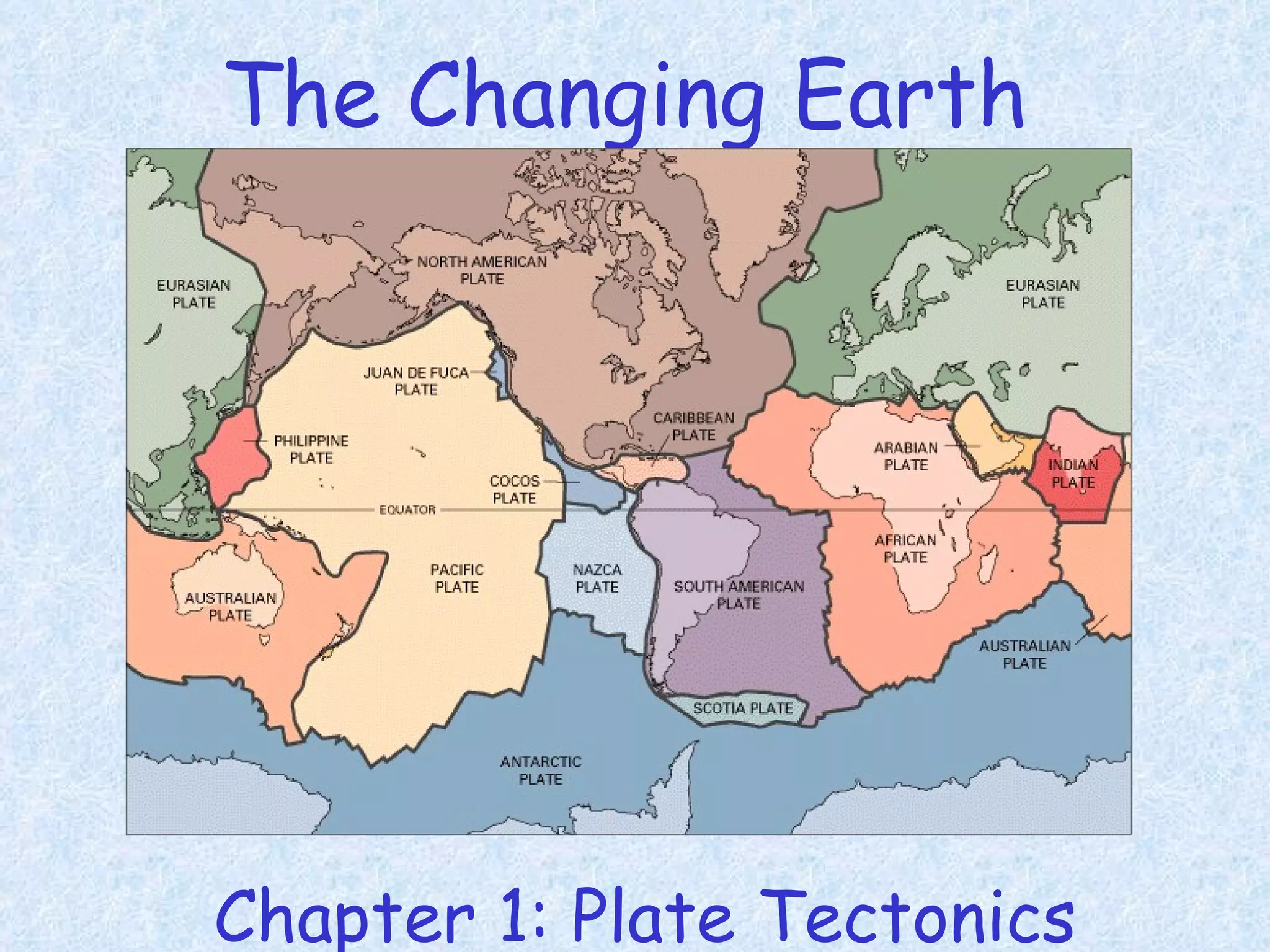
The Changing Earth Chapter 1: Plate Tectonics
Section 1.1 Earth Has Several Layers
Earth is made up of materials with different densities. Theory: Earth began as a spinning mass of rocks and dust 5 (16?) billion years ago. Explosions from comets and asteroids, and pressure of Earth’s gravity, produce enough heat to melt materials inside Earth. Dense material sank to the Earth’s center, less dense material moved toward the surface, forming Earth’s layers.
See Page 10
See Page 11
Earth’s layers have different properties. 6-70 km thick 0-700 °C Cooler rock Crust 2900 km thick 870-4400 °C heated rock Mantle 2300 km thick 4400-6100 °C liquid metals Outer Core 2400 km diameter 7000-8000°C solid metals Inner Core Thickness Temperature  Composition Layer Earth’s Layers
Continued Earth’s crust and the top of the mantle form the  lithosphere . The lithosphere sits on a layer of hotter, softer rock in the upper mantle called the  asthenosphere .
The lithosphere is made up of many plates.
Continued The lithosphere is split into large and small slabs of rocks called  tectonic plates , which fit together like a jigsaw puzzle. Most large plates contain both continental and oceanic crust. Tectonic plates provide evidence of continental movement that supports the theory of Pangaea.
See Page 13
Section 1.2 Continents Change  Position Over Time.
Continents join together  and split apart. Alfred Wegener proposed the theory of  continental drift  in early 1900’s All continents were once joined and gradually moved apart (still moving). Fossils, studies of ancient climates,  and rock formations provide evidence. Africa and Brazil have matching rock formations indicating they were once joined.
Wegner’s theorized that all the continents were once a single landmass. See Page 16
Wegner used fossil evidence to support his continental drift theory. See Page 15
The theory of plate tectonics explains how plates and their continents move. Wegener’s theory and sea floor maps were used to develop the theory of  plate tectonics . Along spreading centers in the sea floor, melted rock rises through cracks, cools, and forms new crust that builds up  mid-ocean ridges .
Continued: Mid Ocean Ridge at Spreading Center
Continued Old crust gets pushed aside and the sea floor slowly spreads apart. Earth DOESN’T get larger because oceanic crust is destroyed along deep-ocean trenches, where the oceanic plates sink into the asthenosphere.
See Page 18
See Page 19
Section 1.3 Plates Move Apart
Tectonic plates have different boundaries. Plate boundary: where the edges of two plates meet Divergent Boundary: occurs where plates move apart, usually found in the ocean Convergent Boundary: occurs when plates push together. Transform Boundary: occur when plates scrape past each other.
Divergent Boundary Convergent Boundary Transform Boundary
The sea floor spreads apart at divergent boundaries. Mid-ocean ridges and rift valleys occur at divergent boundaries in the ocean. Mid-ocean ridges form the longest mountain ranges on earth. Most contain a rift valley along their center.
See Page 23
Continued Earth’s magnetic poles have switched places several times. See Page 24
These magnetic reversals are caused by changes in Earth’s magnetic fields.  Bands of rock record periods of magnetic reversals. As molten material cools, magnetic minerals line up with the magnetic field.  When it hardens, the minerals act like tiny compass needles. See Page 24
Continents split apart at divergent boundaries. Divergent boundaries on continents produce rift valleys. Magma rises through cracks and forms volcanoes. As rift valleys grow wider, continents split apart. If the valley continues to widen, the thinned floor sinks below sea level. It may fill with water to form a sea or lake.
See Page 26
Hot spots can be used to track plate movements. Hot Spot: an area of volcanic activity that develops above where magma rises in a plume from the mantle. Can be used to measure plate movement because it generally stays in one place as the tectonic plate above it moves. Can provide a fixed point for measuring the speed and direction of plate movements.
The Hawaiian islands are located in the middle of the Pacific Plate.  The largest island, Hawaii, is still over the hot spot.
When the plate moves on, it carries the first volcano away from the hot spot.  Heat from the mantle plume will then melt the rock at a new site, forming a new volcano. See Page 28
Section 1.4 Plates Converge or Scrape  Past Each Other.
Tectonic plates push together and form three types of convergent boundaries. Continental-continental collision: Two continental plates collide, crumpling and folding the rock between them.  Mountains could form.
Continued Oceanic-oceanic subductions: two oceanic plates collide and the older, denser plate sinks beneath the top plate, forming deep-ocean trenches and island arcs.
Continued Oceanic-continental subductions: an oceanic plate sinks beneath a continental plate, forming a deep-ocean trench and volcanic coastal mountains.
See Page 32
Tectonic plates scrape past each other at transform boundaries. Two plates move past each other in opposite directions. No crust is formed or destroyed. Occurs on the sea floor and on land.
The San Andreas Fault is a transform boundary and moves about 1 inch per year.
Boundaries are formed when tectonic plates move.  The direction of the movement determines the type of boundary. See Page 35
*oceanic plate sinks under continental plate * forms deep-ocean trench, volcanic coastal mountains Convergent O-C Subduction *older, denser plate sinks *produce deep-ocean trenches, island arcs Convergent O-O Subduction *crumples and folds crust * produces mountains, earthquakes Convergent C-C Collision *plates move past each other in opposite directions *in ocean and on land Transform *plates move apart *in ocean and on land *produce mid-ocean ridges, rift valleys, volcanoes, earthquakes Divergent Comparing Boundaries
The theory of plate tectonics helps geologists today. The plate tectonics theory enables geologists to understand how Earth’s continents and ocean basins formed. Helps scientists predict earthquakes and volcanic activity.

Chapter 1 plate tectonics power point

  • 1.
    The Changing EarthChapter 1: Plate Tectonics
  • 2.
    Section 1.1 EarthHas Several Layers
  • 3.
    Earth is madeup of materials with different densities. Theory: Earth began as a spinning mass of rocks and dust 5 (16?) billion years ago. Explosions from comets and asteroids, and pressure of Earth’s gravity, produce enough heat to melt materials inside Earth. Dense material sank to the Earth’s center, less dense material moved toward the surface, forming Earth’s layers.
  • 4.
  • 5.
  • 6.
    Earth’s layers havedifferent properties. 6-70 km thick 0-700 °C Cooler rock Crust 2900 km thick 870-4400 °C heated rock Mantle 2300 km thick 4400-6100 °C liquid metals Outer Core 2400 km diameter 7000-8000°C solid metals Inner Core Thickness Temperature Composition Layer Earth’s Layers
  • 7.
    Continued Earth’s crustand the top of the mantle form the lithosphere . The lithosphere sits on a layer of hotter, softer rock in the upper mantle called the asthenosphere .
  • 8.
    The lithosphere ismade up of many plates.
  • 9.
    Continued The lithosphereis split into large and small slabs of rocks called tectonic plates , which fit together like a jigsaw puzzle. Most large plates contain both continental and oceanic crust. Tectonic plates provide evidence of continental movement that supports the theory of Pangaea.
  • 10.
  • 11.
    Section 1.2 ContinentsChange Position Over Time.
  • 12.
    Continents join together and split apart. Alfred Wegener proposed the theory of continental drift in early 1900’s All continents were once joined and gradually moved apart (still moving). Fossils, studies of ancient climates, and rock formations provide evidence. Africa and Brazil have matching rock formations indicating they were once joined.
  • 13.
    Wegner’s theorized thatall the continents were once a single landmass. See Page 16
  • 14.
    Wegner used fossilevidence to support his continental drift theory. See Page 15
  • 15.
    The theory ofplate tectonics explains how plates and their continents move. Wegener’s theory and sea floor maps were used to develop the theory of plate tectonics . Along spreading centers in the sea floor, melted rock rises through cracks, cools, and forms new crust that builds up mid-ocean ridges .
  • 16.
    Continued: Mid OceanRidge at Spreading Center
  • 17.
    Continued Old crustgets pushed aside and the sea floor slowly spreads apart. Earth DOESN’T get larger because oceanic crust is destroyed along deep-ocean trenches, where the oceanic plates sink into the asthenosphere.
  • 18.
  • 19.
  • 20.
  • 21.
    Tectonic plates havedifferent boundaries. Plate boundary: where the edges of two plates meet Divergent Boundary: occurs where plates move apart, usually found in the ocean Convergent Boundary: occurs when plates push together. Transform Boundary: occur when plates scrape past each other.
  • 22.
    Divergent Boundary ConvergentBoundary Transform Boundary
  • 23.
    The sea floorspreads apart at divergent boundaries. Mid-ocean ridges and rift valleys occur at divergent boundaries in the ocean. Mid-ocean ridges form the longest mountain ranges on earth. Most contain a rift valley along their center.
  • 24.
  • 25.
    Continued Earth’s magneticpoles have switched places several times. See Page 24
  • 26.
    These magnetic reversalsare caused by changes in Earth’s magnetic fields. Bands of rock record periods of magnetic reversals. As molten material cools, magnetic minerals line up with the magnetic field. When it hardens, the minerals act like tiny compass needles. See Page 24
  • 27.
    Continents split apartat divergent boundaries. Divergent boundaries on continents produce rift valleys. Magma rises through cracks and forms volcanoes. As rift valleys grow wider, continents split apart. If the valley continues to widen, the thinned floor sinks below sea level. It may fill with water to form a sea or lake.
  • 28.
  • 29.
    Hot spots canbe used to track plate movements. Hot Spot: an area of volcanic activity that develops above where magma rises in a plume from the mantle. Can be used to measure plate movement because it generally stays in one place as the tectonic plate above it moves. Can provide a fixed point for measuring the speed and direction of plate movements.
  • 30.
    The Hawaiian islandsare located in the middle of the Pacific Plate. The largest island, Hawaii, is still over the hot spot.
  • 31.
    When the platemoves on, it carries the first volcano away from the hot spot. Heat from the mantle plume will then melt the rock at a new site, forming a new volcano. See Page 28
  • 32.
    Section 1.4 PlatesConverge or Scrape Past Each Other.
  • 33.
    Tectonic plates pushtogether and form three types of convergent boundaries. Continental-continental collision: Two continental plates collide, crumpling and folding the rock between them. Mountains could form.
  • 34.
    Continued Oceanic-oceanic subductions:two oceanic plates collide and the older, denser plate sinks beneath the top plate, forming deep-ocean trenches and island arcs.
  • 35.
    Continued Oceanic-continental subductions:an oceanic plate sinks beneath a continental plate, forming a deep-ocean trench and volcanic coastal mountains.
  • 36.
  • 37.
    Tectonic plates scrapepast each other at transform boundaries. Two plates move past each other in opposite directions. No crust is formed or destroyed. Occurs on the sea floor and on land.
  • 38.
    The San AndreasFault is a transform boundary and moves about 1 inch per year.
  • 39.
    Boundaries are formedwhen tectonic plates move. The direction of the movement determines the type of boundary. See Page 35
  • 40.
    *oceanic plate sinksunder continental plate * forms deep-ocean trench, volcanic coastal mountains Convergent O-C Subduction *older, denser plate sinks *produce deep-ocean trenches, island arcs Convergent O-O Subduction *crumples and folds crust * produces mountains, earthquakes Convergent C-C Collision *plates move past each other in opposite directions *in ocean and on land Transform *plates move apart *in ocean and on land *produce mid-ocean ridges, rift valleys, volcanoes, earthquakes Divergent Comparing Boundaries
  • 41.
    The theory ofplate tectonics helps geologists today. The plate tectonics theory enables geologists to understand how Earth’s continents and ocean basins formed. Helps scientists predict earthquakes and volcanic activity.