TECTONIC
PLATES
WHAT IS
PLATE
TECTONICS ?
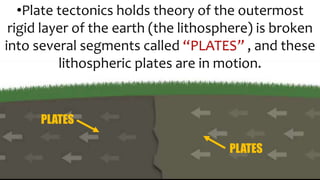
•Plate tectonics holds theory of the outermost
rigid layer of the earth (the lithosphere) is broken
into several segments called “PLATES” , and these
lithospheric plates are in motion.
PLATES
PLATES
•Plate tectonics is the modern version of
CONTINENTAL DRIFT.
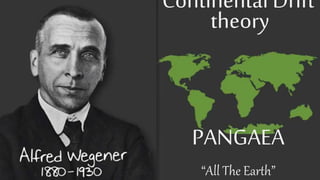
•Continental drift is a theory first proposed by
ALFRED WEGENER, a German meteorologist in
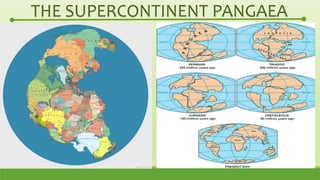
1912. The theory explains that the continents
today had been once joined together in a single
landmass called ‘supercontinent’ PANGAEA 200
million years ago.
•Wegener hypothesized that Pangaea broke apart
into smaller pieces that slowly drifted away from
each other.
Continental Drift
PANGAEA
“All The Earth”
theory
THE SUPERCONTINENT PANGAEA
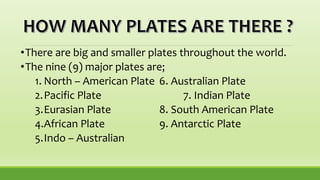
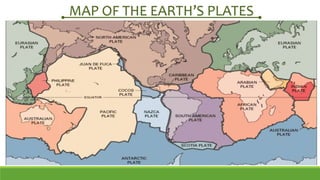
•There are big and smaller plates throughout the world.
•The nine (9) major plates are;
1. North – American Plate 6. Australian Plate
2.Pacific Plate 7. Indian Plate
3.Eurasian Plate 8. South American Plate
4.African Plate 9. Antarctic Plate
5.Indo – Australian
MAP OF THE EARTH’S PLATES
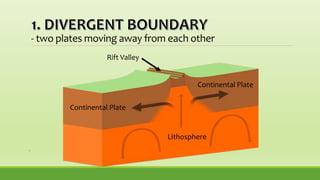
- two plates moving away from each other
.
Continental Plate
Continental Plate
Rift Valley
Lithosphere
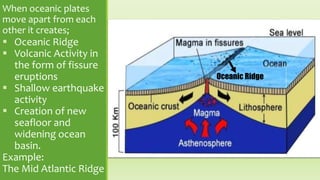
When oceanic plates
move apart from each
other it creates;
 Oceanic Ridge
 Volcanic Activity in
the form of fissure
eruptions
 Shallow earthquake
activity
 Creation of new
seafloor and
widening ocean
basin.
Example:
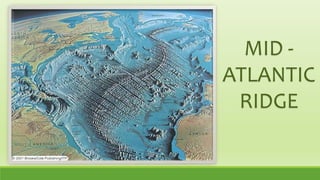
The Mid Atlantic Ridge
Oceanic Ridge
MID -
ATLANTIC
RIDGE
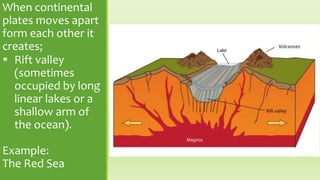
When continental
plates moves apart
form each other it
creates;
 Rift valley
(sometimes
occupied by long
linear lakes or a
shallow arm of
the ocean).
Example:
The Red Sea
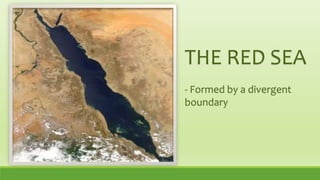
THE RED SEA
- Formed by a divergent
boundary
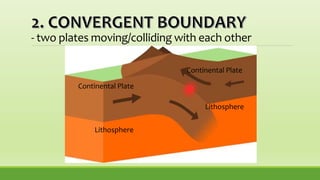
- two plates moving/colliding with each other
Continental Plate
Continental Plate
Lithosphere
Lithosphere
There are three scenarios that may
happen along the convergent boundary;
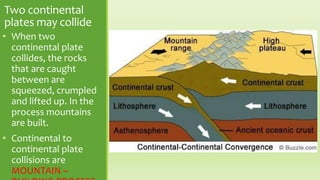
Two continental
plates may collide
• When two
continental plate
collides, the rocks
that are caught
between are
squeezed, crumpled
and lifted up. In the
process mountains
are built.
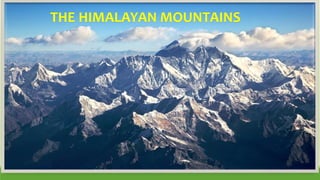
• Continental to
continental plate
collisions are
MOUNTAIN –
THE HIMALAYAN MOUNTAINS
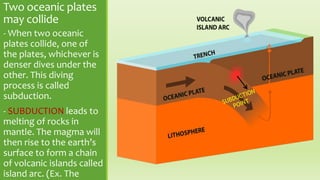
Two oceanic plates
may collide
- When two oceanic
plates collide, one of
the plates, whichever is
denser dives under the
other. This diving
process is called
subduction.
- SUBDUCTION leads to
melting of rocks in
mantle. The magma will
then rise to the earth’s
surface to form a chain
of volcanic islands called
island arc. (Ex. The
AERIAL VIEW OF “ALEUTIAN ISLANDS”. AN EXAMPLE OF ISLAND ARC CAUSED BY
THE COLLISION OF TWO OCEANIC PLATES.
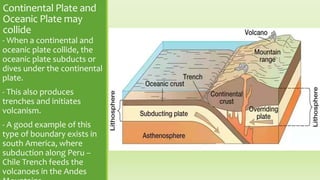
Continental Plate and
Oceanic Plate may
collide
- When a continental and
oceanic plate collide, the
oceanic plate subducts or
dives under the continental
plate.
- This also produces
trenches and initiates
volcanism.
- A good example of this
type of boundary exists in
south America, where
subduction along Peru –
Chile Trench feeds the
volcanoes in the Andes
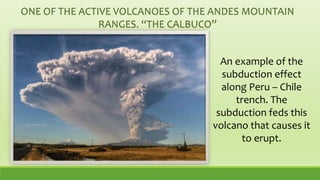
ONE OF THE ACTIVE VOLCANOES OF THE ANDES MOUNTAIN
RANGES. “THE CALBUCO”
An example of the
subduction effect
along Peru – Chile
trench. The
subduction feds this
volcano that causes it
to erupt.
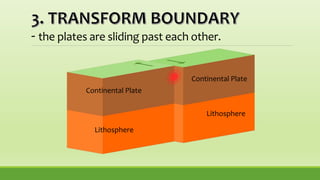
- the plates are sliding past each other.
Continental Plate
Continental Plate
Lithosphere
Lithosphere
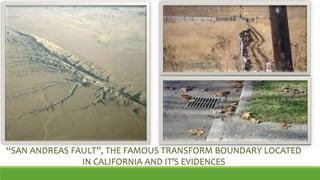
“SAN ANDREAS FAULT”, THE FAMOUS TRANSFORM BOUNDARY LOCATED
IN CALIFORNIA AND IT’S EVIDENCES
WHY
THE
LITOSPHERE
MOVES ?
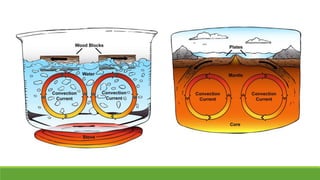
CONVECTION in the mantle is probably the fundamental
driving mechanism responsible for the plate motion.
CONVECTION – is the process of rising and sinking of
rock materials in the mantle. The hot rock materials rise
( because of lesser density ) while cooler rock materials
sink ( because of greater density ).
CONVECTION
PLATE TECTONICS
PLATE TECTONICS

PLATE TECTONICS

  • 1.
  • 2.
  • 3.
    •Plate tectonics holdstheory of the outermost rigid layer of the earth (the lithosphere) is broken into several segments called “PLATES” , and these lithospheric plates are in motion. PLATES PLATES
  • 5.
    •Plate tectonics isthe modern version of CONTINENTAL DRIFT. •Continental drift is a theory first proposed by ALFRED WEGENER, a German meteorologist in 1912. The theory explains that the continents today had been once joined together in a single landmass called ‘supercontinent’ PANGAEA 200 million years ago. •Wegener hypothesized that Pangaea broke apart into smaller pieces that slowly drifted away from each other.
  • 6.
  • 7.
  • 8.
    •There are bigand smaller plates throughout the world. •The nine (9) major plates are; 1. North – American Plate 6. Australian Plate 2.Pacific Plate 7. Indian Plate 3.Eurasian Plate 8. South American Plate 4.African Plate 9. Antarctic Plate 5.Indo – Australian
  • 9.
    MAP OF THEEARTH’S PLATES
  • 11.
    - two platesmoving away from each other . Continental Plate Continental Plate Rift Valley Lithosphere
  • 13.
    When oceanic plates moveapart from each other it creates;  Oceanic Ridge  Volcanic Activity in the form of fissure eruptions  Shallow earthquake activity  Creation of new seafloor and widening ocean basin. Example: The Mid Atlantic Ridge Oceanic Ridge
  • 14.
  • 15.
    When continental plates movesapart form each other it creates;  Rift valley (sometimes occupied by long linear lakes or a shallow arm of the ocean). Example: The Red Sea
  • 16.
    THE RED SEA -Formed by a divergent boundary
  • 17.
    - two platesmoving/colliding with each other Continental Plate Continental Plate Lithosphere Lithosphere
  • 18.
    There are threescenarios that may happen along the convergent boundary;
  • 19.
    Two continental plates maycollide • When two continental plate collides, the rocks that are caught between are squeezed, crumpled and lifted up. In the process mountains are built. • Continental to continental plate collisions are MOUNTAIN –
  • 20.
  • 21.
    Two oceanic plates maycollide - When two oceanic plates collide, one of the plates, whichever is denser dives under the other. This diving process is called subduction. - SUBDUCTION leads to melting of rocks in mantle. The magma will then rise to the earth’s surface to form a chain of volcanic islands called island arc. (Ex. The
  • 22.
    AERIAL VIEW OF“ALEUTIAN ISLANDS”. AN EXAMPLE OF ISLAND ARC CAUSED BY THE COLLISION OF TWO OCEANIC PLATES.
  • 23.
    Continental Plate and OceanicPlate may collide - When a continental and oceanic plate collide, the oceanic plate subducts or dives under the continental plate. - This also produces trenches and initiates volcanism. - A good example of this type of boundary exists in south America, where subduction along Peru – Chile Trench feeds the volcanoes in the Andes
  • 24.
    ONE OF THEACTIVE VOLCANOES OF THE ANDES MOUNTAIN RANGES. “THE CALBUCO” An example of the subduction effect along Peru – Chile trench. The subduction feds this volcano that causes it to erupt.
  • 25.
    - the platesare sliding past each other. Continental Plate Continental Plate Lithosphere Lithosphere
  • 26.
    “SAN ANDREAS FAULT”,THE FAMOUS TRANSFORM BOUNDARY LOCATED IN CALIFORNIA AND IT’S EVIDENCES
  • 27.
  • 28.
    CONVECTION in themantle is probably the fundamental driving mechanism responsible for the plate motion. CONVECTION – is the process of rising and sinking of rock materials in the mantle. The hot rock materials rise ( because of lesser density ) while cooler rock materials sink ( because of greater density ). CONVECTION