BY- SHEETAL BISHT
CONTENTS
 INTRODUCTION
 TYPES OF PLASTIDS
 CHLOROPLAST
 FUNCTION OF CHLOROPLAST
INTRODUCTION
 Plastids are large cytoplasmic organelles.
 Plastids are major organelles found in the cells of plants and algae.
 Plastids are the site of manufacture and storage of important
chemical compounds used by the cell.
 Plastids often contain pigments used in photosynthesis and the
types of pigments used in photosynthesis and the types of pigments
present can change or determine the cell’s colour.
 The term plastids was derived from the Greek word plastikas
meaning formed or moulded.
 This term was coined by schimper in 1885.
 In plants, plastids may differentiate into several forms,
depending upon which function they need to play in the cell.
 The plastids are broadly classified into two main types namely
chromoplasts and leucoplasts.
TYPES OF PLASTIDS
 CHROMOPLAST
 LEUCOPLAST
 CHLOROPLAST
CHROMOPLAST
Chroma (Colour) + Plast (Living).
 They may be round or needle shaped ellipsoidal.
 These are colour plastids containing carotenoids, Xanthophyl and other
pigments.
 It’s found in flower petals, fruit, some roots.
 Flower are coloured by chromoplast and insects attract towards flower
for pollination and dispersal.
 There is reduce chlorophyll in chromoplast.
 For Red colour Pigmentation – Charotein family Lycopene
For Yellow colour - Xanthophyll
For Brown colour – Fucoxanthene
 In bacteria various pigments like phycocyamin, chlorophyll,
carotenoid, erythrin etc are present.
 They are following types:
(1) Phaeoplast : Phaeo- Dark or Brown.
 Pigment – Fucoxanthene.
 Found in diatoms.
(2) Rhodoplast :
 Pigment – Phaeoerythrin.
 Found in red algal.
LEUCOPLAST
Leuco (White) + Plast (Living).
 They are colorless.
 They are found in embryonic and germ cells and meristematic
cell.
 Leucoplasts don’t have thylakoid and ribosome.
 They store the food materials.
TYPES OF LEUCOPLAST
 PROTEINOPLAST : It stores protein as aleurone molecule.
So it’s also called as Aleuronoplast.
Eg – Riccicus comunis.
 AMYLOPLAST : They store starch.
Eg – Potato, Rice.
 ELAIOPLASTS : They store Lipid. It’s found seeds of
monocotyledons and dicotyledons.
CHLOROPLAST
Discovered – Schimper
 Chlor (green) + plast (living)
 It’s present mostly in the green algae and higher plants.
 In higher plants the chloroplasts are generally lens shaped, about 2-
4µm wide and 5-10µm long.
 Number of chloroplasts from 20 to 40 per cell in higher plant.
 This is double membranous organelles.
 This is the most active photosynthetic tissue.
STRUCTURE OF CHLOROPLAST
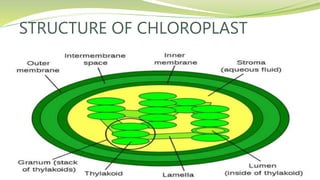
 Proteinaceous ground substance present in it ῶ is called stroma.
 70s Ribosome, granum, thylakoid, oxyphilic drops, starch, protein etc
are found in stroma.
 Circular DNA is present which is called plastidom.
 In presence of DNA, RNA It’s called cell of cell or Semi-Autonomous
organ.
 In chloroplast, Chlorophyll a and b RNA are found.
 In general chloroplasts have a double helical DNA circular with an
average length of 45mm (about 1,35,000 base pair).
FUNCTION OF CHLOROPLAST
 Photosynthesis : Photosynthesis occurs inside the chloroplast.
Thses are considered as the centers of photosynthetic.
 Protein Synthesis : They have sufficient amount of mRNA of its
own. So chloroplast activity incorporate amino acid into protein,
in the presence of CO2.
 Calvin cycle occurs in it/in stroma.
 Mutation : This is known as plastid mutation. After mutation
plastid may perform altered functions.
 Cytoplasmic Heredity : It occurs in present of DNA.
 Role in Krebs Cycle and Fatty Acid Synthesis : It provides
enzymes.
 Light reaction occurs in granum.
THANK YOU

Plastids

  • 1.
  • 2.
    CONTENTS  INTRODUCTION  TYPESOF PLASTIDS  CHLOROPLAST  FUNCTION OF CHLOROPLAST
  • 3.
    INTRODUCTION  Plastids arelarge cytoplasmic organelles.  Plastids are major organelles found in the cells of plants and algae.  Plastids are the site of manufacture and storage of important chemical compounds used by the cell.  Plastids often contain pigments used in photosynthesis and the types of pigments used in photosynthesis and the types of pigments present can change or determine the cell’s colour.
  • 4.
     The termplastids was derived from the Greek word plastikas meaning formed or moulded.  This term was coined by schimper in 1885.  In plants, plastids may differentiate into several forms, depending upon which function they need to play in the cell.  The plastids are broadly classified into two main types namely chromoplasts and leucoplasts.
  • 5.
    TYPES OF PLASTIDS CHROMOPLAST  LEUCOPLAST  CHLOROPLAST
  • 6.
    CHROMOPLAST Chroma (Colour) +Plast (Living).  They may be round or needle shaped ellipsoidal.  These are colour plastids containing carotenoids, Xanthophyl and other pigments.  It’s found in flower petals, fruit, some roots.  Flower are coloured by chromoplast and insects attract towards flower for pollination and dispersal.  There is reduce chlorophyll in chromoplast.
  • 7.
     For Redcolour Pigmentation – Charotein family Lycopene For Yellow colour - Xanthophyll For Brown colour – Fucoxanthene  In bacteria various pigments like phycocyamin, chlorophyll, carotenoid, erythrin etc are present.  They are following types: (1) Phaeoplast : Phaeo- Dark or Brown.  Pigment – Fucoxanthene.  Found in diatoms. (2) Rhodoplast :  Pigment – Phaeoerythrin.  Found in red algal.
  • 8.
    LEUCOPLAST Leuco (White) +Plast (Living).  They are colorless.  They are found in embryonic and germ cells and meristematic cell.  Leucoplasts don’t have thylakoid and ribosome.  They store the food materials.
  • 9.
    TYPES OF LEUCOPLAST PROTEINOPLAST : It stores protein as aleurone molecule. So it’s also called as Aleuronoplast. Eg – Riccicus comunis.  AMYLOPLAST : They store starch. Eg – Potato, Rice.  ELAIOPLASTS : They store Lipid. It’s found seeds of monocotyledons and dicotyledons.
  • 10.
    CHLOROPLAST Discovered – Schimper Chlor (green) + plast (living)  It’s present mostly in the green algae and higher plants.  In higher plants the chloroplasts are generally lens shaped, about 2- 4µm wide and 5-10µm long.  Number of chloroplasts from 20 to 40 per cell in higher plant.  This is double membranous organelles.  This is the most active photosynthetic tissue.
  • 11.
  • 12.
     Proteinaceous groundsubstance present in it ῶ is called stroma.  70s Ribosome, granum, thylakoid, oxyphilic drops, starch, protein etc are found in stroma.  Circular DNA is present which is called plastidom.  In presence of DNA, RNA It’s called cell of cell or Semi-Autonomous organ.  In chloroplast, Chlorophyll a and b RNA are found.  In general chloroplasts have a double helical DNA circular with an average length of 45mm (about 1,35,000 base pair).
  • 13.
    FUNCTION OF CHLOROPLAST Photosynthesis : Photosynthesis occurs inside the chloroplast. Thses are considered as the centers of photosynthetic.  Protein Synthesis : They have sufficient amount of mRNA of its own. So chloroplast activity incorporate amino acid into protein, in the presence of CO2.  Calvin cycle occurs in it/in stroma.
  • 14.
     Mutation :This is known as plastid mutation. After mutation plastid may perform altered functions.  Cytoplasmic Heredity : It occurs in present of DNA.  Role in Krebs Cycle and Fatty Acid Synthesis : It provides enzymes.  Light reaction occurs in granum.
  • 15.