1
G. H. Raisoni College of Engineering , Nagpur
Department of First Year Engineering
INTRODUCTION
 The term “plastics” includes materials composed of various elements such
as carbon, hydrogen, oxygen, nitrogen, chlorine, and sulphur.
 Plastics are macromolecules, formed by polymerization and having the
ability to be shaped by the application of reasonable amount of heat and
pressure or any other form of forces.
 It is one of the few new chemical materials which pose environmental
problem.
 Polyethylene, polyvinyl chloride, polystyrene is largely used in the
manufacturing of plastics.
 Rapid population growth, urbanization and industrial growth have
led to severe problem of waste generation in urban centres.
 The waste quantities increased from 46 million tones in 2001 to 65
million tones in 2010.
 Report says that per capita per day production will increase to 0.7
kg in 2050.
 The characteristics of waste depends on various factors such as
food habits, traditions, lifestyle, climate etc.
TYPES OF PLASTIC MATERIALS
 Plastics, depending on their physical properties, may be
classified as thermoplastic or thermosetting plastic materials.
 Thermoplastic materials can be formed into desired shapes
under heat and pressure and become solids on cooling. If they
are subjected to the same conditions of heat and pressure, they
can be remoulded.
 Thermosetting materials which once shaped cannot be softened/
remoulded by the application of heat.
 Out of total uses of plastic, 80% are Thermoplastic and 20% are
Thermosetting.
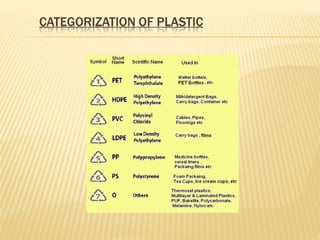
CATEGORIZATION OF PLASTIC
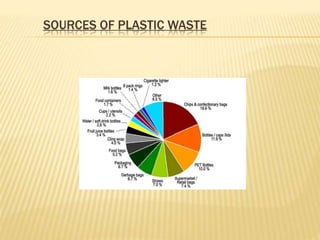
SOURCES OF PLASTIC WASTE
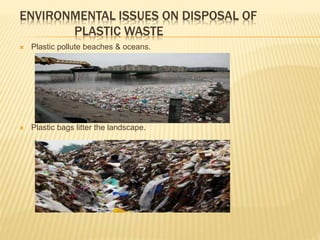
ENVIRONMENTAL ISSUES ON DISPOSAL OF
PLASTIC WASTE
 Plastic pollute beaches & oceans.
 Plastic bags litter the landscape.
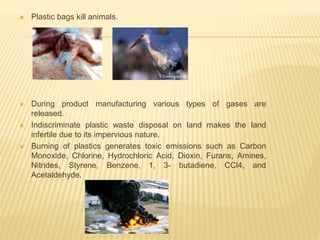
 Plastic bags kill animals.
 During product manufacturing various types of gases are
released.
 Indiscriminate plastic waste disposal on land makes the land
infertile due to its impervious nature.
 Burning of plastics generates toxic emissions such as Carbon
Monoxide, Chlorine, Hydrochloric Acid, Dioxin, Furans, Amines,
Nitrides, Styrene, Benzene, 1, 3- butadiene, CCl4, and
Acetaldehyde.
 Sub-standard plastic bags, films etc. pose problem in
collection and recycling.
 Littered plastics give unaesthetic look and choke the drain.
 Garbage mixed with plastics interferes in waste processing
facilities and also cause problems in landfill operations.
 Lead and Cadmium pigments, commonly used in LDPE,
HDPE and PP as additives are toxic and are known to
leach out.
 Non-recyclable plastic wastes poses disposal problem.
PLASTIC WASTE MANAGEMENT
 Disposal of plastic waste is a serious concern in India. New
technologies have been developed to minimize their
adverse effect on the environment.
Figure 1: Co-processing of plastic waste plastic Waste Management
CONVENTIONAL TECHNOLOGY FOR
PLASTIC WASTE MANAGEMENT
 Recycling of plastics through environmentally
sound manner
 Plastics recycling technologies have been historically divided into four
general types- primary, secondary, tertiary and quaternary.
 Steps Involved in the Recycling Process:
 Selection: The recyclers/reprocessors have to select the waste
/scrap which are suitable for recycling/ reprocessing.
 Segregation: The plastics waste shall be segregated as per the
codes mentioned in the BiS guidelines.
 Processing: After selection and segregation of the preconsumer
waste (factory waste) shall be directly recycled. The post consumer
waste (used plastic waste) shall be washed, shredded, agglomerated,
extruded and granulated.
 Landfilling
 Landfill is the conventional approach to waste
management, but space for landfills is becoming scarce in
some countries.
 A well-managed landfill site results in limited immediate
environmental harm beyond the impacts of collection and
transport, although there are long-term risks of
contamination of soils and groundwater by some additives
and breakdown by products in plastics, which can become
persistent organic pollutants.
 A major drawback to landfills from a sustainability aspect is
that none of the material resources used to produce the
plastic is recovered.
 Incineration
 Incineration reduces the need for landfill of plastics waste,
however, there are concerns that hazardous substances
may be released into the atmosphere in the process.
 Incineration can be used with recovery of some of the
energy content in the plastic.
 The useful energy recovered can vary considerably
depending on whether it is used for electricity generation,
combined heat and power, or as solid refuse fuel for co-
fuelling of blast furnaces or cement kilns.
NEW TECHNOLOGY FOR PLASTIC WASTE
MANAGEMENT
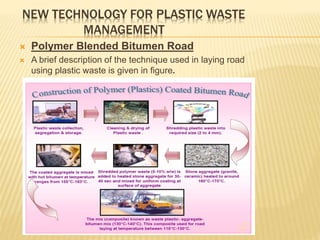
 Polymer Blended Bitumen Road
 A brief description of the technique used in laying road
using plastic waste is given in figure.
 Co-processing of Plastic waste in Cement
Kiln
 Co-processing of plastic waste as Alternative Fuel and
Raw Material (AFR).
 Co-processing indicate substitution of primary fuel and raw
material by waste.
 Waste material such as plastic waste used for co-processing are
referred to as alternative fuels and raw material (AFR).
 One of the advantage of recovery method used in existing facility
is eliminating the need to invest on other plastic waste practices
and to secure land filling.
 Plasma Pyrolysis Technology (PPT)
 Pyrolysis is the thermal disintegration of carbonaceous
material in oxygen-starved atmosphere.
 The intense and versatile heat generation capabilities of
Plasma Pyrolysis technology enable it to dispose of all
types of plastic waste including polymeric, biomedical and
hazardous waste in a safe and reliable manner.
 When optimized, the most likely compounds formed are
methane, carbon monoxide, hydrogen carbon dioxide and
water molecules.
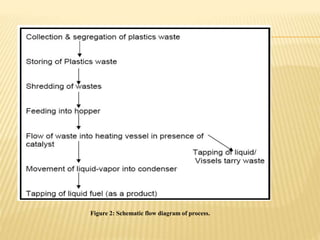
 Conversion of Plastics Waste into liquid fuel
 The entire process is undertaken in closed reactor vessel
followed by condensation, if required.
 Waste plastics while heating upto 2700 to 3000 C convert
into liquid-vapour state, which is collected in condensation
chamber in the form of liquid fuel.
 The tarry liquid waste is topped-down from the heating
reactor vessel.
 The organic gas is generated which can be used in dual
fuel diesel generator set for generation of electricity.
Figure 2: Schematic flow diagram of process.
CONCLUSION
 Plastic Waste Management has assumed great significance
in view of the urbanisation activities.
 Various strategies are being devised to mitigate the impact
of plastic waste in India.
 Some significant challenges still exist from both
technological factors and from economic or social
behaviour issues relating to the collection of recyclable
wastes, and substitution for virgin material.
Plastic waste management

Plastic waste management

  • 1.
    1 G. H. RaisoniCollege of Engineering , Nagpur Department of First Year Engineering
  • 2.
    INTRODUCTION  The term“plastics” includes materials composed of various elements such as carbon, hydrogen, oxygen, nitrogen, chlorine, and sulphur.  Plastics are macromolecules, formed by polymerization and having the ability to be shaped by the application of reasonable amount of heat and pressure or any other form of forces.  It is one of the few new chemical materials which pose environmental problem.  Polyethylene, polyvinyl chloride, polystyrene is largely used in the manufacturing of plastics.
  • 3.
     Rapid populationgrowth, urbanization and industrial growth have led to severe problem of waste generation in urban centres.  The waste quantities increased from 46 million tones in 2001 to 65 million tones in 2010.  Report says that per capita per day production will increase to 0.7 kg in 2050.  The characteristics of waste depends on various factors such as food habits, traditions, lifestyle, climate etc.
  • 4.
    TYPES OF PLASTICMATERIALS  Plastics, depending on their physical properties, may be classified as thermoplastic or thermosetting plastic materials.  Thermoplastic materials can be formed into desired shapes under heat and pressure and become solids on cooling. If they are subjected to the same conditions of heat and pressure, they can be remoulded.  Thermosetting materials which once shaped cannot be softened/ remoulded by the application of heat.  Out of total uses of plastic, 80% are Thermoplastic and 20% are Thermosetting.
  • 5.
  • 6.
  • 7.
    ENVIRONMENTAL ISSUES ONDISPOSAL OF PLASTIC WASTE  Plastic pollute beaches & oceans.  Plastic bags litter the landscape.
  • 8.
     Plastic bagskill animals.  During product manufacturing various types of gases are released.  Indiscriminate plastic waste disposal on land makes the land infertile due to its impervious nature.  Burning of plastics generates toxic emissions such as Carbon Monoxide, Chlorine, Hydrochloric Acid, Dioxin, Furans, Amines, Nitrides, Styrene, Benzene, 1, 3- butadiene, CCl4, and Acetaldehyde.
  • 9.
     Sub-standard plasticbags, films etc. pose problem in collection and recycling.  Littered plastics give unaesthetic look and choke the drain.  Garbage mixed with plastics interferes in waste processing facilities and also cause problems in landfill operations.  Lead and Cadmium pigments, commonly used in LDPE, HDPE and PP as additives are toxic and are known to leach out.  Non-recyclable plastic wastes poses disposal problem.
  • 10.
    PLASTIC WASTE MANAGEMENT Disposal of plastic waste is a serious concern in India. New technologies have been developed to minimize their adverse effect on the environment. Figure 1: Co-processing of plastic waste plastic Waste Management
  • 11.
    CONVENTIONAL TECHNOLOGY FOR PLASTICWASTE MANAGEMENT  Recycling of plastics through environmentally sound manner  Plastics recycling technologies have been historically divided into four general types- primary, secondary, tertiary and quaternary.  Steps Involved in the Recycling Process:  Selection: The recyclers/reprocessors have to select the waste /scrap which are suitable for recycling/ reprocessing.  Segregation: The plastics waste shall be segregated as per the codes mentioned in the BiS guidelines.  Processing: After selection and segregation of the preconsumer waste (factory waste) shall be directly recycled. The post consumer waste (used plastic waste) shall be washed, shredded, agglomerated, extruded and granulated.
  • 12.
     Landfilling  Landfillis the conventional approach to waste management, but space for landfills is becoming scarce in some countries.  A well-managed landfill site results in limited immediate environmental harm beyond the impacts of collection and transport, although there are long-term risks of contamination of soils and groundwater by some additives and breakdown by products in plastics, which can become persistent organic pollutants.  A major drawback to landfills from a sustainability aspect is that none of the material resources used to produce the plastic is recovered.
  • 13.
     Incineration  Incinerationreduces the need for landfill of plastics waste, however, there are concerns that hazardous substances may be released into the atmosphere in the process.  Incineration can be used with recovery of some of the energy content in the plastic.  The useful energy recovered can vary considerably depending on whether it is used for electricity generation, combined heat and power, or as solid refuse fuel for co- fuelling of blast furnaces or cement kilns.
  • 14.
    NEW TECHNOLOGY FORPLASTIC WASTE MANAGEMENT  Polymer Blended Bitumen Road  A brief description of the technique used in laying road using plastic waste is given in figure.
  • 15.
     Co-processing ofPlastic waste in Cement Kiln  Co-processing of plastic waste as Alternative Fuel and Raw Material (AFR).  Co-processing indicate substitution of primary fuel and raw material by waste.  Waste material such as plastic waste used for co-processing are referred to as alternative fuels and raw material (AFR).  One of the advantage of recovery method used in existing facility is eliminating the need to invest on other plastic waste practices and to secure land filling.
  • 16.
     Plasma PyrolysisTechnology (PPT)  Pyrolysis is the thermal disintegration of carbonaceous material in oxygen-starved atmosphere.  The intense and versatile heat generation capabilities of Plasma Pyrolysis technology enable it to dispose of all types of plastic waste including polymeric, biomedical and hazardous waste in a safe and reliable manner.  When optimized, the most likely compounds formed are methane, carbon monoxide, hydrogen carbon dioxide and water molecules.
  • 17.
     Conversion ofPlastics Waste into liquid fuel  The entire process is undertaken in closed reactor vessel followed by condensation, if required.  Waste plastics while heating upto 2700 to 3000 C convert into liquid-vapour state, which is collected in condensation chamber in the form of liquid fuel.  The tarry liquid waste is topped-down from the heating reactor vessel.  The organic gas is generated which can be used in dual fuel diesel generator set for generation of electricity.
  • 18.
    Figure 2: Schematicflow diagram of process.
  • 19.
    CONCLUSION  Plastic WasteManagement has assumed great significance in view of the urbanisation activities.  Various strategies are being devised to mitigate the impact of plastic waste in India.  Some significant challenges still exist from both technological factors and from economic or social behaviour issues relating to the collection of recyclable wastes, and substitution for virgin material.