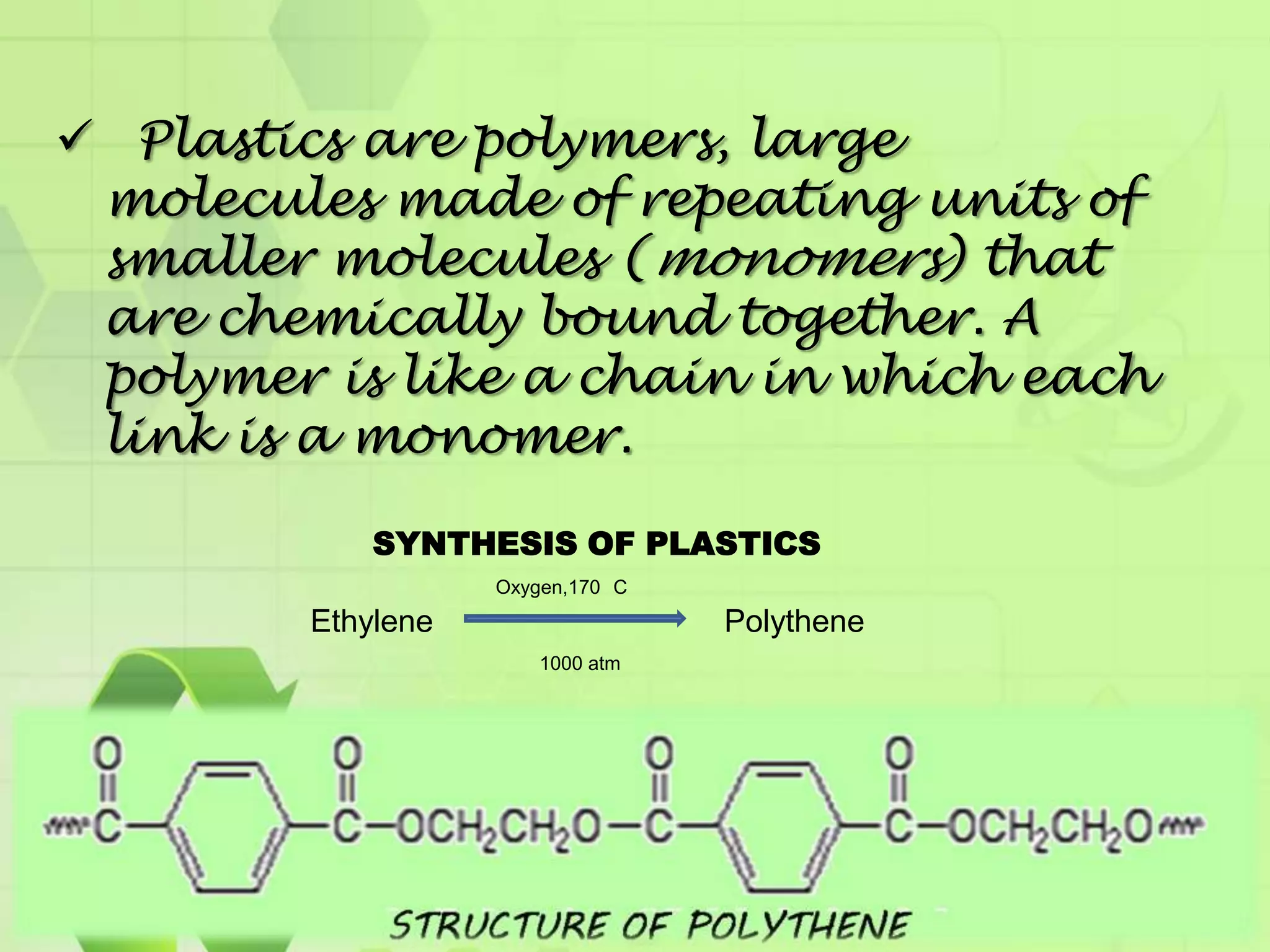
 Plastics are polymers, large
 molecules made of repeating units of
 smaller molecules (monomers) that
 are chemically bound together. A
 polymer is like a chain in which each
 link is a monomer.

            SYNTHESIS OF PLASTICS
                   Oxygen,170 C
        Ethylene                  Polythene
                      1000 atm
 Plastics are chemically produced
  substance that can be molded into a
  permanent or a temporary object.
 TYPES:
   T h e r mo P l a s t i c s
    • Those which can be remoulded into any other desired shape.
  T h e r m o s e t t i n g
   Pl a s t i c s
    • Those which cannot be remoulded into any other desired shape.
 There are about 50 different groups of
  plastics, with hundreds of different
  varieties. American Society of Plastics
  Industry developed a marking code to
  help consumers identify and sort the
  main types of plastics.
TYPE    EXPANSION                          USES
 PET        Poly Ethylene           Fizzy drink bottles and
           Pterephthalate           oven-ready meal trays


HDPE        High-density              Bottles for milk and
            polyethylene              washing-up liquids.


 PVC      Polyvinyl chloride      Food    trays,  cling  film,
                                  bottles for squash, mineral
                                  water and shampoo.


LDPE   Low-density polyethylene   Carrier bags and bin liners.


 PP        Polypropylene -        Microwaveable meal trays,
                                  margarine tubs


                                   Pots, fish trays, boxes and
 PS           Polystyrene            cartons, cups, plastic
 Resistance to
  chemicals, water and
  impact.
 Good safety and
  hygiene properties for
  food packaging.
 Excellent thermal and
  electrical insulation
  properties.
 Relatively inexpensive
  to produce.
 Lighter weight than
  competing materials,
  reducing fuel
  consumption during
  transportation.
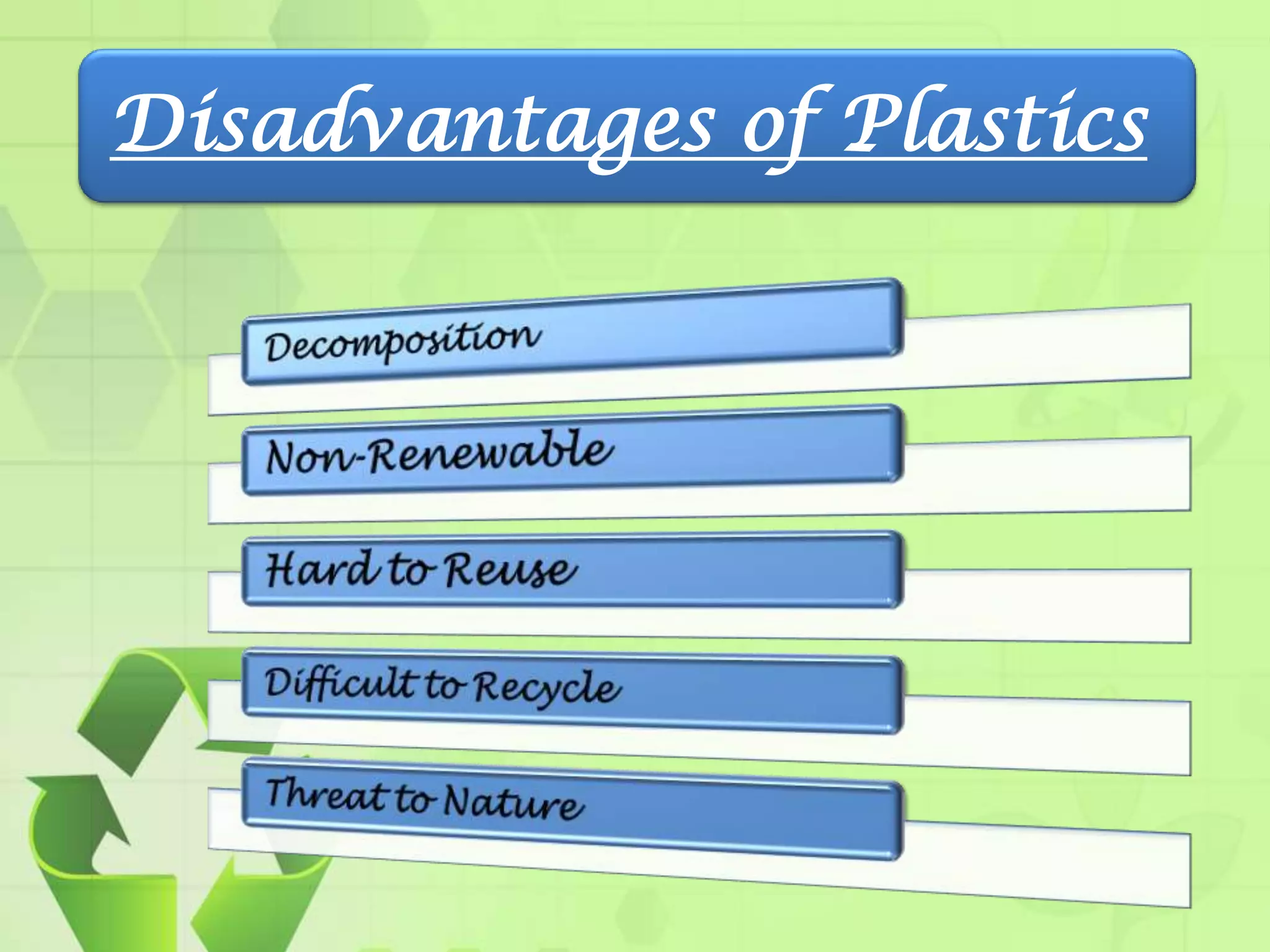
Disadvantages of Plastics
DECOMPOSITION
 The main disadvantage of plastic is
  the shear amount of time they take to
  decompose--the average plastics takes
  500 years. Plastic's decomposition can
  be affected by various factors, such as
  the type of plastic, the climate and
  acids in the landfill; plastic still lasts
  a long time, filling landfills for an
  indefinite period.
DIFFICULT TO RECYCLE
 Glass bottles can be melted and easily
  reused, as can tin cans. Recycling plastic is
  not so simple. Much of the plastic placed in
  recycling boxes is not recycled at all, as
  most plastic cannot be recycled. Those
  bottles that are recycled are not used to
  make new bottles. Instead, recycled plastic
  bottles are used to make non-recyclable
  products, such as T-shirts, plastic lumber or
  parking lot bumpers. This means more raw
  materials need to be used to create new
  plastic bottles than is the case with easily
  recycled material, such as glass or tin.
NON-RENEWABLE

 Plastic is manufactured using oil by-
  products and natural gas, materials
  that could be used in numerous
  other applications or conserved were
  plastic usage lower. Natural gas, for
  example, can be used to heat houses
  and cook food. Using plastic in the
  volume we currently do reduces the
  availability of these resources, which
  are gone forever when used up.
HARD TO REUSE
 The standard disposable plastic bottle
  is meant for one use, not many.
  Recycled plastic bottles are not
  refilled in-mass the way glass beer
  bottles are, and flimsy plastic bottles
  do not lend themselves well to at-
  home re-usage. Water bottles, for
  example, are often reused in the
  home but become less and less sturdy
  over time and are ultimately thrown
  away.
THREAT TO ANIMALS
 Discarded Plastic usually
  ends up within marine
  sources. The Pacific Ocean
  has one of the largest
  dumping ground for
  plastics, unknown numbers
  of sea birds marine
  mammals and fish ingest
  plastics which causes a
  variety of negative health
  effects.
 Plastic is one of the
  few new chemical
  materials which pose
  environmental
  problem.
 Plastic in the
  environment is
  regarded to be more
  an aesthetic
  nuisance than a
  hazard, since the
  material is
  biologically quite
  inert.
 Plastic is cheap, it
  gets discarded easily,
  and, its persistence
  in the environment
  can do great harm.
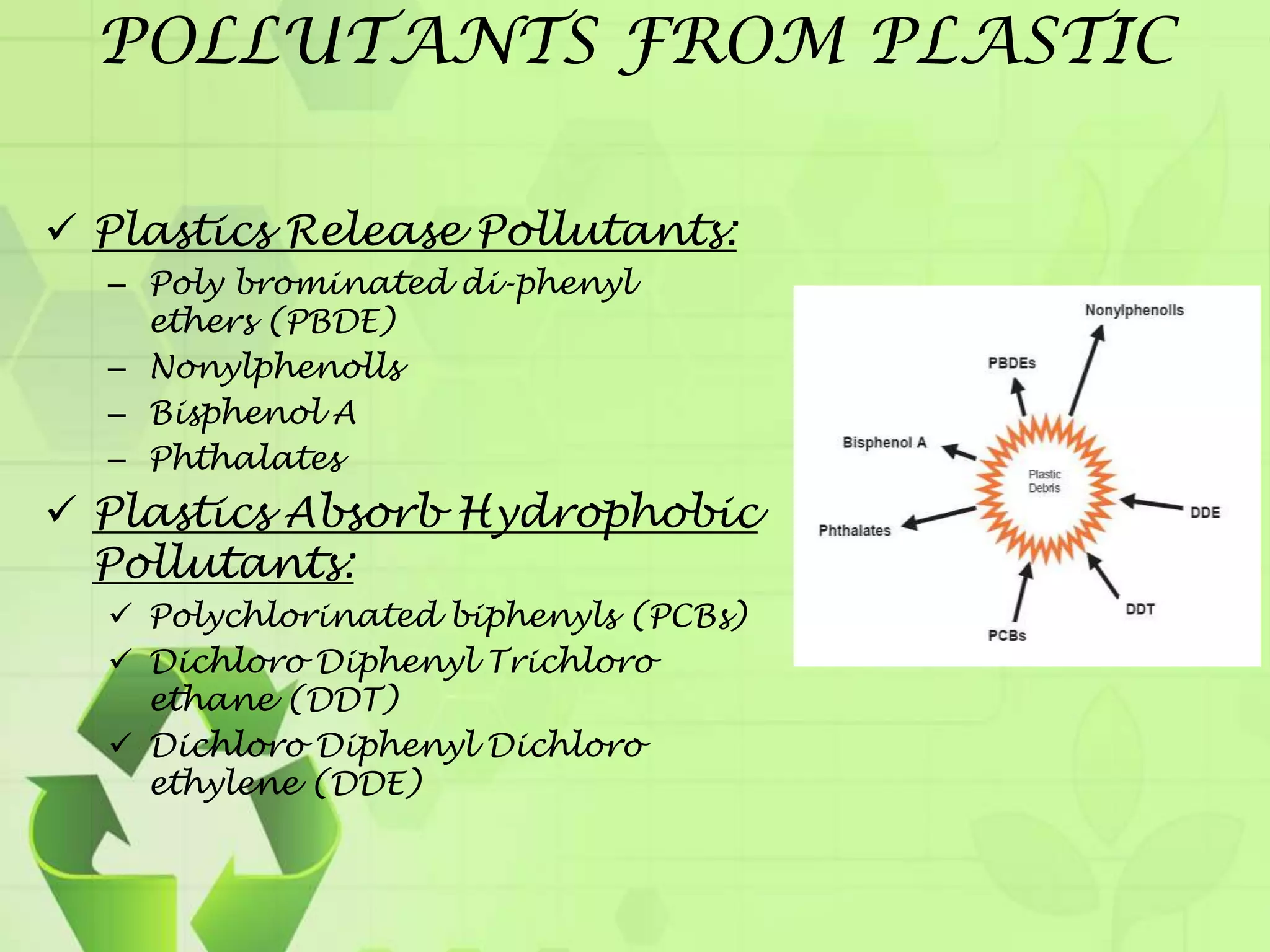
POLLUTANTS FROM PLASTIC

 Plastics Release Pollutants:
  – Poly brominated di-phenyl
    ethers (PBDE)
  – Nonylphenolls
  – Bisphenol A
  – Phthalates
 Plastics Absorb Hydrophobic
  Pollutants:
   Polychlorinated biphenyls (PCBs)
   Dichloro Diphenyl Trichloro
    ethane (DDT)
   Dichloro Diphenyl Dichloro
    ethylene (DDE)
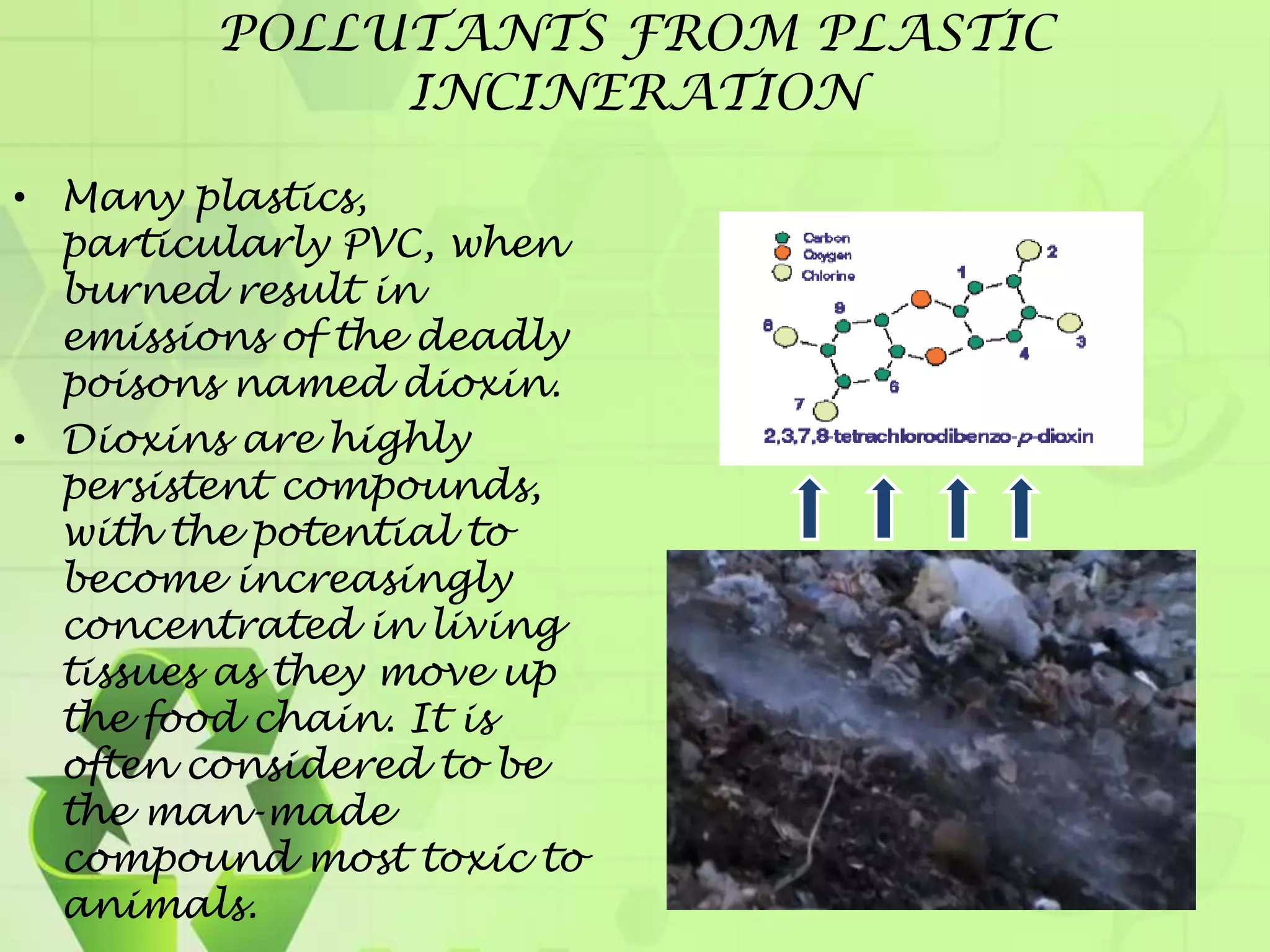
POLLUTANTS FROM PLASTIC
             INCINERATION

• Many plastics,
  particularly PVC, when
  burned result in
  emissions of the deadly
  poisons named dioxin.
• Dioxins are highly
  persistent compounds,
  with the potential to
  become increasingly
  concentrated in living
  tissues as they move up
  the food chain. It is
  often considered to be
  the man-made
  compound most toxic to
  animals.
PLASTIC DEBRIS ON THE
        MOVE
 The per capita consumption of plastic
  in the country is 10.2 kg in 2012.It is
  expected to go up to 12 kg by 2014.

 By 2012, India is also projected to be
  the third largest consumer market for
  plastic goods with a consumption of
  12.5 million tonnes per annum,
  behind US and China.
Percentage of Plastic used in different fields
    Mechanical Engineering
             2%
                   Toys/Sports
       Medical         3%
                             Other
 Footwear 2%                  3%     Agriculture
   1%                                    7%

                                                   Transport
                                                      8%


                                                      Furniture/Houseware
                                                               8%


                                                   Electrical and Electronics
                                                               8%
Packaging
  35%


                                           Building and
                                           Construction
                                               23%
Disposing of plastic waste is
 trickier than dealing with
 other traditional landfill
 material. Not only does
 plastic take thousands of
 years to break down, it
 can leach dangerous
 poison into the
 environment. Plastic is not
 going away, but how
 plastic waste is managed
 is becoming more
 sophisticated. Managing
 plastic waste starts at
 home with the consumer,
 but ultimately depends on
 governments around the
 world as well.
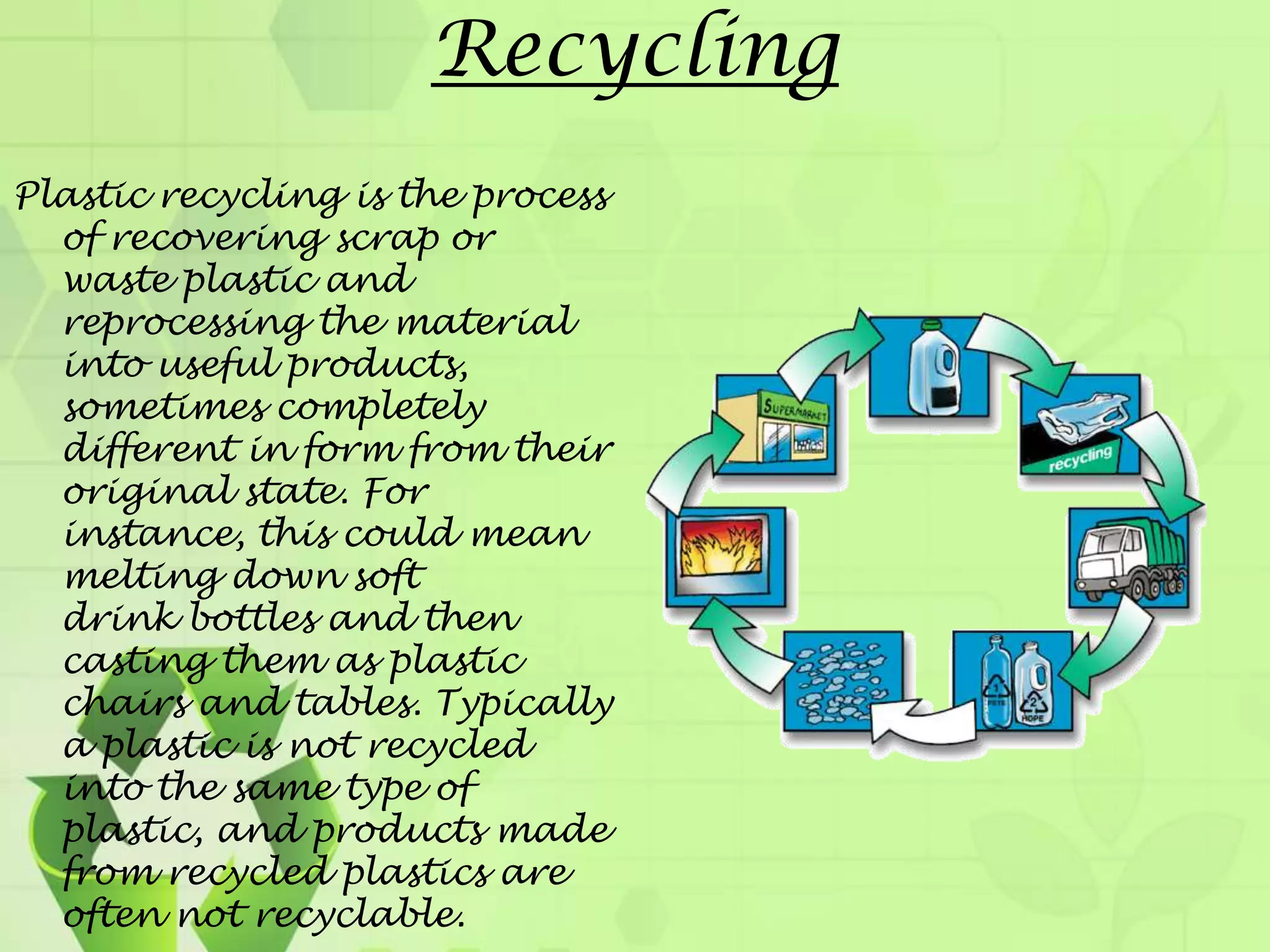
Recycling
Plastic recycling is the process
  of recovering scrap or
  waste plastic and
  reprocessing the material
  into useful products,
  sometimes completely
  different in form from their
  original state. For
  instance, this could mean
  melting down soft
  drink bottles and then
  casting them as plastic
  chairs and tables. Typically
  a plastic is not recycled
  into the same type of
  plastic, and products made
  from recycled plastics are
  often not recyclable.
Plasma Pyrolysis Technology (PPT)

 Plasma pyrolysis or plasma gasification is a
   waste treatment technology that gasifies
   matter in an oxygen-starved environment
   to decompose waste material into its basic
   molecular structure. It uses high electrical
   energy and high temperature created by
   an electrical arc gasifier and does not
   combust the waste as incinerators do. This
   arc breaks down waste primarily into
   elemental gas and solid waste (slag), in a
   device called a plasma converter.
Biodegradable Plastics
Bioplastics are a form of plastics derived from
  renewable biomass sources, such as vegetable fats
  and oils , corn starch or micro biota .Common
  plastics, such as fossil-fuel plastics, are derived
  from petroleum. These plastics rely more on scarce
  fossil fuels and produce more greenhouse gas. Some,
  but not all, bioplastics are designed to biodegrade.
  Bioplastics which are designed to biodegrade can
  break down in either anaerobic or aerobic
  environments, depending on how they are
  manufactured. There is a variety of bioplastics being
  made; they can be composed of starches, cellulose, or
  other biopolymers. Some common applications of
  bioplastics are packaging materials, dining utensils,
  food packaging, and insulation.
Conversion of Plastic Waste into
          Liquid Fuel
  Methods to convert waste plastics into
   hydrocarbon fuel have been in development
   for decades. But the associated costs to
   commercialize the technologies were
   prohibitive in previous years when crude oil
   was relatively inexpensive.
  As costs for crude oil have risen, concerns
   about energy security and the environment
   are renewing efforts in plastics-to fuel
   recycling processes. Scientists hope the
   technologies will soon provide the nation
   with cheaper, alternative fuels that can help
   reduce foreign oil dependency.
DESIGN TO CHANGE
The two best changes we can do
 are
  Use less plastics

  To reuse plastics when possible.
Share what you’ve
          learned
 Lead by example
 Ask your friends
  and family to join
  you
 Speak to city
  council
 Write letters to
  government
  officials
 Get your school
  involved
4-R for Plastics!


Refuse
Reduce
Reuse
Recycle
AKASH N
 Calicut
Tornadoes
Plastic waste management

Plastic waste management

  • 3.
     Plastics arepolymers, large molecules made of repeating units of smaller molecules (monomers) that are chemically bound together. A polymer is like a chain in which each link is a monomer. SYNTHESIS OF PLASTICS Oxygen,170 C Ethylene Polythene 1000 atm
  • 5.
     Plastics arechemically produced substance that can be molded into a permanent or a temporary object.  TYPES:  T h e r mo P l a s t i c s • Those which can be remoulded into any other desired shape. T h e r m o s e t t i n g Pl a s t i c s • Those which cannot be remoulded into any other desired shape.  There are about 50 different groups of plastics, with hundreds of different varieties. American Society of Plastics Industry developed a marking code to help consumers identify and sort the main types of plastics.
  • 6.
    TYPE EXPANSION USES PET Poly Ethylene Fizzy drink bottles and Pterephthalate oven-ready meal trays HDPE High-density Bottles for milk and polyethylene washing-up liquids. PVC Polyvinyl chloride Food trays, cling film, bottles for squash, mineral water and shampoo. LDPE Low-density polyethylene Carrier bags and bin liners. PP Polypropylene - Microwaveable meal trays, margarine tubs Pots, fish trays, boxes and PS Polystyrene cartons, cups, plastic
  • 8.
     Resistance to chemicals, water and impact.  Good safety and hygiene properties for food packaging.  Excellent thermal and electrical insulation properties.  Relatively inexpensive to produce.  Lighter weight than competing materials, reducing fuel consumption during transportation.
  • 10.
  • 11.
    DECOMPOSITION  The maindisadvantage of plastic is the shear amount of time they take to decompose--the average plastics takes 500 years. Plastic's decomposition can be affected by various factors, such as the type of plastic, the climate and acids in the landfill; plastic still lasts a long time, filling landfills for an indefinite period.
  • 12.
    DIFFICULT TO RECYCLE Glass bottles can be melted and easily reused, as can tin cans. Recycling plastic is not so simple. Much of the plastic placed in recycling boxes is not recycled at all, as most plastic cannot be recycled. Those bottles that are recycled are not used to make new bottles. Instead, recycled plastic bottles are used to make non-recyclable products, such as T-shirts, plastic lumber or parking lot bumpers. This means more raw materials need to be used to create new plastic bottles than is the case with easily recycled material, such as glass or tin.
  • 13.
    NON-RENEWABLE  Plastic ismanufactured using oil by- products and natural gas, materials that could be used in numerous other applications or conserved were plastic usage lower. Natural gas, for example, can be used to heat houses and cook food. Using plastic in the volume we currently do reduces the availability of these resources, which are gone forever when used up.
  • 14.
    HARD TO REUSE The standard disposable plastic bottle is meant for one use, not many. Recycled plastic bottles are not refilled in-mass the way glass beer bottles are, and flimsy plastic bottles do not lend themselves well to at- home re-usage. Water bottles, for example, are often reused in the home but become less and less sturdy over time and are ultimately thrown away.
  • 15.
    THREAT TO ANIMALS Discarded Plastic usually ends up within marine sources. The Pacific Ocean has one of the largest dumping ground for plastics, unknown numbers of sea birds marine mammals and fish ingest plastics which causes a variety of negative health effects.
  • 17.
     Plastic isone of the few new chemical materials which pose environmental problem.  Plastic in the environment is regarded to be more an aesthetic nuisance than a hazard, since the material is biologically quite inert.  Plastic is cheap, it gets discarded easily, and, its persistence in the environment can do great harm.
  • 18.
    POLLUTANTS FROM PLASTIC Plastics Release Pollutants: – Poly brominated di-phenyl ethers (PBDE) – Nonylphenolls – Bisphenol A – Phthalates  Plastics Absorb Hydrophobic Pollutants:  Polychlorinated biphenyls (PCBs)  Dichloro Diphenyl Trichloro ethane (DDT)  Dichloro Diphenyl Dichloro ethylene (DDE)
  • 19.
    POLLUTANTS FROM PLASTIC INCINERATION • Many plastics, particularly PVC, when burned result in emissions of the deadly poisons named dioxin. • Dioxins are highly persistent compounds, with the potential to become increasingly concentrated in living tissues as they move up the food chain. It is often considered to be the man-made compound most toxic to animals.
  • 20.
  • 22.
     The percapita consumption of plastic in the country is 10.2 kg in 2012.It is expected to go up to 12 kg by 2014.  By 2012, India is also projected to be the third largest consumer market for plastic goods with a consumption of 12.5 million tonnes per annum, behind US and China.
  • 23.
    Percentage of Plasticused in different fields Mechanical Engineering 2% Toys/Sports Medical 3% Other Footwear 2% 3% Agriculture 1% 7% Transport 8% Furniture/Houseware 8% Electrical and Electronics 8% Packaging 35% Building and Construction 23%
  • 25.
    Disposing of plasticwaste is trickier than dealing with other traditional landfill material. Not only does plastic take thousands of years to break down, it can leach dangerous poison into the environment. Plastic is not going away, but how plastic waste is managed is becoming more sophisticated. Managing plastic waste starts at home with the consumer, but ultimately depends on governments around the world as well.
  • 26.
    Recycling Plastic recycling isthe process of recovering scrap or waste plastic and reprocessing the material into useful products, sometimes completely different in form from their original state. For instance, this could mean melting down soft drink bottles and then casting them as plastic chairs and tables. Typically a plastic is not recycled into the same type of plastic, and products made from recycled plastics are often not recyclable.
  • 27.
    Plasma Pyrolysis Technology(PPT) Plasma pyrolysis or plasma gasification is a waste treatment technology that gasifies matter in an oxygen-starved environment to decompose waste material into its basic molecular structure. It uses high electrical energy and high temperature created by an electrical arc gasifier and does not combust the waste as incinerators do. This arc breaks down waste primarily into elemental gas and solid waste (slag), in a device called a plasma converter.
  • 28.
    Biodegradable Plastics Bioplastics area form of plastics derived from renewable biomass sources, such as vegetable fats and oils , corn starch or micro biota .Common plastics, such as fossil-fuel plastics, are derived from petroleum. These plastics rely more on scarce fossil fuels and produce more greenhouse gas. Some, but not all, bioplastics are designed to biodegrade. Bioplastics which are designed to biodegrade can break down in either anaerobic or aerobic environments, depending on how they are manufactured. There is a variety of bioplastics being made; they can be composed of starches, cellulose, or other biopolymers. Some common applications of bioplastics are packaging materials, dining utensils, food packaging, and insulation.
  • 29.
    Conversion of PlasticWaste into Liquid Fuel  Methods to convert waste plastics into hydrocarbon fuel have been in development for decades. But the associated costs to commercialize the technologies were prohibitive in previous years when crude oil was relatively inexpensive.  As costs for crude oil have risen, concerns about energy security and the environment are renewing efforts in plastics-to fuel recycling processes. Scientists hope the technologies will soon provide the nation with cheaper, alternative fuels that can help reduce foreign oil dependency.
  • 31.
    DESIGN TO CHANGE Thetwo best changes we can do are  Use less plastics  To reuse plastics when possible.
  • 32.
    Share what you’ve learned  Lead by example  Ask your friends and family to join you  Speak to city council  Write letters to government officials  Get your school involved
  • 33.
  • 34.

Editor's Notes

  • #33 Now that you’ve heard about the problem, you can be a part of the solution. Take this message back to your school and your family. Make your community zero waste. Lets stop the flow of throwaway plastics that end up in our oceans. So we’ve taught you this presentation on line. Now its your turn. Find a group of friends, download the script, add some photos of plastic in your community, and help us spread the word. Go on line, fill out the application, and send us your ideas! You may be one of the 100 students selected for plastics are forever youth summit. Lets all help Captain Moore realize his dream to find the solution to plastic pollution. Good luck!