Name of student : Anwar Hussain
Title of seminar : Recycling of
Packaging Materials
Regd. No. : J-12-D-167-A
Division : Post Harvest Technology
Packaging
Packaging is a coordinated system designed
for the efficient delivery of high quality and
safe food products throughout every phase of
the supply chain, from raw material production
to food manufacture, packing, retail, consumer
use, disposal and recycling.
Basic functions of food packaging
• Containment
• Communication
• Convenience
• Protection
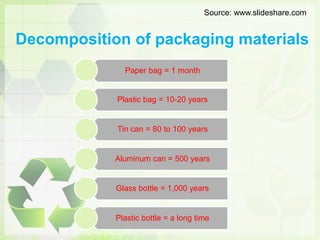
Decomposition of packaging materials
Paper bag = 1 month
Plastic bag = 10-20 years
Tin can = 80 to 100 years
Aluminum can = 500 years
Glass bottle = 1,000 years
Plastic bottle = a long time
Source: www.slideshare.com
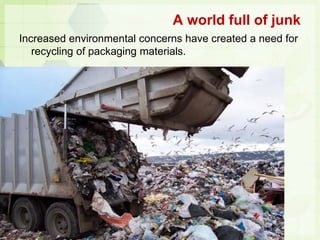
A world full of junk
Increased environmental concerns have created a need for
recycling of packaging materials.
Recycling of packaging
materials
• Recycling reduces the volume of packaging materials
entering the waste stream and saves materials and
energy
• A concern for using recycled package materials for food
contact uses (primary packages) is that contaminants
could jeopardize the safety or quality of the food
• Generally, recycled glass and metal containers are
acceptable for food contact use, but recycled plastic and
paper are not.
What is
recycling?
All common types of food packaging are technically
capable of being recycled. However, whether are
actually recycled in practice depends on
• the local waste management infrastructure and
• the availability of recycling/reprocessing capacity.
Converting waste into reusable
material
Turning a product’s useful parts
into another product
(Butler, 2010)
Recycling Facts
 Recycling one glass bottle saves enough energy to light
a 100-watt bulb for 4 hours
 Americans use 4 million plastic bottles every hour
 Around 200 B.C. the Chinese used fishing nets to create
the world’s very first piece of recycled paper
 Glass never wears out, it can be recycled forever
Source: Butler, 2010
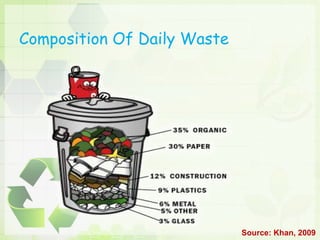
Composition Of Daily Waste
Source: Khan, 2009
Recycling Techniques
 Reuse Recycling
 Physical/Mechanical Recycling
 Chemical Recycling
Reuse Recycling
The reuse technique involves refilling rigid containers after washing.
This approach is common for glass bottles and has been used for rigid
plastic milk containers. However, safety concerns related to this type
of recycling are due to the possible presence of wash-resistant
contaminants.
Physical/Mechanical Recycling
Physical recycling is the remelting and reextrusion or molding of
plastic packages into films or containers. Sources of recycled
packages could include scraps from manufacturers or previously used
packaging materials.
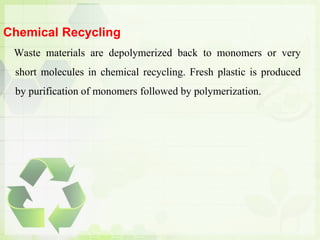
Chemical Recycling
Waste materials are depolymerized back to monomers or very
short molecules in chemical recycling. Fresh plastic is produced
by purification of monomers followed by polymerization.
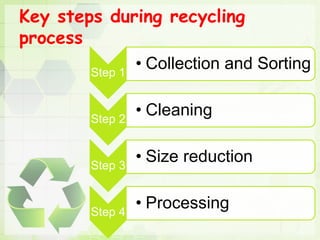
Key steps during recycling
process
Step 1
• Collection and Sorting
Step 2
• Cleaning
Step 3
• Size reduction
Step 4
• Processing
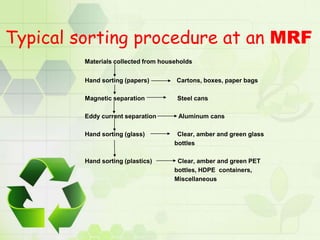
Typical sorting procedure at an MRF
Materials collected from households
Hand sorting (papers) Cartons, boxes, paper bags
Magnetic separation Steel cans
Eddy current separation Aluminum cans
Hand sorting (glass) Clear, amber and green glass
bottles
Hand sorting (plastics) Clear, amber and green PET
bottles, HDPE containers,
Miscellaneous
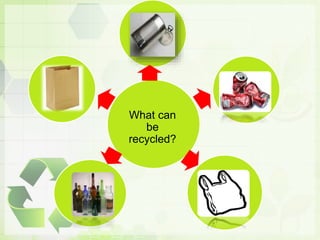
What can
be
recycled?
Paper
Paper
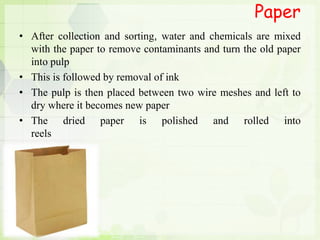
• After collection and sorting, water and chemicals are mixed
with the paper to remove contaminants and turn the old paper
into pulp
• This is followed by removal of ink
• The pulp is then placed between two wire meshes and left to
dry where it becomes new paper
• The dried paper is polished and rolled into
reels
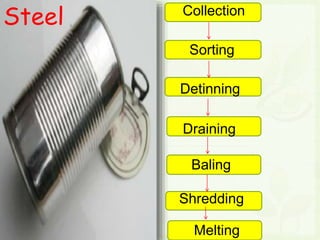
Draining
Baling
Shredding
Detinning
Steel
Sorting
Collection
Melting
Aluminum
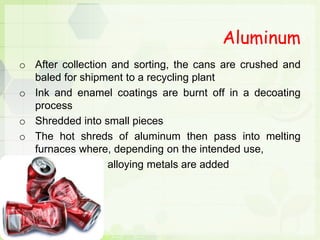
o After collection and sorting, the cans are crushed and
baled for shipment to a recycling plant
o Ink and enamel coatings are burnt off in a decoating
process
o Shredded into small pieces
o The hot shreds of aluminum then pass into melting
furnaces where, depending on the intended use,
alloying metals are added
Glass
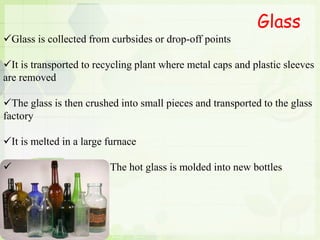
Glass is collected from curbsides or drop-off points
It is transported to recycling plant where metal caps and plastic sleeves
are removed
The glass is then crushed into small pieces and transported to the glass
factory
It is melted in a large furnace
 The hot glass is molded into new bottles
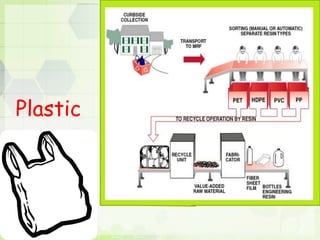
Plastic
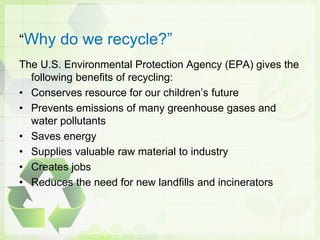
“Why do we recycle?”
The U.S. Environmental Protection Agency (EPA) gives the
following benefits of recycling:
• Conserves resource for our children’s future
• Prevents emissions of many greenhouse gases and
water pollutants
• Saves energy
• Supplies valuable raw material to industry
• Creates jobs
• Reduces the need for new landfills and incinerators
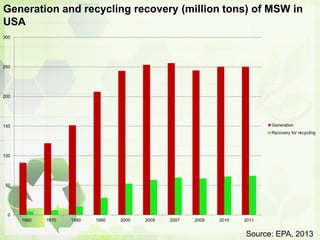
Generation and recycling recovery (million tons) of MSW in
USA
0
50
100
150
200
250
300
1960 1970 1980 1990 2000 2005 2007 2009 2010 2011
Generation
Recovery for recycling
Source: EPA, 2013
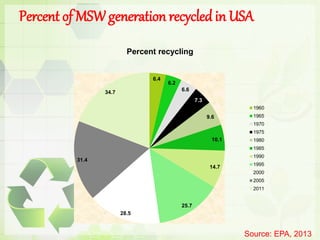
Percent of MSWgeneration recycled in USA
6.4
6.2
6.6
7.3
9.6
10.1
14.7
25.7
28.5
31.4
34.7
Percent recycling
1960
1965
1970
1975
1980
1985
1990
1995
2000
2005
2011
Source: EPA, 2013
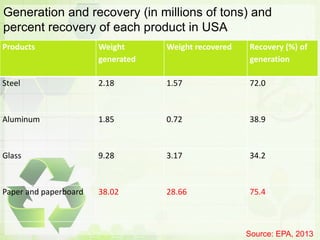
Generation and recovery (in millions of tons) and
percent recovery of each product in USA
Products Weight
generated
Weight recovered Recovery (%) of
generation
Steel 2.18 1.57 72.0
Aluminum 1.85 0.72 38.9
Glass 9.28 3.17 34.2
Paper and paperboard 38.02 28.66 75.4
Source: EPA, 2013
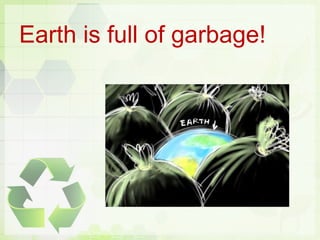
Earth is full of garbage!
Now it’s your turn…..
Recycle!
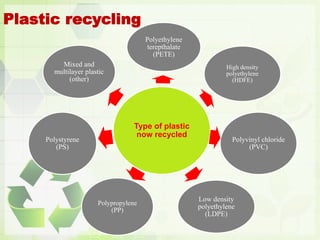
Type of plastic
now recycled
Polyethylene
terepthalate
(PETE)
High density
polyethylene
(HDFE)
Polyvinyl chloride
(PVC)
Low density
polyethylene
(LDPE)
Polypropylene
(PP)
Polystyrene
(PS)
Mixed and
multilayer plastic
(other)
Plastic recycling
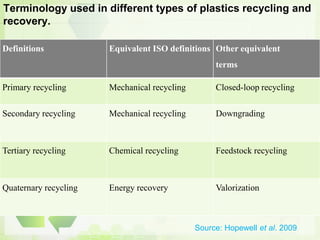
Terminology used in different types of plastics recycling and
recovery.
Definitions Equivalent ISO definitions Other equivalent
terms
Primary recycling Mechanical recycling Closed-loop recycling
Secondary recycling Mechanical recycling Downgrading
Tertiary recycling Chemical recycling Feedstock recycling
Quaternary recycling Energy recovery Valorization
Source: Hopewell et al. 2009
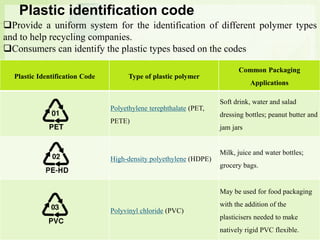
Plastic identification code
Plastic Identification Code Type of plastic polymer
Common Packaging
Applications
Polyethylene terephthalate (PET,
PETE)
Soft drink, water and salad
dressing bottles; peanut butter and
jam jars
High-density polyethylene (HDPE)
Milk, juice and water bottles;
grocery bags.
Polyvinyl chloride (PVC)
May be used for food packaging
with the addition of the
plasticisers needed to make
natively rigid PVC flexible.
Provide a uniform system for the identification of different polymer types
and to help recycling companies.
Consumers can identify the plastic types based on the codes
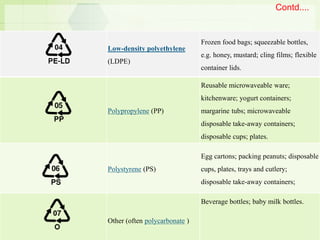
Low-density polyethylene
(LDPE)
Frozen food bags; squeezable bottles,
e.g. honey, mustard; cling films; flexible
container lids.
Polypropylene (PP)
Reusable microwaveable ware;
kitchenware; yogurt containers;
margarine tubs; microwaveable
disposable take-away containers;
disposable cups; plates.
Polystyrene (PS)
Egg cartons; packing peanuts; disposable
cups, plates, trays and cutlery;
disposable take-away containers;
Other (often polycarbonate )
Beverage bottles; baby milk bottles.
Contd....
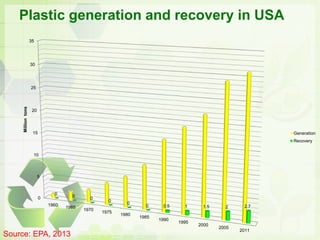
Plastic generation and recovery in USA
0
5
10
15
20
25
30
35
1960
1965
1970
1975
1980
1985
1990
1995
2000
2005
2011
0
0
0
0
0
0 0.5 1 1.5 2 2.7
Milliontons
Generation
Recovery
Source: EPA, 2013
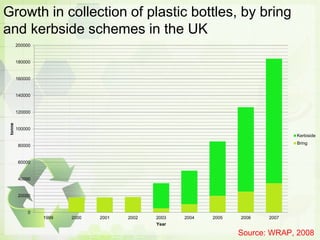
Growth in collection of plastic bottles, by bring
and kerbside schemes in the UK
0
20000
40000
60000
80000
100000
120000
140000
160000
180000
200000
1999 2000 2001 2002 2003 2004 2005 2006 2007
tonne
Year
Kerbiside
Bring
Source: WRAP, 2008
Safety of Re-cycled Plastics for Food
Packaging
Three main approaches are envisaged for producing food
packaging materials from post-consumer collected plastic
packaging materials
• Proper washing
• Purification of monomers formed by depolymerisation and then
repolymerized into pure materials as those made from
conventional monomers.
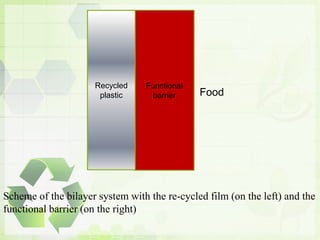
• Lamination of recycled plastics. The layer in contact with food
should be made of a virgin polymer. (Franz et al., 1994). It is
called as functional barrier.
Functional Barrier
The functional barrier is any integral layer
which under normal conditions of use
reduces all possible material transfers to
foodstuffs to a quantity which should not
endanger human health or cause
deterioration of the organoleptic
characteristics. (Council of Europe
document, 1993)
Scheme of the bilayer system with the re-cycled film (on the left) and the
functional barrier (on the right)
Functional
barrier
Recycled
plastic Food
A CFTRI case study on recycled polyethylene
films
• Virgin polyethylene, extrusion waste of virgin (grade A),
recycled milk pouches and B grade waste plastics were
processed.
• The recycled plastics were evaluated for physico-chemical
properties like tensile strength, water vapour transmission
rate and migration test.
Source: Baldev, 2002
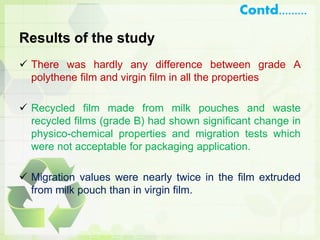
Results of the study
 There was hardly any difference between grade A
polythene film and virgin film in all the properties
 Recycled film made from milk pouches and waste
recycled films (grade B) had shown significant change in
physico-chemical properties and migration tests which
were not acceptable for packaging application.
 Migration values were nearly twice in the film extruded
from milk pouch than in virgin film.
Contd.........
Migration studies
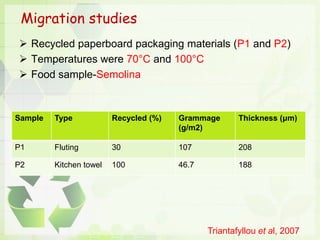
 Recycled paperboard packaging materials (P1 and P2)
 Temperatures were 70°C and 100°C
 Food sample-Semolina
Sample Type Recycled (%) Grammage
(g/m2)
Thickness (μm)
P1 Fluting 30 107 208
P2 Kitchen towel 100 46.7 188
Triantafyllou et al, 2007
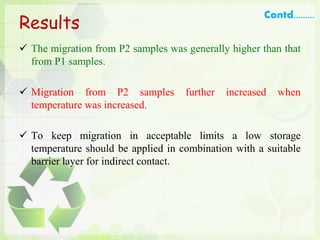
Results
 The migration from P2 samples was generally higher than that
from P1 samples.
 Migration from P2 samples further increased when
temperature was increased.
 To keep migration in acceptable limits a low storage
temperature should be applied in combination with a suitable
barrier layer for indirect contact.
Contd.........
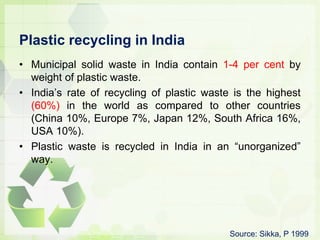
Plastic recycling in India
• Municipal solid waste in India contain 1-4 per cent by
weight of plastic waste.
• India’s rate of recycling of plastic waste is the highest
(60%) in the world as compared to other countries
(China 10%, Europe 7%, Japan 12%, South Africa 16%,
USA 10%).
• Plastic waste is recycled in India in an “unorganized”
way.
Source: Sikka, P 1999
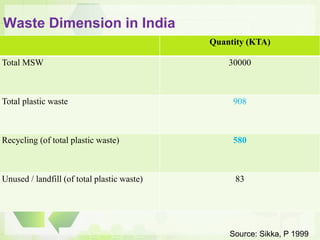
Waste Dimension in India
Quantity (KTA)
Total MSW 30000
Total plastic waste 908
Recycling (of total plastic waste) 580
Unused / landfill (of total plastic waste) 83
Source: Sikka, P 1999
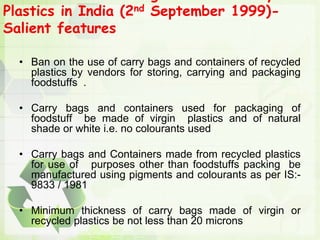
Plastics in India (2nd September 1999)-
Salient features
• Ban on the use of carry bags and containers of recycled
plastics by vendors for storing, carrying and packaging
foodstuffs .
• Carry bags and containers used for packaging of
foodstuff be made of virgin plastics and of natural
shade or white i.e. no colourants used
• Carry bags and Containers made from recycled plastics
for use of purposes other than foodstuffs packing be
manufactured using pigments and colourants as per IS:-
9833 / 1981
• Minimum thickness of carry bags made of virgin or
recycled plastics be not less than 20 microns
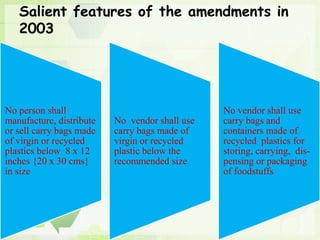
Salient features of the amendments in
2003
No person shall
manufacture, distribute
or sell carry bags made
of virgin or recycled
plastics below 8 x 12
inches {20 x 30 cms}
in size
No vendor shall use
carry bags made of
virgin or recycled
plastic below the
recommended size
No vendor shall use
carry bags and
containers made of
recycled plastics for
storing, carrying, dis-
pensing or packaging
of foodstuffs
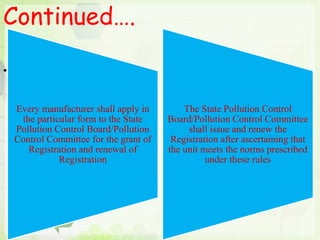
Continued….
• .
Every manufacturer shall apply in
the particular form to the State
Pollution Control Board/Pollution
Control Committee for the grant of
Registration and renewal of
Registration
The State Pollution Control
Board/Pollution Control Committee
shall issue and renew the
Registration after ascertaining that
the unit meets the norms prescribed
under these rules
State specific initiatives
Few states in India have also instituted
state laws to minimize plastic waste.
Himachal Pradesh was the first to
formulate a state rule to protect the
state from plastic waste menace which
is followed by Goa, Jammu & Kashmir,
Maharashtra etc.
Ecological case for recycling
o If recycled plastics are used to produce goods this will directly
reduce oil usage and emissions of greenhouse gases.
o Greater positive environmental benefits for recycling over
landfill and incineration with energy recovery
o Energy recovery from waste plastics (transformation to fuel)
can be used to reduce landfill volumes
Current advances in recycling
• Reliable detectors and sophisticated recognition and
decision softwares collectively increase the accuracy and
productivity of automatic sorting.
• Higher value applications for recycled polymers in closed-
loop processes, which can directly replace virgin polymer
• Recycling of the non-bottle packaging has become
possible because of improvements in sorting and washing
technologies and emerging markets for the recyclates
Public support for recycling
• There is significant people who value environmental values in
their purchasing patterns.
• Wide participation among the general population in recycling
schemes has been noted.
• Some governments use policy to encourage post consumer
recycling
Economic issues relating to recycling
• Two key economic drivers influence the viability of recycling.
These are the price of the recycled polymer compared with
virgin polymer and the cost of recycling compared with
alternative forms of acceptable disposal.
• Lack of information about the availability of recycled plastics, its
quality and suitability for specific applications, can also act as a
disincentive to use recycled material.
• Collection of used plastics from households i.e. Kerbside
scheme is more economical in suburbs
• In rural areas ‘bring schemes’ are considered more cost-
effective than kerbside collection
Conclusion
• In summary, recycling is one strategy for end-of-life
waste management of packaging materials.
• It is more economical as well as environmentally better
as compared to other waste reducing systems such as
incineration, landfill, decomposition, etc.
Recycling presentation

Recycling presentation

  • 1.
    Name of student: Anwar Hussain Title of seminar : Recycling of Packaging Materials Regd. No. : J-12-D-167-A Division : Post Harvest Technology
  • 2.
    Packaging Packaging is acoordinated system designed for the efficient delivery of high quality and safe food products throughout every phase of the supply chain, from raw material production to food manufacture, packing, retail, consumer use, disposal and recycling.
  • 3.
    Basic functions offood packaging • Containment • Communication • Convenience • Protection
  • 4.
    Decomposition of packagingmaterials Paper bag = 1 month Plastic bag = 10-20 years Tin can = 80 to 100 years Aluminum can = 500 years Glass bottle = 1,000 years Plastic bottle = a long time Source: www.slideshare.com
  • 5.
    A world fullof junk Increased environmental concerns have created a need for recycling of packaging materials.
  • 6.
    Recycling of packaging materials •Recycling reduces the volume of packaging materials entering the waste stream and saves materials and energy • A concern for using recycled package materials for food contact uses (primary packages) is that contaminants could jeopardize the safety or quality of the food • Generally, recycled glass and metal containers are acceptable for food contact use, but recycled plastic and paper are not.
  • 7.
    What is recycling? All commontypes of food packaging are technically capable of being recycled. However, whether are actually recycled in practice depends on • the local waste management infrastructure and • the availability of recycling/reprocessing capacity. Converting waste into reusable material Turning a product’s useful parts into another product (Butler, 2010)
  • 8.
    Recycling Facts  Recyclingone glass bottle saves enough energy to light a 100-watt bulb for 4 hours  Americans use 4 million plastic bottles every hour  Around 200 B.C. the Chinese used fishing nets to create the world’s very first piece of recycled paper  Glass never wears out, it can be recycled forever Source: Butler, 2010
  • 9.
    Composition Of DailyWaste Source: Khan, 2009
  • 10.
    Recycling Techniques  ReuseRecycling  Physical/Mechanical Recycling  Chemical Recycling
  • 11.
    Reuse Recycling The reusetechnique involves refilling rigid containers after washing. This approach is common for glass bottles and has been used for rigid plastic milk containers. However, safety concerns related to this type of recycling are due to the possible presence of wash-resistant contaminants. Physical/Mechanical Recycling Physical recycling is the remelting and reextrusion or molding of plastic packages into films or containers. Sources of recycled packages could include scraps from manufacturers or previously used packaging materials.
  • 12.
    Chemical Recycling Waste materialsare depolymerized back to monomers or very short molecules in chemical recycling. Fresh plastic is produced by purification of monomers followed by polymerization.
  • 13.
    Key steps duringrecycling process Step 1 • Collection and Sorting Step 2 • Cleaning Step 3 • Size reduction Step 4 • Processing
  • 14.
    Typical sorting procedureat an MRF Materials collected from households Hand sorting (papers) Cartons, boxes, paper bags Magnetic separation Steel cans Eddy current separation Aluminum cans Hand sorting (glass) Clear, amber and green glass bottles Hand sorting (plastics) Clear, amber and green PET bottles, HDPE containers, Miscellaneous
  • 15.
  • 16.
    Paper • After collectionand sorting, water and chemicals are mixed with the paper to remove contaminants and turn the old paper into pulp • This is followed by removal of ink • The pulp is then placed between two wire meshes and left to dry where it becomes new paper • The dried paper is polished and rolled into reels
  • 17.
  • 18.
    Aluminum o After collectionand sorting, the cans are crushed and baled for shipment to a recycling plant o Ink and enamel coatings are burnt off in a decoating process o Shredded into small pieces o The hot shreds of aluminum then pass into melting furnaces where, depending on the intended use, alloying metals are added
  • 19.
    Glass Glass is collectedfrom curbsides or drop-off points It is transported to recycling plant where metal caps and plastic sleeves are removed The glass is then crushed into small pieces and transported to the glass factory It is melted in a large furnace  The hot glass is molded into new bottles
  • 20.
  • 21.
    “Why do werecycle?” The U.S. Environmental Protection Agency (EPA) gives the following benefits of recycling: • Conserves resource for our children’s future • Prevents emissions of many greenhouse gases and water pollutants • Saves energy • Supplies valuable raw material to industry • Creates jobs • Reduces the need for new landfills and incinerators
  • 22.
    Generation and recyclingrecovery (million tons) of MSW in USA 0 50 100 150 200 250 300 1960 1970 1980 1990 2000 2005 2007 2009 2010 2011 Generation Recovery for recycling Source: EPA, 2013
  • 23.
    Percent of MSWgenerationrecycled in USA 6.4 6.2 6.6 7.3 9.6 10.1 14.7 25.7 28.5 31.4 34.7 Percent recycling 1960 1965 1970 1975 1980 1985 1990 1995 2000 2005 2011 Source: EPA, 2013
  • 24.
    Generation and recovery(in millions of tons) and percent recovery of each product in USA Products Weight generated Weight recovered Recovery (%) of generation Steel 2.18 1.57 72.0 Aluminum 1.85 0.72 38.9 Glass 9.28 3.17 34.2 Paper and paperboard 38.02 28.66 75.4 Source: EPA, 2013
  • 25.
    Earth is fullof garbage!
  • 26.
    Now it’s yourturn….. Recycle!
  • 27.
    Type of plastic nowrecycled Polyethylene terepthalate (PETE) High density polyethylene (HDFE) Polyvinyl chloride (PVC) Low density polyethylene (LDPE) Polypropylene (PP) Polystyrene (PS) Mixed and multilayer plastic (other) Plastic recycling
  • 28.
    Terminology used indifferent types of plastics recycling and recovery. Definitions Equivalent ISO definitions Other equivalent terms Primary recycling Mechanical recycling Closed-loop recycling Secondary recycling Mechanical recycling Downgrading Tertiary recycling Chemical recycling Feedstock recycling Quaternary recycling Energy recovery Valorization Source: Hopewell et al. 2009
  • 29.
    Plastic identification code PlasticIdentification Code Type of plastic polymer Common Packaging Applications Polyethylene terephthalate (PET, PETE) Soft drink, water and salad dressing bottles; peanut butter and jam jars High-density polyethylene (HDPE) Milk, juice and water bottles; grocery bags. Polyvinyl chloride (PVC) May be used for food packaging with the addition of the plasticisers needed to make natively rigid PVC flexible. Provide a uniform system for the identification of different polymer types and to help recycling companies. Consumers can identify the plastic types based on the codes
  • 30.
    Low-density polyethylene (LDPE) Frozen foodbags; squeezable bottles, e.g. honey, mustard; cling films; flexible container lids. Polypropylene (PP) Reusable microwaveable ware; kitchenware; yogurt containers; margarine tubs; microwaveable disposable take-away containers; disposable cups; plates. Polystyrene (PS) Egg cartons; packing peanuts; disposable cups, plates, trays and cutlery; disposable take-away containers; Other (often polycarbonate ) Beverage bottles; baby milk bottles. Contd....
  • 31.
    Plastic generation andrecovery in USA 0 5 10 15 20 25 30 35 1960 1965 1970 1975 1980 1985 1990 1995 2000 2005 2011 0 0 0 0 0 0 0.5 1 1.5 2 2.7 Milliontons Generation Recovery Source: EPA, 2013
  • 32.
    Growth in collectionof plastic bottles, by bring and kerbside schemes in the UK 0 20000 40000 60000 80000 100000 120000 140000 160000 180000 200000 1999 2000 2001 2002 2003 2004 2005 2006 2007 tonne Year Kerbiside Bring Source: WRAP, 2008
  • 33.
    Safety of Re-cycledPlastics for Food Packaging Three main approaches are envisaged for producing food packaging materials from post-consumer collected plastic packaging materials • Proper washing • Purification of monomers formed by depolymerisation and then repolymerized into pure materials as those made from conventional monomers. • Lamination of recycled plastics. The layer in contact with food should be made of a virgin polymer. (Franz et al., 1994). It is called as functional barrier.
  • 34.
    Functional Barrier The functionalbarrier is any integral layer which under normal conditions of use reduces all possible material transfers to foodstuffs to a quantity which should not endanger human health or cause deterioration of the organoleptic characteristics. (Council of Europe document, 1993)
  • 35.
    Scheme of thebilayer system with the re-cycled film (on the left) and the functional barrier (on the right) Functional barrier Recycled plastic Food
  • 36.
    A CFTRI casestudy on recycled polyethylene films • Virgin polyethylene, extrusion waste of virgin (grade A), recycled milk pouches and B grade waste plastics were processed. • The recycled plastics were evaluated for physico-chemical properties like tensile strength, water vapour transmission rate and migration test. Source: Baldev, 2002
  • 37.
    Results of thestudy  There was hardly any difference between grade A polythene film and virgin film in all the properties  Recycled film made from milk pouches and waste recycled films (grade B) had shown significant change in physico-chemical properties and migration tests which were not acceptable for packaging application.  Migration values were nearly twice in the film extruded from milk pouch than in virgin film. Contd.........
  • 38.
    Migration studies  Recycledpaperboard packaging materials (P1 and P2)  Temperatures were 70°C and 100°C  Food sample-Semolina Sample Type Recycled (%) Grammage (g/m2) Thickness (μm) P1 Fluting 30 107 208 P2 Kitchen towel 100 46.7 188 Triantafyllou et al, 2007
  • 39.
    Results  The migrationfrom P2 samples was generally higher than that from P1 samples.  Migration from P2 samples further increased when temperature was increased.  To keep migration in acceptable limits a low storage temperature should be applied in combination with a suitable barrier layer for indirect contact. Contd.........
  • 40.
    Plastic recycling inIndia • Municipal solid waste in India contain 1-4 per cent by weight of plastic waste. • India’s rate of recycling of plastic waste is the highest (60%) in the world as compared to other countries (China 10%, Europe 7%, Japan 12%, South Africa 16%, USA 10%). • Plastic waste is recycled in India in an “unorganized” way. Source: Sikka, P 1999
  • 41.
    Waste Dimension inIndia Quantity (KTA) Total MSW 30000 Total plastic waste 908 Recycling (of total plastic waste) 580 Unused / landfill (of total plastic waste) 83 Source: Sikka, P 1999
  • 42.
    Plastics in India(2nd September 1999)- Salient features • Ban on the use of carry bags and containers of recycled plastics by vendors for storing, carrying and packaging foodstuffs . • Carry bags and containers used for packaging of foodstuff be made of virgin plastics and of natural shade or white i.e. no colourants used • Carry bags and Containers made from recycled plastics for use of purposes other than foodstuffs packing be manufactured using pigments and colourants as per IS:- 9833 / 1981 • Minimum thickness of carry bags made of virgin or recycled plastics be not less than 20 microns
  • 43.
    Salient features ofthe amendments in 2003 No person shall manufacture, distribute or sell carry bags made of virgin or recycled plastics below 8 x 12 inches {20 x 30 cms} in size No vendor shall use carry bags made of virgin or recycled plastic below the recommended size No vendor shall use carry bags and containers made of recycled plastics for storing, carrying, dis- pensing or packaging of foodstuffs
  • 44.
    Continued…. • . Every manufacturershall apply in the particular form to the State Pollution Control Board/Pollution Control Committee for the grant of Registration and renewal of Registration The State Pollution Control Board/Pollution Control Committee shall issue and renew the Registration after ascertaining that the unit meets the norms prescribed under these rules
  • 45.
    State specific initiatives Fewstates in India have also instituted state laws to minimize plastic waste. Himachal Pradesh was the first to formulate a state rule to protect the state from plastic waste menace which is followed by Goa, Jammu & Kashmir, Maharashtra etc.
  • 46.
    Ecological case forrecycling o If recycled plastics are used to produce goods this will directly reduce oil usage and emissions of greenhouse gases. o Greater positive environmental benefits for recycling over landfill and incineration with energy recovery o Energy recovery from waste plastics (transformation to fuel) can be used to reduce landfill volumes
  • 47.
    Current advances inrecycling • Reliable detectors and sophisticated recognition and decision softwares collectively increase the accuracy and productivity of automatic sorting. • Higher value applications for recycled polymers in closed- loop processes, which can directly replace virgin polymer • Recycling of the non-bottle packaging has become possible because of improvements in sorting and washing technologies and emerging markets for the recyclates
  • 48.
    Public support forrecycling • There is significant people who value environmental values in their purchasing patterns. • Wide participation among the general population in recycling schemes has been noted. • Some governments use policy to encourage post consumer recycling
  • 49.
    Economic issues relatingto recycling • Two key economic drivers influence the viability of recycling. These are the price of the recycled polymer compared with virgin polymer and the cost of recycling compared with alternative forms of acceptable disposal. • Lack of information about the availability of recycled plastics, its quality and suitability for specific applications, can also act as a disincentive to use recycled material. • Collection of used plastics from households i.e. Kerbside scheme is more economical in suburbs • In rural areas ‘bring schemes’ are considered more cost- effective than kerbside collection
  • 50.
    Conclusion • In summary,recycling is one strategy for end-of-life waste management of packaging materials. • It is more economical as well as environmentally better as compared to other waste reducing systems such as incineration, landfill, decomposition, etc.