The word plastic is derived from
the Greek (plastikos) meaning capable
of being shaped or moulded,
from (plastos) meaning moulded. It
refers to their malleability, or
plasticity during manufacture, that
allows them to be cast, pressed,
or extruded into a variety of shapes โ€”
such as films, fibres, plates, tubes,
bottles, boxes, and much more.
Plastic are materials formed by
long chains of carbon and
hydrogen called polymers,
formed by units called
monomers. The most important
characteristic of plastic is the
capacity of deformation.
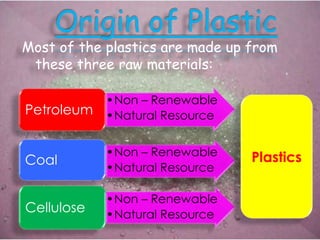
Most of the plastics are made up from
these three raw materials:
โ€ขNon โ€“ Renewable
โ€ขNatural ResourcePetroleum
โ€ขNon โ€“ Renewable
โ€ขNatural Resource
Coal
โ€ขNon โ€“ Renewable
โ€ขNatural Resource
Cellulose
Plastics
Plastics are made from fossil fuels.
Fossil fuels contains hydrocarbons, which
provide small building blocks called monomer.
These hydrocarbons monomers are link
together to form long carbon chains called
polymers.
The process of forming long molecules is
called polymerization.
The polymerization form viscous, sticky
substances known as resins, which are used
to make plastic products.
These joined molecules form a plastic resin
known as polythene.
๏‚ž Plastics are strong , light weight, flexible and
durable.
๏‚ž Plastics can be easily moulded into a variety
of shapes and sizes.
๏‚ž Plastics have excellent mechanical strength
(tensile properties, tear resistance, and
impact resistance).
๏‚ž Plastics are relatively cheaper than compared
to metals like steel, tin etc.
๏‚ž Plastics are reusable and recyclable.
๏‚ž Plastics have long use age life.
๏ฑ Plastics are good electricity and
heat insulators.
๏ฑ Plastics do not corrode or decay.
๏ฑ Plastics are cheap and dispensable.
๏ฑ Plastics are resistant to chemicals,
water or grease.
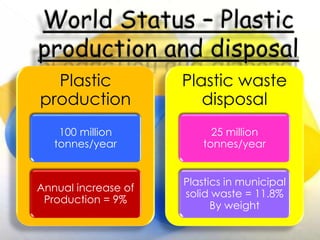
Plastic
production
100 million
tonnes/year
Annual increase of
Production = 9%
Plastic waste
disposal
25 million
tonnes/year
Plastics in municipal
solid waste = 11.8%
By weight
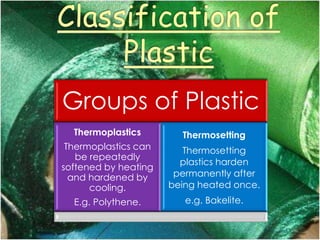
Groups of Plastic
Thermoplastics
Thermoplastics can
be repeatedly
softened by heating
and hardened by
cooling.
E.g. Polythene.
Thermosetting
Thermosetting
plastics harden
permanently after
being heated once.
e.g. Bakelite.
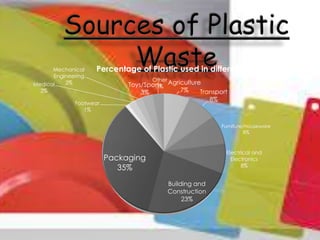
Agriculture
7% Transport
8%
Furniture/Houseware
8%
Electrical and
Electronics
8%
Building and
Construction
23%
Packaging
35%
Footwear
1%
Medical
2%
Mechanical
Engineering
2% Toys/Sports
3%
Other
3%
Percentage of Plastic used in different fields
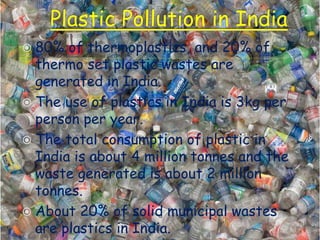
๏‚ž 80% of thermoplastics, and 20% of
thermo set plastic wastes are
generated in India.
๏‚ž The use of plastics in India is 3kg per
person per year.
๏‚ž The total consumption of plastic in
India is about 4 million tonnes and the
waste generated is about 2 million
tonnes.
๏‚ž About 20% of solid municipal wastes
are plastics in India.
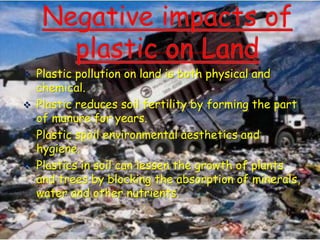
๏ถ Plastic pollution on land is both physical and
chemical.
๏ถ Plastic reduces soil fertility by forming the part
of manure for years.
๏ถ Plastic spoil environmental aesthetics and
hygiene.
๏ถ Plastics in soil can lessen the growth of plants
and trees by blocking the absorption of minerals,
water and other nutrients.
Disposing of plastic waste is trickier than
dealing with other traditional landfill
material. Not only does plastic take
thousands of years to break down, it can
leach dangerous poison into the
environment. Plastic is not going away, but
how plastic waste is managed is becoming
more sophisticated. Managing plastic
waste starts at home with the consumer,
but ultimately depends on governments
around the world as well.
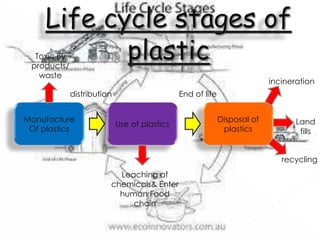
Manufacture
Of plastics
Use of plastics
Disposal of
plastics
Toxic By
products/
waste
Leaching of
chemicals& Enter
human Food
chain
recycling
Land
fills
incineration
distribution End of life
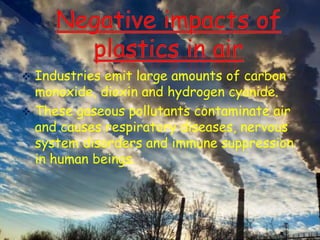
๏ถ Industries emit large amounts of carbon
monoxide, dioxin and hydrogen cyanide.
๏ถ These gaseous pollutants contaminate air
and causes respiratory diseases, nervous
system disorders and immune suppression
in human beings.
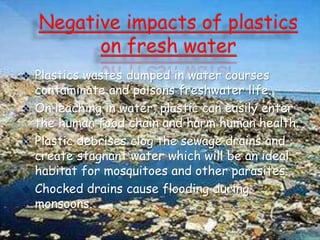
๏ถ Plastics wastes dumped in water courses
contaminate and poisons freshwater life.
๏ถ On leaching in water, plastic can easily enter
the human food chain and harm human health.
๏ถ Plastic debrises clog the sewage drains and
create stagnant water which will be an ideal
habitat for mosquitoes and other parasites.
๏ถ Chocked drains cause flooding during
monsoons.
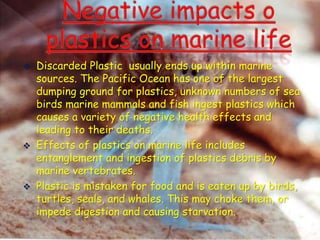
๏ถ Discarded Plastic usually ends up within marine
sources. The Pacific Ocean has one of the largest
dumping ground for plastics, unknown numbers of sea
birds marine mammals and fish ingest plastics which
causes a variety of negative health effects and
leading to their deaths.
๏ถ Effects of plastics on marine life includes
entanglement and ingestion of plastics debris by
marine vertebrates.
๏ถ Plastic is mistaken for food and is eaten up by birds,
turtles, seals, and whales. This may choke them, or
impede digestion and causing starvation.
๏ถ Toxic chemicals contained in plastics cause
neurological problems, cancer, birth defects,
hormonal changes gastric ulcer, thyroid
problems and cardiovascular disease.
๏ถ The endocrine disrupting chemicals (EDCs) in
plastics have been contributing to obesity
and diabetes.
๏ถ The plastic bottles may leach cancer โ€“
causing chemicals such as phthalates (a
component makes plastic pliable) and Bis โ€“
phenol A ( a component harden plastic).
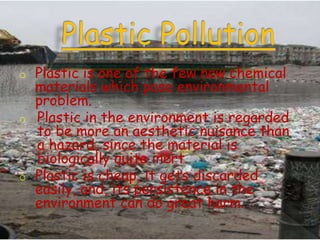
o Plastic is one of the few new chemical
materials which pose environmental
problem.
o Plastic in the environment is regarded
to be more an aesthetic nuisance than
a hazard, since the material is
biologically quite inert.
o Plastic is cheap, it gets discarded
easily, and, its persistence in the
environment can do great harm.
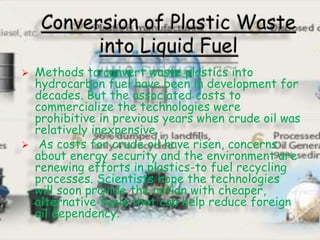
๏ƒ˜ Methods to convert waste plastics into
hydrocarbon fuel have been in development for
decades. But the associated costs to
commercialize the technologies were
prohibitive in previous years when crude oil was
relatively inexpensive.
๏ƒ˜ As costs for crude oil have risen, concerns
about energy security and the environment are
renewing efforts in plastics-to fuel recycling
processes. Scientists hope the technologies
will soon provide the nation with cheaper,
alternative fuels that can help reduce foreign
oil dependency.
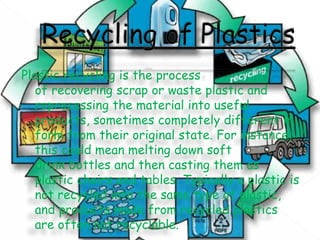
Plastic recycling is the process
of recovering scrap or waste plastic and
reprocessing the material into useful
products, sometimes completely different in
form from their original state. For instance,
this could mean melting down soft
drink bottles and then casting them as
plastic chairs and tables. Typically a plastic is
not recycled into the same type of plastic,
and products made from recycled plastics
are often not recyclable.
Bioplastics are a form of plastics derived from
renewable biomass sources, such as vegetable fats
and oils , corn starch or micro biota .Common
plastics, such as fossil-fuel plastics, are derived
from petroleum. These plastics rely more on scarce
fossil fuels and produce more greenhouse gas. Some,
but not all, bioplastics are designed to biodegrade.
Bioplastics which are designed to biodegrade can
break down in either anaerobic or aerobic
environments, depending on how they are
manufactured. There is a variety of bioplastics being
made; they can be composed of starches, cellulose,
or other biopolymers. Some common applications of
bioplastics are packaging materials, dining utensils,
food packaging, and insulation.
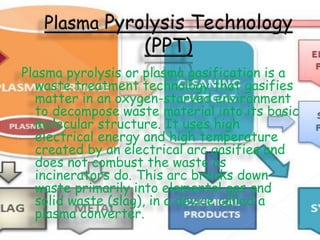
Plasma pyrolysis or plasma gasification is a
waste treatment technology that gasifies
matter in an oxygen-starved environment
to decompose waste material into its basic
molecular structure. It uses high
electrical energy and high temperature
created by an electrical arc gasifies and
does not combust the waste as
incinerators do. This arc breaks down
waste primarily into elemental gas and
solid waste (slag), in a device called a
plasma converter.
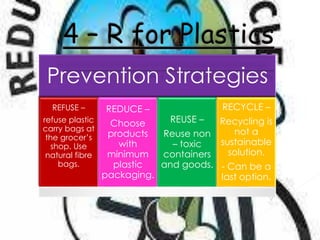
Prevention Strategies
REFUSE โ€“
refuse plastic
carry bags at
the grocerโ€™s
shop. Use
natural fibre
bags.
REDUCE โ€“
Choose
products
with
minimum
plastic
packaging.
REUSE โ€“
Reuse non
โ€“ toxic
containers
and goods.
RECYCLE โ€“
Recycling is
not a
sustainable
solution.
- Can be a
last option.
๏ƒผ Lead by example
๏ƒผ Ask your friends and family to join you
๏ƒผ Speak to city council
๏ƒผ Write letters to government officials
๏ƒผ Get your school involved.
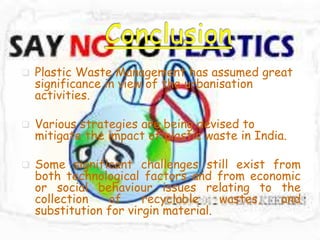
๏ฑ Plastic Waste Management has assumed great
significance in view of the urbanisation
activities.
๏ฑ Various strategies are being devised to
mitigate the impact of plastic waste in India.
๏ฑ Some significant challenges still exist from
both technological factors and from economic
or social behaviour issues relating to the
collection of recyclable wastes, and
substitution for virgin material.
๏ฑ Mahatma Gandhi โ€“
โ€œYou must be the change if you wish to see
in the worldโ€.
๏ฑ Time for a new ethic :
Save yourself and you save the environment.
Presentation1 2

Presentation1 2

  • 2.
    The word plasticis derived from the Greek (plastikos) meaning capable of being shaped or moulded, from (plastos) meaning moulded. It refers to their malleability, or plasticity during manufacture, that allows them to be cast, pressed, or extruded into a variety of shapes โ€” such as films, fibres, plates, tubes, bottles, boxes, and much more.
  • 3.
    Plastic are materialsformed by long chains of carbon and hydrogen called polymers, formed by units called monomers. The most important characteristic of plastic is the capacity of deformation.
  • 4.
    Most of theplastics are made up from these three raw materials: โ€ขNon โ€“ Renewable โ€ขNatural ResourcePetroleum โ€ขNon โ€“ Renewable โ€ขNatural Resource Coal โ€ขNon โ€“ Renewable โ€ขNatural Resource Cellulose Plastics
  • 5.
    Plastics are madefrom fossil fuels. Fossil fuels contains hydrocarbons, which provide small building blocks called monomer. These hydrocarbons monomers are link together to form long carbon chains called polymers. The process of forming long molecules is called polymerization. The polymerization form viscous, sticky substances known as resins, which are used to make plastic products. These joined molecules form a plastic resin known as polythene.
  • 6.
    ๏‚ž Plastics arestrong , light weight, flexible and durable. ๏‚ž Plastics can be easily moulded into a variety of shapes and sizes. ๏‚ž Plastics have excellent mechanical strength (tensile properties, tear resistance, and impact resistance). ๏‚ž Plastics are relatively cheaper than compared to metals like steel, tin etc. ๏‚ž Plastics are reusable and recyclable. ๏‚ž Plastics have long use age life.
  • 7.
    ๏ฑ Plastics aregood electricity and heat insulators. ๏ฑ Plastics do not corrode or decay. ๏ฑ Plastics are cheap and dispensable. ๏ฑ Plastics are resistant to chemicals, water or grease.
  • 9.
    Plastic production 100 million tonnes/year Annual increaseof Production = 9% Plastic waste disposal 25 million tonnes/year Plastics in municipal solid waste = 11.8% By weight
  • 10.
    Groups of Plastic Thermoplastics Thermoplasticscan be repeatedly softened by heating and hardened by cooling. E.g. Polythene. Thermosetting Thermosetting plastics harden permanently after being heated once. e.g. Bakelite.
  • 11.
    Agriculture 7% Transport 8% Furniture/Houseware 8% Electrical and Electronics 8% Buildingand Construction 23% Packaging 35% Footwear 1% Medical 2% Mechanical Engineering 2% Toys/Sports 3% Other 3% Percentage of Plastic used in different fields
  • 12.
    ๏‚ž 80% ofthermoplastics, and 20% of thermo set plastic wastes are generated in India. ๏‚ž The use of plastics in India is 3kg per person per year. ๏‚ž The total consumption of plastic in India is about 4 million tonnes and the waste generated is about 2 million tonnes. ๏‚ž About 20% of solid municipal wastes are plastics in India.
  • 13.
    ๏ถ Plastic pollutionon land is both physical and chemical. ๏ถ Plastic reduces soil fertility by forming the part of manure for years. ๏ถ Plastic spoil environmental aesthetics and hygiene. ๏ถ Plastics in soil can lessen the growth of plants and trees by blocking the absorption of minerals, water and other nutrients.
  • 14.
    Disposing of plasticwaste is trickier than dealing with other traditional landfill material. Not only does plastic take thousands of years to break down, it can leach dangerous poison into the environment. Plastic is not going away, but how plastic waste is managed is becoming more sophisticated. Managing plastic waste starts at home with the consumer, but ultimately depends on governments around the world as well.
  • 15.
    Manufacture Of plastics Use ofplastics Disposal of plastics Toxic By products/ waste Leaching of chemicals& Enter human Food chain recycling Land fills incineration distribution End of life
  • 16.
    ๏ถ Industries emitlarge amounts of carbon monoxide, dioxin and hydrogen cyanide. ๏ถ These gaseous pollutants contaminate air and causes respiratory diseases, nervous system disorders and immune suppression in human beings.
  • 17.
    ๏ถ Plastics wastesdumped in water courses contaminate and poisons freshwater life. ๏ถ On leaching in water, plastic can easily enter the human food chain and harm human health. ๏ถ Plastic debrises clog the sewage drains and create stagnant water which will be an ideal habitat for mosquitoes and other parasites. ๏ถ Chocked drains cause flooding during monsoons.
  • 18.
    ๏ถ Discarded Plasticusually ends up within marine sources. The Pacific Ocean has one of the largest dumping ground for plastics, unknown numbers of sea birds marine mammals and fish ingest plastics which causes a variety of negative health effects and leading to their deaths. ๏ถ Effects of plastics on marine life includes entanglement and ingestion of plastics debris by marine vertebrates. ๏ถ Plastic is mistaken for food and is eaten up by birds, turtles, seals, and whales. This may choke them, or impede digestion and causing starvation.
  • 19.
    ๏ถ Toxic chemicalscontained in plastics cause neurological problems, cancer, birth defects, hormonal changes gastric ulcer, thyroid problems and cardiovascular disease. ๏ถ The endocrine disrupting chemicals (EDCs) in plastics have been contributing to obesity and diabetes. ๏ถ The plastic bottles may leach cancer โ€“ causing chemicals such as phthalates (a component makes plastic pliable) and Bis โ€“ phenol A ( a component harden plastic).
  • 20.
    o Plastic isone of the few new chemical materials which pose environmental problem. o Plastic in the environment is regarded to be more an aesthetic nuisance than a hazard, since the material is biologically quite inert. o Plastic is cheap, it gets discarded easily, and, its persistence in the environment can do great harm.
  • 21.
    ๏ƒ˜ Methods toconvert waste plastics into hydrocarbon fuel have been in development for decades. But the associated costs to commercialize the technologies were prohibitive in previous years when crude oil was relatively inexpensive. ๏ƒ˜ As costs for crude oil have risen, concerns about energy security and the environment are renewing efforts in plastics-to fuel recycling processes. Scientists hope the technologies will soon provide the nation with cheaper, alternative fuels that can help reduce foreign oil dependency.
  • 22.
    Plastic recycling isthe process of recovering scrap or waste plastic and reprocessing the material into useful products, sometimes completely different in form from their original state. For instance, this could mean melting down soft drink bottles and then casting them as plastic chairs and tables. Typically a plastic is not recycled into the same type of plastic, and products made from recycled plastics are often not recyclable.
  • 23.
    Bioplastics are aform of plastics derived from renewable biomass sources, such as vegetable fats and oils , corn starch or micro biota .Common plastics, such as fossil-fuel plastics, are derived from petroleum. These plastics rely more on scarce fossil fuels and produce more greenhouse gas. Some, but not all, bioplastics are designed to biodegrade. Bioplastics which are designed to biodegrade can break down in either anaerobic or aerobic environments, depending on how they are manufactured. There is a variety of bioplastics being made; they can be composed of starches, cellulose, or other biopolymers. Some common applications of bioplastics are packaging materials, dining utensils, food packaging, and insulation.
  • 24.
    Plasma pyrolysis orplasma gasification is a waste treatment technology that gasifies matter in an oxygen-starved environment to decompose waste material into its basic molecular structure. It uses high electrical energy and high temperature created by an electrical arc gasifies and does not combust the waste as incinerators do. This arc breaks down waste primarily into elemental gas and solid waste (slag), in a device called a plasma converter.
  • 25.
    Prevention Strategies REFUSE โ€“ refuseplastic carry bags at the grocerโ€™s shop. Use natural fibre bags. REDUCE โ€“ Choose products with minimum plastic packaging. REUSE โ€“ Reuse non โ€“ toxic containers and goods. RECYCLE โ€“ Recycling is not a sustainable solution. - Can be a last option.
  • 26.
    ๏ƒผ Lead byexample ๏ƒผ Ask your friends and family to join you ๏ƒผ Speak to city council ๏ƒผ Write letters to government officials ๏ƒผ Get your school involved.
  • 27.
    ๏ฑ Plastic WasteManagement has assumed great significance in view of the urbanisation activities. ๏ฑ Various strategies are being devised to mitigate the impact of plastic waste in India. ๏ฑ Some significant challenges still exist from both technological factors and from economic or social behaviour issues relating to the collection of recyclable wastes, and substitution for virgin material.
  • 28.
    ๏ฑ Mahatma Gandhiโ€“ โ€œYou must be the change if you wish to see in the worldโ€. ๏ฑ Time for a new ethic : Save yourself and you save the environment.