Electronic waste Management
Core Case Study: E-waste—An
Exploding Problem (1)
 Electronic waste, e-waste: fastest growing
solid waste problem
 Composition includes
• High-quality plastics
• Valuable metals
• Toxic and hazardous pollutants
Core Case Study: E-waste—An
Exploding Problem (2)
 Shipped to other countries
• What happens in China?
 International Basel Convention
• Bans transferring hazardous wastes from
developed countries to developing countries
 European Union
• Cradle-to-grave approach
Core Case Study: E-waste—An
Exploding Problem (3)
 What should be done?
• Recycle
• E-cycle
• Reuse
• Prevention approach: remove the toxic materials
Rapidly Growing E-Waste from Discarded
Computers and Other Electronics
21-1 What Are Solid Waste and Hazardous
Waste, and Why Are They Problems?
 Concept 21-1 Solid waste represents pollution
and unnecessary waste of resources, and
hazardous waste contributes to pollution, natural
capital degradation, health problems, and
premature deaths.
We Throw Away Huge Amounts of Useful
Things and Hazardous Materials (1)
 Solid waste
• Industrial solid
• Municipal solid waste (MSW)
• Hazardous, toxic, waste
 Hazardous wastes
• Organic compounds
• Toxic heavy metals
• Radioactive waste
We Throw Away Huge Amounts of Useful
Things and Hazardous Materials (2)
 80–90% of hazardous wastes produced by
developed countries
 Why reduce solid wastes?
• ¾ of the materials are an unnecessary waste of
the earth's resources
• Huge amounts of air pollution, greenhouse gases,
and water pollution
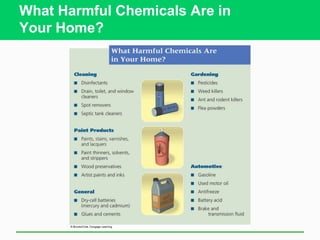
What Harmful Chemicals Are in
Your Home?
Fig. 21-2, p. 562
What Harmful Chemicals
Are in Your Home?
Cleaning Gardening
Disinfectants Pesticides
Drain, toilet, and
window cleaners
Weed killers
Ant and rodent killers
Spot removers Flea powders
Septic tank cleaners
Paint Products
Paints, stains,
varnishes, and
lacquers
Paint thinners,
solvents, and
strippers
Wood preservatives
Automotive
Artist paints and inks
Gasoline
Used motor oil
General Antifreeze
Dry-cell batteries
(mercury and
cadmium)
Battery acid
Brake and
transmission fluid
Glues and cements
Fig. 21-2, p. 562
What Harmful Chemicals
Are in Your Home?
Cleaning
Disinfectants
Drain, toilet, and
window cleaners
Spot removers
Septic tank cleaners
Paint Products
Paints, stains,
varnishes, and
lacquers
Paint thinners,
solvents, and
strippers
Wood preservatives
Artist paints and inks
Gardening
Pesticides
Weed killers
Ant and rodent killers
Flea powders
General
Dry-cell batteries
(mercury and
cadmium)
Glues and cements
Automotive
Gasoline
Used motor oil
Antifreeze
Battery acid
Brake and
transmission fluid
Stepped Art
Solid Waste
 Leader in solid waste problem
• What is thrown away?
 Leader in trash production, by weight, per
person
 Recycling is helping
21-2 How Should We Deal with
Solid Waste?
 Concept 21-2 A sustainable approach to solid
waste is first to reduce it, then to reuse or
recycle it, and finally to safely dispose of what is
left.
We Can Burn or Bury Solid Waste or
Produce Less of It
 Waste Management
 Waste Reduction
 Integrated waste management
• Uses a variety of strategies
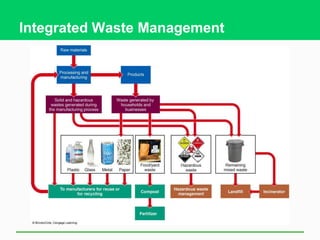
Integrated Waste Management
Fig. 21-5, p. 565
Raw materials
Processing
and
manufacturing
Products
Solid and hazardous
wastes generated during
the manufacturing
process
Waste generated by
households and
businesses
Food/yard
waste
Hazardous
waste
Remaining
mixed waste
Plastic Glass Metal Paper
To manufacturers for reuse
or for recycling
Compost Hazardous waste
management Landfill Incinerator
Fertilizer
Integrated Waste Management: Priorities
for Dealing with Solid Waste
Fig. 21-6, p. 565
First Priority Second Priority Last Priority
Primary Pollution and Waste
Prevention
Secondary Pollution and
Waste Prevention
Waste Management
Change industrial process to
eliminate use of harmful chemicals
Reuse
Treat waste to reduce
toxicity
Repair Incinerate waste
Use less of a harmful product Recycle Bury waste in landfills
Reduce packaging and materials in
products
Compost
Release waste into
environment for dispersal
or dilution
Make products that last longer and
are recyclable, reusable, or easy to
repair
Buy reusable and
recyclable products
Fig. 21-6, p. 565
Use less of a harmful product
Last Priority
Waste Management
Treat waste to reduce
toxicity
Incinerate waste
Bury waste in landfills
Release waste into
environment for dispersal
or dilution
First Priority
Primary Pollution and Waste
Prevention
Change industrial process to
eliminate use of harmful chemicals
Reduce packaging and materials in
products
Make products that last longer and
are recyclable, reusable, or easy to
repair
Second Priority
Secondary Pollution and
Waste Prevention
Reuse
Repair
Recycle
Compost
Buy reusable and
recyclable products
Stepped Art
Science Focus: Garbology
 William Rathje: analyzes garbage in landfills
 Landfills and trash decomposition
We Can Cut Solid Wastes by Reducing,
Reusing, and Recycling (1)
 Waste reduction is based on
• Reduce
• Reuse
• Recycle
 Seven strategies:
(1) Redesign manufacturing processes and
products to use less material and energy
(2) Redesign manufacturing processes to produce
less waste and pollution
We Can Cut Solid Wastes by Reducing,
Reusing, and Recycling (2)
 Seven strategies cont…
(3) Develop products that are easy to repair,
reuse, remanufacture, compost, or recycle
(4) Eliminate or reduce unnecessary packaging
(5) Use fee-per-bag waste collection systems
(6) Establish cradle-to grave responsibility
(7) Restructure urban transportation systems
What Can You Do? Solid Waste
21-3 Why Is Reusing and Recycling
Materials So Important?
 Concept 21-3 Reusing items decreases the use
of matter and energy resources and reduces
pollution and natural capital degradation;
recycling does so to a lesser degree.
Reuse: Important Way to Reduce Solid
Waste, Pollution and to Save Money
 Reuse: clean and use materials over and over
 Downside of reuse in developing countries
 Salvaging automobiles parts
 Rechargeable batteries
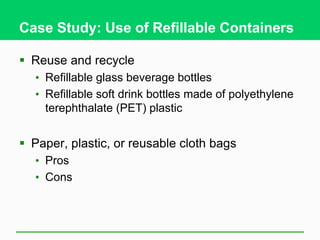
Case Study: Use of Refillable Containers
 Reuse and recycle
• Refillable glass beverage bottles
• Refillable soft drink bottles made of polyethylene
terephthalate (PET) plastic
 Paper, plastic, or reusable cloth bags
• Pros
• Cons
Energy Consumption Involved with Using
Different Types of 350 ml Containers
Fig. 21-8, p. 568
Aluminum can,
used once
Steel can, used once
Recycled steel can
Glass drink bottle, used once
Recycled aluminum can
Recycled glass drink bottle
Refillable drink bottle, used 10 times
0 8 16 24 32
Energy (thousands of kilocalories)
What Can You Do? Reuse
There Are Two Types of Recycling (1)
 Primary, closed-loop recycling
 Secondary recycling
 Types of wastes that can be recycled
• Preconsumer: internal waste
• Postconsumer: external waste
There Are Two Types of Recycling (2)
 Do items actually get recycled?
 What are the numbers?
 Will the consumer buy recycled goods?
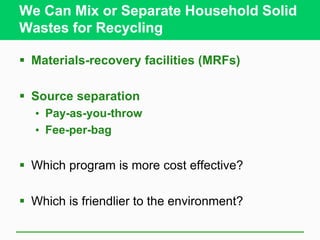
We Can Mix or Separate Household Solid
Wastes for Recycling
 Materials-recovery facilities (MRFs)
 Source separation
• Pay-as-you-throw
• Fee-per-bag
 Which program is more cost effective?
 Which is friendlier to the environment?
We Can Copy Nature and Recycle
Biodegradable Solid Wastes
 Composting
• Individual
• Municipal
 Benefits
 Successful program in Edmonton, Alberta,
Canada
Backyard Composter Drum: Bacteria
Convert Kitchen Waste into Compost
Case Study: Recycling Paper
 Production of paper versus recycled paper
• Energy use
• Water use
• Pollution
 Countries that are recycling
 Replacement of chlorine-based bleaching
chemicals with H2O2 or O2
Case Study: Recycling Plastics (1)
 Plastics: composed of resins
 Most containers discarded: 4% recycled
 Litter: beaches, water
• Significance?
Case Study: Recycling Plastics (2)
 Low plastic recycling rate
• Hard to isolate one type of plastic
• Low yields of plastic
• Cheaper to make it new
Individuals Matter: Mike Biddle’s
Contribution to Recycling Plastics
 Mike Biddle and Trip Allen: MBA Polymers, Inc.
 Leaders in plastic recycling
 Plants in
• U.S.
• China
• Australia
Science Focus: Bioplastics (1)
 Plastics from soybeans: not a new concept
 Key to bioplastics: catalysts
 Sources
• Corn
• Soy
• Sugarcane
Science Focus: Bioplastics (2)
 Sources cont…
• Switchgrass
• Chicken feathers
• Some garbage
• CO2 from coal-burning plant emissions
 Benefits: lighter, stronger, cheaper, and
biodegradable
Recycling Has Advantages and
Disadvantages
 Advantages
 Disadvantages
Trade-Offs: Recycling, Advantages and
Disadvantages
Fig. 21-12, p. 573
TRADE-OFFS
Recycling
Advantages Disadvantages
Reduces air and
water pollution
Can cost more than
burying in areas with
ample landfill space
Saves energy
Reduces mineral
demand May lose money for
items such as glass
and some plastics
Reduces greenhouse
gas emissions
Reduces solid waste
production and disposal Reduces profits for
landfill and
incinerator owners
Helps protect
biodiversity
Can save landfill
space
Source separation is
inconvenient for
some people
Important part of
economy
We Can Encourage Reuse and
Recycling (1)
 What hinders reuse and recycling?
 Encourage reuse and recycling
• Government
• Increase subsidies and tax breaks for using such
products
• Decrease subsidies and tax breaks for making
items from virgin resources
We Can Encourage Reuse and
Recycling (2)
• Fee-per-bag collection
• New laws
• Citizen pressure
21-4 The Advantages and Disadvantages
of Burning or Burying Solid Waste
 Concept 21-4 Technologies for burning and
burying solid wastes are well developed, but
burning contributes to pollution and greenhouse
gas emissions, and buried wastes eventually
contribute to pollution and land degradation.
Burning Solid Waste Has Advantages
and Disadvantages
 Waste-to-energy incinerators
 600 Globally
• Most in Great Britain
 Advantages
 Disadvantages
Solutions: A Waste-to-Energy Incinerator
with Pollution Controls
Fig. 21-13, p. 575
Electricity
Turbine Smokestack
Crane
Steam
Generator
Furnace
Wet
scrubber
Boiler
Electrostatic
precipitator
Waste
pit
Water
added
Ash for treatment,
disposal in landfill, or
use as landfill cover
Trade-Offs: Incineration, Advantages and
Disadvantages
Burying Solid Waste Has Advantages
and Disadvantages
 Open dumps
 Sanitary landfills
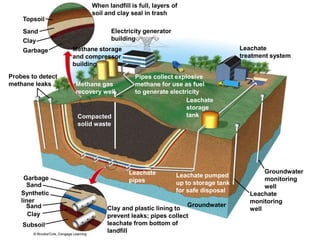
Solutions: State-of-the-Art Sanitary
Landfill
When landfill is full, layers of
soil and clay seal in trash
Topsoil
Sand Electricity generator
building
Clay
Garbage Methane storage
and compressor
building
Leachate
treatment system
Probes to detect
methane leaks
Pipes collect explosive
methane for use as fuel
to generate electricity
Methane gas
recovery well
Leachate
storage
tank
Compacted
solid waste
Leachate
pipes
Garbage Leachate pumped
up to storage tank
for safe disposal
Groundwater
monitoring
well
Sand
Synthetic
liner
Leachate
monitoring
well
Sand Groundwater
Clay
Clay and plastic lining to
prevent leaks; pipes collect
leachate from bottom of
landfill
Subsoil
Trade-Offs: Sanitary Landfills,
Advantages and Disadvantages
Fig. 21-16, p. 576
TRADE-OFFS
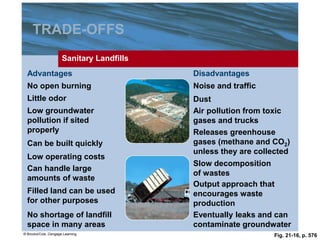
Sanitary Landfills
Advantages Disadvantages
No open burning Noise and traffic
Little odor Dust
Low groundwater
pollution if sited
properly
Air pollution from toxic
gases and trucks
Can be built quickly
Releases greenhouse
gases (methane and CO2)
unless they are collected
Low operating costs
Can handle large
amounts of waste
Slow decomposition
of wastes
Filled land can be used
for other purposes
Output approach that
encourages waste
production
No shortage of landfill
space in many areas
Eventually leaks and can
contaminate groundwater
21-5 How Should We Deal with
Hazardous Waste?
 Concept 21-5 A sustainable approach to
hazardous waste is first to produce less of it,
then to reuse or recycle it, then to convert it to
less hazardous materials, and finally, to safely
store what is left.
We Can Use Integrated Management of
Hazardous Waste
 Integrated management of hazardous wastes
• Produce less
• Convert to less hazardous substances
• Rest in long-term safe storage
 Increased use for postconsumer hazardous
waste
Integrated Hazardous Waste
Management
Fig. 21-17, p. 577
Produce Less
Hazardous Waste
Convert to Less Hazardous or
Nonhazardous Substances
Put in Perpetual
Storage
Change industrial
processes to reduce or
eliminate hazardous
waste production
Natural decomposition Landfill
Incineration Underground
injection wells
Recycle and reuse
hazardous waste
Thermal treatment
Surface
impoundments
Chemical, physical, and
biological treatment
Underground salt
formations
Dilution in air or water
Case Study: Recycling E-Waste
 70% goes to China
• Hazardous working conditions
 Reduce toxic components in electronics
 2008: Basal Action Network
• Instituted e-Stewards Initiative
We Can Detoxify Hazardous Wastes
 Collect and then detoxify
• Physical methods
• Chemical methods
• Use nanomagnets
• Bioremediation
• Phytoremediation
 Incineration
 Using a plasma arc torch
Solutions: Phytoremediation
Trade-Offs: Phytoremediation,
Advantages and Disadvantages
Fig. 21-19, p. 579
TRADE-OFFS
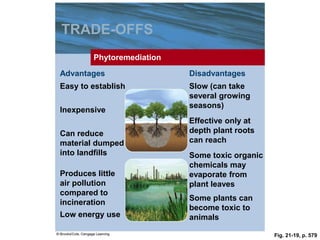
Phytoremediation
Advantages Disadvantages
Easy to establish Slow (can take
several growing
seasons)
Inexpensive
Effective only at
depth plant roots
can reach
Can reduce
material dumped
into landfills Some toxic organic
chemicals may
evaporate from
plant leaves
Produces little
air pollution
compared to
incineration
Some plants can
become toxic to
animals
Low energy use
Trade-Offs: Plasma Arc, Advantages
and Disadvantages
Fig. 21-20, p. 580
TRADE-OFFS
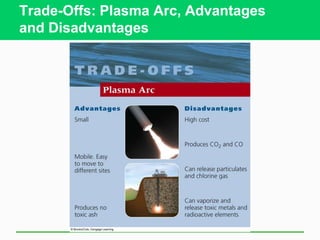
Plasma Arc
Advantages Disadvantages
Small High cost
Produces CO2 and
CO
Mobile. Easy
to move to
different sites Can release
particulates and
chlorine gas
Can vaporize and
release toxic metals
and radioactive
elements
Produces no
toxic ash
We Can Store Some Forms of
Hazardous Waste
 Burial on land or long-term storage
 Deep-well disposal
 Surface impoundments
 Secure hazardous landfills
Trade-Offs: Deep-Well Disposal,
Advantages and Disadvantages
Fig. 21-21, p. 580
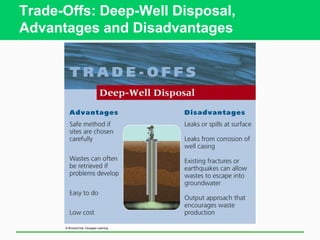
TRADE-OFFS
Deep-Well Disposal
Advantages Disadvantages
Safe method if
sites are chosen
carefully
Leaks or spills at
surface
Leaks from corrosion
of well casing
Wastes can often
be retrieved if
problems develop
Existing fractures or
earthquakes can allow
wastes to escape into
groundwater
Output approach that
encourages waste
production
Easy to do
Low cost
Trade-Offs Surface Impoundments,
Advantages and Disadvantages
Fig. 21-23, p. 581
TRADE-OFFS
Surface Impoundments
Advantages Disadvantages
Low construction
costs
Groundwater
contamination from
leaking liners (or no
lining)
Low operating
costs
Air pollution from
volatile organic
compounds
Can be built
quickly
Overflow from
flooding
Wastes can often
be retrieved if
necessary Disruption and
leakage from
earthquakes
Can store wastes
indefinitely with
secure double
liners
Output approach that
encourages waste
production
Solutions: Secure Hazardous
Waste Landfill
Fig. 21-24, p. 582
Bulk
waste
Gas
vent
Topsoil
Earth
Plastic cover
Sand Impervious
clay cap
Clay
cap
Impervious
clay
Water
table
Earth
Leak
detection
system
Groundwater
Double leachate
collection system
Plastic
double
liner
Reactive
wastes
in drums
Groundwater
monitoring
well
What Can You Do? Hazardous Waste
Case Study: Hazardous Waste
Regulation in the United States
 1976: Resource Conservation and Recovery Act
(RCRA)
 1980: Comprehensive Environmental,
Compensation, and Liability Act (CERCLA), or
Superfund
• Pace of cleanup has slowed
• Superfund is broke
 Laws encouraging the cleanup of brownfields
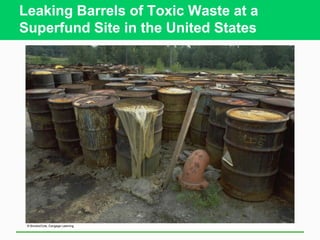
Leaking Barrels of Toxic Waste at a
Superfund Site in the United States
21-6 How Can We Make the Transition to
a More Sustainable Low-Waste Society?
 Concept 21-6 Shifting to a low-waste society
requires individuals and businesses to reduce
resource use and to reuse and recycle wastes at
local, national, and global levels.
Grassroots Action Has Led to Better
Solid and Hazardous Waste Management
 “Not in my backyard”
 Produce less waste
• “Not in anyone’s backyard”
• “Not on planet Earth”
Providing Environmental Justice for
Everyone Is an Important Goal
 Environmental Justice
 Which communities in the U.S. have the largest
share of hazardous waster dumps?
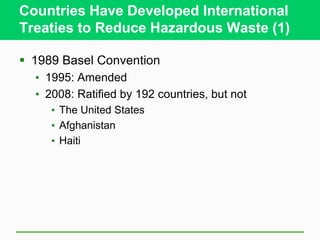
Countries Have Developed International
Treaties to Reduce Hazardous Waste (1)
 1989 Basel Convention
• 1995: Amended
• 2008: Ratified by 192 countries, but not
• The United States
• Afghanistan
• Haiti
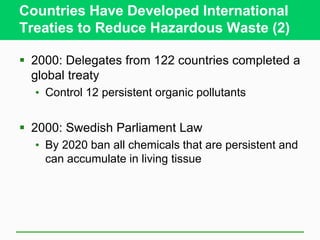
Countries Have Developed International
Treaties to Reduce Hazardous Waste (2)
 2000: Delegates from 122 countries completed a
global treaty
• Control 12 persistent organic pollutants
 2000: Swedish Parliament Law
• By 2020 ban all chemicals that are persistent and
can accumulate in living tissue
We Can Make the Transition to
Low-Waste Societies
 Norway, Austria, and the Netherlands
• Committed to reduce resource waste by 75%
 East Hampton, NY, U.S.
• Reduced solid waste by 85%
 Follow guidelines to prevent pollution and
reduce waste

e waste.ppt

  • 1.
  • 2.
    Core Case Study:E-waste—An Exploding Problem (1)  Electronic waste, e-waste: fastest growing solid waste problem  Composition includes • High-quality plastics • Valuable metals • Toxic and hazardous pollutants
  • 3.
    Core Case Study:E-waste—An Exploding Problem (2)  Shipped to other countries • What happens in China?  International Basel Convention • Bans transferring hazardous wastes from developed countries to developing countries  European Union • Cradle-to-grave approach
  • 4.
    Core Case Study:E-waste—An Exploding Problem (3)  What should be done? • Recycle • E-cycle • Reuse • Prevention approach: remove the toxic materials
  • 5.
    Rapidly Growing E-Wastefrom Discarded Computers and Other Electronics
  • 6.
    21-1 What AreSolid Waste and Hazardous Waste, and Why Are They Problems?  Concept 21-1 Solid waste represents pollution and unnecessary waste of resources, and hazardous waste contributes to pollution, natural capital degradation, health problems, and premature deaths.
  • 7.
    We Throw AwayHuge Amounts of Useful Things and Hazardous Materials (1)  Solid waste • Industrial solid • Municipal solid waste (MSW) • Hazardous, toxic, waste  Hazardous wastes • Organic compounds • Toxic heavy metals • Radioactive waste
  • 8.
    We Throw AwayHuge Amounts of Useful Things and Hazardous Materials (2)  80–90% of hazardous wastes produced by developed countries  Why reduce solid wastes? • ¾ of the materials are an unnecessary waste of the earth's resources • Huge amounts of air pollution, greenhouse gases, and water pollution
  • 9.
    What Harmful ChemicalsAre in Your Home?
  • 10.
    Fig. 21-2, p.562 What Harmful Chemicals Are in Your Home? Cleaning Gardening Disinfectants Pesticides Drain, toilet, and window cleaners Weed killers Ant and rodent killers Spot removers Flea powders Septic tank cleaners Paint Products Paints, stains, varnishes, and lacquers Paint thinners, solvents, and strippers Wood preservatives Automotive Artist paints and inks Gasoline Used motor oil General Antifreeze Dry-cell batteries (mercury and cadmium) Battery acid Brake and transmission fluid Glues and cements
  • 11.
    Fig. 21-2, p.562 What Harmful Chemicals Are in Your Home? Cleaning Disinfectants Drain, toilet, and window cleaners Spot removers Septic tank cleaners Paint Products Paints, stains, varnishes, and lacquers Paint thinners, solvents, and strippers Wood preservatives Artist paints and inks Gardening Pesticides Weed killers Ant and rodent killers Flea powders General Dry-cell batteries (mercury and cadmium) Glues and cements Automotive Gasoline Used motor oil Antifreeze Battery acid Brake and transmission fluid Stepped Art
  • 12.
    Solid Waste  Leaderin solid waste problem • What is thrown away?  Leader in trash production, by weight, per person  Recycling is helping
  • 13.
    21-2 How ShouldWe Deal with Solid Waste?  Concept 21-2 A sustainable approach to solid waste is first to reduce it, then to reuse or recycle it, and finally to safely dispose of what is left.
  • 14.
    We Can Burnor Bury Solid Waste or Produce Less of It  Waste Management  Waste Reduction  Integrated waste management • Uses a variety of strategies
  • 15.
  • 16.
    Fig. 21-5, p.565 Raw materials Processing and manufacturing Products Solid and hazardous wastes generated during the manufacturing process Waste generated by households and businesses Food/yard waste Hazardous waste Remaining mixed waste Plastic Glass Metal Paper To manufacturers for reuse or for recycling Compost Hazardous waste management Landfill Incinerator Fertilizer
  • 17.
    Integrated Waste Management:Priorities for Dealing with Solid Waste
  • 18.
    Fig. 21-6, p.565 First Priority Second Priority Last Priority Primary Pollution and Waste Prevention Secondary Pollution and Waste Prevention Waste Management Change industrial process to eliminate use of harmful chemicals Reuse Treat waste to reduce toxicity Repair Incinerate waste Use less of a harmful product Recycle Bury waste in landfills Reduce packaging and materials in products Compost Release waste into environment for dispersal or dilution Make products that last longer and are recyclable, reusable, or easy to repair Buy reusable and recyclable products
  • 19.
    Fig. 21-6, p.565 Use less of a harmful product Last Priority Waste Management Treat waste to reduce toxicity Incinerate waste Bury waste in landfills Release waste into environment for dispersal or dilution First Priority Primary Pollution and Waste Prevention Change industrial process to eliminate use of harmful chemicals Reduce packaging and materials in products Make products that last longer and are recyclable, reusable, or easy to repair Second Priority Secondary Pollution and Waste Prevention Reuse Repair Recycle Compost Buy reusable and recyclable products Stepped Art
  • 20.
    Science Focus: Garbology William Rathje: analyzes garbage in landfills  Landfills and trash decomposition
  • 21.
    We Can CutSolid Wastes by Reducing, Reusing, and Recycling (1)  Waste reduction is based on • Reduce • Reuse • Recycle  Seven strategies: (1) Redesign manufacturing processes and products to use less material and energy (2) Redesign manufacturing processes to produce less waste and pollution
  • 22.
    We Can CutSolid Wastes by Reducing, Reusing, and Recycling (2)  Seven strategies cont… (3) Develop products that are easy to repair, reuse, remanufacture, compost, or recycle (4) Eliminate or reduce unnecessary packaging (5) Use fee-per-bag waste collection systems (6) Establish cradle-to grave responsibility (7) Restructure urban transportation systems
  • 23.
    What Can YouDo? Solid Waste
  • 24.
    21-3 Why IsReusing and Recycling Materials So Important?  Concept 21-3 Reusing items decreases the use of matter and energy resources and reduces pollution and natural capital degradation; recycling does so to a lesser degree.
  • 25.
    Reuse: Important Wayto Reduce Solid Waste, Pollution and to Save Money  Reuse: clean and use materials over and over  Downside of reuse in developing countries  Salvaging automobiles parts  Rechargeable batteries
  • 26.
    Case Study: Useof Refillable Containers  Reuse and recycle • Refillable glass beverage bottles • Refillable soft drink bottles made of polyethylene terephthalate (PET) plastic  Paper, plastic, or reusable cloth bags • Pros • Cons
  • 27.
    Energy Consumption Involvedwith Using Different Types of 350 ml Containers
  • 28.
    Fig. 21-8, p.568 Aluminum can, used once Steel can, used once Recycled steel can Glass drink bottle, used once Recycled aluminum can Recycled glass drink bottle Refillable drink bottle, used 10 times 0 8 16 24 32 Energy (thousands of kilocalories)
  • 29.
    What Can YouDo? Reuse
  • 30.
    There Are TwoTypes of Recycling (1)  Primary, closed-loop recycling  Secondary recycling  Types of wastes that can be recycled • Preconsumer: internal waste • Postconsumer: external waste
  • 31.
    There Are TwoTypes of Recycling (2)  Do items actually get recycled?  What are the numbers?  Will the consumer buy recycled goods?
  • 32.
    We Can Mixor Separate Household Solid Wastes for Recycling  Materials-recovery facilities (MRFs)  Source separation • Pay-as-you-throw • Fee-per-bag  Which program is more cost effective?  Which is friendlier to the environment?
  • 33.
    We Can CopyNature and Recycle Biodegradable Solid Wastes  Composting • Individual • Municipal  Benefits  Successful program in Edmonton, Alberta, Canada
  • 34.
    Backyard Composter Drum:Bacteria Convert Kitchen Waste into Compost
  • 35.
    Case Study: RecyclingPaper  Production of paper versus recycled paper • Energy use • Water use • Pollution  Countries that are recycling  Replacement of chlorine-based bleaching chemicals with H2O2 or O2
  • 36.
    Case Study: RecyclingPlastics (1)  Plastics: composed of resins  Most containers discarded: 4% recycled  Litter: beaches, water • Significance?
  • 37.
    Case Study: RecyclingPlastics (2)  Low plastic recycling rate • Hard to isolate one type of plastic • Low yields of plastic • Cheaper to make it new
  • 38.
    Individuals Matter: MikeBiddle’s Contribution to Recycling Plastics  Mike Biddle and Trip Allen: MBA Polymers, Inc.  Leaders in plastic recycling  Plants in • U.S. • China • Australia
  • 39.
    Science Focus: Bioplastics(1)  Plastics from soybeans: not a new concept  Key to bioplastics: catalysts  Sources • Corn • Soy • Sugarcane
  • 40.
    Science Focus: Bioplastics(2)  Sources cont… • Switchgrass • Chicken feathers • Some garbage • CO2 from coal-burning plant emissions  Benefits: lighter, stronger, cheaper, and biodegradable
  • 41.
    Recycling Has Advantagesand Disadvantages  Advantages  Disadvantages
  • 42.
  • 43.
    Fig. 21-12, p.573 TRADE-OFFS Recycling Advantages Disadvantages Reduces air and water pollution Can cost more than burying in areas with ample landfill space Saves energy Reduces mineral demand May lose money for items such as glass and some plastics Reduces greenhouse gas emissions Reduces solid waste production and disposal Reduces profits for landfill and incinerator owners Helps protect biodiversity Can save landfill space Source separation is inconvenient for some people Important part of economy
  • 44.
    We Can EncourageReuse and Recycling (1)  What hinders reuse and recycling?  Encourage reuse and recycling • Government • Increase subsidies and tax breaks for using such products • Decrease subsidies and tax breaks for making items from virgin resources
  • 45.
    We Can EncourageReuse and Recycling (2) • Fee-per-bag collection • New laws • Citizen pressure
  • 46.
    21-4 The Advantagesand Disadvantages of Burning or Burying Solid Waste  Concept 21-4 Technologies for burning and burying solid wastes are well developed, but burning contributes to pollution and greenhouse gas emissions, and buried wastes eventually contribute to pollution and land degradation.
  • 47.
    Burning Solid WasteHas Advantages and Disadvantages  Waste-to-energy incinerators  600 Globally • Most in Great Britain  Advantages  Disadvantages
  • 48.
    Solutions: A Waste-to-EnergyIncinerator with Pollution Controls
  • 49.
    Fig. 21-13, p.575 Electricity Turbine Smokestack Crane Steam Generator Furnace Wet scrubber Boiler Electrostatic precipitator Waste pit Water added Ash for treatment, disposal in landfill, or use as landfill cover
  • 50.
  • 51.
    Burying Solid WasteHas Advantages and Disadvantages  Open dumps  Sanitary landfills
  • 52.
  • 53.
    When landfill isfull, layers of soil and clay seal in trash Topsoil Sand Electricity generator building Clay Garbage Methane storage and compressor building Leachate treatment system Probes to detect methane leaks Pipes collect explosive methane for use as fuel to generate electricity Methane gas recovery well Leachate storage tank Compacted solid waste Leachate pipes Garbage Leachate pumped up to storage tank for safe disposal Groundwater monitoring well Sand Synthetic liner Leachate monitoring well Sand Groundwater Clay Clay and plastic lining to prevent leaks; pipes collect leachate from bottom of landfill Subsoil
  • 54.
  • 55.
    Fig. 21-16, p.576 TRADE-OFFS Sanitary Landfills Advantages Disadvantages No open burning Noise and traffic Little odor Dust Low groundwater pollution if sited properly Air pollution from toxic gases and trucks Can be built quickly Releases greenhouse gases (methane and CO2) unless they are collected Low operating costs Can handle large amounts of waste Slow decomposition of wastes Filled land can be used for other purposes Output approach that encourages waste production No shortage of landfill space in many areas Eventually leaks and can contaminate groundwater
  • 56.
    21-5 How ShouldWe Deal with Hazardous Waste?  Concept 21-5 A sustainable approach to hazardous waste is first to produce less of it, then to reuse or recycle it, then to convert it to less hazardous materials, and finally, to safely store what is left.
  • 57.
    We Can UseIntegrated Management of Hazardous Waste  Integrated management of hazardous wastes • Produce less • Convert to less hazardous substances • Rest in long-term safe storage  Increased use for postconsumer hazardous waste
  • 58.
  • 59.
    Fig. 21-17, p.577 Produce Less Hazardous Waste Convert to Less Hazardous or Nonhazardous Substances Put in Perpetual Storage Change industrial processes to reduce or eliminate hazardous waste production Natural decomposition Landfill Incineration Underground injection wells Recycle and reuse hazardous waste Thermal treatment Surface impoundments Chemical, physical, and biological treatment Underground salt formations Dilution in air or water
  • 60.
    Case Study: RecyclingE-Waste  70% goes to China • Hazardous working conditions  Reduce toxic components in electronics  2008: Basal Action Network • Instituted e-Stewards Initiative
  • 61.
    We Can DetoxifyHazardous Wastes  Collect and then detoxify • Physical methods • Chemical methods • Use nanomagnets • Bioremediation • Phytoremediation  Incineration  Using a plasma arc torch
  • 62.
  • 63.
  • 64.
    Fig. 21-19, p.579 TRADE-OFFS Phytoremediation Advantages Disadvantages Easy to establish Slow (can take several growing seasons) Inexpensive Effective only at depth plant roots can reach Can reduce material dumped into landfills Some toxic organic chemicals may evaporate from plant leaves Produces little air pollution compared to incineration Some plants can become toxic to animals Low energy use
  • 65.
    Trade-Offs: Plasma Arc,Advantages and Disadvantages
  • 66.
    Fig. 21-20, p.580 TRADE-OFFS Plasma Arc Advantages Disadvantages Small High cost Produces CO2 and CO Mobile. Easy to move to different sites Can release particulates and chlorine gas Can vaporize and release toxic metals and radioactive elements Produces no toxic ash
  • 67.
    We Can StoreSome Forms of Hazardous Waste  Burial on land or long-term storage  Deep-well disposal  Surface impoundments  Secure hazardous landfills
  • 68.
  • 69.
    Fig. 21-21, p.580 TRADE-OFFS Deep-Well Disposal Advantages Disadvantages Safe method if sites are chosen carefully Leaks or spills at surface Leaks from corrosion of well casing Wastes can often be retrieved if problems develop Existing fractures or earthquakes can allow wastes to escape into groundwater Output approach that encourages waste production Easy to do Low cost
  • 70.
  • 71.
    Fig. 21-23, p.581 TRADE-OFFS Surface Impoundments Advantages Disadvantages Low construction costs Groundwater contamination from leaking liners (or no lining) Low operating costs Air pollution from volatile organic compounds Can be built quickly Overflow from flooding Wastes can often be retrieved if necessary Disruption and leakage from earthquakes Can store wastes indefinitely with secure double liners Output approach that encourages waste production
  • 72.
  • 73.
    Fig. 21-24, p.582 Bulk waste Gas vent Topsoil Earth Plastic cover Sand Impervious clay cap Clay cap Impervious clay Water table Earth Leak detection system Groundwater Double leachate collection system Plastic double liner Reactive wastes in drums Groundwater monitoring well
  • 74.
    What Can YouDo? Hazardous Waste
  • 75.
    Case Study: HazardousWaste Regulation in the United States  1976: Resource Conservation and Recovery Act (RCRA)  1980: Comprehensive Environmental, Compensation, and Liability Act (CERCLA), or Superfund • Pace of cleanup has slowed • Superfund is broke  Laws encouraging the cleanup of brownfields
  • 76.
    Leaking Barrels ofToxic Waste at a Superfund Site in the United States
  • 77.
    21-6 How CanWe Make the Transition to a More Sustainable Low-Waste Society?  Concept 21-6 Shifting to a low-waste society requires individuals and businesses to reduce resource use and to reuse and recycle wastes at local, national, and global levels.
  • 78.
    Grassroots Action HasLed to Better Solid and Hazardous Waste Management  “Not in my backyard”  Produce less waste • “Not in anyone’s backyard” • “Not on planet Earth”
  • 79.
    Providing Environmental Justicefor Everyone Is an Important Goal  Environmental Justice  Which communities in the U.S. have the largest share of hazardous waster dumps?
  • 80.
    Countries Have DevelopedInternational Treaties to Reduce Hazardous Waste (1)  1989 Basel Convention • 1995: Amended • 2008: Ratified by 192 countries, but not • The United States • Afghanistan • Haiti
  • 81.
    Countries Have DevelopedInternational Treaties to Reduce Hazardous Waste (2)  2000: Delegates from 122 countries completed a global treaty • Control 12 persistent organic pollutants  2000: Swedish Parliament Law • By 2020 ban all chemicals that are persistent and can accumulate in living tissue
  • 82.
    We Can Makethe Transition to Low-Waste Societies  Norway, Austria, and the Netherlands • Committed to reduce resource waste by 75%  East Hampton, NY, U.S. • Reduced solid waste by 85%  Follow guidelines to prevent pollution and reduce waste

Editor's Notes

  • #11 Figure 21.2 Harmful chemicals found in many homes. The U.S. Congress has exempted disposal of these materials from government regulation. Question: Which of these chemicals are in your home?
  • #12 Figure 21.2 Harmful chemicals found in many homes. The U.S. Congress has exempted disposal of these materials from government regulation. Question: Which of these chemicals are in your home?
  • #17 Figure 21.5 Integrated waste management: wastes are reduced through recycling, reuse, and composting or managed by burying them in landfills or incinerating them. Most countries rely primarily on burial and incineration. Question: What happens to the solid waste you produce?
  • #19 Figure 21.6 Integrated waste management: priorities suggested by the U.S. National Academy of Sciences for dealing with solid waste. To date, these waste reduction priorities have not been followed in the United States or in most other countries. Instead, most efforts are devoted to waste management (bury it or burn it). Question: Why do you think most countries do not follow these priorities, even though they are based on reliable science? (Data from U.S. Environmental Protection Agency and U.S. National Academy of Sciences)
  • #20 Figure 21.6 Integrated waste management: priorities suggested by the U.S. National Academy of Sciences for dealing with solid waste. To date, these waste reduction priorities have not been followed in the United States or in most other countries. Instead, most efforts are devoted to waste management (bury it or burn it). Question: Why do you think most countries do not follow these priorities, even though they are based on reliable science? (Data from U.S. Environmental Protection Agency and U.S. National Academy of Sciences)
  • #29 Figure 21.8 Energy consumption involved with using different types of 350-milliliter (12-fluid-ounce) beverage containers. (Data from Argonne National Laboratory)
  • #44 Figure 21.12 Advantages and disadvantages of recycling solid waste (Concept 21-3). Question: Which single advantage and which single disadvantage do you think are the most important? Why?
  • #50 Figure 21.13 Solutions: a waste-to-energy incinerator with pollution controls. It burns mixed solid wastes and recovers some of the energy to produce steam used for heating or producing electricity. Question: Would you invest in such a project? Why or why not?
  • #54 Figure 21.15 Solutions: state-of-the-art sanitary landfill, which is designed to eliminate or minimize environmental problems that plague older landfills. Since 1997, only modern sanitary landfills are allowed in the United States. As a result, many small, older local landfills have been closed and replaced with larger regional landfills. Question: How do you think sanitary landfills could develop leaks of toxic liquids?
  • #56 Figure 21.16 Advantages and disadvantages of using sanitary landfills to dispose of solid waste (Concept 21-4). Question: Which single advantage and which single disadvantage do you think are the most important? Why?
  • #60 Figure 21.17 Integrated hazardous waste management: priorities suggested by the U.S. National Academy of Sciences for dealing with hazardous waste (Concept 21-5). To date, these priorities have not been followed in the United States and in most other countries. Question: Why do you think that most countries do not follow these priorities? (Data from U.S. National Academy of Sciences)
  • #65 Figure 21.19 Advantages and disadvantages of using phytoremediation to remove or detoxify hazardous waste. Question: Which single advantage and which single disadvantage do you think are the most important? Why?
  • #67 Figure 21.20 Advantages and disadvantages of using a plasma arc torch to detoxify hazardous wastes. Question: Which single advantage and which single disadvantage do you think are the most important? Why?
  • #70 Figure 21.21 Advantages and disadvantages of injecting liquid hazardous wastes into deep underground wells. Question: Which single advantage and which single disadvantage do you think are the most important? Why?
  • #72 Figure 21.23 Advantages and disadvantages of storing liquid hazardous wastes in surface impoundments. Question: Which single advantage and which single disadvantage do you think are the most important? Why?
  • #74 Figure 21.24 Solutions: secure hazardous waste landfill.