Plastic waste
Presented by
Edy Kurniawan
Arofah Laemoh
722-593 Current Issues in Applied Biology
Outline
Introduction of plastics
Type of plastics
Category of plastics
Source plastics waste materials
Effect to environmental
Management of plastics waste
Trend of future plastics waste
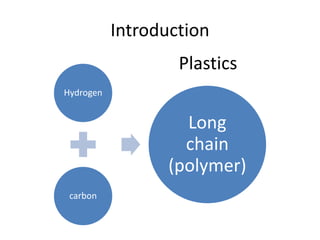
Basic information about plastics
Plastic is one of the most used and widespread materials
globally
Plastic covers a range of synthetic or semisynthetic
polymerization products
Plastic is the hydrocarbon compounds
Plastic causing environmental problems and human
health
Source: Krüger,et al., 2016
1
History of plastic
 Plastics started to be developed around 100 years ago
with the use of natural materials (chewing gum,
shellac)
 The development of chemically modified natural
materials (rubber, nitrocellulose, collagen)
 Parks (1862) the first example is found cellulose
nitrate name it “Parkesine”
 Baekeland (1907) have succeeded in doing synthetic
polymer (plastic) first
Source: อรสา, 2006
2
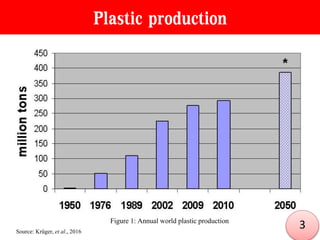
Plastic production
Figure 1: Annual world plastic production
Source: Krüger,et al., 2016
3
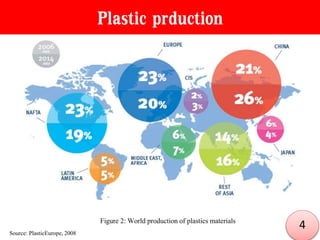
Plastic prduction
Figure 2: World productionof plasticsmaterials
Source: PlasticEurope,2008
4
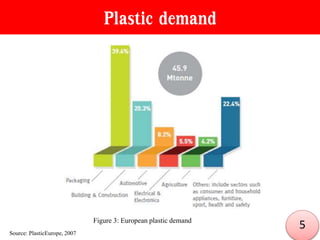
Plastic demand
Figure 3: European plastic demand
Source: PlasticEurope,2007
5
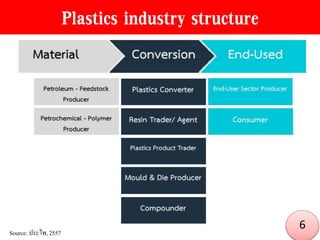
Plastics industry structure
Source: ประไพ, 2557
6
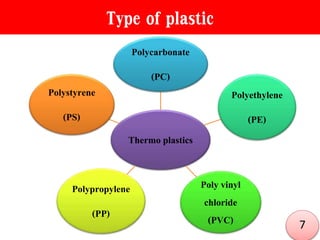
Type of plastic
Thermo plastics
Polycarbonate
(PC)
Polyethylene
(PE)
Poly vinyl
chloride
(PVC)
Polypropylene
(PP)
Polystyrene
(PS)
7
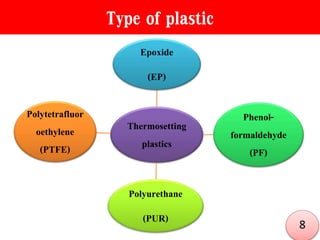
Type of plastic
Thermosetting
plastics
Epoxide
(EP)
Phenol-
formaldehyde
(PF)
Polyurethane
(PUR)
Polytetrafluor
oethylene
(PTFE)
8
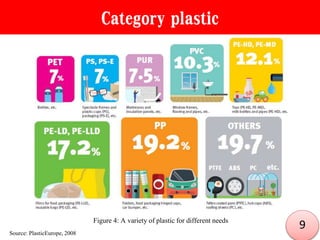
Category plastic
Figure 4: A variety ofplastic for different needs
Source: PlasticEurope,2008
9
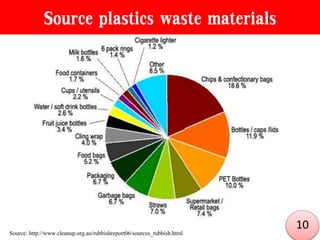
Source plastics waste materials
Source: http://www.cleanup.org.au/rubbishreport06/sources_rubbish.html
10
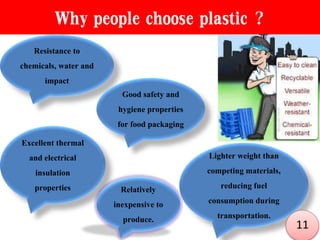
Why people choose plastic ?
Resistance to
chemicals, water and
impact
Good safety and
hygiene properties
for food packaging
Excellent thermal
and electrical
insulation
properties Relatively
inexpensive to
produce.
Lighter weight than
competing materials,
reducing fuel
consumption during
transportation.
11
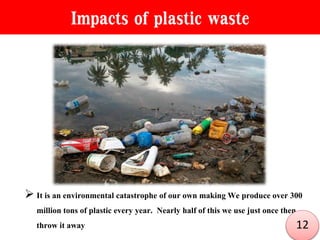
Impacts of plastic waste
 It is an environmental catastrophe of our own making We produce over 300
million tons of plastic every year. Nearly half of this we use just once then
throw it away 12
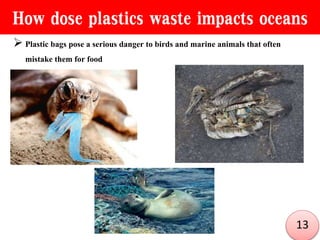
How dose plastics waste impacts oceans
 Plastic bags pose a serious danger to birds and marine animals that often
mistake them for food

13
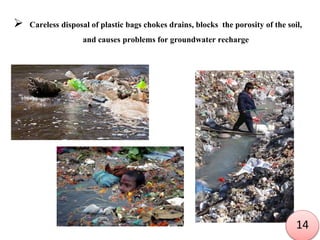
 Careless disposal of plastic bags chokes drains, blocks the porosity of the soil,
and causes problems for groundwater recharge
14
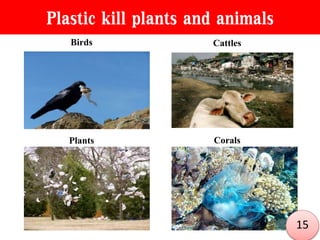
Plastic kill plants and animals
Cattles
Plants
Birds
Corals
15
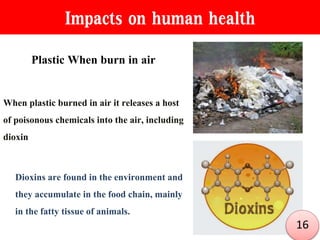
Impacts on human health
Plastic When burn in air
When plastic burned in air it releases a host
of poisonous chemicals into the air, including
dioxin
Dioxins are found in the environment and
they accumulate in the food chain, mainly
in the fatty tissue of animals.
16
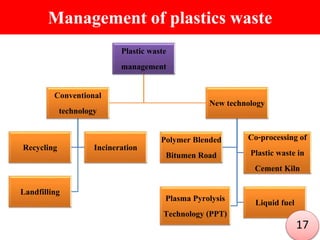
Management of plastics waste
Plastic waste
management
Conventional
technology
Recycling Incineration
Landfilling
New technology
Polymer Blended
Bitumen Road
Co-processing of
Plastic waste in
Cement Kiln
Plasma Pyrolysis
Technology (PPT)
Liquid fuel
17
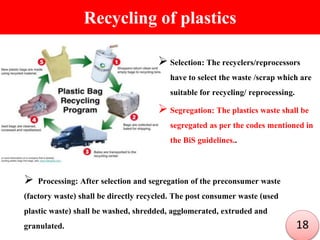
Recycling of plastics
 Selection: The recyclers/reprocessors
have to select the waste /scrap which are
suitable for recycling/ reprocessing.
 Segregation: The plastics waste shall be
segregated as per the codes mentioned in
the BiS guidelines..
 Processing: After selection and segregation of the preconsumer waste
(factory waste) shall be directly recycled. The post consumer waste (used
plastic waste) shall be washed, shredded, agglomerated, extruded and
granulated. 18
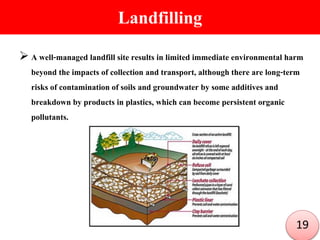
Landfilling
 A well-managed landfill site results in limited immediate environmental harm
beyond the impacts of collection and transport, although there are long-term
risks of contamination of soils and groundwater by some additives and
breakdown by products in plastics, which can become persistent organic
pollutants.
19
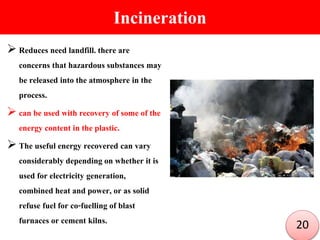
Incineration
 Reduces need landfill. there are
concerns that hazardous substances may
be released into the atmosphere in the
process.
 can be used with recovery of some of the
energy content in the plastic.
 The useful energy recovered can vary
considerably depending on whether it is
used for electricity generation,
combined heat and power, or as solid
refuse fuel for co-fuelling of blast
furnaces or cement kilns. 20
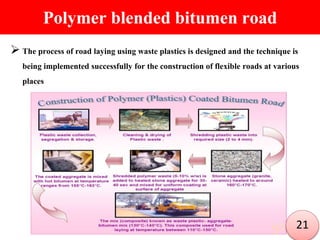
Polymer blended bitumen road
 The process of road laying using waste plastics is designed and the technique is
being implemented successfully for the construction of flexible roads at various
places
21
Co-processing of Plastic waste in Cement Kiln
 Co-processing of plastic waste as Alternative Fuel and Raw Material (AFR).
 Co-processing indicate substitution of primary fuel and raw material by waste.
 Waste material such as plastic waste used for co-processing are referred to as
alternative fuels and raw material (AFR).
 One of the advantage of recovery method used in existing facility is eliminating
the need to invest on other plastic waste practices and to secure land filling.
22
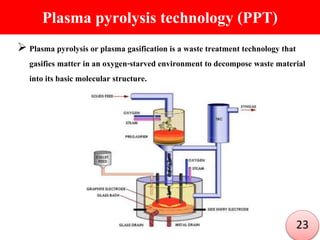
Plasma pyrolysis technology (PPT)
 Plasma pyrolysis or plasma gasification is a waste treatment technology that
gasifies matter in an oxygen-starved environment to decompose waste material
into its basic molecular structure.
23
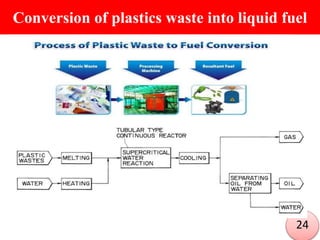
24
Conversion of plastics waste into liquid fuel
Reference
ประไพ นาธวัช. 2557. สถานการณ์และแนวโน้มอุตสาหกรรมพลาสติกไทย. สถาบันปิโตรเลียมแห่งประเทศ
ไทย. หน้า 43.
อรสา อ่อนจันทร์. 2549. มหัศจรรย์พลาสติก. Available online: http://www.vcharkarn.com/varticle/331
[23/02/2560]
Krüger, S., Petrat, P., Popat, E., Garg, B. and Abraham, A.K. 2016. Plastic flows in a worldwide
context. Faculty of environmental scinces, Technische universitat dgesden. pp. 32.
Plasticseurope. 2007. The Compelling Facts About Plastics. An analysis of plastics pro-duction,
demand and recovery. PlasticsEurope: Belgium.
Plasticseurope. 2008. The compelling facts about plastics. An analysis of plastics produc-tion,
demand and recovery for 2006 in Europe. PlasticsEurope: Belgium.
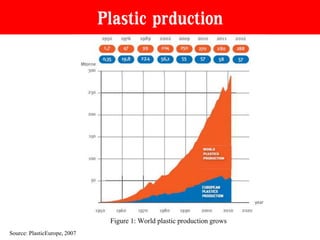
Plastic prduction
Figure 1: World plastic productiongrows
Source: PlasticEurope,2007
Introduction
Hydrogen
carbon
Long
chain
(polymer)
Plastics
Introduction
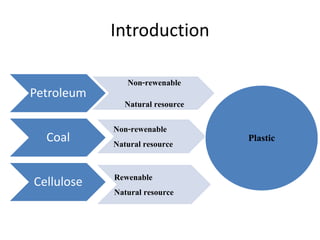
Petroleum
Non-rewenable
Natural resource
Coal
Cellulose
Non-rewenable
Natural resource
Rewenable
Natural resource
Plastic
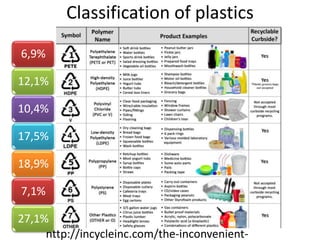
Classification of plastics
http://incycleinc.com/the-inconvenient-
6,9%
12,1%
10,4%
17,5%
18,9%
7,1%
27,1%

Plastic waste management

  • 1.
    Plastic waste Presented by EdyKurniawan Arofah Laemoh 722-593 Current Issues in Applied Biology
  • 2.
    Outline Introduction of plastics Typeof plastics Category of plastics Source plastics waste materials Effect to environmental Management of plastics waste Trend of future plastics waste
  • 3.
    Basic information aboutplastics Plastic is one of the most used and widespread materials globally Plastic covers a range of synthetic or semisynthetic polymerization products Plastic is the hydrocarbon compounds Plastic causing environmental problems and human health Source: Krüger,et al., 2016 1
  • 4.
    History of plastic Plastics started to be developed around 100 years ago with the use of natural materials (chewing gum, shellac)  The development of chemically modified natural materials (rubber, nitrocellulose, collagen)  Parks (1862) the first example is found cellulose nitrate name it “Parkesine”  Baekeland (1907) have succeeded in doing synthetic polymer (plastic) first Source: อรสา, 2006 2
  • 5.
    Plastic production Figure 1:Annual world plastic production Source: Krüger,et al., 2016 3
  • 6.
    Plastic prduction Figure 2:World productionof plasticsmaterials Source: PlasticEurope,2008 4
  • 7.
    Plastic demand Figure 3:European plastic demand Source: PlasticEurope,2007 5
  • 8.
    Plastics industry structure Source:ประไพ, 2557 6
  • 9.
    Type of plastic Thermoplastics Polycarbonate (PC) Polyethylene (PE) Poly vinyl chloride (PVC) Polypropylene (PP) Polystyrene (PS) 7
  • 10.
  • 11.
    Category plastic Figure 4:A variety ofplastic for different needs Source: PlasticEurope,2008 9
  • 12.
    Source plastics wastematerials Source: http://www.cleanup.org.au/rubbishreport06/sources_rubbish.html 10
  • 13.
    Why people chooseplastic ? Resistance to chemicals, water and impact Good safety and hygiene properties for food packaging Excellent thermal and electrical insulation properties Relatively inexpensive to produce. Lighter weight than competing materials, reducing fuel consumption during transportation. 11
  • 14.
    Impacts of plasticwaste  It is an environmental catastrophe of our own making We produce over 300 million tons of plastic every year. Nearly half of this we use just once then throw it away 12
  • 15.
    How dose plasticswaste impacts oceans  Plastic bags pose a serious danger to birds and marine animals that often mistake them for food  13
  • 16.
     Careless disposalof plastic bags chokes drains, blocks the porosity of the soil, and causes problems for groundwater recharge 14
  • 17.
    Plastic kill plantsand animals Cattles Plants Birds Corals 15
  • 18.
    Impacts on humanhealth Plastic When burn in air When plastic burned in air it releases a host of poisonous chemicals into the air, including dioxin Dioxins are found in the environment and they accumulate in the food chain, mainly in the fatty tissue of animals. 16
  • 19.
    Management of plasticswaste Plastic waste management Conventional technology Recycling Incineration Landfilling New technology Polymer Blended Bitumen Road Co-processing of Plastic waste in Cement Kiln Plasma Pyrolysis Technology (PPT) Liquid fuel 17
  • 20.
    Recycling of plastics Selection: The recyclers/reprocessors have to select the waste /scrap which are suitable for recycling/ reprocessing.  Segregation: The plastics waste shall be segregated as per the codes mentioned in the BiS guidelines..  Processing: After selection and segregation of the preconsumer waste (factory waste) shall be directly recycled. The post consumer waste (used plastic waste) shall be washed, shredded, agglomerated, extruded and granulated. 18
  • 21.
    Landfilling  A well-managedlandfill site results in limited immediate environmental harm beyond the impacts of collection and transport, although there are long-term risks of contamination of soils and groundwater by some additives and breakdown by products in plastics, which can become persistent organic pollutants. 19
  • 22.
    Incineration  Reduces needlandfill. there are concerns that hazardous substances may be released into the atmosphere in the process.  can be used with recovery of some of the energy content in the plastic.  The useful energy recovered can vary considerably depending on whether it is used for electricity generation, combined heat and power, or as solid refuse fuel for co-fuelling of blast furnaces or cement kilns. 20
  • 23.
    Polymer blended bitumenroad  The process of road laying using waste plastics is designed and the technique is being implemented successfully for the construction of flexible roads at various places 21
  • 24.
    Co-processing of Plasticwaste in Cement Kiln  Co-processing of plastic waste as Alternative Fuel and Raw Material (AFR).  Co-processing indicate substitution of primary fuel and raw material by waste.  Waste material such as plastic waste used for co-processing are referred to as alternative fuels and raw material (AFR).  One of the advantage of recovery method used in existing facility is eliminating the need to invest on other plastic waste practices and to secure land filling. 22
  • 25.
    Plasma pyrolysis technology(PPT)  Plasma pyrolysis or plasma gasification is a waste treatment technology that gasifies matter in an oxygen-starved environment to decompose waste material into its basic molecular structure. 23
  • 26.
    24 Conversion of plasticswaste into liquid fuel
  • 27.
    Reference ประไพ นาธวัช. 2557.สถานการณ์และแนวโน้มอุตสาหกรรมพลาสติกไทย. สถาบันปิโตรเลียมแห่งประเทศ ไทย. หน้า 43. อรสา อ่อนจันทร์. 2549. มหัศจรรย์พลาสติก. Available online: http://www.vcharkarn.com/varticle/331 [23/02/2560] Krüger, S., Petrat, P., Popat, E., Garg, B. and Abraham, A.K. 2016. Plastic flows in a worldwide context. Faculty of environmental scinces, Technische universitat dgesden. pp. 32. Plasticseurope. 2007. The Compelling Facts About Plastics. An analysis of plastics pro-duction, demand and recovery. PlasticsEurope: Belgium. Plasticseurope. 2008. The compelling facts about plastics. An analysis of plastics produc-tion, demand and recovery for 2006 in Europe. PlasticsEurope: Belgium.
  • 28.
    Plastic prduction Figure 1:World plastic productiongrows Source: PlasticEurope,2007
  • 29.
  • 30.
  • 31.

Editor's Notes

  • #5 ดร.อรสา อ่อนจันทร์ จบ ป.ตรี ด้านเคมี ที่คณะวิทยาศาสตร์ มหาวิทยาลัยสงขลานครินทร์ และ ปริญญาโทใบแรก ด้าน Polymer Science (international program) จาก Petroleum and Petrochemical College (จุฬาลงกรณมหาิวิทยาลัย combined with Case Western University, University of Michigan, University of Oklahoma) และสำเร็จปริญญาโทใบที่ 2 และ ปริญญาเอก ด้าน Polymer Science and Engineering จาก Lehigh University ประเทศสหรัฐอเมริกา
  • #10 Thermoplastics which soften on heating and then harden again on cooling Examples Acrylonitrile butadiene styrene – ABS Polycarbonate - PC Polyethylene - PE Polyethylene terephthalate - PET Poly(vinyl chloride) - PVC Polypropylene - PP Polystyrene - PS Expanded Polystyrene - EPS
  • #11 Thermosets which never soften when they have been moulded Examples Epoxide (EP) Phenol-formaldehyde (PF) Polyurethane (PUR) Polytetrafluoroethylene - PTFE Unsaturated polyester resins (UP)
  • #12 PLASTICSEUROPE (2007). The Compelling Facts About Plastics - An analysis of plastics pro-duction, demand and recovery. PlasticsEurope: Belgium. PLASTICSEUROPE (2008). The compelling facts about plastics. An analysis of plastics produc-tion, demand and recovery for 2006 in Europe. PlasticsEurope: Belgium. PLASTICSEUROPE (2013). Plastics – the facts 2013. Analysis of European plastics production, demand and waste. PlasticsEurope: Belgium. PLASTICSEUROPE (2015). Plastics – the Facts 2014/2015, An analysis of European plastics production, demand and waste data. PlasticsEurope: Belgium