Jessica Bayer
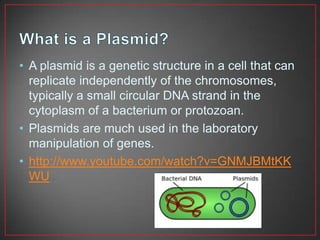
• A plasmid is a genetic structure in a cell that can
  replicate independently of the chromosomes,
  typically a small circular DNA strand in the
  cytoplasm of a bacterium or protozoan.
• Plasmids are much used in the laboratory
  manipulation of genes.
• http://www.youtube.com/watch?v=GNMJBMtKK
  WU
• Plasmids are easy to manipulate and isolate
  using bacteria. They can be inserted to
  mammals genomes, allowing you to introduce
  genes into an organism by using bacteria. This
  type of plasmid is the basis of recombinant DNA
  technology.
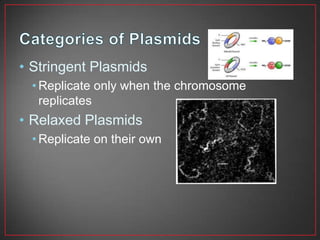
• Stringent Plasmids
 • Replicate only when the chromosome
   replicates
• Relaxed Plasmids
 • Replicate on their own
• Fertility Plasmids
  • Contain transfer genes and are capable of
    conjugation
• Resistance Plasmids
  • Contain genes that can build resistance to
    antibiotics or poisons and help bacteria
    produce pili.
• Col Plasmids
  • Contain genes that code for proteins that kill
    other bacteria
• Degradative Plasmids
  • Allows to digest unusual substances
• Virulence Plasmids
  • Turn bacterium into a pathogen
• Supercoiled
  • DNA is one but has a twist in it causing it to be more compact
• Supercoiled Denatured
  • Less compact then supercoiled
• Linear
  • DNA has free ends
• Nicked Open-Circular
  • DNA has a strand cut
• Relaxed Circular
  • DNA is intact as one
1. Mutate
  •   Use a restriction enzyme to cut out portions of one genome and
      insert them into a plasmid
2. Select
  •   Use genetic markers, the one that is resistant to antibiotics can
      be added to the gene that is being inserted into the plasmid
3. Isolate
  •   Separate the plasmids
4. Transform
  •   Transform them into cells where they become vectors to
      transport foreign genes

Plasmids

  • 1.
  • 2.
    • A plasmidis a genetic structure in a cell that can replicate independently of the chromosomes, typically a small circular DNA strand in the cytoplasm of a bacterium or protozoan. • Plasmids are much used in the laboratory manipulation of genes. • http://www.youtube.com/watch?v=GNMJBMtKK WU
  • 3.
    • Plasmids areeasy to manipulate and isolate using bacteria. They can be inserted to mammals genomes, allowing you to introduce genes into an organism by using bacteria. This type of plasmid is the basis of recombinant DNA technology.
  • 4.
    • Stringent Plasmids • Replicate only when the chromosome replicates • Relaxed Plasmids • Replicate on their own
  • 5.
    • Fertility Plasmids • Contain transfer genes and are capable of conjugation • Resistance Plasmids • Contain genes that can build resistance to antibiotics or poisons and help bacteria produce pili. • Col Plasmids • Contain genes that code for proteins that kill other bacteria • Degradative Plasmids • Allows to digest unusual substances • Virulence Plasmids • Turn bacterium into a pathogen
  • 6.
    • Supercoiled • DNA is one but has a twist in it causing it to be more compact • Supercoiled Denatured • Less compact then supercoiled • Linear • DNA has free ends • Nicked Open-Circular • DNA has a strand cut • Relaxed Circular • DNA is intact as one
  • 7.
    1. Mutate • Use a restriction enzyme to cut out portions of one genome and insert them into a plasmid 2. Select • Use genetic markers, the one that is resistant to antibiotics can be added to the gene that is being inserted into the plasmid 3. Isolate • Separate the plasmids 4. Transform • Transform them into cells where they become vectors to transport foreign genes