
Plaque Psoriasis
YOGESH VISHWAKARMA
ABIGAIL GREAVES
EMMANUEL KINGSLEY
What is Psoriasis?
• A chronic condition in which the body makes new cells in 3-7 days rather than 3-
4 weeks
• Red, itchy scaly patches seen on the surface of skin as the cells pile on each
other
• The patches can be seen on various parts of body depending on type of
Psoriasis
• It can be triggered by infections, medications, stress, genetics and trauma
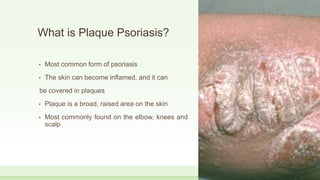
What is Plaque Psoriasis?
• Most common form of psoriasis
• The skin can become inflamed, and it can
be covered in plaques
• Plaque is a broad, raised area on the skin
• Most commonly found on the elbow, knees and
scalp
Plaque Psoriasis cont’d
• It is autoimmune disease, overactive T cells attack healthy skin and trigger the
production of more skin cells.
• Symptoms such as painful swollen joints and soreness occurs in patients with
plaque psoriasis.
• It is caused by a mutation in the gene CARD14 when it is exposed to an
infection.
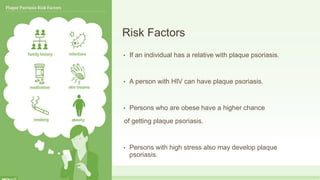
Risk Factors
• If an individual has a relative with plaque psoriasis.
• A person with HIV can have plaque psoriasis.
• Persons who are obese have a higher chance
of getting plaque psoriasis.
• Persons with high stress also may develop plaque
psoriasis.
Anatomy and Physiology of
Cutaneous Membrane
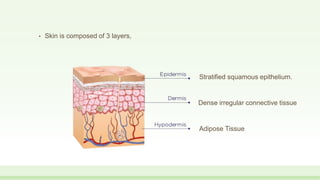
• Skin is composed of 3 layers,
Stratified squamous epithelium.
Dense irregular connective tissue
Adipose Tissue
Epidermis
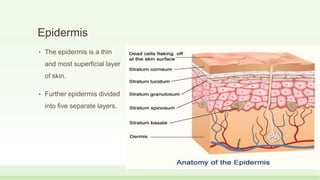
• The epidermis is a thin
and most superficial layer
of skin.
• Further epidermis divided
into five separate layers.
Epidermis
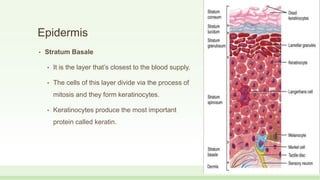
• Stratum Basale
• It is the layer that’s closest to the blood supply.
• The cells of this layer divide via the process of
mitosis and they form keratinocytes.
• Keratinocytes produce the most important
protein called keratin.
Keratinocytes
• It consist 90% - 95% of epidermis layer.
• Life cycle of keratinocytes are around 8 to 10 days from mitosis.
• Skin wound repairing.
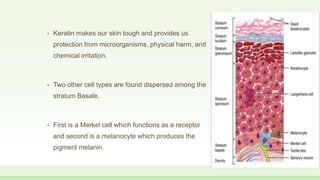
• Keratin makes our skin tough and provides us
protection from microorganisms, physical harm, and
chemical irritation.
• Two other cell types are found dispersed among the
stratum Basale.
• First is a Merkel cell which functions as a receptor
and second is a melanocyte which produces the
pigment melanin.
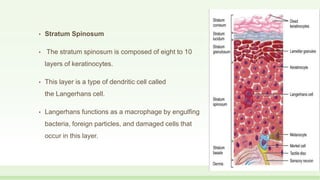
• Stratum Spinosum
• The stratum spinosum is composed of eight to 10
layers of keratinocytes.
• This layer is a type of dendritic cell called
the Langerhans cell.
• Langerhans functions as a macrophage by engulfing
bacteria, foreign particles, and damaged cells that
occur in this layer.
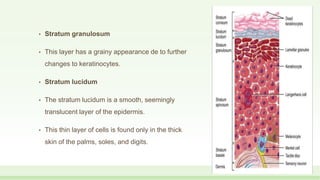
• Stratum granulosum
• This layer has a grainy appearance de to further
changes to keratinocytes.
• Stratum lucidum
• The stratum lucidum is a smooth, seemingly
translucent layer of the epidermis.
• This thin layer of cells is found only in the thick
skin of the palms, soles, and digits.
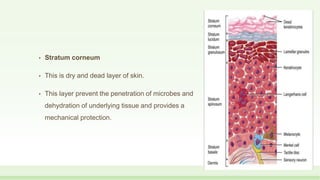
• Stratum corneum
• This is dry and dead layer of skin.
• This layer prevent the penetration of microbes and
dehydration of underlying tissue and provides a
mechanical protection.
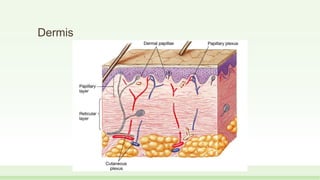
Dermis
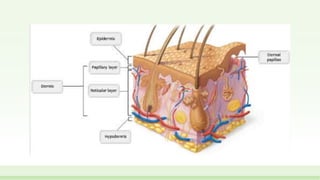
Dermis
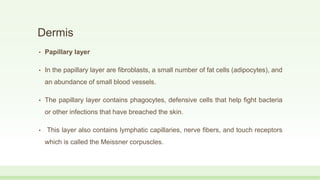
• Papillary layer
• In the papillary layer are fibroblasts, a small number of fat cells (adipocytes), and
an abundance of small blood vessels.
• The papillary layer contains phagocytes, defensive cells that help fight bacteria
or other infections that have breached the skin.
• This layer also contains lymphatic capillaries, nerve fibers, and touch receptors
which is called the Meissner corpuscles.
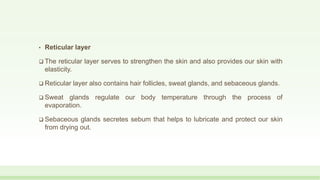
• Reticular layer
 The reticular layer serves to strengthen the skin and also provides our skin with
elasticity.
 Reticular layer also contains hair follicles, sweat glands, and sebaceous glands.
 Sweat glands regulate our body temperature through the process of
evaporation.
 Sebaceous glands secretes sebum that helps to lubricate and protect our skin
from drying out.
Hypodermis
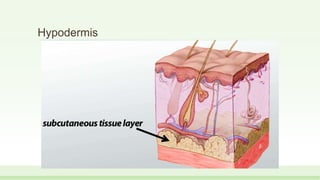
Hypodermis
• Subcutaneous layer or superficial fascia is a layer below the dermis and serves
to connect the skin to the fibrous tissue of the bones and muscles.
• This layer consist adipose tissue, which functions as a mode of fat storage and
provides insulation and cushioning.
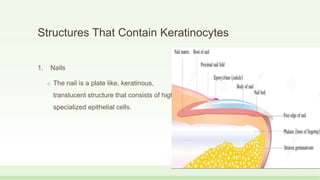
Structures That Contain Keratinocytes
1. Nails
o The nail is a plate like, keratinous,
translucent structure that consists of highly
specialized epithelial cells.
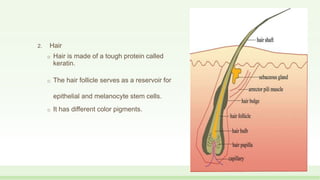
2. Hair
o Hair is made of a tough protein called
keratin.
o The hair follicle serves as a reservoir for
epithelial and melanocyte stem cells.
o It has different color pigments.
Physiology/function of the skin
• For protection
• Insulates, waterproof i.e. keratin
• Protects from harsh weather conditions i.e dermis.
• Protects from UV rays
• Regulates body temperature
• Helps to synthesis vitamin D
• An organ for sensation
• Also helps to prevent excess water escaping from our
body.
Risks factors of plaque psoriasis
• Family history: approximately 30% of all patients with
psoriasis have a close relative who also has the condition
• HIV- Patients with HIV have high risks of plaque psoriasis
compared to people who don’t have.
• Mental stress: high stress levels also increases plaque
psoriasis.
• Overweight or obesity: people that are too at have a great chance
of getting plaque psoriasis.
• Regular tobacco smoking: not only is the risk of developing
psoriasis higher, but also its severity.
• Recurring infections: people with recurring infections have a higher
risk of developing psoriasis e.g strep throat.
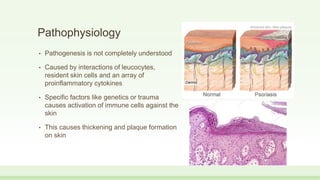
Pathophysiology
• Pathogenesis is not completely understood
• Caused by interactions of leucocytes,
resident skin cells and an array of
proinflammatory cytokines
• Specific factors like genetics or trauma
causes activation of immune cells against the
skin
• This causes thickening and plaque formation
on skin
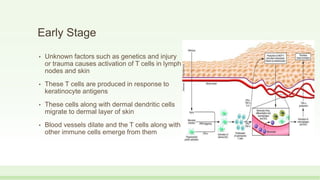
Early Stage
• Unknown factors such as genetics and injury
or trauma causes activation of T cells in lymph
nodes and skin
• These T cells are produced in response to
keratinocyte antigens
• These cells along with dermal dendritic cells
migrate to dermal layer of skin
• Blood vessels dilate and the T cells along with
other immune cells emerge from them
• This inflammatory process causes production of various cytokines, e.g. TNF-a
• They accumulate around the basal membrane of epidermis
• These T cells interact with keratinocytes
• They induce proliferation of keratinocytes
• This leads to accelerated cell turnover (from 23d to 3-5d) and improper cell
maturation
• Increased hard and died keratinized cells and decreased stratum spinosum and
granulosum layers
• This causes thickening and hardening of the affected area
• Cells in stratum granulosum which normally loses their nuclei,
retain them a condition known as “Parakeratosis”
• Lipids work as cement adhesion between corneocytes
• Epidermal cells fail to release adequate levels of lipids
• This cause poorly adherent stratum corneum leading to flaky and
scaly surface of lesions
Later Stages
• It is characterized by acanthosis (thickening of stratum spinosum)
• Psoriasiform hyperplasia which consists of;
• Elongated Rete Ridges
• Suprapapillary thinning
• Dilation of dermal blood vessels
• Parakeratosis becomes confluent and finally granular layer is lost
• Intracorneal collection of neutrophils
• Collection of neutrophils in stratum spinosum known as “Spongiform
Pustule Kogoj’
Diagnosis and treatment
Diagnosis
• No special blood tests or diagnostic tests are
needed.
• Physical exam and medical history- by examining
the patient’s skin, scalp and nails.
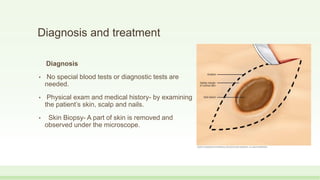
• Skin Biopsy- A part of skin is removed and
observed under the microscope.
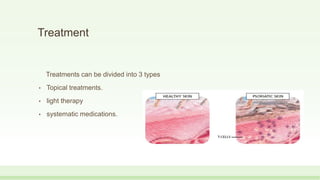
Treatment
Treatments can be divided into 3 types
• Topical treatments.
• light therapy
• systematic medications.
Topical treatments include…
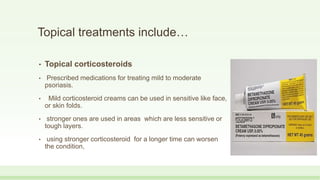
• Topical corticosteroids
• Prescribed medications for treating mild to moderate
psoriasis.
• Mild corticosteroid creams can be used in sensitive like face,
or skin folds.
• stronger ones are used in areas which are less sensitive or
tough layers.
• using stronger corticosteroid for a longer time can worsen
the condition,
Vitamin -D analogues ……..
• These analouges slow down the skin growth.
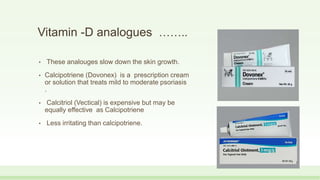
• Calcipotriene (Dovonex) is a prescription cream
or solution that treats mild to moderate psoriasis
.
• Calcitriol (Vectical) is expensive but may be
equally effective as Calcipotriene
• Less irritating than calcipotriene.
• Light therapy [Photo therapy]
the treatment uses natural sunlight or artificial UV
light.
• They include ……..
• Sunlight
• exposure to UV light slows down skin growth
reducing scaling and inflammation.
• exposure to sunlight everyday may improve skin.
• But intense exposure to sunlight may worsen the
condition.
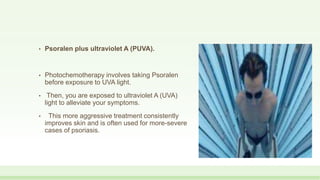
• Psoralen plus ultraviolet A (PUVA).
• Photochemotherapy involves taking Psoralen
before exposure to UVA light.
• Then, you are exposed to ultraviolet A (UVA)
light to alleviate your symptoms.
• This more aggressive treatment consistently
improves skin and is often used for more-severe
cases of psoriasis.
• Oral or injected medications
• this type of medications are used when psoriasis is resistant to other type of
medications.
• Methotrexate
• Helps the patient by decreasing the production of skin cells and
suppressing inflammation.
• It may also slow the progression of psoriatic arthritis in some people.
• When used for long periods, it causes severe liver damage and decreased
production of red and white blood cells and platelets.
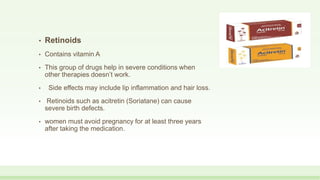
• Retinoids
• Contains vitamin A
• This group of drugs help in severe conditions when
other therapies doesn’t work.
• Side effects may include lip inflammation and hair loss.
• Retinoids such as acitretin (Soriatane) can cause
severe birth defects.
• women must avoid pregnancy for at least three years
after taking the medication.
References
• Boundless. (n.d.). Boundless Anatomy and Physiology. Retrieved from
https://courses.lumenlearning.com/boundless-ap/chapter/the-skin/
• Erdoğan, B. (2017, May 03). Anatomy and Physiology of Hair. Retrieved from
https://www.intechopen.com/books/hair-and-scalp-disorders/anatomy-and-
physiology-of-hair
• Brannon, H., & Gallagher, C. (n.d.). An Overview of Plaque Psoriasis. Retrieved
from https://www.verywellhealth.com/plaque-psoriasis-overview-1069489
• (n.d.). Retrieved from https://www.nhs.uk/conditions/psoriasis/
• Psoriasis. (2018, March 06). Retrieved from
https://www.mayoclinic.org/diseases-conditions/psoriasis/symptoms-causes/syc-
20355840

Plaque psoriasis presentation

  • 1.
  • 2.
    What is Psoriasis? •A chronic condition in which the body makes new cells in 3-7 days rather than 3- 4 weeks • Red, itchy scaly patches seen on the surface of skin as the cells pile on each other • The patches can be seen on various parts of body depending on type of Psoriasis • It can be triggered by infections, medications, stress, genetics and trauma
  • 3.
    What is PlaquePsoriasis? • Most common form of psoriasis • The skin can become inflamed, and it can be covered in plaques • Plaque is a broad, raised area on the skin • Most commonly found on the elbow, knees and scalp
  • 4.
    Plaque Psoriasis cont’d •It is autoimmune disease, overactive T cells attack healthy skin and trigger the production of more skin cells. • Symptoms such as painful swollen joints and soreness occurs in patients with plaque psoriasis. • It is caused by a mutation in the gene CARD14 when it is exposed to an infection.
  • 5.
    Risk Factors • Ifan individual has a relative with plaque psoriasis. • A person with HIV can have plaque psoriasis. • Persons who are obese have a higher chance of getting plaque psoriasis. • Persons with high stress also may develop plaque psoriasis.
  • 6.
    Anatomy and Physiologyof Cutaneous Membrane
  • 7.
    • Skin iscomposed of 3 layers, Stratified squamous epithelium. Dense irregular connective tissue Adipose Tissue
  • 8.
    Epidermis • The epidermisis a thin and most superficial layer of skin. • Further epidermis divided into five separate layers.
  • 9.
    Epidermis • Stratum Basale •It is the layer that’s closest to the blood supply. • The cells of this layer divide via the process of mitosis and they form keratinocytes. • Keratinocytes produce the most important protein called keratin.
  • 10.
    Keratinocytes • It consist90% - 95% of epidermis layer. • Life cycle of keratinocytes are around 8 to 10 days from mitosis. • Skin wound repairing.
  • 11.
    • Keratin makesour skin tough and provides us protection from microorganisms, physical harm, and chemical irritation. • Two other cell types are found dispersed among the stratum Basale. • First is a Merkel cell which functions as a receptor and second is a melanocyte which produces the pigment melanin.
  • 12.
    • Stratum Spinosum •The stratum spinosum is composed of eight to 10 layers of keratinocytes. • This layer is a type of dendritic cell called the Langerhans cell. • Langerhans functions as a macrophage by engulfing bacteria, foreign particles, and damaged cells that occur in this layer.
  • 13.
    • Stratum granulosum •This layer has a grainy appearance de to further changes to keratinocytes. • Stratum lucidum • The stratum lucidum is a smooth, seemingly translucent layer of the epidermis. • This thin layer of cells is found only in the thick skin of the palms, soles, and digits.
  • 14.
    • Stratum corneum •This is dry and dead layer of skin. • This layer prevent the penetration of microbes and dehydration of underlying tissue and provides a mechanical protection.
  • 15.
  • 16.
    Dermis • Papillary layer •In the papillary layer are fibroblasts, a small number of fat cells (adipocytes), and an abundance of small blood vessels. • The papillary layer contains phagocytes, defensive cells that help fight bacteria or other infections that have breached the skin. • This layer also contains lymphatic capillaries, nerve fibers, and touch receptors which is called the Meissner corpuscles.
  • 18.
    • Reticular layer The reticular layer serves to strengthen the skin and also provides our skin with elasticity.  Reticular layer also contains hair follicles, sweat glands, and sebaceous glands.  Sweat glands regulate our body temperature through the process of evaporation.  Sebaceous glands secretes sebum that helps to lubricate and protect our skin from drying out.
  • 19.
  • 20.
    Hypodermis • Subcutaneous layeror superficial fascia is a layer below the dermis and serves to connect the skin to the fibrous tissue of the bones and muscles. • This layer consist adipose tissue, which functions as a mode of fat storage and provides insulation and cushioning.
  • 21.
    Structures That ContainKeratinocytes 1. Nails o The nail is a plate like, keratinous, translucent structure that consists of highly specialized epithelial cells.
  • 22.
    2. Hair o Hairis made of a tough protein called keratin. o The hair follicle serves as a reservoir for epithelial and melanocyte stem cells. o It has different color pigments.
  • 23.
    Physiology/function of theskin • For protection • Insulates, waterproof i.e. keratin • Protects from harsh weather conditions i.e dermis. • Protects from UV rays • Regulates body temperature
  • 24.
    • Helps tosynthesis vitamin D • An organ for sensation • Also helps to prevent excess water escaping from our body.
  • 25.
    Risks factors ofplaque psoriasis • Family history: approximately 30% of all patients with psoriasis have a close relative who also has the condition • HIV- Patients with HIV have high risks of plaque psoriasis compared to people who don’t have. • Mental stress: high stress levels also increases plaque psoriasis.
  • 26.
    • Overweight orobesity: people that are too at have a great chance of getting plaque psoriasis. • Regular tobacco smoking: not only is the risk of developing psoriasis higher, but also its severity. • Recurring infections: people with recurring infections have a higher risk of developing psoriasis e.g strep throat.
  • 27.
    Pathophysiology • Pathogenesis isnot completely understood • Caused by interactions of leucocytes, resident skin cells and an array of proinflammatory cytokines • Specific factors like genetics or trauma causes activation of immune cells against the skin • This causes thickening and plaque formation on skin
  • 28.
    Early Stage • Unknownfactors such as genetics and injury or trauma causes activation of T cells in lymph nodes and skin • These T cells are produced in response to keratinocyte antigens • These cells along with dermal dendritic cells migrate to dermal layer of skin • Blood vessels dilate and the T cells along with other immune cells emerge from them
  • 29.
    • This inflammatoryprocess causes production of various cytokines, e.g. TNF-a • They accumulate around the basal membrane of epidermis • These T cells interact with keratinocytes • They induce proliferation of keratinocytes • This leads to accelerated cell turnover (from 23d to 3-5d) and improper cell maturation • Increased hard and died keratinized cells and decreased stratum spinosum and granulosum layers • This causes thickening and hardening of the affected area
  • 30.
    • Cells instratum granulosum which normally loses their nuclei, retain them a condition known as “Parakeratosis” • Lipids work as cement adhesion between corneocytes • Epidermal cells fail to release adequate levels of lipids • This cause poorly adherent stratum corneum leading to flaky and scaly surface of lesions
  • 31.
    Later Stages • Itis characterized by acanthosis (thickening of stratum spinosum) • Psoriasiform hyperplasia which consists of; • Elongated Rete Ridges • Suprapapillary thinning • Dilation of dermal blood vessels • Parakeratosis becomes confluent and finally granular layer is lost • Intracorneal collection of neutrophils • Collection of neutrophils in stratum spinosum known as “Spongiform Pustule Kogoj’
  • 32.
    Diagnosis and treatment Diagnosis •No special blood tests or diagnostic tests are needed. • Physical exam and medical history- by examining the patient’s skin, scalp and nails. • Skin Biopsy- A part of skin is removed and observed under the microscope.
  • 33.
    Treatment Treatments can bedivided into 3 types • Topical treatments. • light therapy • systematic medications.
  • 34.
    Topical treatments include… •Topical corticosteroids • Prescribed medications for treating mild to moderate psoriasis. • Mild corticosteroid creams can be used in sensitive like face, or skin folds. • stronger ones are used in areas which are less sensitive or tough layers. • using stronger corticosteroid for a longer time can worsen the condition,
  • 35.
    Vitamin -D analogues…….. • These analouges slow down the skin growth. • Calcipotriene (Dovonex) is a prescription cream or solution that treats mild to moderate psoriasis . • Calcitriol (Vectical) is expensive but may be equally effective as Calcipotriene • Less irritating than calcipotriene.
  • 36.
    • Light therapy[Photo therapy] the treatment uses natural sunlight or artificial UV light. • They include …….. • Sunlight • exposure to UV light slows down skin growth reducing scaling and inflammation. • exposure to sunlight everyday may improve skin. • But intense exposure to sunlight may worsen the condition.
  • 37.
    • Psoralen plusultraviolet A (PUVA). • Photochemotherapy involves taking Psoralen before exposure to UVA light. • Then, you are exposed to ultraviolet A (UVA) light to alleviate your symptoms. • This more aggressive treatment consistently improves skin and is often used for more-severe cases of psoriasis.
  • 38.
    • Oral orinjected medications • this type of medications are used when psoriasis is resistant to other type of medications. • Methotrexate • Helps the patient by decreasing the production of skin cells and suppressing inflammation. • It may also slow the progression of psoriatic arthritis in some people. • When used for long periods, it causes severe liver damage and decreased production of red and white blood cells and platelets.
  • 39.
    • Retinoids • Containsvitamin A • This group of drugs help in severe conditions when other therapies doesn’t work. • Side effects may include lip inflammation and hair loss. • Retinoids such as acitretin (Soriatane) can cause severe birth defects. • women must avoid pregnancy for at least three years after taking the medication.
  • 40.
    References • Boundless. (n.d.).Boundless Anatomy and Physiology. Retrieved from https://courses.lumenlearning.com/boundless-ap/chapter/the-skin/ • Erdoğan, B. (2017, May 03). Anatomy and Physiology of Hair. Retrieved from https://www.intechopen.com/books/hair-and-scalp-disorders/anatomy-and- physiology-of-hair • Brannon, H., & Gallagher, C. (n.d.). An Overview of Plaque Psoriasis. Retrieved from https://www.verywellhealth.com/plaque-psoriasis-overview-1069489 • (n.d.). Retrieved from https://www.nhs.uk/conditions/psoriasis/ • Psoriasis. (2018, March 06). Retrieved from https://www.mayoclinic.org/diseases-conditions/psoriasis/symptoms-causes/syc- 20355840