Tinea Capitis
Abdullatiff Sami Al-Rashed
Block 4.1 (Dermatology Week)
College of Medicine, King Faisal University
Al-Ahsa, Saudi Arabia
Case
A 3-year-old boy presents with a 3-week history of a
circular scalp area of hair loss and flaky skin.
He attends daycare and is provided with a sleep mat
for an afternoon nap, which is not exclusively for his
use.
The scalp lesion is not itchy, but has not gone away
with an anti-dandruff shampoo. There are no other skin
lesions present.
Definition
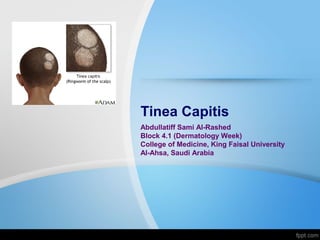
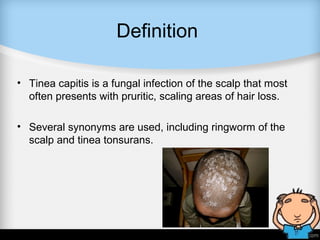
• Tinea capitis is a fungal infection of the scalp that most
often presents with pruritic, scaling areas of hair loss.
• Several synonyms are used, including ringworm of the
scalp and tinea tonsurans.
Epidemiology
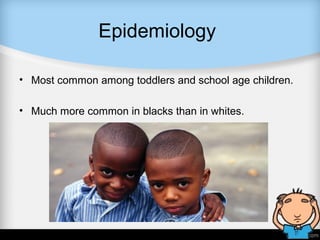
• Most common among toddlers and school age children.
• Much more common in blacks than in whites.
Etiology
• Tinea capitis is a dermatophyte infection.
• Dermatophytes are filamentous fungi in the
genera Trichophyton, Microsporum, and
Epidermophyton that infect keratinized tissue of skin,
hair, or nails.
Etiology
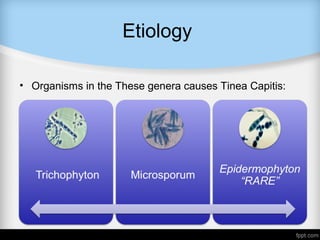
• Organisms in the These genera causes Tinea Capitis:
Etiology
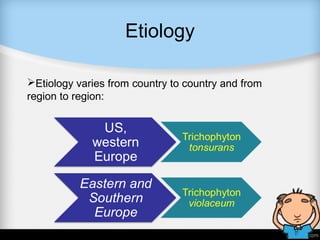
Etiology varies from country to country and from
region to region:
Transmission
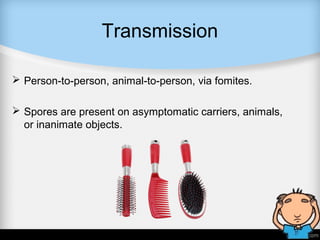
 Person-to-person, animal-to-person, via fomites.
 Spores are present on asymptomatic carriers, animals,
or inanimate objects.
Clinical presentation
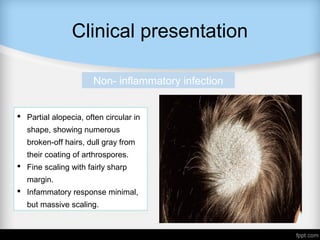
Non- inflammatory infection
 Partial alopecia, often circular in
shape, showing numerous
broken-off hairs, dull gray from
their coating of arthrospores.
 Fine scaling with fairly sharp
margin.
 Infammatory response minimal,
but massive scaling.
Clinical presentation
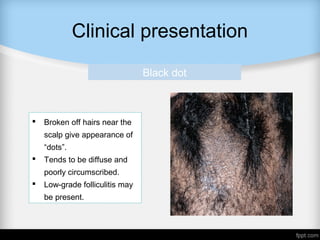
Black dot
 Broken off hairs near the
scalp give appearance of
“dots”.
 Tends to be diffuse and
poorly circumscribed.
 Low-grade folliculitis may
be present.
Clinical presentation
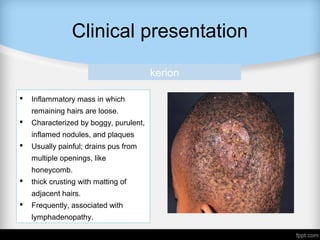
kerion
 Inflammatory mass in which
remaining hairs are loose.
 Characterized by boggy, purulent,
inflamed nodules, and plaques
 Usually painful; drains pus from
multiple openings, like
honeycomb.
 thick crusting with matting of
adjacent hairs.
 Frequently, associated with
lymphadenopathy.
Clinical presentation
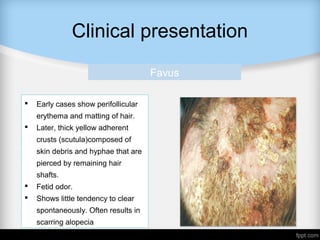
Favus
 Early cases show perifollicular
erythema and matting of hair.
 Later, thick yellow adherent
crusts (scutula)composed of
skin debris and hyphae that are
pierced by remaining hair
shafts.
 Fetid odor.
 Shows little tendency to clear
spontaneously. Often results in
scarring alopecia
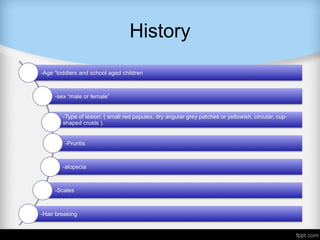
History
History
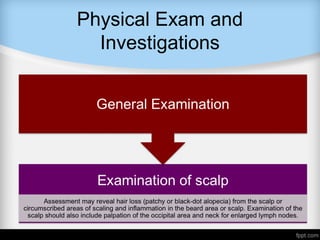
Physical Exam and
Investigations
Physical Exam and
Investigations
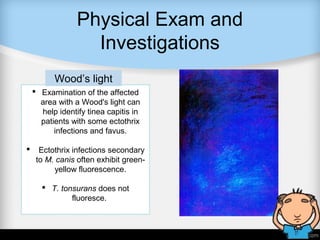
 Examination of the affected
area with a Wood's light can
help identify tinea capitis in
patients with some ectothrix
infections and favus.
 Ectothrix infections secondary
to M. canis often exhibit green-
yellow fluorescence.
 T. tonsurans does not
fluoresce.
Wood’s light
Diagnosis
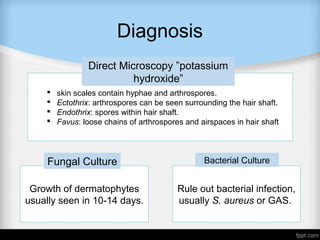
 skin scales contain hyphae and arthrospores.
 Ectothrix: arthrospores can be seen surrounding the hair shaft.
 Endothrix: spores within hair shaft.
 Favus: loose chains of arthrospores and airspaces in hair shaft
Direct Microscopy ”potassium
hydroxide”
Growth of dermatophytes
usually seen in 10-14 days.
Rule out bacterial infection,
usually S. aureus or GAS.
Fungal Culture Bacterial Culture
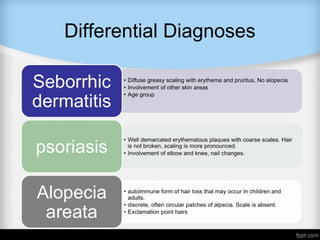
Differential Diagnoses
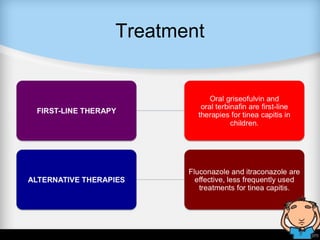
Treatment
Treatment
Adjunctive interventions:
• Antifungal shampoo : Selenium sulfide
5-10 ml on wet scalp, 2 applications each
week for 2 weeks will provide control.
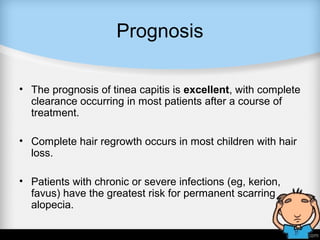
Prognosis
• The prognosis of tinea capitis is excellent, with complete
clearance occurring in most patients after a course of
treatment.
• Complete hair regrowth occurs in most children with hair
loss.
• Patients with chronic or severe infections (eg, kerion,
favus) have the greatest risk for permanent scarring
alopecia.
Reference
Tinea Capitis

Tinea Capitis

  • 1.
    Tinea Capitis Abdullatiff SamiAl-Rashed Block 4.1 (Dermatology Week) College of Medicine, King Faisal University Al-Ahsa, Saudi Arabia
  • 2.
    Case A 3-year-old boypresents with a 3-week history of a circular scalp area of hair loss and flaky skin. He attends daycare and is provided with a sleep mat for an afternoon nap, which is not exclusively for his use. The scalp lesion is not itchy, but has not gone away with an anti-dandruff shampoo. There are no other skin lesions present.
  • 4.
    Definition • Tinea capitisis a fungal infection of the scalp that most often presents with pruritic, scaling areas of hair loss. • Several synonyms are used, including ringworm of the scalp and tinea tonsurans.
  • 5.
    Epidemiology • Most commonamong toddlers and school age children. • Much more common in blacks than in whites.
  • 6.
    Etiology • Tinea capitisis a dermatophyte infection. • Dermatophytes are filamentous fungi in the genera Trichophyton, Microsporum, and Epidermophyton that infect keratinized tissue of skin, hair, or nails.
  • 7.
    Etiology • Organisms inthe These genera causes Tinea Capitis:
  • 8.
    Etiology Etiology varies fromcountry to country and from region to region:
  • 9.
    Transmission  Person-to-person, animal-to-person,via fomites.  Spores are present on asymptomatic carriers, animals, or inanimate objects.
  • 10.
    Clinical presentation Non- inflammatoryinfection  Partial alopecia, often circular in shape, showing numerous broken-off hairs, dull gray from their coating of arthrospores.  Fine scaling with fairly sharp margin.  Infammatory response minimal, but massive scaling.
  • 11.
    Clinical presentation Black dot Broken off hairs near the scalp give appearance of “dots”.  Tends to be diffuse and poorly circumscribed.  Low-grade folliculitis may be present.
  • 12.
    Clinical presentation kerion  Inflammatorymass in which remaining hairs are loose.  Characterized by boggy, purulent, inflamed nodules, and plaques  Usually painful; drains pus from multiple openings, like honeycomb.  thick crusting with matting of adjacent hairs.  Frequently, associated with lymphadenopathy.
  • 13.
    Clinical presentation Favus  Earlycases show perifollicular erythema and matting of hair.  Later, thick yellow adherent crusts (scutula)composed of skin debris and hyphae that are pierced by remaining hair shafts.  Fetid odor.  Shows little tendency to clear spontaneously. Often results in scarring alopecia
  • 14.
  • 15.
  • 16.
  • 17.
    Physical Exam and Investigations Examination of the affected area with a Wood's light can help identify tinea capitis in patients with some ectothrix infections and favus.  Ectothrix infections secondary to M. canis often exhibit green- yellow fluorescence.  T. tonsurans does not fluoresce. Wood’s light
  • 18.
    Diagnosis  skin scalescontain hyphae and arthrospores.  Ectothrix: arthrospores can be seen surrounding the hair shaft.  Endothrix: spores within hair shaft.  Favus: loose chains of arthrospores and airspaces in hair shaft Direct Microscopy ”potassium hydroxide” Growth of dermatophytes usually seen in 10-14 days. Rule out bacterial infection, usually S. aureus or GAS. Fungal Culture Bacterial Culture
  • 19.
  • 20.
  • 21.
    Treatment Adjunctive interventions: • Antifungalshampoo : Selenium sulfide 5-10 ml on wet scalp, 2 applications each week for 2 weeks will provide control.
  • 22.
    Prognosis • The prognosisof tinea capitis is excellent, with complete clearance occurring in most patients after a course of treatment. • Complete hair regrowth occurs in most children with hair loss. • Patients with chronic or severe infections (eg, kerion, favus) have the greatest risk for permanent scarring alopecia.
  • 23.

Editor's Notes

  • #11 Partial alopecia, often circular in shape, showing numerous broken-off hairs, dull gray from their coating of arthrospores. Fine scaling with fairly sharp margin. Hair shaft becomes brittle, breaking off at or slightly above scalp. Small patches coalesce, forming larger patches. Infammatory response minimal, but massive scaling.
  • #12 Broken-offhairs near the scalp give appearance of “dots” (Fig. 26-44) (swollen hair shafts) in dark-haired patients. Dots occur as affected hair breaks at surface of scalp. Tends to be diffuse and poorly circum- scribed. Low-grade folliculitis may be pres- ent.
  • #14 latin for honeycomb. Early cases show perifollicular erythema and matting of hair. Lat- er, thick yellow adherent crusts (scutula) com- posed of skin debris and hyphae that are pierced by remaining hair shafts (Fig. 26-46). Fetid odor. Shows little tendency to clear spontaneously. Often results in scarring alopecia The scutula contain fungi, neutrophils, dried serum, and epidermal cells. Scutula eventually coalesce to form adherent masses above areas of severe alopecia.