Babinski Reflex
• Described by the neurologist Joseph Babinski in 1896.
• Tests the integrity of the corticospinal tract (CST)
• Fibers from the CST synapse with the alpha motor neuron in the spinal cord and
help direct motor function.
• The CST is considered the upper motor neuron (UMN), and the alpha motor
neuron is considered the lower motor neuron (LMN).
• Damage anywhere along the CST can result in the presence of a Babinski sign.
• Stimulation of the lateral plantar aspect of the foot (S1 dermatome) normally leads to
plantar flexion of the toes (due to stimulation of the S1 myotome).
• The response results from nociceptive fibers in the S1 dermatome detecting the
stimulation.
• Nociceptive input travels up the tibial and sciatic nerve to the S1 region of the spine and
synapses with anterior horn cells.
• The motor response which leads to the plantar flexion is mediated through the S1 root
and tibial nerve.
• The toes curl down and inward.
• Sometimes there is no response to stimulation.
• This is called a neutral response. This response does not rule out pathology.
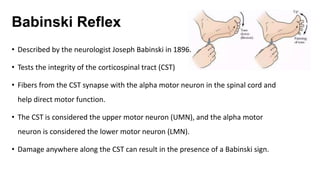
• Babinski sign occurs when stimulation of the lateral plantar aspect of the foot leads to
extension (dorsiflexion or upward movement) of the big toe (hallux).
• There may be fanning of the other toes.
• This suggests that there is been spread of the sensory input beyond the S1 myotome to
L4 and L5. An intact CST prevents such spread.
• In infants with CST, which is not fully myelinated, the presence of a Babinski sign in the
absence of other neurological deficits is considered normal up to 24 months of age.
• Babinski’s may be present when a patient is asleep
• Contraindication - lesion (such as an infection) in the affected area of the foot that
precludes the effective performance of the reflex
• Elicited by a dull, blunt instrument that does not cause pain or injury. Sharp objects
should be avoided. The dull point of a reflex hammer, a tongue depressor, or the edge of
a key is often utilized.
• The instrument is run up the lateral plantar side of the foot from the heel to the toes and
across the metatarsal pads to the base of the big toe.
• Variations - Chaddock (stimulating under lateral malleolus), Gordon (squeezing calf),
Oppenheim (applying pressure to the medial side of the tibia), and Throckmorton (hitting
the metatarsophalangeal joint of the big toe).
• The Hoffman reflex in the upper extremity - nearest equivalent of the Babinski sign

Babinski REFLEX AND PATHOPHYSIOLOGY.pptx

  • 1.
    Babinski Reflex • Describedby the neurologist Joseph Babinski in 1896. • Tests the integrity of the corticospinal tract (CST) • Fibers from the CST synapse with the alpha motor neuron in the spinal cord and help direct motor function. • The CST is considered the upper motor neuron (UMN), and the alpha motor neuron is considered the lower motor neuron (LMN). • Damage anywhere along the CST can result in the presence of a Babinski sign.
  • 2.
    • Stimulation ofthe lateral plantar aspect of the foot (S1 dermatome) normally leads to plantar flexion of the toes (due to stimulation of the S1 myotome). • The response results from nociceptive fibers in the S1 dermatome detecting the stimulation. • Nociceptive input travels up the tibial and sciatic nerve to the S1 region of the spine and synapses with anterior horn cells. • The motor response which leads to the plantar flexion is mediated through the S1 root and tibial nerve. • The toes curl down and inward. • Sometimes there is no response to stimulation. • This is called a neutral response. This response does not rule out pathology.
  • 3.
    • Babinski signoccurs when stimulation of the lateral plantar aspect of the foot leads to extension (dorsiflexion or upward movement) of the big toe (hallux). • There may be fanning of the other toes. • This suggests that there is been spread of the sensory input beyond the S1 myotome to L4 and L5. An intact CST prevents such spread. • In infants with CST, which is not fully myelinated, the presence of a Babinski sign in the absence of other neurological deficits is considered normal up to 24 months of age. • Babinski’s may be present when a patient is asleep
  • 4.
    • Contraindication -lesion (such as an infection) in the affected area of the foot that precludes the effective performance of the reflex • Elicited by a dull, blunt instrument that does not cause pain or injury. Sharp objects should be avoided. The dull point of a reflex hammer, a tongue depressor, or the edge of a key is often utilized. • The instrument is run up the lateral plantar side of the foot from the heel to the toes and across the metatarsal pads to the base of the big toe. • Variations - Chaddock (stimulating under lateral malleolus), Gordon (squeezing calf), Oppenheim (applying pressure to the medial side of the tibia), and Throckmorton (hitting the metatarsophalangeal joint of the big toe). • The Hoffman reflex in the upper extremity - nearest equivalent of the Babinski sign