PLANT TISSUES
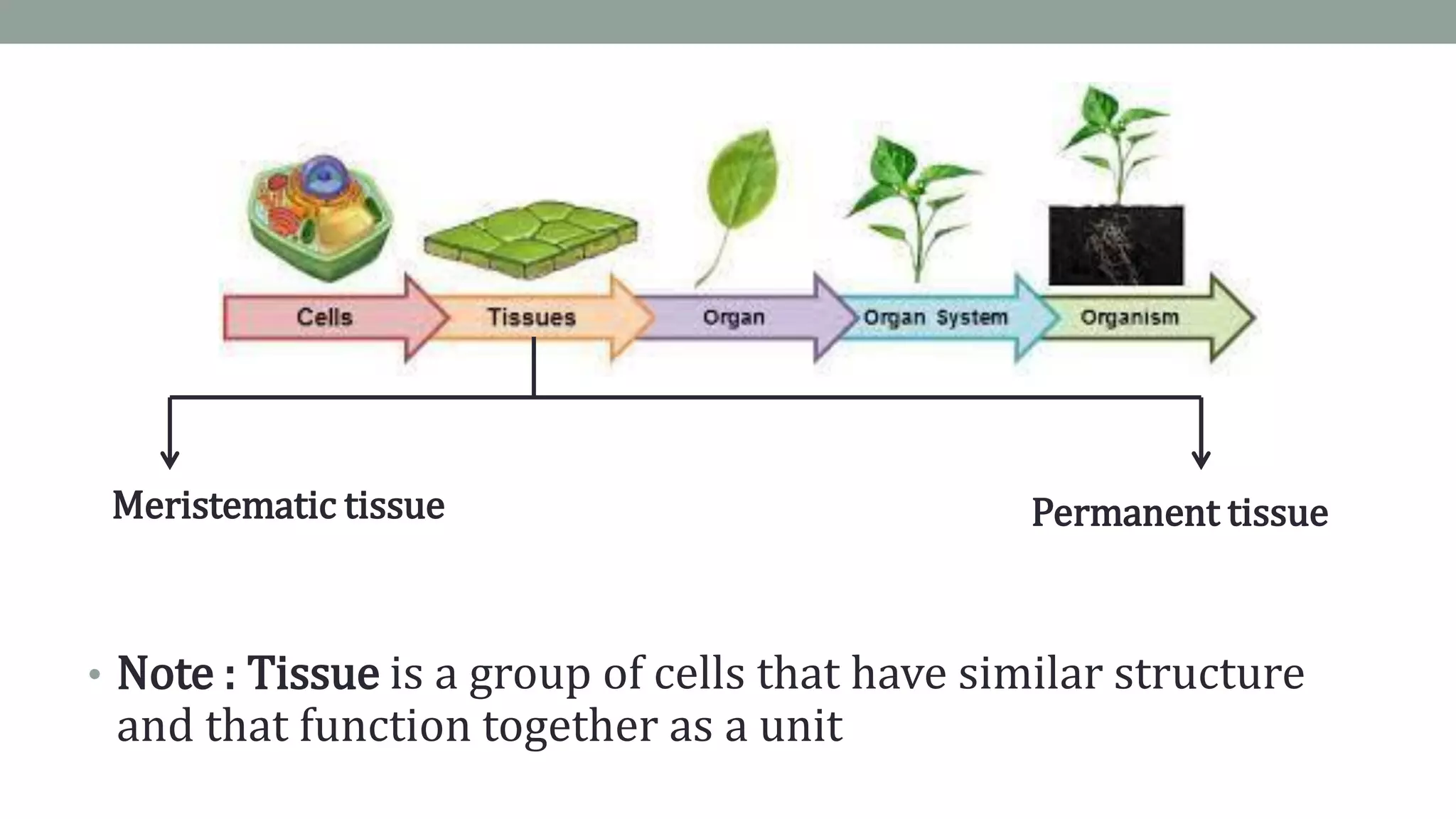
• Note : Tissue is a group of cells that have similar structure
and that function together as a unit
Meristematic tissue Permanent tissue
Meristematic tissue
• Meristematic tissues are cells or
group of cells that have the ability
to divide
• Living cell
• Small cells
• Thin cell walls
• Large cell nuclei
• Absent or small vacuoles
• No intercellular spaces
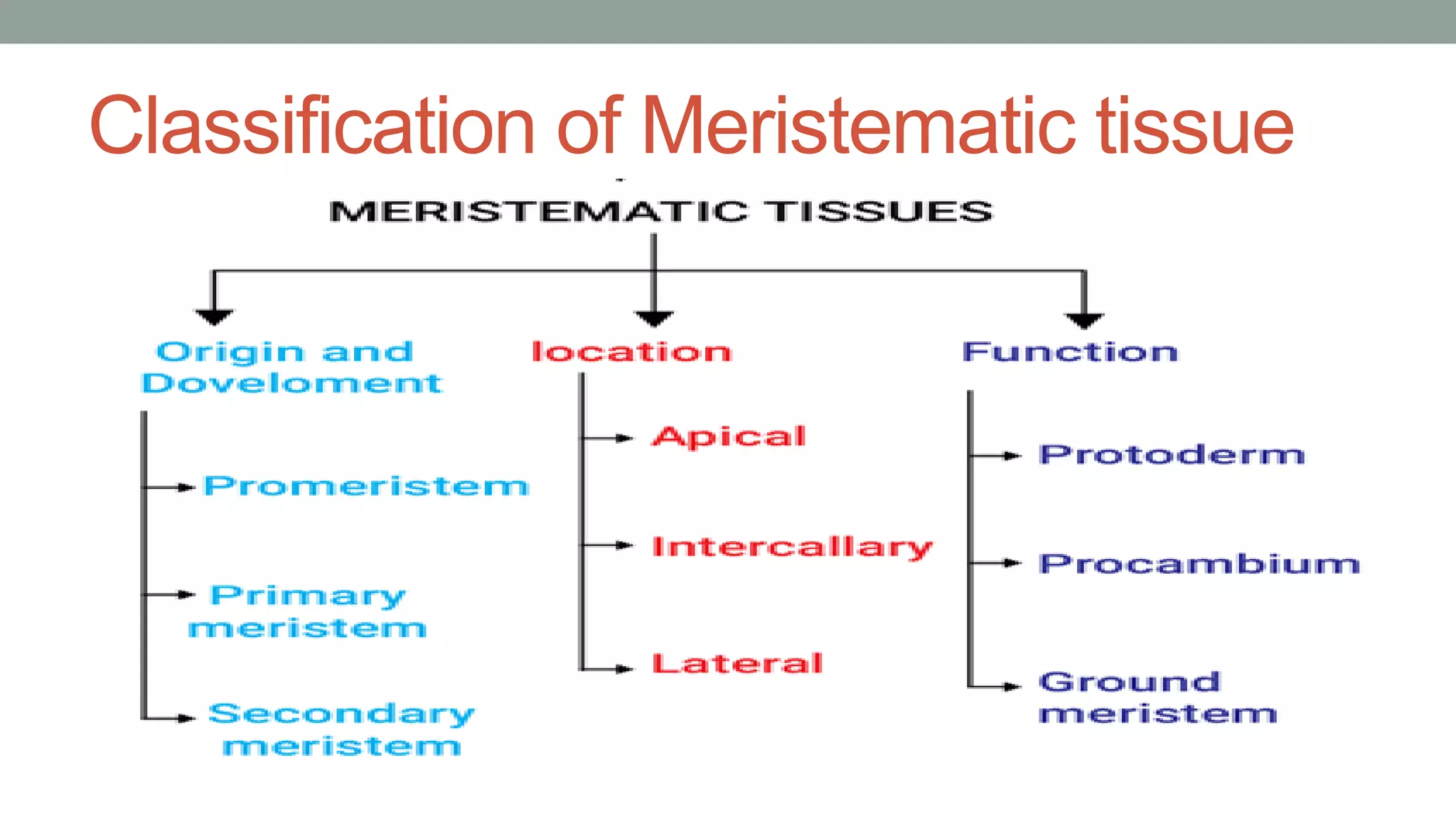
Classification of Meristematic tissue
CLASSIFICATION OF MERISTEMACCORDING TO ORIGIN
1.Promeristem:
• It is the region of new
growth in plant body
• Foundation for all
growing parts
2.Primary meristem:
• Cells originate directly from the embryonic cells
• Apices of stems, roots and intrafasicular cambium
3.Secondary meristem:
• Develop from mature that is permanent tissues which have
already undergone differentiation
• The vascular cambium (fascicular cambium) and cork
cambium (phellogen)
CLASSIFICATION OF MERISTEMSACCORDING TO THEIR
POSITION IN THE PLANT BODY
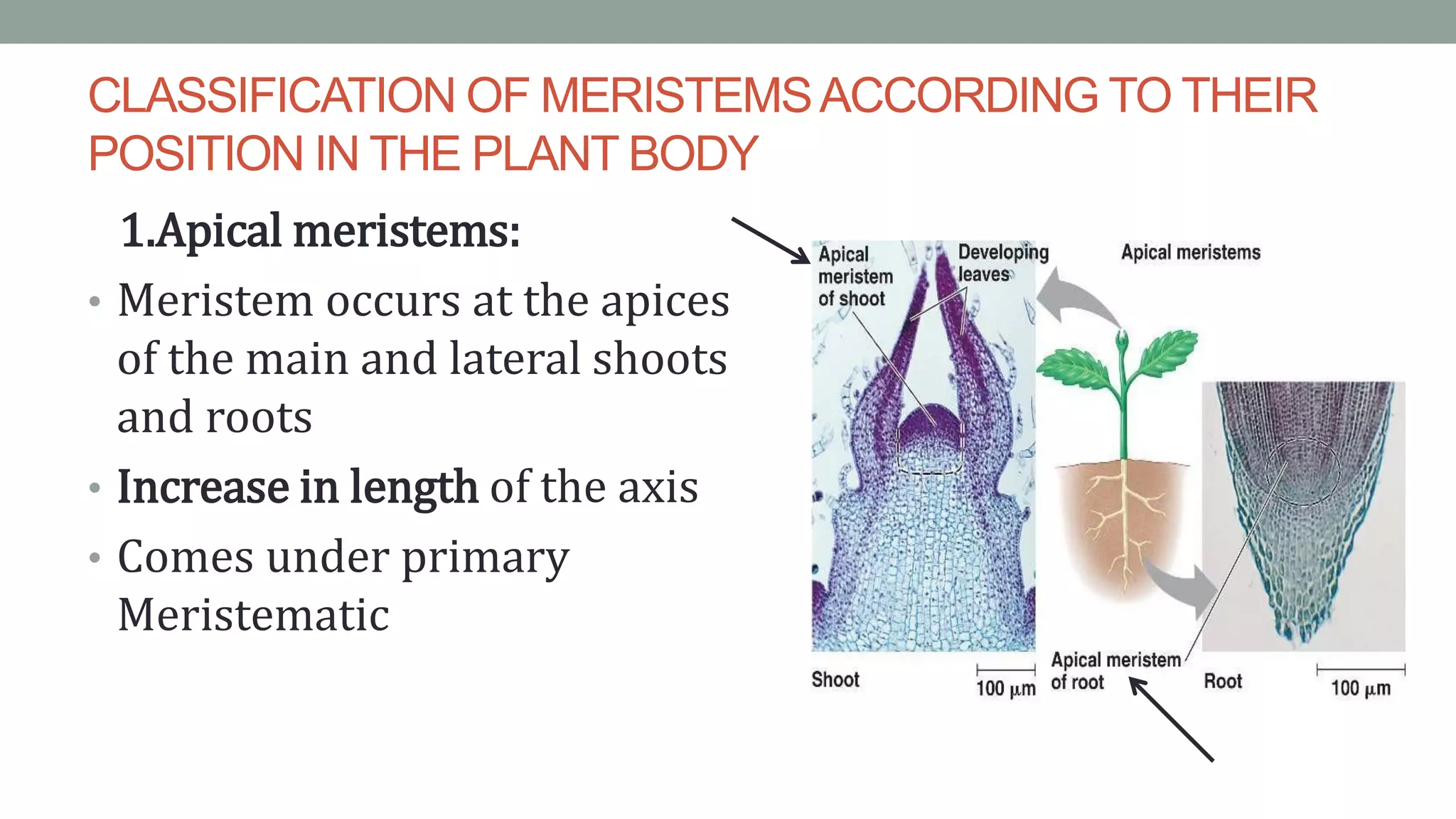
1.Apical meristems:
• Meristem occurs at the apices
of the main and lateral shoots
and roots
• Increase in length of the axis
• Comes under primary
Meristematic
2.Intercalary meristems:
• These meristems are inserted
between the permanent tissues
while growing.
• Increase in the length of the axis
• Comes under primary
Meristematic
• Leaf base, base of the internode,
base of the node . etc.
3.Lateral meristems
• Situated laterally that is
parallel to the circumference
of the organs
• Increase in diameter of the
plant organs
• The vascular cambium
(fascicular cambium) and the
cork cambium (phellogen)
CLASSIFICATION OF MERISTEMACCORDING TO THEIR
FUNCTION
1. Protoderm
• The outermost cell layer
• Gives rise to epidermis
2. Procambium
• Responsible for producing the new vascular tissues in
mature stems and roots
3.Fundamental or ground meristem
It is gradually differentiated into cortex, medullary rays and
the pith.
Permanent tissue
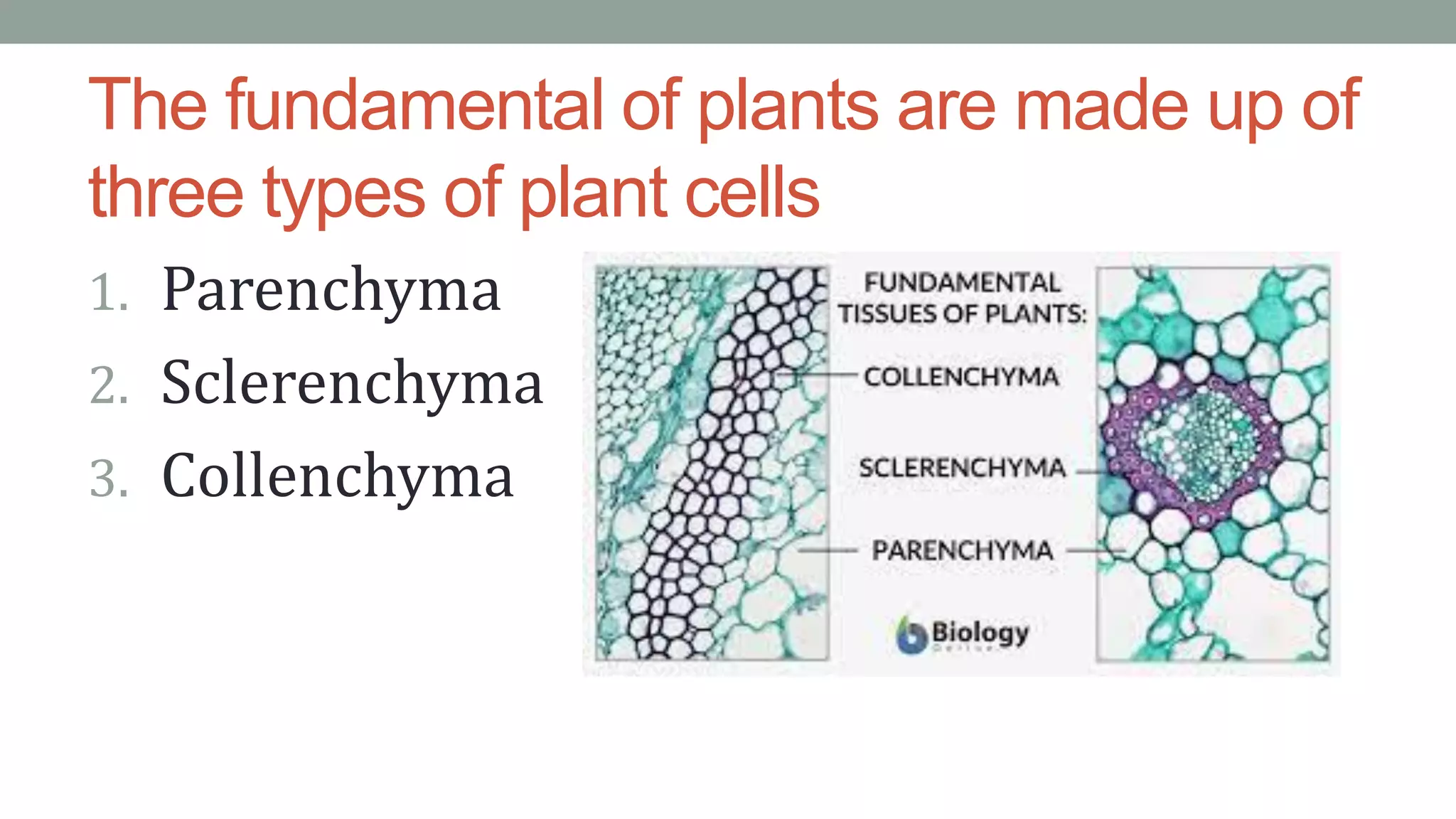
The fundamental of plants are made up of
three types of plant cells
1. Parenchyma
2. Sclerenchyma
3. Collenchyma
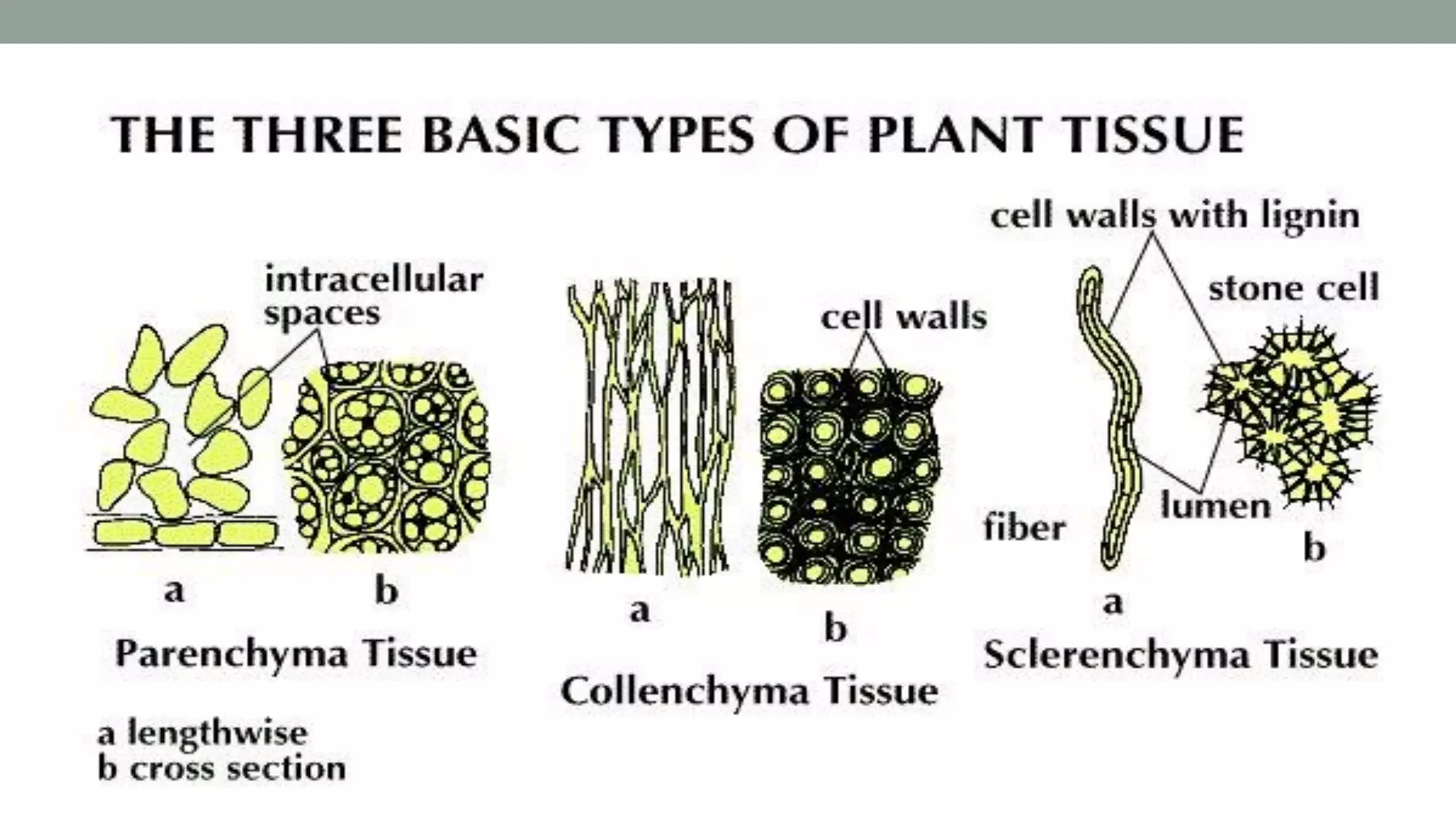
Parenchyma tissue
• Living tissue
• Thin cell-walled, It is made up of one layer (“primary wall”)
that is composed of cellulose and hemicellulose
• The cells are found in many places throughout plant bodies
• Metabolically active
• Involved in Essential activities like
Storage, Secretion, Photosynthesis, Assimilation,
Respiration, Excretion etc.
Types of parenchyma:
on basis of function and shape
1.Chlorenchyma
• In the mesophyll part of the
leaves
• Cells have chloroplast in them
• Function: photosynthesis
2. Aerenchyma
• Found in aquatic plants
where in they are
involved in providing
buoyancy to the plants.
• large intercellular spaces
wherein the air cavities
or the air pockets are
present
3. Prosenchyma
• Found in the vascular tissues of
plants.
• Responsible for making the plant
more rigid.
• These cells characteristically
possess pointed end and are
elongated narrow cells.
4· Vascular parenchyma
• Vascular parenchymal cells present in the vascular tissues of
the plants provide nutrients to the vascular tissues
5. Medullary parenchyma
• Found in the medullary ray of the
primary vascular tissue of the stem.
6· Conjunctive parenchyma
• These parenchymatous cells are
part of the conjunctive tissue of
the stele of the plant roots.
7. Armed parenchyma
• These are the star-shaped parenchymatous cells
found in the mesophyll part of the gymnosperms
• The cells have many spiny projections. It is defensive
in function.
Collenchyma
• Living cell with living protoplast
• The primary walls are unevenly thickened
• Provides mechanical support to growing parts
• Present in hypodermis of dicot stem, petioles .etc.
• More or less compactly arranged
• As the thickening materials deposit more heavily at the corners
and on the radial walls of cell in addition to normal uniform
thickening.
• The walls are thickened by high amounts of pectin and
hemicellulose.
• Usually lignin is completely absent.
Types of collenchyma:
On basis of nature of wall thickenings
1.Angular
• The thickening materials deposit at the angles or corners
of the cells.
2.Lamellar
• The thickening materials deposit heavily on the tangential
walls of the cell than the radial walls
3.Lacunar
• The thickening materials deposit at those places of the cell
wall, which are in direct contact with the intercellular spaces
4.Annular
• This is the only type of collenchyma where the thickenings of
the cell walls are uniform around the cell.
• It contains empty intercellular spaces.
Sclerenchyma
• Dead cell
• Lignin deposition
• Mechanical Supports to dead
part of plant
• No protoplast
Types of Sclerenchyma Tissue: based on functions
1. Mechanical sclerenchyma
2. Conductive sclerenchyma
1.Mechanical sclerenchyma
• Functions as a supportive tissue :
 Minimizes wilting in plants
 Maintains plant physiology
 Provides strength to withstand the tearing forces of waves
and current.
Based on morphology it is divided into two:
1. Sclereid
2. Fiber cells
Sclereids
• Narrow lumen
• Several simple pits with round apertures
• Found in the hard shell of nuts and the outer hard
coat of many seeds.
Types of Sclereids :Based on the shape
• Macrosclereids/Malpigian cells
• Osteosclereids/Bone cells
• Astrosclereids/Stellate cells
• Brachysclereids/Grit cells
• Trichosclereids/“Needle-like cells
• Filiformsclereids/Fiber-like cells
Fibers
• Elongated
• Thick-walled
• Narrow lumen
• Tapered ends
Types of fibers :Based on the shape
a. Surface fiber: found on fruit wall and seed coat
b. Xylary Fibers/wood fiber: associate with xylem
c. Extraxylary Fibers/bast fiber: associate with cortex,
phloem and pericycle
2. Conductive Sclerenchyma: Treachery Elements
• It consists of a treachery element
• Function: strength and water
conduction.
They occur in vascular plants and
include
a. Vessel Elements
b. Tracheids
Vessel Elements
• They possess perforated/pits end
walls
• More efficient in water
conduction, where the water
flows vertically from one cell to
the other without any hindrances
Tracheids
• Appear spindle-shaped
• Elongated with tapered ends
• Less efficient than vessel
• They possess perforated wall
Thank you!!

Plant tissues-basis for plant anatomy

  • 1.
  • 2.
    • Note :Tissue is a group of cells that have similar structure and that function together as a unit Meristematic tissue Permanent tissue
  • 3.
    Meristematic tissue • Meristematictissues are cells or group of cells that have the ability to divide • Living cell • Small cells • Thin cell walls • Large cell nuclei • Absent or small vacuoles • No intercellular spaces
  • 4.
  • 5.
    CLASSIFICATION OF MERISTEMACCORDINGTO ORIGIN 1.Promeristem: • It is the region of new growth in plant body • Foundation for all growing parts
  • 6.
    2.Primary meristem: • Cellsoriginate directly from the embryonic cells • Apices of stems, roots and intrafasicular cambium
  • 7.
    3.Secondary meristem: • Developfrom mature that is permanent tissues which have already undergone differentiation • The vascular cambium (fascicular cambium) and cork cambium (phellogen)
  • 8.
    CLASSIFICATION OF MERISTEMSACCORDINGTO THEIR POSITION IN THE PLANT BODY 1.Apical meristems: • Meristem occurs at the apices of the main and lateral shoots and roots • Increase in length of the axis • Comes under primary Meristematic
  • 9.
    2.Intercalary meristems: • Thesemeristems are inserted between the permanent tissues while growing. • Increase in the length of the axis • Comes under primary Meristematic • Leaf base, base of the internode, base of the node . etc.
  • 10.
    3.Lateral meristems • Situatedlaterally that is parallel to the circumference of the organs • Increase in diameter of the plant organs • The vascular cambium (fascicular cambium) and the cork cambium (phellogen)
  • 11.
    CLASSIFICATION OF MERISTEMACCORDINGTO THEIR FUNCTION 1. Protoderm • The outermost cell layer • Gives rise to epidermis
  • 12.
    2. Procambium • Responsiblefor producing the new vascular tissues in mature stems and roots
  • 13.
    3.Fundamental or groundmeristem It is gradually differentiated into cortex, medullary rays and the pith.
  • 14.
  • 15.
    The fundamental ofplants are made up of three types of plant cells 1. Parenchyma 2. Sclerenchyma 3. Collenchyma
  • 17.
    Parenchyma tissue • Livingtissue • Thin cell-walled, It is made up of one layer (“primary wall”) that is composed of cellulose and hemicellulose • The cells are found in many places throughout plant bodies • Metabolically active • Involved in Essential activities like Storage, Secretion, Photosynthesis, Assimilation, Respiration, Excretion etc.
  • 19.
    Types of parenchyma: onbasis of function and shape
  • 20.
    1.Chlorenchyma • In themesophyll part of the leaves • Cells have chloroplast in them • Function: photosynthesis
  • 21.
    2. Aerenchyma • Foundin aquatic plants where in they are involved in providing buoyancy to the plants. • large intercellular spaces wherein the air cavities or the air pockets are present
  • 22.
    3. Prosenchyma • Foundin the vascular tissues of plants. • Responsible for making the plant more rigid. • These cells characteristically possess pointed end and are elongated narrow cells.
  • 23.
    4· Vascular parenchyma •Vascular parenchymal cells present in the vascular tissues of the plants provide nutrients to the vascular tissues
  • 24.
    5. Medullary parenchyma •Found in the medullary ray of the primary vascular tissue of the stem.
  • 25.
    6· Conjunctive parenchyma •These parenchymatous cells are part of the conjunctive tissue of the stele of the plant roots.
  • 26.
    7. Armed parenchyma •These are the star-shaped parenchymatous cells found in the mesophyll part of the gymnosperms • The cells have many spiny projections. It is defensive in function.
  • 27.
    Collenchyma • Living cellwith living protoplast • The primary walls are unevenly thickened • Provides mechanical support to growing parts • Present in hypodermis of dicot stem, petioles .etc. • More or less compactly arranged • As the thickening materials deposit more heavily at the corners and on the radial walls of cell in addition to normal uniform thickening. • The walls are thickened by high amounts of pectin and hemicellulose. • Usually lignin is completely absent.
  • 29.
    Types of collenchyma: Onbasis of nature of wall thickenings
  • 30.
    1.Angular • The thickeningmaterials deposit at the angles or corners of the cells.
  • 31.
    2.Lamellar • The thickeningmaterials deposit heavily on the tangential walls of the cell than the radial walls
  • 32.
    3.Lacunar • The thickeningmaterials deposit at those places of the cell wall, which are in direct contact with the intercellular spaces
  • 33.
    4.Annular • This isthe only type of collenchyma where the thickenings of the cell walls are uniform around the cell. • It contains empty intercellular spaces.
  • 34.
    Sclerenchyma • Dead cell •Lignin deposition • Mechanical Supports to dead part of plant • No protoplast
  • 35.
    Types of SclerenchymaTissue: based on functions 1. Mechanical sclerenchyma 2. Conductive sclerenchyma
  • 36.
    1.Mechanical sclerenchyma • Functionsas a supportive tissue :  Minimizes wilting in plants  Maintains plant physiology  Provides strength to withstand the tearing forces of waves and current. Based on morphology it is divided into two: 1. Sclereid 2. Fiber cells
  • 37.
    Sclereids • Narrow lumen •Several simple pits with round apertures • Found in the hard shell of nuts and the outer hard coat of many seeds.
  • 38.
    Types of Sclereids:Based on the shape • Macrosclereids/Malpigian cells • Osteosclereids/Bone cells • Astrosclereids/Stellate cells • Brachysclereids/Grit cells • Trichosclereids/“Needle-like cells • Filiformsclereids/Fiber-like cells
  • 39.
    Fibers • Elongated • Thick-walled •Narrow lumen • Tapered ends
  • 40.
    Types of fibers:Based on the shape a. Surface fiber: found on fruit wall and seed coat b. Xylary Fibers/wood fiber: associate with xylem c. Extraxylary Fibers/bast fiber: associate with cortex, phloem and pericycle
  • 41.
    2. Conductive Sclerenchyma:Treachery Elements • It consists of a treachery element • Function: strength and water conduction. They occur in vascular plants and include a. Vessel Elements b. Tracheids
  • 42.
    Vessel Elements • Theypossess perforated/pits end walls • More efficient in water conduction, where the water flows vertically from one cell to the other without any hindrances
  • 43.
    Tracheids • Appear spindle-shaped •Elongated with tapered ends • Less efficient than vessel • They possess perforated wall
  • 44.