MANGALAYATAN UNIVERSITY, JABALPUR
DEPARTMENT OF AGRICULTURE
‘Plant Propagation Technique of orchard
crops ’
Presented by:
Dr. Sunil Prajapati
Assistant Professor (Agriculture)
PLANT PROPAGATION
“The art and science of multiplying plants by sexual or
asexual means.”
TYPES OF PROPAGATION
o Sexual
o Asexual
(A).SEXUAL PROPAGATION
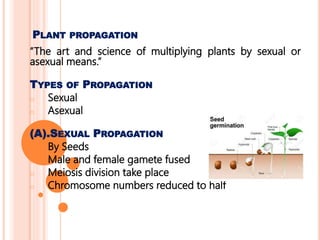
o By Seeds
o Male and female gamete fused
o Meiosis division take place
o Chromosome numbers reduced to half
Advantages of Sexual propagation
o Simple and easy
o Create diversity
o Long life cycle
o Express tolerance against stress
o Rootstock preparation
o e.i. Papaya and Coconut
Disadvantages of Sexual propagation
o Not true to type
o Plant possess long juvenile phase
o Plant are heighted and gigantic in nature
o Obtain inferior quality yield
o Parental disease transmission
Disadvantages of Asexual propagation
 Short life
 Lessen diversity
 Disease transmission e.i. citrus tristeza
(B). Asexual Propagation
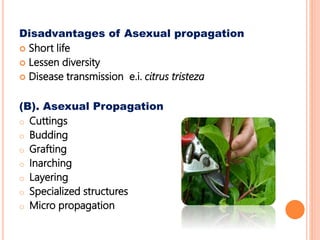
o Cuttings
o Budding
o Grafting
o Inarching
o Layering
o Specialized structures
o Micro propagation
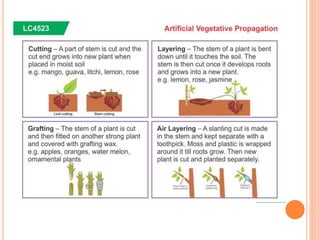
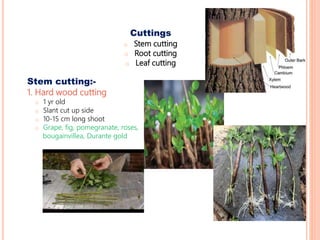
Cuttings
o Stem cutting
o Root cutting
o Leaf cutting
Stem cutting:-
1. Hard wood cutting
o 1 yr old
o Slant cut up side
o 10-15 cm long shoot
o Grape, fig, pomegranate, roses,
bougainvillea, Durante gold
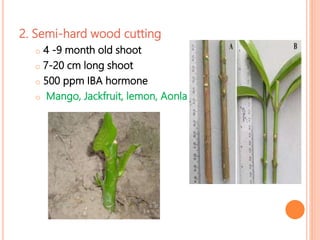
2. Semi-hard wood cutting
o 4 -9 month old shoot
o 7-20 cm long shoot
o 500 ppm IBA hormone
o Mango, Jackfruit, lemon, Aonla
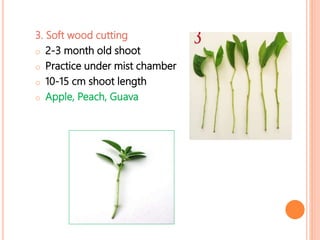
3. Soft wood cutting
o 2-3 month old shoot
o Practice under mist chamber
o 10-15 cm shoot length
o Apple, Peach, Guava
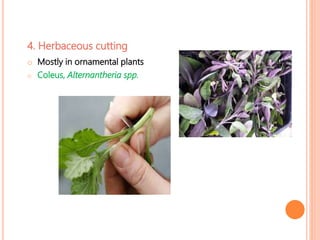
4. Herbaceous cutting
o Mostly in ornamental plants
o Coleus, Alternantheria spp.
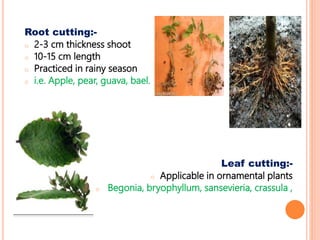
Root cutting:-
o 2-3 cm thickness shoot
o 10-15 cm length
o Practiced in rainy season
o i.e. Apple, pear, guava, bael.
Leaf cutting:-
o Applicable in ornamental plants
o Begonia, bryophyllum, sansevieria, crassula ,
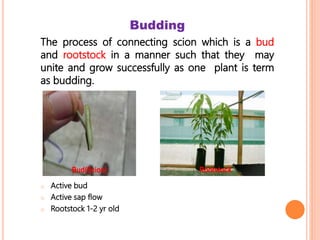
Budding
The process of connecting scion which is a bud
and rootstock in a manner such that they may
unite and grow successfully as one plant is term
as budding.
o Active bud
o Active sap flow
o Rootstock 1-2 yr old
Bud(Scion) Rootstock
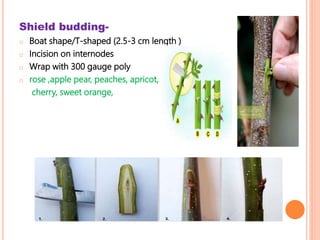
Shield budding-
o Boat shape/T-shaped (2.5-3 cm length )
o Incision on internodes
o Wrap with 300 gauge poly
o rose ,apple pear, peaches, apricot,
cherry, sweet orange,
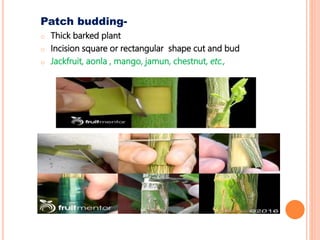
Patch budding-
o Thick barked plant
o Incision square or rectangular shape cut and bud
o Jackfruit, aonla , mango, jamun, chestnut, etc.,
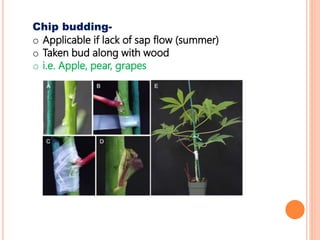
Chip budding-
o Applicable if lack of sap flow (summer)
o Taken bud along with wood
o i.e. Apple, pear, grapes
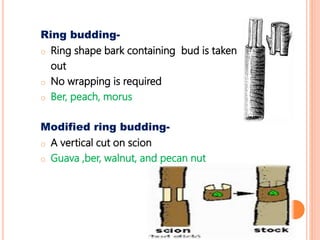
Ring budding-
o Ring shape bark containing bud is taken
out
o No wrapping is required
o Ber, peach, morus
Modified ring budding-
o A vertical cut on scion
o Guava ,ber, walnut, and pecan nut
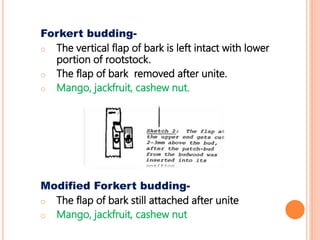
Forkert budding-
o The vertical flap of bark is left intact with lower
portion of rootstock.
o The flap of bark removed after unite.
o Mango, jackfruit, cashew nut.
Modified Forkert budding-
o The flap of bark still attached after unite
o Mango, jackfruit, cashew nut
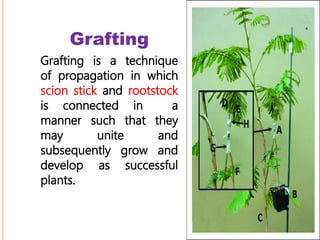
Grafting
Grafting is a technique
of propagation in which
scion stick and rootstock
is connected in a
manner such that they
may unite and
subsequently grow and
develop as successful
plants.
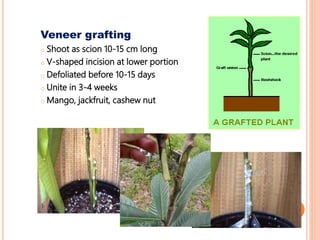
Veneer grafting
o Shoot as scion 10-15 cm long
o V-shaped incision at lower portion
o Defoliated before 10-15 days
o Unite in 3-4 weeks
o Mango, jackfruit, cashew nut
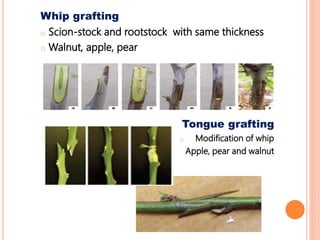
Whip grafting
o Scion-stock and rootstock with same thickness
o Walnut, apple, pear
Tongue grafting
o Modification of whip
o Apple, pear and walnut
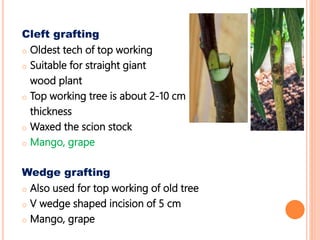
Cleft grafting
o Oldest tech of top working
o Suitable for straight giant
wood plant
o Top working tree is about 2-10 cm
thickness
o Waxed the scion stock
o Mango, grape
Wedge grafting
o Also used for top working of old tree
o V wedge shaped incision of 5 cm
o Mango, grape
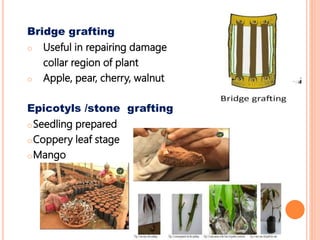
Bridge grafting
o Useful in repairing damage
collar region of plant
o Apple, pear, cherry, walnut
Epicotyls /stone grafting
oSeedling prepared
oCoppery leaf stage
oMango
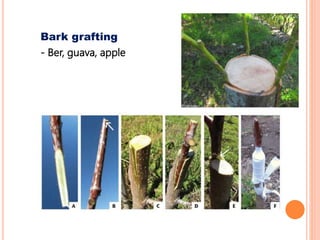
Bark grafting
- Ber, guava, apple
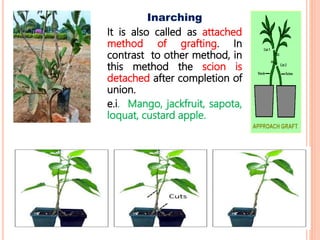
Inarching
It is also called as attached
method of grafting. In
contrast to other method, in
this method the scion is
detached after completion of
union.
e.i. Mango, jackfruit, sapota,
loquat, custard apple.
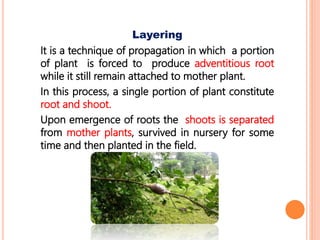
Layering
It is a technique of propagation in which a portion
of plant is forced to produce adventitious root
while it still remain attached to mother plant.
In this process, a single portion of plant constitute
root and shoot.
Upon emergence of roots the shoots is separated
from mother plants, survived in nursery for some
time and then planted in the field.
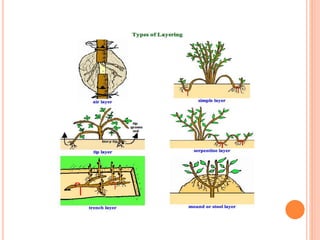
Types of Layering
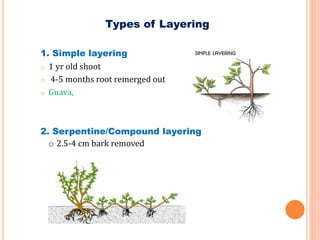
1. Simple layering
o 1 yr old shoot
o 4-5 months root remerged out
o Guava,
2. Serpentine/Compound layering
o 2.5-4 cm bark removed
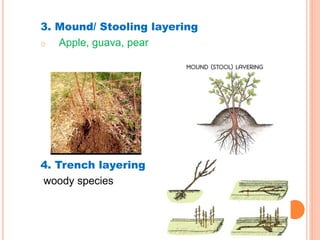
3. Mound/ Stooling layering
o Apple, guava, pear
4. Trench layering
woody species
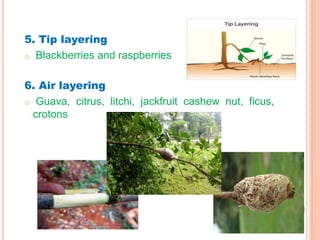
5. Tip layering
o Blackberries and raspberries
6. Air layering
o Guava, citrus, litchi, jackfruit cashew nut, ficus,
crotons
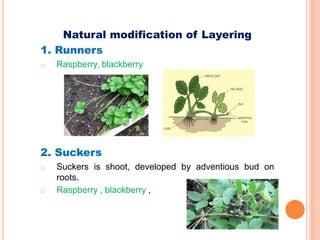
Natural modification of Layering
1. Runners
o Raspberry, blackberry
2. Suckers
o Suckers is shoot, developed by adventious bud on
roots.
o Raspberry , blackberry ,
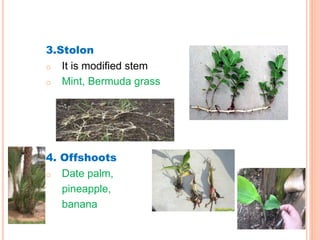
3.Stolon
o It is modified stem
o Mint, Bermuda grass
4. Offshoots
o Date palm,
pineapple,
banana
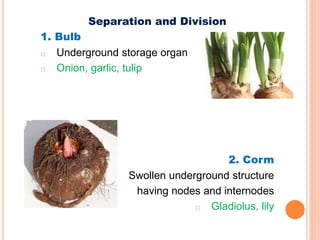
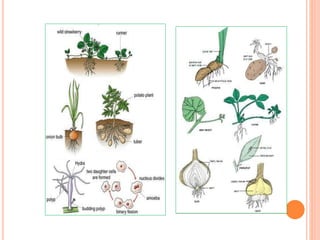
Separation and Division
1. Bulb
o Underground storage organ
o Onion, garlic, tulip
2. Corm
o Swollen underground structure
having nodes and internodes
o Gladiolus, lily
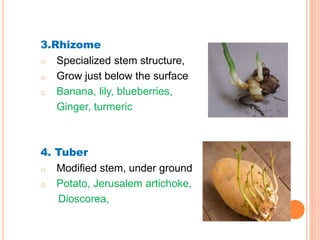
3.Rhizome
o Specialized stem structure,
o Grow just below the surface
o Banana, lily, blueberries,
Ginger, turmeric
4. Tuber
o Modified stem, under ground
o Potato, Jerusalem artichoke,
Dioscorea,
Separation and Division
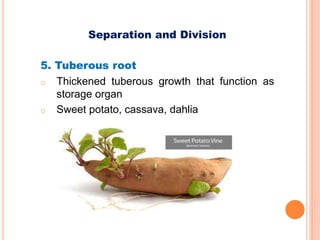
5. Tuberous root
o Thickened tuberous growth that function as
storage organ
o Sweet potato, cassava, dahlia
Plant Propagation Methods

Plant Propagation Methods

  • 1.
    MANGALAYATAN UNIVERSITY, JABALPUR DEPARTMENTOF AGRICULTURE ‘Plant Propagation Technique of orchard crops ’ Presented by: Dr. Sunil Prajapati Assistant Professor (Agriculture)
  • 2.
    PLANT PROPAGATION “The artand science of multiplying plants by sexual or asexual means.” TYPES OF PROPAGATION o Sexual o Asexual (A).SEXUAL PROPAGATION o By Seeds o Male and female gamete fused o Meiosis division take place o Chromosome numbers reduced to half
  • 3.
    Advantages of Sexualpropagation o Simple and easy o Create diversity o Long life cycle o Express tolerance against stress o Rootstock preparation o e.i. Papaya and Coconut Disadvantages of Sexual propagation o Not true to type o Plant possess long juvenile phase o Plant are heighted and gigantic in nature o Obtain inferior quality yield o Parental disease transmission
  • 4.
    Disadvantages of Asexualpropagation  Short life  Lessen diversity  Disease transmission e.i. citrus tristeza (B). Asexual Propagation o Cuttings o Budding o Grafting o Inarching o Layering o Specialized structures o Micro propagation
  • 6.
    Cuttings o Stem cutting oRoot cutting o Leaf cutting Stem cutting:- 1. Hard wood cutting o 1 yr old o Slant cut up side o 10-15 cm long shoot o Grape, fig, pomegranate, roses, bougainvillea, Durante gold
  • 7.
    2. Semi-hard woodcutting o 4 -9 month old shoot o 7-20 cm long shoot o 500 ppm IBA hormone o Mango, Jackfruit, lemon, Aonla
  • 8.
    3. Soft woodcutting o 2-3 month old shoot o Practice under mist chamber o 10-15 cm shoot length o Apple, Peach, Guava
  • 9.
    4. Herbaceous cutting oMostly in ornamental plants o Coleus, Alternantheria spp.
  • 10.
    Root cutting:- o 2-3cm thickness shoot o 10-15 cm length o Practiced in rainy season o i.e. Apple, pear, guava, bael. Leaf cutting:- o Applicable in ornamental plants o Begonia, bryophyllum, sansevieria, crassula ,
  • 11.
    Budding The process ofconnecting scion which is a bud and rootstock in a manner such that they may unite and grow successfully as one plant is term as budding. o Active bud o Active sap flow o Rootstock 1-2 yr old Bud(Scion) Rootstock
  • 12.
    Shield budding- o Boatshape/T-shaped (2.5-3 cm length ) o Incision on internodes o Wrap with 300 gauge poly o rose ,apple pear, peaches, apricot, cherry, sweet orange,
  • 13.
    Patch budding- o Thickbarked plant o Incision square or rectangular shape cut and bud o Jackfruit, aonla , mango, jamun, chestnut, etc.,
  • 14.
    Chip budding- o Applicableif lack of sap flow (summer) o Taken bud along with wood o i.e. Apple, pear, grapes
  • 15.
    Ring budding- o Ringshape bark containing bud is taken out o No wrapping is required o Ber, peach, morus Modified ring budding- o A vertical cut on scion o Guava ,ber, walnut, and pecan nut
  • 16.
    Forkert budding- o Thevertical flap of bark is left intact with lower portion of rootstock. o The flap of bark removed after unite. o Mango, jackfruit, cashew nut. Modified Forkert budding- o The flap of bark still attached after unite o Mango, jackfruit, cashew nut
  • 17.
    Grafting Grafting is atechnique of propagation in which scion stick and rootstock is connected in a manner such that they may unite and subsequently grow and develop as successful plants.
  • 18.
    Veneer grafting o Shootas scion 10-15 cm long o V-shaped incision at lower portion o Defoliated before 10-15 days o Unite in 3-4 weeks o Mango, jackfruit, cashew nut
  • 19.
    Whip grafting o Scion-stockand rootstock with same thickness o Walnut, apple, pear Tongue grafting o Modification of whip o Apple, pear and walnut
  • 20.
    Cleft grafting o Oldesttech of top working o Suitable for straight giant wood plant o Top working tree is about 2-10 cm thickness o Waxed the scion stock o Mango, grape Wedge grafting o Also used for top working of old tree o V wedge shaped incision of 5 cm o Mango, grape
  • 21.
    Bridge grafting o Usefulin repairing damage collar region of plant o Apple, pear, cherry, walnut Epicotyls /stone grafting oSeedling prepared oCoppery leaf stage oMango
  • 22.
  • 23.
    Inarching It is alsocalled as attached method of grafting. In contrast to other method, in this method the scion is detached after completion of union. e.i. Mango, jackfruit, sapota, loquat, custard apple.
  • 24.
    Layering It is atechnique of propagation in which a portion of plant is forced to produce adventitious root while it still remain attached to mother plant. In this process, a single portion of plant constitute root and shoot. Upon emergence of roots the shoots is separated from mother plants, survived in nursery for some time and then planted in the field.
  • 25.
    Types of Layering 1.Simple layering o 1 yr old shoot o 4-5 months root remerged out o Guava, 2. Serpentine/Compound layering o 2.5-4 cm bark removed
  • 26.
    3. Mound/ Stoolinglayering o Apple, guava, pear 4. Trench layering woody species
  • 27.
    5. Tip layering oBlackberries and raspberries 6. Air layering o Guava, citrus, litchi, jackfruit cashew nut, ficus, crotons
  • 29.
    Natural modification ofLayering 1. Runners o Raspberry, blackberry 2. Suckers o Suckers is shoot, developed by adventious bud on roots. o Raspberry , blackberry ,
  • 30.
    3.Stolon o It ismodified stem o Mint, Bermuda grass 4. Offshoots o Date palm, pineapple, banana
  • 31.
    Separation and Division 1.Bulb o Underground storage organ o Onion, garlic, tulip 2. Corm o Swollen underground structure having nodes and internodes o Gladiolus, lily
  • 32.
    3.Rhizome o Specialized stemstructure, o Grow just below the surface o Banana, lily, blueberries, Ginger, turmeric 4. Tuber o Modified stem, under ground o Potato, Jerusalem artichoke, Dioscorea,
  • 33.
    Separation and Division 5.Tuberous root o Thickened tuberous growth that function as storage organ o Sweet potato, cassava, dahlia