PLANT
PROPAGATION
Presented By: Ms. Seema Rajapure. M.Sc B.Ed
Contents:
 Introduction
 Seed propagation
 Cutting
 Grafting
 Budding
 Division
 Layering
 Tissue culture
Introduction
 The process or multiplying or increasing the number
or plants of the same species and at the same time
perpetuating their desirable characteristics.
 Each plant responds differently to different
methods of propagation.
 Various techniques of propagation have been
developed with the objective to have uniformity in
crops, early bearing, increased production,
resistance against pests and diseases, and introduce
certain characters in new generation.
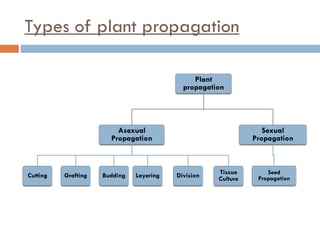
Types of plant propagation
Plant
propagation
Asexual
Propagation
Cutting Grafting Budding Layering Division Tissue
Culture
Sexual
Propagation
Seed
Propagation
Sexual Propagation of plant
 Sexual propagation is propagation or multiplication
of plants by seeds.
 Seeds are formed as a result of successful
fertilization and combination of parental gametes.
 It is widely used for the propagation of crops like
ornamental annuals, vegetables, medicinal and fruit
plants.
Seed Propagation
 The propagation or reproducing of plants from
seeds.
 Pollen is transferred from the anther to the stigma.
 Fertilization occurs and seeds are produced
 Viruses don’t transmit through seeds, thus mostly the
seedlings are free from virus diseases.
Planting of seeds
 Planting depth depends on the size of the seeds.
 The larger the seed, the deeper it is planted.
 Small seeds should be watered by
bottom soaking.
Germination
 Germination rate is the % that sprout.
 Example: 75 out of 100 = 75%
 Rates affected by….
o Seed viability.
o Temperature.
o Moisture.
oType of plant.
o Quality of seed.
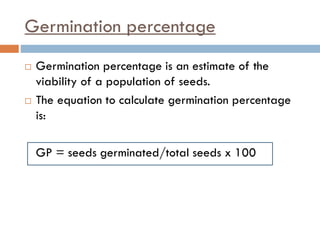
Germination percentage
 Germination percentage is an estimate of the
viability of a population of seeds.
 The equation to calculate germination percentage
is:
GP = seeds germinated/total seeds x 100
Pre – germination Seed Treatment
 Chemical (Acid scarification):
o The purpose is to modify hard or important or
impermeable seed covering generally soaking seed
in concentrated sulphuric acid is an effective
method.
o The time of treatment may vary from 10 minutes to
6 hour according to species.
o After treatment seeds are thoroughly washed in
clean water to make them free of acid and then re
sown immediately.
Cont…
 Mechanical(Scarification):
o Involves breaking or weakening the seed coat and
can be carried out using sand paper or a file to
abrade the seed coat or using a knife to nick the
coat or using a hammer to crack the coat for
allowing water to enter.
o Make attention to not crush the seed as to damage
the embryo.
Cont…
 Seedling (Boiled Water Treatment):
o Pouring boiling water over seeds and getting it to
cool gradually for about 12 to 24 Hour to soften
dry and hard shelled seeds.
o E.g. Coffee, This will hasten the process of
germination.
Cont…
 Soaking in Water:
o The purpose of soaking seeds in water is to modify
hard seed coats, to remove inhibitors, to soften seed
and to reduce the time of germination.
o The time of soaking seeds in cold water depend
upon the hardness of the seed coat.
o Eg: peas, beans, acassia tree etc.
Cont…
 Stratification (Moist Chilling):
o Seed of many woody trees or shrubs are exposed to
low temperature to bring about prompt and uniform
germination.
o It has some benefit in softening the seed coats.
o The seeds are arranged in alternate layers of sand
in shallow boxes for pits or trenches.
o This condition helps in rapid germination peach
cherry, plum, oat, grapes.
Asexual Propagation in plants
 The vegetative parts of a plant like leaf, stem, root or
their modified forms are used for propagation.
 Most of the horticultural crops are commercially
propagated by this method.
 Have short juvenile phase, thus come into bearing
earlier than seedling plants.
 Plants are derived from single parent thus there is no
genetic changes.
 Plant propagated through asexual propagation has
same features as the parent plant.
Methods of Asexual Propagation
 Cutting
 Grafting
 Budding
 Division
 Layering
 Tissue culture
Cutting
 Detaching portion of the selected motherplant for
the purpose of producing new plants
 The three main types of cuttings are….
 Stem
 Leaf
 Root
Stem Cutting
 Based on the age and maturity of shoots detached
for vegetative propagation.
 stem cuttings is of four types:
(i) Hardwood cutting
(ii) Semi-hardwood cutting
(iii) Softwood cutting
(iv) Herbaceous cutting
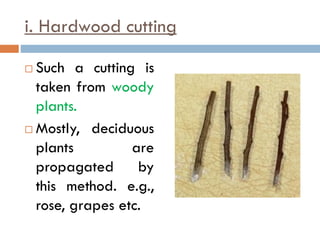
i. Hardwood cutting
 Such a cutting is
taken from woody
plants.
 Mostly, deciduous
plants are
propagated by
this method. e.g.,
rose, grapes etc.
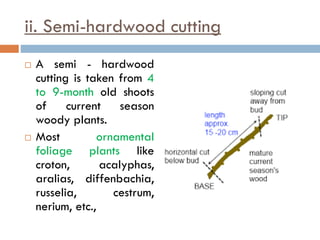
ii. Semi-hardwood cutting
 A semi - hardwood
cutting is taken from 4
to 9-month old shoots
of current season
woody plants.
 Most ornamental
foliage plants like
croton, acalyphas,
aralias, diffenbachia,
russelia, cestrum,
nerium, etc.,
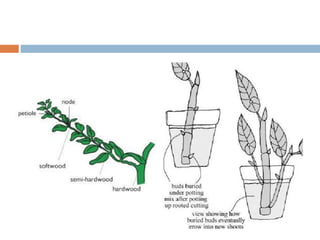
iii. Softwood cutting
 Such a cutting is taken from herbaceous or succulent
plants.
 Shoots of 2 to 3-month old plants are selected for
softwood cuttings.
 Example: salternanthera, coleus, duranta,
clerodendrum, etc.
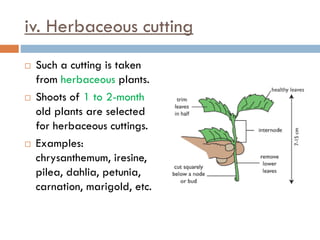
iv. Herbaceous cutting
 Such a cutting is taken
from herbaceous plants.
 Shoots of 1 to 2-month
old plants are selected
for herbaceous cuttings.
 Examples:
chrysanthemum, iresine,
pilea, dahlia, petunia,
carnation, marigold, etc.
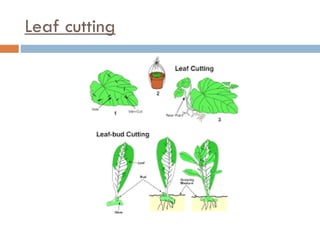
Leaf cutting
 Plants with thick fleshy leaves having buds are
propagated by leaf cutting.
 Vegetative buds are present in the notches of leaf
margin (bryophyllum) or on the vein (begonia rex).
 Leaf blade or pieces of it with bud are put on the
rooting medium under favourable conditions.
 In case of black raspberry, the leaf blade, along
with petiole and a short piece of the stem with
attached axillary buds, are kept in the medium for
rooting.
Leaf cutting
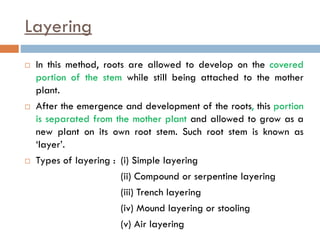
Layering
 In this method, roots are allowed to develop on the covered
portion of the stem while still being attached to the mother
plant.
 After the emergence and development of the roots, this portion
is separated from the mother plant and allowed to grow as a
new plant on its own root stem. Such root stem is known as
‘layer’.
 Types of layering : (i) Simple layering
(ii) Compound or serpentine layering
(iii) Trench layering
(iv) Mound layering or stooling
(v) Air layering
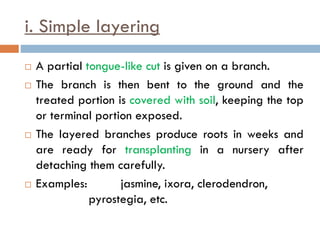
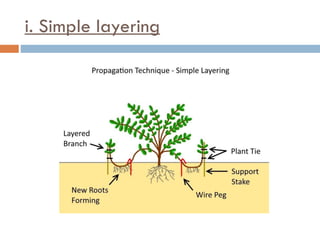
i. Simple layering
 A partial tongue-like cut is given on a branch.
 The branch is then bent to the ground and the
treated portion is covered with soil, keeping the top
or terminal portion exposed.
 The layered branches produce roots in weeks and
are ready for transplanting in a nursery after
detaching them carefully.
 Examples: jasmine, ixora, clerodendron,
pyrostegia, etc.
i. Simple layering
ii. Compound or serpentine layering
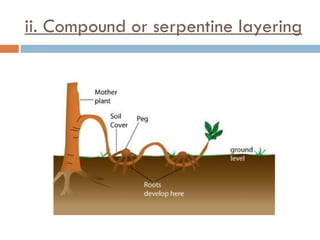
 Compound layering is similar to simple layering,
except the branches are alternately covered and
exposed along their length.
 The branches must be longer so that they can be
layered at several places.
 Eg: bougainvillea, jasmine, clematis,
muscadine grape and wisteria.
ii. Compound or serpentine layering
iii. Trench layering
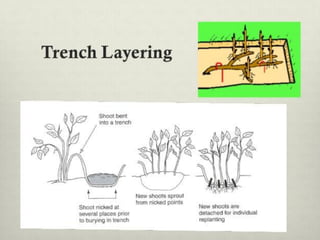
 Trench layering is primarily used in fruit plants.
 Covering the shoots with soil results in etiolation, so
it is also known as ‘etiolation layering’.
 New shoots arise from the length of the burried
buds and roots form under soil.
 After rooting, individual shoots are separated from
the mother plant.
 Eg: apple, cherry, pear, jasmine and
rhododendron.
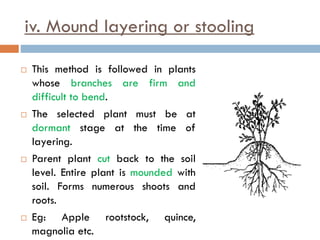
iv. Mound layering or stooling
 This method is followed in plants
whose branches are firm and
difficult to bend.
 The selected plant must be at
dormant stage at the time of
layering.
 Parent plant cut back to the soil
level. Entire plant is mounded with
soil. Forms numerous shoots and
roots.
 Eg: Apple rootstock, quince,
magnolia etc.
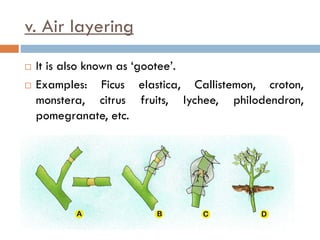
v. Air layering
 It is also known as ‘gootee’.
 Examples: Ficus elastica, Callistemon, croton,
monstera, citrus fruits, lychee, philodendron,
pomegranate, etc.
Grafting
 The method of joining parts of two plants in a
manner that they form a unit and function as one
plant is known as ‘grafting’.
 Rootstock: The part of the graft that provides root
system to the grafted plant.
 Scion: The upper portion of graft combination taken
from the desired plant to be multiplied.
Methods of grafting :
1. Scion attached method -
 The scion shoot is not detached from the mother
plant until the union takes place.
 After the successful union of the scion and rootstock,
the scion is separated in gradual cut from the
mother plant.
 It is classified into two types:
i. Sliced approach grafting
ii. Tongue grafting
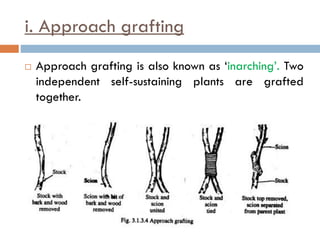
i. Approach grafting
 Approach grafting is also known as ‘inarching’. Two
independent self-sustaining plants are grafted
together.
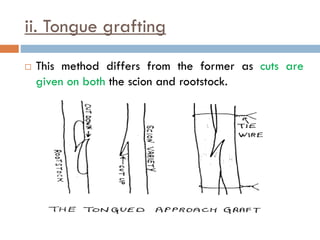
ii. Tongue grafting
 This method differs from the former as cuts are
given on both the scion and rootstock.
2. Scion detached method
 The scion is first detached from the mother plant,
and then, inserted or tied on the rootstock.
 Types of scion detached method:
I. Veneer grafting
II. Side grafting
III. Wedge or cleft grafting
IV. Stone or epicotyl grafting
V. Whip or splice grafting
VI. Bark grafting
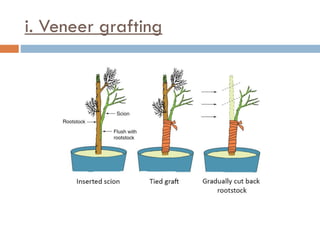
i. Veneer grafting
 In this, the vertical flap of the stock is completely
removed and a slanting cut is given on one side of
the scion.
 The best time in north India for veneer grafting is
March−April and July−August.
 Eg: Mango, cashew and peach are commercially
propagated by this technique.
i. Veneer grafting
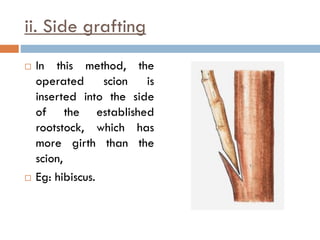
ii. Side grafting
 In this method, the
operated scion is
inserted into the side
of the established
rootstock, which has
more girth than the
scion,
 Eg: hibiscus.
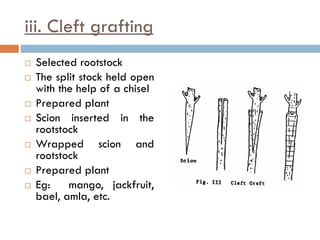
iii. Cleft grafting
 Selected rootstock
 The split stock held open
with the help of a chisel
 Prepared plant
 Scion inserted in the
rootstock
 Wrapped scion and
rootstock
 Prepared plant
 Eg: mango, jackfruit,
bael, amla, etc.
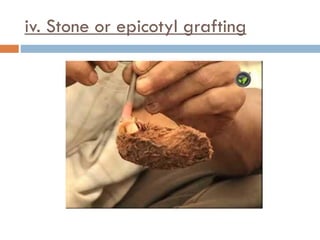
iv. Stone or epicotyl grafting
 This method is commonly adopted for the rapid
multiplication of mango plants.
 In this method, stones (seeds) are sown in polythene
bags or moist sand bed and covered with 5 to 7-cm
layer of leaf mould for germination.
 When the seedlings are about 15 days old, they
are taken out and grafted indoor.
iv. Stone or epicotyl grafting
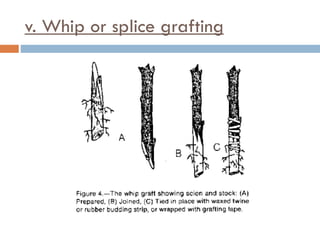
v. Whip or splice grafting
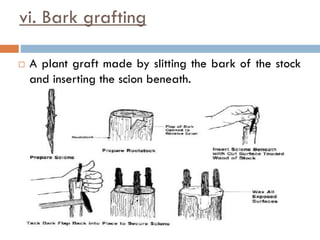
vi. Bark grafting
 A plant graft made by slitting the bark of the stock
and inserting the scion beneath.
Budding
 The process of inserting a single mature scion bud into
the stem (rootstock) in a way that results into a union
and continues to grow as a new plant.
Types of budding:
I. T – budding
II. Patch budding
III. Ring budding
IV. Flute budding
V. Forkert budding
VI. Chip budding
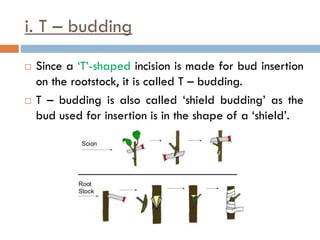
i. T – budding
 Since a ‘T’-shaped incision is made for bud insertion
on the rootstock, it is called T – budding.
 T – budding is also called ‘shield budding’ as the
bud used for insertion is in the shape of a ‘shield’.
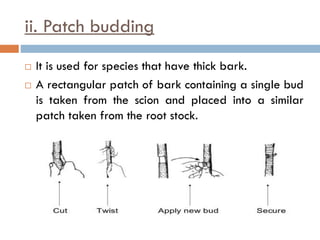
ii. Patch budding
 It is used for species that have thick bark.
 A rectangular patch of bark containing a single bud
is taken from the scion and placed into a similar
patch taken from the root stock.
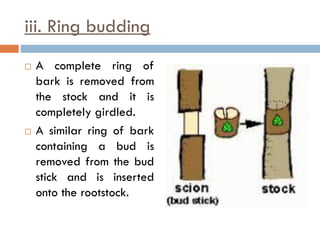
iii. Ring budding
 A complete ring of
bark is removed from
the stock and it is
completely girdled.
 A similar ring of bark
containing a bud is
removed from the bud
stick and is inserted
onto the rootstock.
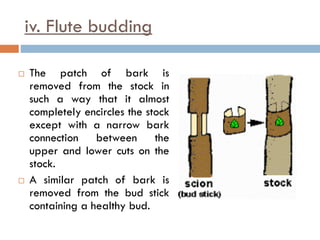
iv. Flute budding
 The patch of bark is
removed from the stock in
such a way that it almost
completely encircles the stock
except with a narrow bark
connection between the
upper and lower cuts on the
stock.
 A similar patch of bark is
removed from the bud stick
containing a healthy bud.
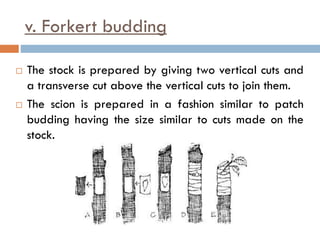
v. Forkert budding
 The stock is prepared by giving two vertical cuts and
a transverse cut above the vertical cuts to join them.
 The scion is prepared in a fashion similar to patch
budding having the size similar to cuts made on the
stock.
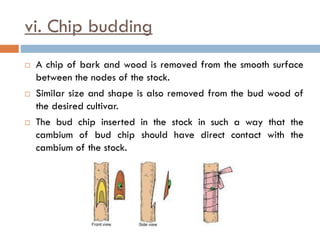
vi. Chip budding
 A chip of bark and wood is removed from the smooth surface
between the nodes of the stock.
 Similar size and shape is also removed from the bud wood of
the desired cultivar.
 The bud chip inserted in the stock in such a way that the
cambium of bud chip should have direct contact with the
cambium of the stock.
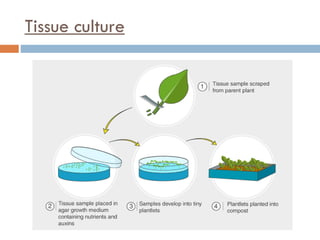
Tissue culture
References
 http://ncert.nic.in/vocational/pdf/kegr103.pdf
 https://www.sas.upenn.edu/~dailey/VegetativePro
pagationTechniques.pdf
 http://ecoursesonline.iasri.res.in/mod/page/view.p
hp?id=96828
 https://irrecenvhort.ifas.ufl.edu/plant-prop-
glossary/06-grafting/03-buddingtypes/04-
grafting-budflute.html

Plant propagation

  • 1.
    PLANT PROPAGATION Presented By: Ms.Seema Rajapure. M.Sc B.Ed
  • 2.
    Contents:  Introduction  Seedpropagation  Cutting  Grafting  Budding  Division  Layering  Tissue culture
  • 3.
    Introduction  The processor multiplying or increasing the number or plants of the same species and at the same time perpetuating their desirable characteristics.  Each plant responds differently to different methods of propagation.  Various techniques of propagation have been developed with the objective to have uniformity in crops, early bearing, increased production, resistance against pests and diseases, and introduce certain characters in new generation.
  • 4.
    Types of plantpropagation Plant propagation Asexual Propagation Cutting Grafting Budding Layering Division Tissue Culture Sexual Propagation Seed Propagation
  • 5.
    Sexual Propagation ofplant  Sexual propagation is propagation or multiplication of plants by seeds.  Seeds are formed as a result of successful fertilization and combination of parental gametes.  It is widely used for the propagation of crops like ornamental annuals, vegetables, medicinal and fruit plants.
  • 6.
    Seed Propagation  Thepropagation or reproducing of plants from seeds.  Pollen is transferred from the anther to the stigma.  Fertilization occurs and seeds are produced  Viruses don’t transmit through seeds, thus mostly the seedlings are free from virus diseases.
  • 7.
    Planting of seeds Planting depth depends on the size of the seeds.  The larger the seed, the deeper it is planted.  Small seeds should be watered by bottom soaking.
  • 8.
    Germination  Germination rateis the % that sprout.  Example: 75 out of 100 = 75%  Rates affected by…. o Seed viability. o Temperature. o Moisture. oType of plant. o Quality of seed.
  • 9.
    Germination percentage  Germinationpercentage is an estimate of the viability of a population of seeds.  The equation to calculate germination percentage is: GP = seeds germinated/total seeds x 100
  • 10.
    Pre – germinationSeed Treatment  Chemical (Acid scarification): o The purpose is to modify hard or important or impermeable seed covering generally soaking seed in concentrated sulphuric acid is an effective method. o The time of treatment may vary from 10 minutes to 6 hour according to species. o After treatment seeds are thoroughly washed in clean water to make them free of acid and then re sown immediately.
  • 11.
    Cont…  Mechanical(Scarification): o Involvesbreaking or weakening the seed coat and can be carried out using sand paper or a file to abrade the seed coat or using a knife to nick the coat or using a hammer to crack the coat for allowing water to enter. o Make attention to not crush the seed as to damage the embryo.
  • 12.
    Cont…  Seedling (BoiledWater Treatment): o Pouring boiling water over seeds and getting it to cool gradually for about 12 to 24 Hour to soften dry and hard shelled seeds. o E.g. Coffee, This will hasten the process of germination.
  • 13.
    Cont…  Soaking inWater: o The purpose of soaking seeds in water is to modify hard seed coats, to remove inhibitors, to soften seed and to reduce the time of germination. o The time of soaking seeds in cold water depend upon the hardness of the seed coat. o Eg: peas, beans, acassia tree etc.
  • 14.
    Cont…  Stratification (MoistChilling): o Seed of many woody trees or shrubs are exposed to low temperature to bring about prompt and uniform germination. o It has some benefit in softening the seed coats. o The seeds are arranged in alternate layers of sand in shallow boxes for pits or trenches. o This condition helps in rapid germination peach cherry, plum, oat, grapes.
  • 15.
    Asexual Propagation inplants  The vegetative parts of a plant like leaf, stem, root or their modified forms are used for propagation.  Most of the horticultural crops are commercially propagated by this method.  Have short juvenile phase, thus come into bearing earlier than seedling plants.  Plants are derived from single parent thus there is no genetic changes.  Plant propagated through asexual propagation has same features as the parent plant.
  • 16.
    Methods of AsexualPropagation  Cutting  Grafting  Budding  Division  Layering  Tissue culture
  • 17.
    Cutting  Detaching portionof the selected motherplant for the purpose of producing new plants  The three main types of cuttings are….  Stem  Leaf  Root
  • 18.
    Stem Cutting  Basedon the age and maturity of shoots detached for vegetative propagation.  stem cuttings is of four types: (i) Hardwood cutting (ii) Semi-hardwood cutting (iii) Softwood cutting (iv) Herbaceous cutting
  • 19.
    i. Hardwood cutting Such a cutting is taken from woody plants.  Mostly, deciduous plants are propagated by this method. e.g., rose, grapes etc.
  • 20.
    ii. Semi-hardwood cutting A semi - hardwood cutting is taken from 4 to 9-month old shoots of current season woody plants.  Most ornamental foliage plants like croton, acalyphas, aralias, diffenbachia, russelia, cestrum, nerium, etc.,
  • 21.
    iii. Softwood cutting Such a cutting is taken from herbaceous or succulent plants.  Shoots of 2 to 3-month old plants are selected for softwood cuttings.  Example: salternanthera, coleus, duranta, clerodendrum, etc.
  • 23.
    iv. Herbaceous cutting Such a cutting is taken from herbaceous plants.  Shoots of 1 to 2-month old plants are selected for herbaceous cuttings.  Examples: chrysanthemum, iresine, pilea, dahlia, petunia, carnation, marigold, etc.
  • 24.
    Leaf cutting  Plantswith thick fleshy leaves having buds are propagated by leaf cutting.  Vegetative buds are present in the notches of leaf margin (bryophyllum) or on the vein (begonia rex).  Leaf blade or pieces of it with bud are put on the rooting medium under favourable conditions.  In case of black raspberry, the leaf blade, along with petiole and a short piece of the stem with attached axillary buds, are kept in the medium for rooting.
  • 25.
  • 26.
    Layering  In thismethod, roots are allowed to develop on the covered portion of the stem while still being attached to the mother plant.  After the emergence and development of the roots, this portion is separated from the mother plant and allowed to grow as a new plant on its own root stem. Such root stem is known as ‘layer’.  Types of layering : (i) Simple layering (ii) Compound or serpentine layering (iii) Trench layering (iv) Mound layering or stooling (v) Air layering
  • 27.
    i. Simple layering A partial tongue-like cut is given on a branch.  The branch is then bent to the ground and the treated portion is covered with soil, keeping the top or terminal portion exposed.  The layered branches produce roots in weeks and are ready for transplanting in a nursery after detaching them carefully.  Examples: jasmine, ixora, clerodendron, pyrostegia, etc.
  • 28.
  • 29.
    ii. Compound orserpentine layering  Compound layering is similar to simple layering, except the branches are alternately covered and exposed along their length.  The branches must be longer so that they can be layered at several places.  Eg: bougainvillea, jasmine, clematis, muscadine grape and wisteria.
  • 30.
    ii. Compound orserpentine layering
  • 31.
    iii. Trench layering Trench layering is primarily used in fruit plants.  Covering the shoots with soil results in etiolation, so it is also known as ‘etiolation layering’.  New shoots arise from the length of the burried buds and roots form under soil.  After rooting, individual shoots are separated from the mother plant.  Eg: apple, cherry, pear, jasmine and rhododendron.
  • 33.
    iv. Mound layeringor stooling  This method is followed in plants whose branches are firm and difficult to bend.  The selected plant must be at dormant stage at the time of layering.  Parent plant cut back to the soil level. Entire plant is mounded with soil. Forms numerous shoots and roots.  Eg: Apple rootstock, quince, magnolia etc.
  • 34.
    v. Air layering It is also known as ‘gootee’.  Examples: Ficus elastica, Callistemon, croton, monstera, citrus fruits, lychee, philodendron, pomegranate, etc.
  • 35.
    Grafting  The methodof joining parts of two plants in a manner that they form a unit and function as one plant is known as ‘grafting’.  Rootstock: The part of the graft that provides root system to the grafted plant.  Scion: The upper portion of graft combination taken from the desired plant to be multiplied.
  • 36.
    Methods of grafting: 1. Scion attached method -  The scion shoot is not detached from the mother plant until the union takes place.  After the successful union of the scion and rootstock, the scion is separated in gradual cut from the mother plant.  It is classified into two types: i. Sliced approach grafting ii. Tongue grafting
  • 37.
    i. Approach grafting Approach grafting is also known as ‘inarching’. Two independent self-sustaining plants are grafted together.
  • 38.
    ii. Tongue grafting This method differs from the former as cuts are given on both the scion and rootstock.
  • 39.
    2. Scion detachedmethod  The scion is first detached from the mother plant, and then, inserted or tied on the rootstock.  Types of scion detached method: I. Veneer grafting II. Side grafting III. Wedge or cleft grafting IV. Stone or epicotyl grafting V. Whip or splice grafting VI. Bark grafting
  • 40.
    i. Veneer grafting In this, the vertical flap of the stock is completely removed and a slanting cut is given on one side of the scion.  The best time in north India for veneer grafting is March−April and July−August.  Eg: Mango, cashew and peach are commercially propagated by this technique.
  • 41.
  • 42.
    ii. Side grafting In this method, the operated scion is inserted into the side of the established rootstock, which has more girth than the scion,  Eg: hibiscus.
  • 43.
    iii. Cleft grafting Selected rootstock  The split stock held open with the help of a chisel  Prepared plant  Scion inserted in the rootstock  Wrapped scion and rootstock  Prepared plant  Eg: mango, jackfruit, bael, amla, etc.
  • 44.
    iv. Stone orepicotyl grafting  This method is commonly adopted for the rapid multiplication of mango plants.  In this method, stones (seeds) are sown in polythene bags or moist sand bed and covered with 5 to 7-cm layer of leaf mould for germination.  When the seedlings are about 15 days old, they are taken out and grafted indoor.
  • 45.
    iv. Stone orepicotyl grafting
  • 46.
    v. Whip orsplice grafting
  • 47.
    vi. Bark grafting A plant graft made by slitting the bark of the stock and inserting the scion beneath.
  • 48.
    Budding  The processof inserting a single mature scion bud into the stem (rootstock) in a way that results into a union and continues to grow as a new plant. Types of budding: I. T – budding II. Patch budding III. Ring budding IV. Flute budding V. Forkert budding VI. Chip budding
  • 49.
    i. T –budding  Since a ‘T’-shaped incision is made for bud insertion on the rootstock, it is called T – budding.  T – budding is also called ‘shield budding’ as the bud used for insertion is in the shape of a ‘shield’.
  • 50.
    ii. Patch budding It is used for species that have thick bark.  A rectangular patch of bark containing a single bud is taken from the scion and placed into a similar patch taken from the root stock.
  • 51.
    iii. Ring budding A complete ring of bark is removed from the stock and it is completely girdled.  A similar ring of bark containing a bud is removed from the bud stick and is inserted onto the rootstock.
  • 52.
    iv. Flute budding The patch of bark is removed from the stock in such a way that it almost completely encircles the stock except with a narrow bark connection between the upper and lower cuts on the stock.  A similar patch of bark is removed from the bud stick containing a healthy bud.
  • 53.
    v. Forkert budding The stock is prepared by giving two vertical cuts and a transverse cut above the vertical cuts to join them.  The scion is prepared in a fashion similar to patch budding having the size similar to cuts made on the stock.
  • 54.
    vi. Chip budding A chip of bark and wood is removed from the smooth surface between the nodes of the stock.  Similar size and shape is also removed from the bud wood of the desired cultivar.  The bud chip inserted in the stock in such a way that the cambium of bud chip should have direct contact with the cambium of the stock.
  • 55.
  • 56.
    References  http://ncert.nic.in/vocational/pdf/kegr103.pdf  https://www.sas.upenn.edu/~dailey/VegetativePro pagationTechniques.pdf http://ecoursesonline.iasri.res.in/mod/page/view.p hp?id=96828  https://irrecenvhort.ifas.ufl.edu/plant-prop- glossary/06-grafting/03-buddingtypes/04- grafting-budflute.html