NAND LAL BAGDANAND LAL BAGDA
JAIPURJAIPUR
CONTANTSCONTANTS
NUTRIENTS IN PLANTSNUTRIENTS IN PLANTS
NUTRITIONS –NUTRITIONS –
Food is the most important and basic thing forFood is the most important and basic thing for
life. Carbohydrates, proteins, fats, vitamins and minerals arelife. Carbohydrates, proteins, fats, vitamins and minerals are
the components of food. These components are necessary forthe components of food. These components are necessary for
all living beings. All plants and animals require food for theirall living beings. All plants and animals require food for their
growth and getting energy. The process of utilization of foodgrowth and getting energy. The process of utilization of food
by an animal to obtain energy for growth and development isby an animal to obtain energy for growth and development is
known as nutrition. Plants make their food themselves butknown as nutrition. Plants make their food themselves but
animals cannot. Hence, animals depend directly or indirectlyanimals cannot. Hence, animals depend directly or indirectly
on the plant.on the plant.
INTRODUCTION :-INTRODUCTION :-
CRIETERIA FORCRIETERIA FOR
ESSENTIALITYESSENTIALITY
THE ELEMENT MUST BETHE ELEMENT MUST BE
DIRECTLY INVOLVED INDIRECTLY INVOLVED IN
THE METABOLISM OF THETHE METABOLISM OF THE
PLANT.PLANT.
ELEMENTS MUST BEELEMENTS MUST BE
NECESSARY FORNECESSARY FOR
SUPPORTING NORMALSUPPORTING NORMAL
GROWTH ANDGROWTH AND
REPRODUCTION. INREPRODUCTION. IN
THE ABSENCE OFTHE ABSENCE OF
ELEMENTS THE PLANTELEMENTS THE PLANT
DO NOT COMPLETEDO NOT COMPLETE
THEIR LIFE CYCLE.THEIR LIFE CYCLE.
THE REQUIREMENT OFTHE REQUIREMENT OF
THE ELEMENT MUSTTHE ELEMENT MUST
BE SPECIFIC AND NOTBE SPECIFIC AND NOT
REPLACIBLE BYREPLACIBLE BY
ANOTHER ELEMENT.ANOTHER ELEMENT.
Plant NutritionPlant Nutrition
16 Essential Nutrients for16 Essential Nutrients for
Normal Plant GrowthNormal Plant Growth
Macro nutrientsMacro nutrients: macronutrients are: macronutrients are
generally present in plant tissue ingenerally present in plant tissue in
large amount (in excess of 10large amount (in excess of 10
mmole Kgmmole Kg-1-1
of dry matter).of dry matter).
 carboncarbon
 HydrogenHydrogen
 OxygenOxygen
 NitrogenNitrogen
 PhosphorousPhosphorous
 SulphurSulphur
 PotassiumPotassium
 CalciumCalcium
 Magnesium.Magnesium.
MACRO NUTRIENTSMACRO NUTRIENTS
M
A
C
R
O
N
U
T
R
I
E
N
T
S
are:
1. Nitrogen (N) ––
is needed for vegetativeis needed for vegetative
growth and dark greengrowth and dark green
color. (easily leached out)color. (easily leached out)
Nitrogen is the most importantNitrogen is the most important
nutrient.nutrient.
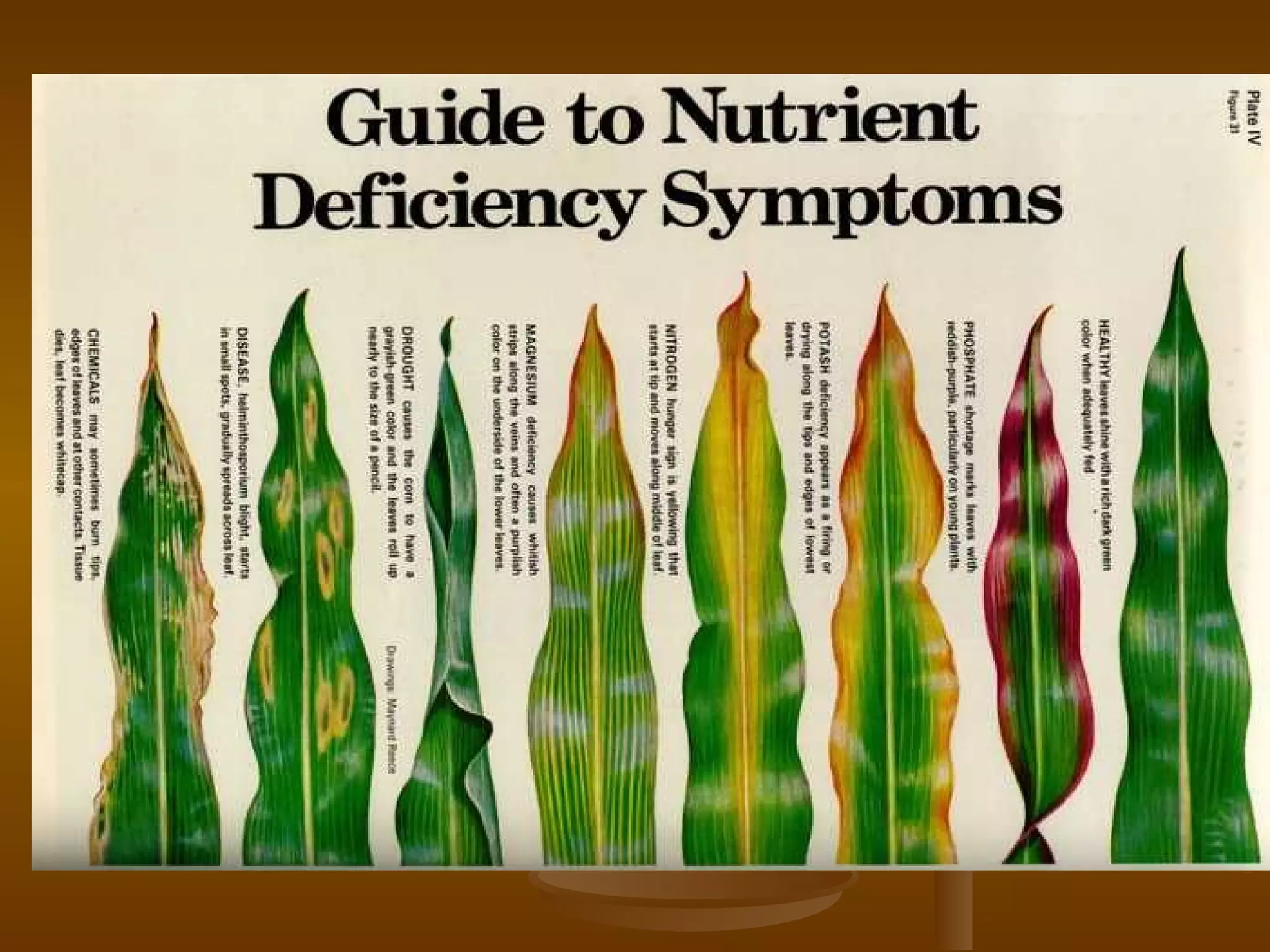
Deficiency signsDeficiency signs ––
reduced growth & yellowing ofreduced growth & yellowing of
lower leaves.lower leaves.
Yellowing is calledYellowing is called ChlorosisChlorosis
 2. Phosphorus (P)2. Phosphorus (P) ––
important for seedlingimportant for seedling
and young plant growthand young plant growth
and develop good rootand develop good root
system.system. (not easily leached out)(not easily leached out)
 AKA – PotashAKA – Potash
 Deficiency signs-Deficiency signs-
reduced growth, poor rootreduced growth, poor root
systems, reducedsystems, reduced
flowering. Also thinflowering. Also thin
stems and browning orstems and browning or
purpling of foliage.purpling of foliage.
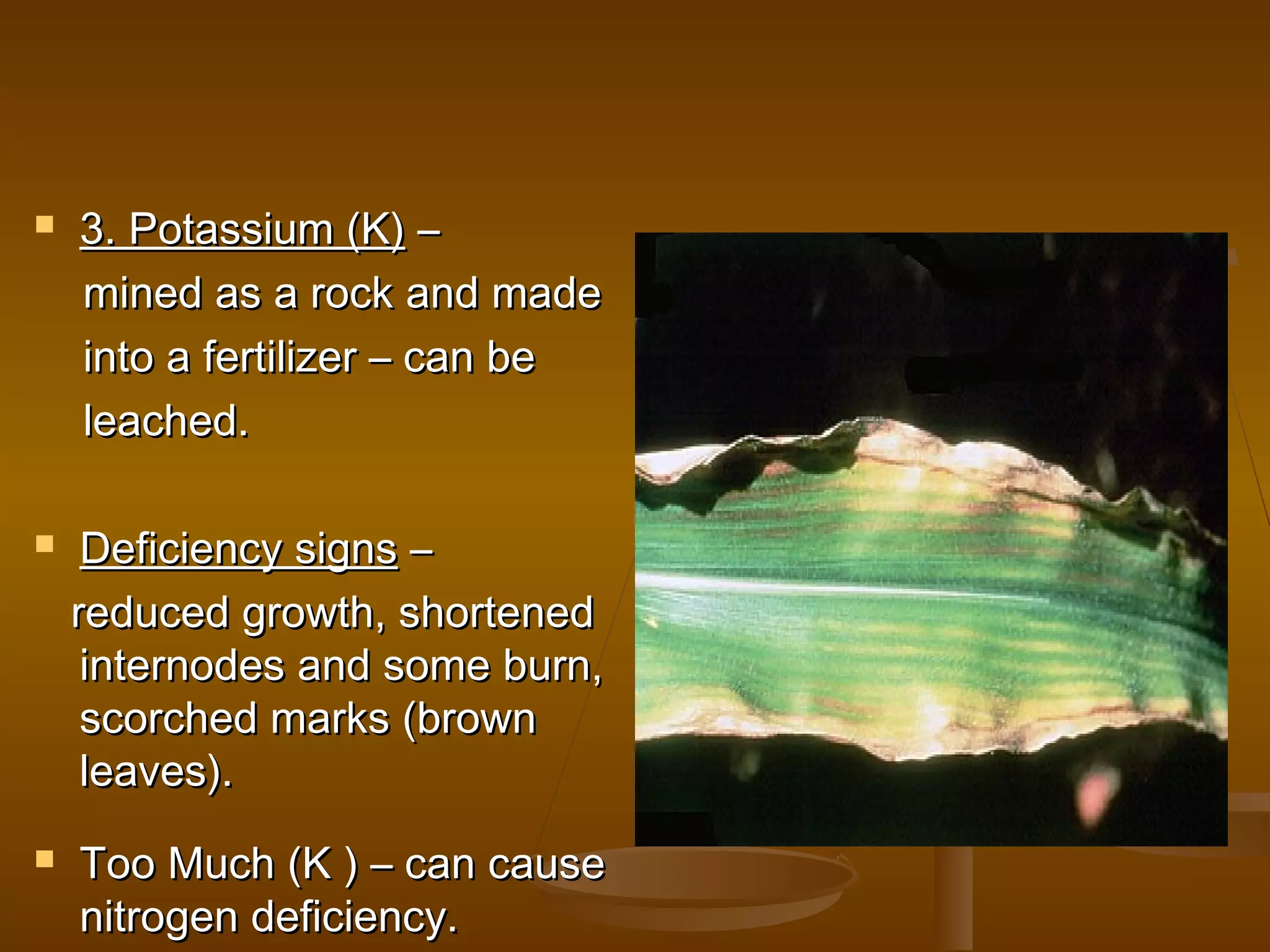
 3. Potassium (K)3. Potassium (K) ––
mined as a rock and mademined as a rock and made
into a fertilizer – can beinto a fertilizer – can be
leached.leached.
 Deficiency signsDeficiency signs ––
reduced growth, shortenedreduced growth, shortened
internodes and some burn,internodes and some burn,
scorched marks (brownscorched marks (brown
leaves).leaves).
 Too Much (K ) – can causeToo Much (K ) – can cause
nitrogen deficiency.nitrogen deficiency.
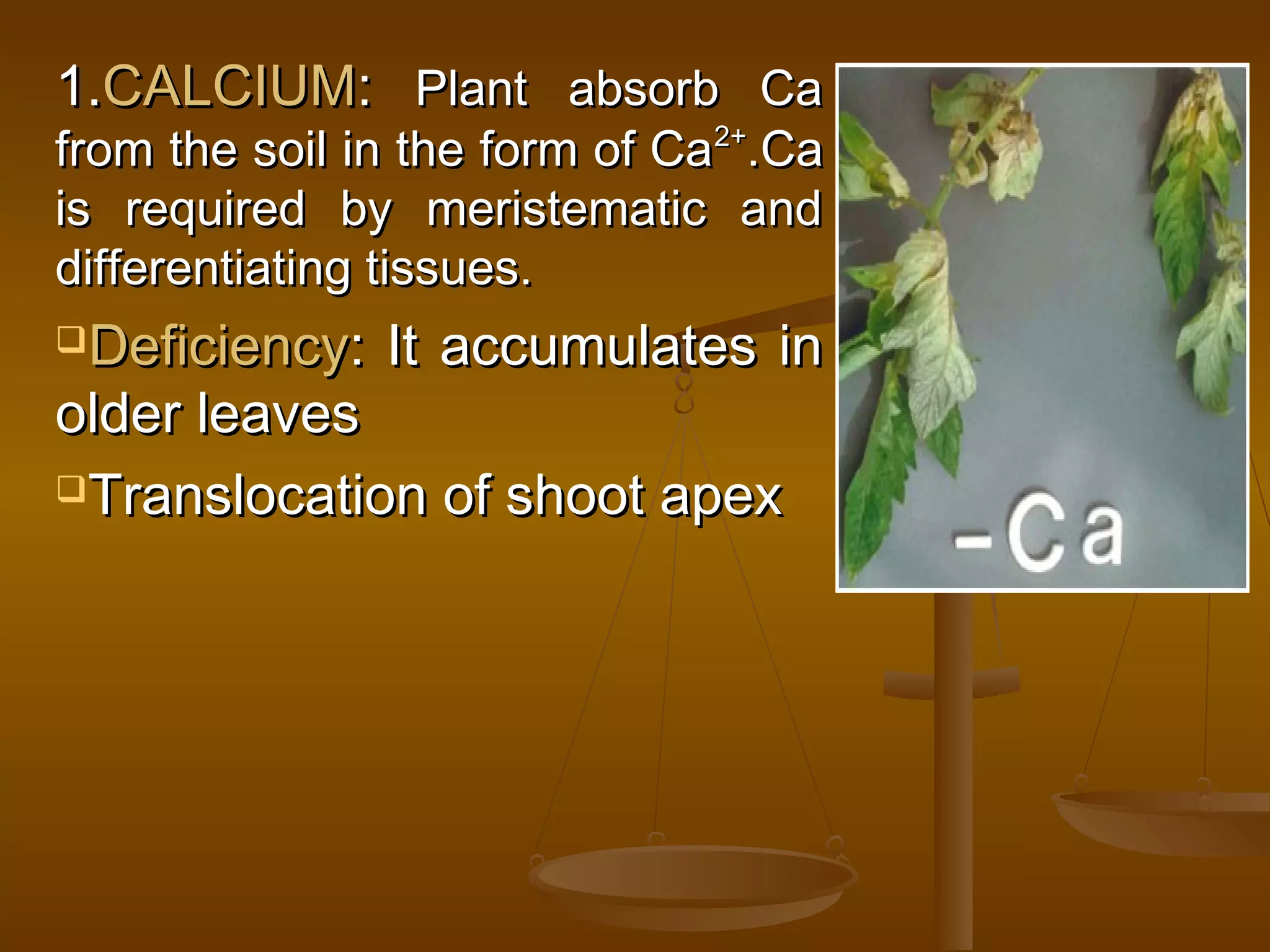
1.1.CALCIUMCALCIUM:: Plant absorb CaPlant absorb Ca
from the soil in the form of Cafrom the soil in the form of Ca2+2+
.Ca.Ca
is required by meristematic andis required by meristematic and
differentiating tissues.differentiating tissues.
DeficiencyDeficiency: It accumulates in: It accumulates in
older leavesolder leaves
Translocation of shoot apexTranslocation of shoot apex
MicronutrientsMicronutrients
 They are used in small quantities – and obtained fromThey are used in small quantities – and obtained from
the soil. (excess amounts are toxic)the soil. (excess amounts are toxic)
 Boron, (B)Boron, (B)
 Chlorine (Cl)Chlorine (Cl)
 Copper (Cu)Copper (Cu)
 Iron (Fe)Iron (Fe)
 Manganese (Mn)Manganese (Mn)
 Molybenum (Mo)Molybenum (Mo)
 Zinc (Zn)Zinc (Zn)
 Nickel (ni)Nickel (ni)
ROLE OF MACRO AND MICROROLE OF MACRO AND MICRO
NUTRIENTNUTRIENT
MICRO AND MACRO NUTRITION IN PLANT

MICRO AND MACRO NUTRITION IN PLANT

  • 1.
    NAND LAL BAGDANANDLAL BAGDA JAIPURJAIPUR
  • 2.
  • 3.
    NUTRITIONS –NUTRITIONS – Foodis the most important and basic thing forFood is the most important and basic thing for life. Carbohydrates, proteins, fats, vitamins and minerals arelife. Carbohydrates, proteins, fats, vitamins and minerals are the components of food. These components are necessary forthe components of food. These components are necessary for all living beings. All plants and animals require food for theirall living beings. All plants and animals require food for their growth and getting energy. The process of utilization of foodgrowth and getting energy. The process of utilization of food by an animal to obtain energy for growth and development isby an animal to obtain energy for growth and development is known as nutrition. Plants make their food themselves butknown as nutrition. Plants make their food themselves but animals cannot. Hence, animals depend directly or indirectlyanimals cannot. Hence, animals depend directly or indirectly on the plant.on the plant. INTRODUCTION :-INTRODUCTION :-
  • 4.
    CRIETERIA FORCRIETERIA FOR ESSENTIALITYESSENTIALITY THEELEMENT MUST BETHE ELEMENT MUST BE DIRECTLY INVOLVED INDIRECTLY INVOLVED IN THE METABOLISM OF THETHE METABOLISM OF THE PLANT.PLANT. ELEMENTS MUST BEELEMENTS MUST BE NECESSARY FORNECESSARY FOR SUPPORTING NORMALSUPPORTING NORMAL GROWTH ANDGROWTH AND REPRODUCTION. INREPRODUCTION. IN THE ABSENCE OFTHE ABSENCE OF ELEMENTS THE PLANTELEMENTS THE PLANT DO NOT COMPLETEDO NOT COMPLETE THEIR LIFE CYCLE.THEIR LIFE CYCLE. THE REQUIREMENT OFTHE REQUIREMENT OF THE ELEMENT MUSTTHE ELEMENT MUST BE SPECIFIC AND NOTBE SPECIFIC AND NOT REPLACIBLE BYREPLACIBLE BY ANOTHER ELEMENT.ANOTHER ELEMENT.
  • 5.
    Plant NutritionPlant Nutrition 16Essential Nutrients for16 Essential Nutrients for Normal Plant GrowthNormal Plant Growth
  • 6.
    Macro nutrientsMacro nutrients:macronutrients are: macronutrients are generally present in plant tissue ingenerally present in plant tissue in large amount (in excess of 10large amount (in excess of 10 mmole Kgmmole Kg-1-1 of dry matter).of dry matter).  carboncarbon  HydrogenHydrogen  OxygenOxygen  NitrogenNitrogen  PhosphorousPhosphorous  SulphurSulphur  PotassiumPotassium  CalciumCalcium  Magnesium.Magnesium. MACRO NUTRIENTSMACRO NUTRIENTS M A C R O N U T R I E N T S are:
  • 7.
    1. Nitrogen (N)–– is needed for vegetativeis needed for vegetative growth and dark greengrowth and dark green color. (easily leached out)color. (easily leached out) Nitrogen is the most importantNitrogen is the most important nutrient.nutrient. Deficiency signsDeficiency signs –– reduced growth & yellowing ofreduced growth & yellowing of lower leaves.lower leaves. Yellowing is calledYellowing is called ChlorosisChlorosis
  • 8.
     2. Phosphorus(P)2. Phosphorus (P) –– important for seedlingimportant for seedling and young plant growthand young plant growth and develop good rootand develop good root system.system. (not easily leached out)(not easily leached out)  AKA – PotashAKA – Potash  Deficiency signs-Deficiency signs- reduced growth, poor rootreduced growth, poor root systems, reducedsystems, reduced flowering. Also thinflowering. Also thin stems and browning orstems and browning or purpling of foliage.purpling of foliage.
  • 9.
     3. Potassium(K)3. Potassium (K) –– mined as a rock and mademined as a rock and made into a fertilizer – can beinto a fertilizer – can be leached.leached.  Deficiency signsDeficiency signs –– reduced growth, shortenedreduced growth, shortened internodes and some burn,internodes and some burn, scorched marks (brownscorched marks (brown leaves).leaves).  Too Much (K ) – can causeToo Much (K ) – can cause nitrogen deficiency.nitrogen deficiency.
  • 10.
    1.1.CALCIUMCALCIUM:: Plant absorbCaPlant absorb Ca from the soil in the form of Cafrom the soil in the form of Ca2+2+ .Ca.Ca is required by meristematic andis required by meristematic and differentiating tissues.differentiating tissues. DeficiencyDeficiency: It accumulates in: It accumulates in older leavesolder leaves Translocation of shoot apexTranslocation of shoot apex
  • 11.
    MicronutrientsMicronutrients  They areused in small quantities – and obtained fromThey are used in small quantities – and obtained from the soil. (excess amounts are toxic)the soil. (excess amounts are toxic)  Boron, (B)Boron, (B)  Chlorine (Cl)Chlorine (Cl)  Copper (Cu)Copper (Cu)  Iron (Fe)Iron (Fe)  Manganese (Mn)Manganese (Mn)  Molybenum (Mo)Molybenum (Mo)  Zinc (Zn)Zinc (Zn)  Nickel (ni)Nickel (ni)
  • 16.
    ROLE OF MACROAND MICROROLE OF MACRO AND MICRO NUTRIENTNUTRIENT

Editor's Notes

  • #8 Nitrogen is the most important nutrient Nitrogen moves through soil quickly (leaching