Planning for Low CarbonPlanning for Low CarbonPlanning for Low CarbonPlanning for Low Carbon
Development in CitiesDevelopment in CitiesDevelopment in CitiesDevelopment in Cities
Rajendra P Sharma
rpsharma@mailcity.com
• Cities occupy 3% of the Earth’s
land surface, and house 75% of
the human population
• Cities account for a considerable
portion of a country’s energy
Energy Concerns in Urban Development
portion of a country’s energy
consumption. [2/3 of worldwide
energy usage and GHG emissions]
• Most production, trade and
transportation activities usually
are located in these areas. [80%
of Asia’s GDP is produced by
Asian cities] Per capita carbon emission of selected cities ( World Bank, 2010)
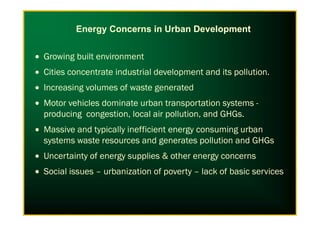
• Growing built environment
• Cities concentrate industrial development and its pollution.
• Increasing volumes of waste generated
• Motor vehicles dominate urban transportation systems -
producing congestion, local air pollution, and GHGs.
Energy Concerns in Urban Development
producing congestion, local air pollution, and GHGs.
• Massive and typically inefficient energy consuming urban
systems waste resources and generates pollution and GHGs
• Uncertainty of energy supplies & other energy concerns
• Social issues – urbanization of poverty – lack of basic services
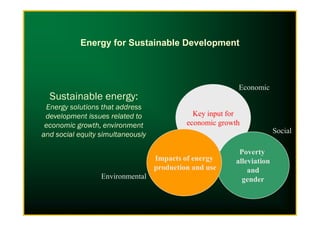
Energy for Sustainable Development
Sustainable energy:
Energy solutions that address
development issues related to Key input for
Economic
development issues related to
economic growth, environment
and social equity simultaneously
Key input for
economic growth
Social
Environmental
Poverty
alleviation
and
gender
Impacts of energy
production and use
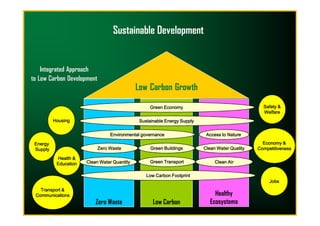
Low Carbon Growth
Integrated Approach
to Low Carbon Development
Sustainable Development
Healthy
EcosystemsZero Waste Low Carbon
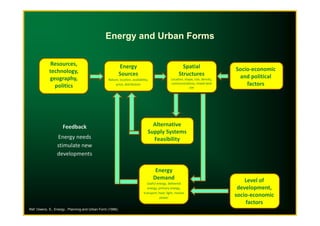
Energy and Urban Forms
Resources,
technology,
geography,
politics
Energy
Sources
Nature, location, availability,
price, distribution
Spatial
Structures
Location, shape, size, density,
communications, mixed land
use
Socio-economic
and political
factors
Feedback
Energy needs
stimulate new
developments
Energy
Demand
Useful energy, delivered
energy, primary energy,
transport, heat, light, motive
power
Alternative
Supply Systems
Feasibility
Level of
development,
socio-economic
factors
Ref: Owens, S., Energy , Planning and Urban Form (1986)
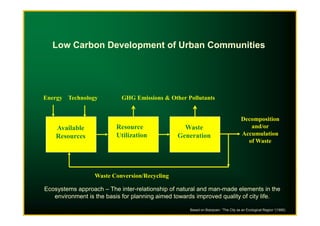
Energy Technology GHG Emissions & Other Pollutants
Low Carbon Development of Urban Communities
Available
Resources
Resource
Utilization
Waste
Generation
Decomposition
and/or
Accumulation
of Waste
Waste Conversion/Recycling
Based on Bianpoen. “The City as an Ecological Region “(1990)
Ecosystems approach – The inter-relationship of natural and man-made elements in the
environment is the basis for planning aimed towards improved quality of city life.
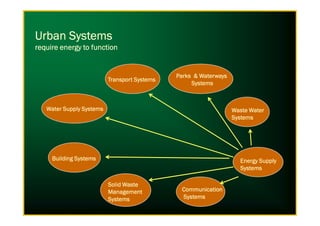
Transport SystemsTransport SystemsTransport SystemsTransport Systems
Waste WaterWaste WaterWaste WaterWaste Water
Parks & WaterwaysParks & WaterwaysParks & WaterwaysParks & Waterways
SystemsSystemsSystemsSystems
Water Supply SystemsWater Supply SystemsWater Supply SystemsWater Supply Systems
Urban SystemsUrban SystemsUrban SystemsUrban Systems
require energy to functionrequire energy to functionrequire energy to functionrequire energy to function
CommunicationCommunicationCommunicationCommunication
SystemsSystemsSystemsSystems
Building SystemsBuilding SystemsBuilding SystemsBuilding Systems Energy SupplyEnergy SupplyEnergy SupplyEnergy Supply
SystemsSystemsSystemsSystems
Waste WaterWaste WaterWaste WaterWaste Water
SystemsSystemsSystemsSystems
Solid WasteSolid WasteSolid WasteSolid Waste
ManagementManagementManagementManagement
SystemsSystemsSystemsSystems
Low Carbon Development of Urban Communities
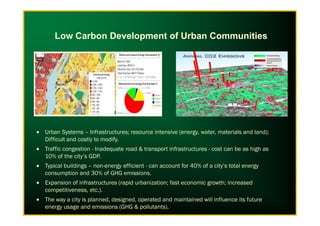
• Urban Systems – Infrastructures; resource intensive (energy, water, materials and land);
Difficult and costly to modify.
• Traffic congestion - Inadequate road & transport infrastructures - cost can be as high as
10% of the city’s GDP.
• Typical buildings – non-energy efficient - can account for 40% of a city’s total energy
consumption and 30% of GHG emissions.
• Expansion of infrastructures (rapid urbanization; fast economic growth; increased
competitiveness, etc.).
• The way a city is planned, designed, operated and maintained will influence its future
energy usage and emissions (GHG & pollutants).
Energy Consuming Urban SystemsEnergy Consuming Urban SystemsEnergy Consuming Urban SystemsEnergy Consuming Urban Systems
Linkage between energy demand and the way the development and
arrangement of cities are planned.
Correlation between the urban systems and environmental health,
Low Carbon Development of Urban Communities
economic competitiveness and the quality of life in cities.
The patterns of consumption and production of infrastructures that are built
for urban systems can have positive or negative outcomes, depending on
how these are designed, operated and maintained.
Investments on urban system infrastructure development to achieve and
sustain socio-economic development goals.
AreAreAreAre these systems designedthese systems designedthese systems designedthese systems designed and operated forand operated forand operated forand operated for energy efficiency?energy efficiency?energy efficiency?energy efficiency?
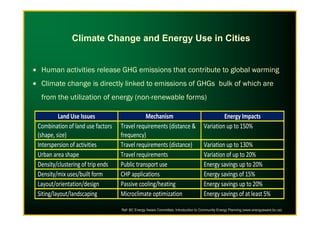
• Human activities release GHG emissions that contribute to global warming
• Climate change is directly linked to emissions of GHGs bulk of which are
from the utilization of energy (non-renewable forms)
Land Use Issues Mechanism Energy Impacts
Climate Change and Energy Use in Cities
Land Use Issues Mechanism Energy Impacts
Combination of land use factors
(shape, size)
Travel requirements (distance &
frequency)
Variation up to 150%
Interspersion of activities Travel requirements (distance) Variation up to 130%
Urban area shape Travel requirements Variation of up to 20%
Density/clustering of trip ends Public transport use Energy savings up to 20%
Density/mix uses/built form CHP applications Energy savings of 15%
Layout/orientation/design Passive cooling/heating Energy savings up to 20%
Siting/layout/landscaping Microclimate optimization Energy savings of at least 5%
Ref: BC Energy Aware Committee, Introduction to Community Energy Planning (www.energyaware.bc.ca)
Increasing Carbon FootprintIncreasing Carbon FootprintIncreasing Carbon FootprintIncreasing Carbon Footprint
• Increasing urban sprawl – increased use of private transport
• Energy-consuming lifestyles and practices
• Poor urban planning, management and governance
• What is the challenge?What is the challenge?What is the challenge?What is the challenge? Managing a city’s development thatManaging a city’s development thatManaging a city’s development thatManaging a city’s development that:
Maximizes low-carbon energy sources
Climate Change Challenges in Cities
Maximizes low-carbon energy sources
Enhances efficiency in delivering urban services
Moves to low-carbon intensity for a given unit of GDP
Vulnerability to Climate ExtremesVulnerability to Climate ExtremesVulnerability to Climate ExtremesVulnerability to Climate Extremes
• Cities situated in low lying coastal or river plains
• Extreme weather events - increasing in intensity and frequency
• Sea level rise; Poor suffer more
• New driver of urbanization - “eco-refugees/eco-migrants”
ChallengesChallengesChallengesChallenges
• Inadequate policy and regulatory frameworks that support
environmentally sustainable development in cities
• Insufficient capacity of cities to plan, design and implement
integrated sustainable development actions
Low Carbon Development of Urban Communities
integrated sustainable development actions
• Lack of financing for initiatives on environmentally sustainable
urban development
• Lack of available replicable successful examples of sustainable
development applications at the urban level
• Lack of easily accessible information on feasible and applicable
technologies and practices on sustainable urban development
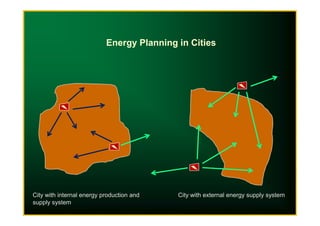
Energy Planning in Cities
City with internal energy production and
supply system
City with external energy supply system
Sustainable Energy in CitiesSustainable Energy in CitiesSustainable Energy in CitiesSustainable Energy in Cities7.341.91
18.68
10.670.90
0.07
Commercial
Sector Use
Agriculture
Sector Use
Residential
Sector Use
Industrial
Sector Use
Institutional
Sector Use
To stock
8.06
Outside
Sales
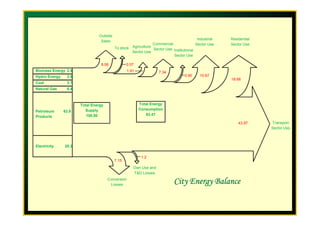
Total Energy
Supply
Total Energy
Consumption
83.47
Petroleum 63.9
Natural Gas 6.4
Coal 3.7
Hydro Energy 2.9
Biomass Energy 2.9
City Energy BalanceCity Energy BalanceCity Energy BalanceCity Energy Balance
43.97 Transport
Sector Use
1.25
7.15
Own Use and
T&D Losses
Conversion
Losses
100.00 83.47
Petroleum 63.9
Products
Electricity 20.2
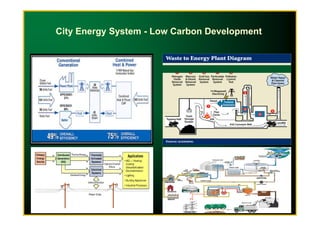
City Energy System - Low Carbon Development
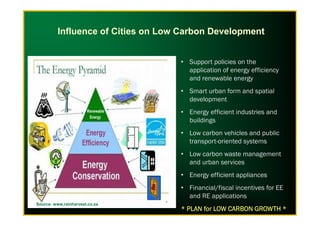
• Support policies on the
application of energy efficiency
and renewable energy
• Smart urban form and spatial
development
• Energy efficient industries and
Influence of Cities on Low Carbon Development
• Energy efficient industries and
buildings
• Low carbon vehicles and public
transport-oriented systems
• Low carbon waste management
and urban services
• Energy efficient appliances
• Financial/fiscal incentives for EE
and RE applications
* PLAN for LOW CARBON GROWTH ** PLAN for LOW CARBON GROWTH ** PLAN for LOW CARBON GROWTH ** PLAN for LOW CARBON GROWTH *
Source: www.rainharvest.co.za
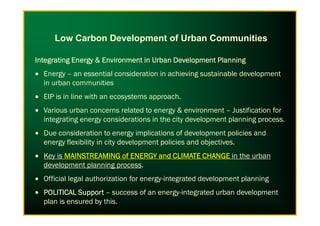
Integrating Energy & Environment in Urban Development PlanningIntegrating Energy & Environment in Urban Development PlanningIntegrating Energy & Environment in Urban Development PlanningIntegrating Energy & Environment in Urban Development Planning
• Energy – an essential consideration in achieving sustainable development
in urban communities
• EIP is in line with an ecosystems approach.
• Various urban concerns related to energy & environment – Justification for
Low Carbon Development of Urban Communities
• Various urban concerns related to energy & environment – Justification for
integrating energy considerations in the city development planning process.
• Due consideration to energy implications of development policies and
energy flexibility in city development policies and objectives.
• Key is MAINSTREAMING of ENERGY and CLIMATE CHANGEMAINSTREAMING of ENERGY and CLIMATE CHANGEMAINSTREAMING of ENERGY and CLIMATE CHANGEMAINSTREAMING of ENERGY and CLIMATE CHANGE in the urban
development planning process.
• Official legal authorization for energy-integrated development planning
• POLITICAL SupportPOLITICAL SupportPOLITICAL SupportPOLITICAL Support – success of an energy-integrated urban development
plan is ensured by this.
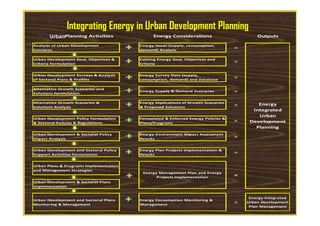
Land Use Planning Activities Energy Considerations Outputs
Analysis of Urban Development
Concerns
Energy Issues (supply, consumption,
demand) Analysis
=
Urban Development Goal, Objectives &
Criteria Formulation
Existing Energy Goal, Objectives and
Criteria
=
Urban Development Surveys & Analysis
of Sectoral Plans & Profiles
Energy Survey Data (supply,
consumption, demand) and Database
=
Alternative Growth Scenarios and
Solutions Formulation
Energy Supply & Demand Scenarios =
Alternative Growth Scenarios &
Solutions Analysis
Energy Implications of Growth Scenarios
& Proposed Solutions
= Energy
Integrated
Integrating Energy in Urban Development Planning
Urban
Urban Development Policy Formulation
& Sectoral Policies & Regulations
Formulated & Enforced Energy Policies &
Plans/Programs
=
Urban Development & Sectoral Policy
Impact Analysis
Energy-Environment Impact Assessment
Results
=
Urban Development and Sectoral Policy
Support Activities Formulation
Energy Plan Projects Implementation &
Results
=
Urban Plans & Programs Implementation
and Management Strategies
Urban Development & Sectoral Plans
Implementation
Urban Development and Sectoral Plans
Monitoring & Management
Energy Consumption Monitoring &
Management
=
Energy-Integrated
Urban Development
Plan Management
Urban
Development
Planning
Energy Management Plan and Energy
Projects Implementation =
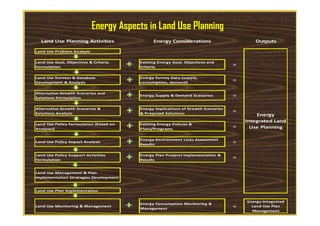
Land Use Planning Activities Energy Considerations Outputs
Land Use Problem Analysis
Land Use Goal, Objectives & Criteria
Formulation
Existing Energy Goal, Objectives and
Criteria
=
Land Use Surveys & Database
Development & Analysis
Energy Survey Data (supply,
consumption, demand)
=
Alternative Growth Scenarios and
Solutions Formulation
Energy Supply & Demand Scenarios =
Alternative Growth Scenarios &
Solutions Analysis
Energy Implications of Growth Scenarios
& Proposed Solutions
=
Energy
Energy Aspects in Land Use Planning
Solutions Analysis & Proposed Solutions
=
Land Use Policy Formulation (based on
Analyses)
Existing Energy Policies &
Plans/Programs
=
Land Use Policy Impact Analysis
Energy-Environment Links Assessment
Results
=
Land Use Policy Support Activities
Formulation
Energy Plan Projects Implementation &
Results
=
Land Use Management & Plan
Implementation Strategies Development
Land Use Plan Implementation
Land Use Monitoring & Management
Energy Consumption Monitoring &
Management =
Energy-Integrated
Land Use Plan
Management
Energy
Integrated Land
Use Planning
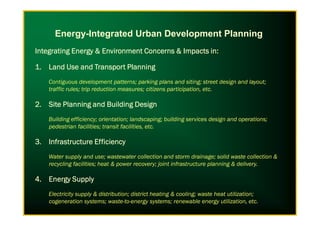
Energy-Integrated Urban Development Planning
Integrating Energy & Environment Concerns & Impacts in:Integrating Energy & Environment Concerns & Impacts in:Integrating Energy & Environment Concerns & Impacts in:Integrating Energy & Environment Concerns & Impacts in:
1.1.1.1. LandLandLandLand Use and Transport PlanningUse and Transport PlanningUse and Transport PlanningUse and Transport Planning
Contiguous development patterns; parking plans and siting; street design and layout;
traffic rules; trip reduction measures; citizens participation, etc.
2.2.2.2. Site Planning and Building DesignSite Planning and Building DesignSite Planning and Building DesignSite Planning and Building Design
Building efficiency; orientation; landscaping; building services design and operations;
pedestrian facilities; transit facilities, etc.
3.3.3.3. Infrastructure EfficiencyInfrastructure EfficiencyInfrastructure EfficiencyInfrastructure Efficiency
Water supply and use; wastewater collection and storm drainage; solid waste collection &
recycling facilities; heat & power recovery; joint infrastructure planning & delivery.
4.4.4.4. Energy SupplyEnergy SupplyEnergy SupplyEnergy Supply
Electricity supply & distribution; district heating & cooling; waste heat utilization;
cogeneration systems; waste-to-energy systems; renewable energy utilization, etc.
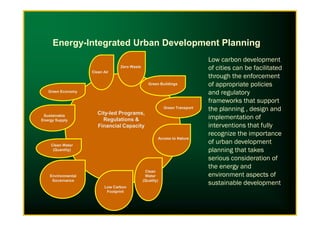
Low carbon development
of cities can be facilitated
through the enforcement
of appropriate policies
and regulatory
frameworks that support
the planning , design and
implementation of
Green Economy
Clean Air
Zero Waste
Green Transport
Green Buildings
City-led Programs,
Energy-Integrated Urban Development Planning
the planning , design and
implementation of
interventions that fully
recognize the importance
of urban development
planning that takes
serious consideration of
the energy and
environment aspects of
sustainable development
Sustainable
Energy Supply
Access to Nature
Clean Water
(Quantity)
Clean
Water
(Quality)
Low Carbon
Footprint
Environmental
Governance
City-led Programs,
Regulations &
Financial Capacity
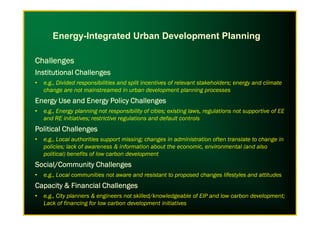
ChallengesChallengesChallengesChallenges
Institutional ChallengesInstitutional ChallengesInstitutional ChallengesInstitutional Challenges
• e.g., Divided responsibilities and split incentives of relevant stakeholders; energy and climate
change are not mainstreamed in urban development planning processes
Energy Use and Energy Policy ChallengesEnergy Use and Energy Policy ChallengesEnergy Use and Energy Policy ChallengesEnergy Use and Energy Policy Challenges
• e.g., Energy planning not responsibility of cities; existing laws, regulations not supportive of EE
Energy-Integrated Urban Development Planning
• e.g., Energy planning not responsibility of cities; existing laws, regulations not supportive of EE
and RE initiatives; restrictive regulations and default controls
Political ChallengesPolitical ChallengesPolitical ChallengesPolitical Challenges
• e.g., Local authorities support missing; changes in administration often translate to change in
policies; lack of awareness & information about the economic, environmental (and also
political) benefits of low carbon development
Social/Community ChallengesSocial/Community ChallengesSocial/Community ChallengesSocial/Community Challenges
• e.g., Local communities not aware and resistant to proposed changes lifestyles and attitudes
Capacity & Financial ChallengesCapacity & Financial ChallengesCapacity & Financial ChallengesCapacity & Financial Challenges
• e.g., City planners & engineers not skilled/knowledgeable of EIP and low carbon development;
Lack of financing for low carbon development initiatives
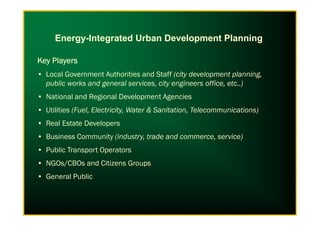
Key PlayersKey PlayersKey PlayersKey Players
• Local Government Authorities and Staff (city development planning,
public works and general services, city engineers office, etc..)
• National and Regional Development Agencies
• Utilities (Fuel, Electricity, Water & Sanitation, Telecommunications)
Energy-Integrated Urban Development Planning
• Utilities (Fuel, Electricity, Water & Sanitation, Telecommunications)
• Real Estate Developers
• Business Community (industry, trade and commerce, service)
• Public Transport Operators
• NGOs/CBOs and Citizens Groups
• General Public
Planned Development AreasPlanned Development AreasPlanned Development AreasPlanned Development Areas
• Preservation and Protection of Natural Features of the Land including
Environmentally Sensitive Areas
• Access to Existing Infrastructure and Services
• Access to Transport and Transit Systems
Community Design & LayoutCommunity Design & LayoutCommunity Design & LayoutCommunity Design & Layout
Spatial Structures
Energy-Integrated Urban Development Planning
• Spatial Structures
• Streets and Roads
• Natural Features and Open Spaces
BuildingsBuildingsBuildingsBuildings and Infrastructuresand Infrastructuresand Infrastructuresand Infrastructures
• Energy Efficient Buildings & Building Materials
• Utilization of the Natural Landscapes & Green Infrastructures
• Energy Efficient Design, Operation and Maintenance of Urban Systems
• Green Construction
• Sustainable Energy Production and Supply
Strategies to Support Plan ImplementationStrategies to Support Plan ImplementationStrategies to Support Plan ImplementationStrategies to Support Plan Implementation
Privatization and the Role of the Private SectorPrivatization and the Role of the Private SectorPrivatization and the Role of the Private SectorPrivatization and the Role of the Private Sector
• Joint development (e.g., residential housing program; public facilities)
• Privatization (Garbage collection; Sewerage system operation; selected user fee
collection; Road infrastructure construction; Leasing of government vehicles;
Tourism promotion; Historical and cultural preservation; Road and park
maintenance; Building inspection; and, Information dissemination campaigns)
Sustainable and Energy Efficient City Development
maintenance; Building inspection; and, Information dissemination campaigns)
Improvement of City's Public ImageImprovement of City's Public ImageImprovement of City's Public ImageImprovement of City's Public Image
Revenue Enhancement InterventionsRevenue Enhancement InterventionsRevenue Enhancement InterventionsRevenue Enhancement Interventions
• Improve collection efficiency of locally levied taxes
• Improve city government fee rates to better coincide with cost recovery of
development infrastructures/services and improve fee collection procedures.
• Consider the potentials of grantsmanship.
• Introduce fundamental reforms in local government revenue structure.
Strategies to Support Low Carbon InitiativesStrategies to Support Low Carbon InitiativesStrategies to Support Low Carbon InitiativesStrategies to Support Low Carbon Initiatives
• InvestmentsInvestmentsInvestmentsInvestments
• Investment for installation of new energy efficient urban systems, or
enhancement of the existing ones.
• Investment in improving city energy supply and distribution systems.
Sustainable and Energy Efficient City Development
• Investment for research and development, information dissemination and
promotional programs on low carbon development.
• Encourage sponsorship of urban energy projects by the energy industryEncourage sponsorship of urban energy projects by the energy industryEncourage sponsorship of urban energy projects by the energy industryEncourage sponsorship of urban energy projects by the energy industry
sector and other service companies.sector and other service companies.sector and other service companies.sector and other service companies.
• Third Party FinancingThird Party FinancingThird Party FinancingThird Party Financing
• Financial InstitutionsFinancial InstitutionsFinancial InstitutionsFinancial Institutions
• LeaseLeaseLeaseLease----Purchase Agreements; BuildPurchase Agreements; BuildPurchase Agreements; BuildPurchase Agreements; Build----OperateOperateOperateOperate----Transfer AgreementsTransfer AgreementsTransfer AgreementsTransfer Agreements
Examples of Strategies to Support Plan ImplementationExamples of Strategies to Support Plan ImplementationExamples of Strategies to Support Plan ImplementationExamples of Strategies to Support Plan Implementation
1. Energy1. Energy1. Energy1. Energy----Environment Conservation StrategiesEnvironment Conservation StrategiesEnvironment Conservation StrategiesEnvironment Conservation Strategies
• Implementation of a Public Utilities Surcharge
• Restructuring and Increasing Vehicle Tax
• Authorization of Cordon Pricing or Trip Tolls to CBD
Sustainable and Energy Efficient City Development
• Authorization of Cordon Pricing or Trip Tolls to CBD
• Parking Fees
2. City Development Strategies2. City Development Strategies2. City Development Strategies2. City Development Strategies
• User Fees, Surcharges
• Increase Share in Land Registration Tax Earnings
• Increase Development Fees for Building Permits
• Implementation of Betterment Charges
• Privatization of Selected Urban Infrastructure and Services
• Increase Public/Private Sector Joint Development
Sustainable and Energy Efficient Cities
Benefits from Sustainable Energy Projects in CitiesBenefits from Sustainable Energy Projects in CitiesBenefits from Sustainable Energy Projects in CitiesBenefits from Sustainable Energy Projects in Cities
• Reduction in the use of raw materials as resource inputs
• Reduction in pollution
• Increased energy efficiency leading to reduced energy use in the• Increased energy efficiency leading to reduced energy use in the
city as a whole
• Reduction in the volume of waste products requiring disposal (with
the added benefit of preventing disposal-related pollution)
• Increase in the amount and types of process outputs that have
market value
Sustainable and Energy Efficient Cities
Benefits of Low Carbon Development of CitiesBenefits of Low Carbon Development of CitiesBenefits of Low Carbon Development of CitiesBenefits of Low Carbon Development of Cities
• GHG Emission Reduction (climate change mitigation)
• Energy Use and Energy Cost Reduction
• Preservation of Natural Environment
• Pollution Reduction (air, land, water)• Pollution Reduction (air, land, water)
• Improved Public Health
• Empowered Communities
• Enhanced Quality of Life in Cities (safety, welfare and well-being)
• Improved Economy and Competitiveness
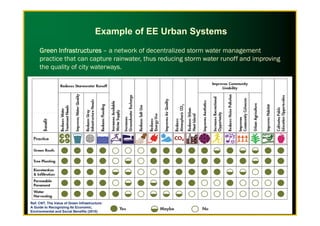
Example of EE Urban Systems
Green InfrastructuresGreen InfrastructuresGreen InfrastructuresGreen Infrastructures – a network of decentralized storm water management
practice that can capture rainwater, thus reducing storm water runoff and improving
the quality of city waterways.
Ref: CNT, The Value of Green Infrastructure:
A Guide to Recognizing Its Economic,
Environmental and Social Benefits (2010)
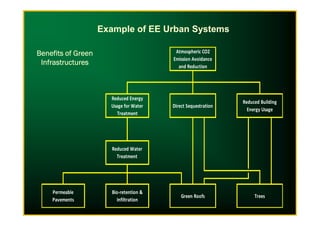
Atmospheric CO2
Emission Avoidance
and Reduction
Direct Sequestration
Reduced Building
Energy Usage
Reduced Energy
Usage for Water
Treatment
Benefits of GreenBenefits of GreenBenefits of GreenBenefits of Green
InfrastructuresInfrastructuresInfrastructuresInfrastructures
Example of EE Urban Systems
Permeable
Pavements
Bio-retention &
Infiltration
TreesGreen Roofs
Treatment
Reduced Water
Treatment
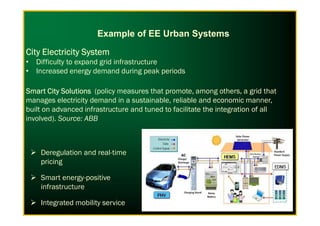
City Electricity SystemCity Electricity SystemCity Electricity SystemCity Electricity System
• Difficulty to expand grid infrastructure
• Increased energy demand during peak periods
Smart City SolutionsSmart City SolutionsSmart City SolutionsSmart City Solutions (policy measures that promote, among others, a grid that
manages electricity demand in a sustainable, reliable and economic manner,
built on advanced infrastructure and tuned to facilitate the integration of all
Example of EE Urban Systems
built on advanced infrastructure and tuned to facilitate the integration of all
involved). Source: ABB
Deregulation and real-time
pricing
Smart energy-positive
infrastructure
Integrated mobility service
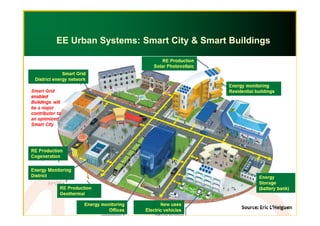
EE Urban Systems: Smart City & Smart Buildings
How urban areas expand in the future has big implications on the GHG
emissions that are generated in cities.
Urban development planning should consider energy as one important
component of sustainable development.
Energy and Climate Change should be mainstreamed into the urban
development planning processes
Conclusions
development planning processes
Policies formulated for various concerns in city development plans should be in
accord with the preservation of man's environment and the provision of energy
for sustaining growth and development.
The capacity of local governments should be improved to better identify the
optimum mix of regulatory and public financing instruments to attract catalytic
financial flows toward low-emissions climate-resilient development.
The success of an energy integrated city development plan can only be
ensured if there is political support. Without it, any planning approach will fail.
Thank YouThank YouThank YouThank YouThank YouThank YouThank YouThank You

Planning for low carbon development in cities [compatibility mode]

  • 1.
    Planning for LowCarbonPlanning for Low CarbonPlanning for Low CarbonPlanning for Low Carbon Development in CitiesDevelopment in CitiesDevelopment in CitiesDevelopment in Cities Rajendra P Sharma rpsharma@mailcity.com
  • 2.
    • Cities occupy3% of the Earth’s land surface, and house 75% of the human population • Cities account for a considerable portion of a country’s energy Energy Concerns in Urban Development portion of a country’s energy consumption. [2/3 of worldwide energy usage and GHG emissions] • Most production, trade and transportation activities usually are located in these areas. [80% of Asia’s GDP is produced by Asian cities] Per capita carbon emission of selected cities ( World Bank, 2010)
  • 3.
    • Growing builtenvironment • Cities concentrate industrial development and its pollution. • Increasing volumes of waste generated • Motor vehicles dominate urban transportation systems - producing congestion, local air pollution, and GHGs. Energy Concerns in Urban Development producing congestion, local air pollution, and GHGs. • Massive and typically inefficient energy consuming urban systems waste resources and generates pollution and GHGs • Uncertainty of energy supplies & other energy concerns • Social issues – urbanization of poverty – lack of basic services
  • 4.
    Energy for SustainableDevelopment Sustainable energy: Energy solutions that address development issues related to Key input for Economic development issues related to economic growth, environment and social equity simultaneously Key input for economic growth Social Environmental Poverty alleviation and gender Impacts of energy production and use
  • 5.
    Low Carbon Growth IntegratedApproach to Low Carbon Development Sustainable Development Healthy EcosystemsZero Waste Low Carbon
  • 6.
    Energy and UrbanForms Resources, technology, geography, politics Energy Sources Nature, location, availability, price, distribution Spatial Structures Location, shape, size, density, communications, mixed land use Socio-economic and political factors Feedback Energy needs stimulate new developments Energy Demand Useful energy, delivered energy, primary energy, transport, heat, light, motive power Alternative Supply Systems Feasibility Level of development, socio-economic factors Ref: Owens, S., Energy , Planning and Urban Form (1986)
  • 7.
    Energy Technology GHGEmissions & Other Pollutants Low Carbon Development of Urban Communities Available Resources Resource Utilization Waste Generation Decomposition and/or Accumulation of Waste Waste Conversion/Recycling Based on Bianpoen. “The City as an Ecological Region “(1990) Ecosystems approach – The inter-relationship of natural and man-made elements in the environment is the basis for planning aimed towards improved quality of city life.
  • 8.
    Transport SystemsTransport SystemsTransportSystemsTransport Systems Waste WaterWaste WaterWaste WaterWaste Water Parks & WaterwaysParks & WaterwaysParks & WaterwaysParks & Waterways SystemsSystemsSystemsSystems Water Supply SystemsWater Supply SystemsWater Supply SystemsWater Supply Systems Urban SystemsUrban SystemsUrban SystemsUrban Systems require energy to functionrequire energy to functionrequire energy to functionrequire energy to function CommunicationCommunicationCommunicationCommunication SystemsSystemsSystemsSystems Building SystemsBuilding SystemsBuilding SystemsBuilding Systems Energy SupplyEnergy SupplyEnergy SupplyEnergy Supply SystemsSystemsSystemsSystems Waste WaterWaste WaterWaste WaterWaste Water SystemsSystemsSystemsSystems Solid WasteSolid WasteSolid WasteSolid Waste ManagementManagementManagementManagement SystemsSystemsSystemsSystems
  • 9.
    Low Carbon Developmentof Urban Communities • Urban Systems – Infrastructures; resource intensive (energy, water, materials and land); Difficult and costly to modify. • Traffic congestion - Inadequate road & transport infrastructures - cost can be as high as 10% of the city’s GDP. • Typical buildings – non-energy efficient - can account for 40% of a city’s total energy consumption and 30% of GHG emissions. • Expansion of infrastructures (rapid urbanization; fast economic growth; increased competitiveness, etc.). • The way a city is planned, designed, operated and maintained will influence its future energy usage and emissions (GHG & pollutants).
  • 10.
    Energy Consuming UrbanSystemsEnergy Consuming Urban SystemsEnergy Consuming Urban SystemsEnergy Consuming Urban Systems Linkage between energy demand and the way the development and arrangement of cities are planned. Correlation between the urban systems and environmental health, Low Carbon Development of Urban Communities economic competitiveness and the quality of life in cities. The patterns of consumption and production of infrastructures that are built for urban systems can have positive or negative outcomes, depending on how these are designed, operated and maintained. Investments on urban system infrastructure development to achieve and sustain socio-economic development goals. AreAreAreAre these systems designedthese systems designedthese systems designedthese systems designed and operated forand operated forand operated forand operated for energy efficiency?energy efficiency?energy efficiency?energy efficiency?
  • 11.
    • Human activitiesrelease GHG emissions that contribute to global warming • Climate change is directly linked to emissions of GHGs bulk of which are from the utilization of energy (non-renewable forms) Land Use Issues Mechanism Energy Impacts Climate Change and Energy Use in Cities Land Use Issues Mechanism Energy Impacts Combination of land use factors (shape, size) Travel requirements (distance & frequency) Variation up to 150% Interspersion of activities Travel requirements (distance) Variation up to 130% Urban area shape Travel requirements Variation of up to 20% Density/clustering of trip ends Public transport use Energy savings up to 20% Density/mix uses/built form CHP applications Energy savings of 15% Layout/orientation/design Passive cooling/heating Energy savings up to 20% Siting/layout/landscaping Microclimate optimization Energy savings of at least 5% Ref: BC Energy Aware Committee, Introduction to Community Energy Planning (www.energyaware.bc.ca)
  • 12.
    Increasing Carbon FootprintIncreasingCarbon FootprintIncreasing Carbon FootprintIncreasing Carbon Footprint • Increasing urban sprawl – increased use of private transport • Energy-consuming lifestyles and practices • Poor urban planning, management and governance • What is the challenge?What is the challenge?What is the challenge?What is the challenge? Managing a city’s development thatManaging a city’s development thatManaging a city’s development thatManaging a city’s development that: Maximizes low-carbon energy sources Climate Change Challenges in Cities Maximizes low-carbon energy sources Enhances efficiency in delivering urban services Moves to low-carbon intensity for a given unit of GDP Vulnerability to Climate ExtremesVulnerability to Climate ExtremesVulnerability to Climate ExtremesVulnerability to Climate Extremes • Cities situated in low lying coastal or river plains • Extreme weather events - increasing in intensity and frequency • Sea level rise; Poor suffer more • New driver of urbanization - “eco-refugees/eco-migrants”
  • 13.
    ChallengesChallengesChallengesChallenges • Inadequate policyand regulatory frameworks that support environmentally sustainable development in cities • Insufficient capacity of cities to plan, design and implement integrated sustainable development actions Low Carbon Development of Urban Communities integrated sustainable development actions • Lack of financing for initiatives on environmentally sustainable urban development • Lack of available replicable successful examples of sustainable development applications at the urban level • Lack of easily accessible information on feasible and applicable technologies and practices on sustainable urban development
  • 14.
    Energy Planning inCities City with internal energy production and supply system City with external energy supply system
  • 15.
    Sustainable Energy inCitiesSustainable Energy in CitiesSustainable Energy in CitiesSustainable Energy in Cities7.341.91 18.68 10.670.90 0.07 Commercial Sector Use Agriculture Sector Use Residential Sector Use Industrial Sector Use Institutional Sector Use To stock 8.06 Outside Sales Total Energy Supply Total Energy Consumption 83.47 Petroleum 63.9 Natural Gas 6.4 Coal 3.7 Hydro Energy 2.9 Biomass Energy 2.9 City Energy BalanceCity Energy BalanceCity Energy BalanceCity Energy Balance 43.97 Transport Sector Use 1.25 7.15 Own Use and T&D Losses Conversion Losses 100.00 83.47 Petroleum 63.9 Products Electricity 20.2
  • 16.
    City Energy System- Low Carbon Development
  • 17.
    • Support policieson the application of energy efficiency and renewable energy • Smart urban form and spatial development • Energy efficient industries and Influence of Cities on Low Carbon Development • Energy efficient industries and buildings • Low carbon vehicles and public transport-oriented systems • Low carbon waste management and urban services • Energy efficient appliances • Financial/fiscal incentives for EE and RE applications * PLAN for LOW CARBON GROWTH ** PLAN for LOW CARBON GROWTH ** PLAN for LOW CARBON GROWTH ** PLAN for LOW CARBON GROWTH * Source: www.rainharvest.co.za
  • 18.
    Integrating Energy &Environment in Urban Development PlanningIntegrating Energy & Environment in Urban Development PlanningIntegrating Energy & Environment in Urban Development PlanningIntegrating Energy & Environment in Urban Development Planning • Energy – an essential consideration in achieving sustainable development in urban communities • EIP is in line with an ecosystems approach. • Various urban concerns related to energy & environment – Justification for Low Carbon Development of Urban Communities • Various urban concerns related to energy & environment – Justification for integrating energy considerations in the city development planning process. • Due consideration to energy implications of development policies and energy flexibility in city development policies and objectives. • Key is MAINSTREAMING of ENERGY and CLIMATE CHANGEMAINSTREAMING of ENERGY and CLIMATE CHANGEMAINSTREAMING of ENERGY and CLIMATE CHANGEMAINSTREAMING of ENERGY and CLIMATE CHANGE in the urban development planning process. • Official legal authorization for energy-integrated development planning • POLITICAL SupportPOLITICAL SupportPOLITICAL SupportPOLITICAL Support – success of an energy-integrated urban development plan is ensured by this.
  • 19.
    Land Use PlanningActivities Energy Considerations Outputs Analysis of Urban Development Concerns Energy Issues (supply, consumption, demand) Analysis = Urban Development Goal, Objectives & Criteria Formulation Existing Energy Goal, Objectives and Criteria = Urban Development Surveys & Analysis of Sectoral Plans & Profiles Energy Survey Data (supply, consumption, demand) and Database = Alternative Growth Scenarios and Solutions Formulation Energy Supply & Demand Scenarios = Alternative Growth Scenarios & Solutions Analysis Energy Implications of Growth Scenarios & Proposed Solutions = Energy Integrated Integrating Energy in Urban Development Planning Urban Urban Development Policy Formulation & Sectoral Policies & Regulations Formulated & Enforced Energy Policies & Plans/Programs = Urban Development & Sectoral Policy Impact Analysis Energy-Environment Impact Assessment Results = Urban Development and Sectoral Policy Support Activities Formulation Energy Plan Projects Implementation & Results = Urban Plans & Programs Implementation and Management Strategies Urban Development & Sectoral Plans Implementation Urban Development and Sectoral Plans Monitoring & Management Energy Consumption Monitoring & Management = Energy-Integrated Urban Development Plan Management Urban Development Planning Energy Management Plan and Energy Projects Implementation =
  • 20.
    Land Use PlanningActivities Energy Considerations Outputs Land Use Problem Analysis Land Use Goal, Objectives & Criteria Formulation Existing Energy Goal, Objectives and Criteria = Land Use Surveys & Database Development & Analysis Energy Survey Data (supply, consumption, demand) = Alternative Growth Scenarios and Solutions Formulation Energy Supply & Demand Scenarios = Alternative Growth Scenarios & Solutions Analysis Energy Implications of Growth Scenarios & Proposed Solutions = Energy Energy Aspects in Land Use Planning Solutions Analysis & Proposed Solutions = Land Use Policy Formulation (based on Analyses) Existing Energy Policies & Plans/Programs = Land Use Policy Impact Analysis Energy-Environment Links Assessment Results = Land Use Policy Support Activities Formulation Energy Plan Projects Implementation & Results = Land Use Management & Plan Implementation Strategies Development Land Use Plan Implementation Land Use Monitoring & Management Energy Consumption Monitoring & Management = Energy-Integrated Land Use Plan Management Energy Integrated Land Use Planning
  • 21.
    Energy-Integrated Urban DevelopmentPlanning Integrating Energy & Environment Concerns & Impacts in:Integrating Energy & Environment Concerns & Impacts in:Integrating Energy & Environment Concerns & Impacts in:Integrating Energy & Environment Concerns & Impacts in: 1.1.1.1. LandLandLandLand Use and Transport PlanningUse and Transport PlanningUse and Transport PlanningUse and Transport Planning Contiguous development patterns; parking plans and siting; street design and layout; traffic rules; trip reduction measures; citizens participation, etc. 2.2.2.2. Site Planning and Building DesignSite Planning and Building DesignSite Planning and Building DesignSite Planning and Building Design Building efficiency; orientation; landscaping; building services design and operations; pedestrian facilities; transit facilities, etc. 3.3.3.3. Infrastructure EfficiencyInfrastructure EfficiencyInfrastructure EfficiencyInfrastructure Efficiency Water supply and use; wastewater collection and storm drainage; solid waste collection & recycling facilities; heat & power recovery; joint infrastructure planning & delivery. 4.4.4.4. Energy SupplyEnergy SupplyEnergy SupplyEnergy Supply Electricity supply & distribution; district heating & cooling; waste heat utilization; cogeneration systems; waste-to-energy systems; renewable energy utilization, etc.
  • 22.
    Low carbon development ofcities can be facilitated through the enforcement of appropriate policies and regulatory frameworks that support the planning , design and implementation of Green Economy Clean Air Zero Waste Green Transport Green Buildings City-led Programs, Energy-Integrated Urban Development Planning the planning , design and implementation of interventions that fully recognize the importance of urban development planning that takes serious consideration of the energy and environment aspects of sustainable development Sustainable Energy Supply Access to Nature Clean Water (Quantity) Clean Water (Quality) Low Carbon Footprint Environmental Governance City-led Programs, Regulations & Financial Capacity
  • 23.
    ChallengesChallengesChallengesChallenges Institutional ChallengesInstitutional ChallengesInstitutionalChallengesInstitutional Challenges • e.g., Divided responsibilities and split incentives of relevant stakeholders; energy and climate change are not mainstreamed in urban development planning processes Energy Use and Energy Policy ChallengesEnergy Use and Energy Policy ChallengesEnergy Use and Energy Policy ChallengesEnergy Use and Energy Policy Challenges • e.g., Energy planning not responsibility of cities; existing laws, regulations not supportive of EE Energy-Integrated Urban Development Planning • e.g., Energy planning not responsibility of cities; existing laws, regulations not supportive of EE and RE initiatives; restrictive regulations and default controls Political ChallengesPolitical ChallengesPolitical ChallengesPolitical Challenges • e.g., Local authorities support missing; changes in administration often translate to change in policies; lack of awareness & information about the economic, environmental (and also political) benefits of low carbon development Social/Community ChallengesSocial/Community ChallengesSocial/Community ChallengesSocial/Community Challenges • e.g., Local communities not aware and resistant to proposed changes lifestyles and attitudes Capacity & Financial ChallengesCapacity & Financial ChallengesCapacity & Financial ChallengesCapacity & Financial Challenges • e.g., City planners & engineers not skilled/knowledgeable of EIP and low carbon development; Lack of financing for low carbon development initiatives
  • 24.
    Key PlayersKey PlayersKeyPlayersKey Players • Local Government Authorities and Staff (city development planning, public works and general services, city engineers office, etc..) • National and Regional Development Agencies • Utilities (Fuel, Electricity, Water & Sanitation, Telecommunications) Energy-Integrated Urban Development Planning • Utilities (Fuel, Electricity, Water & Sanitation, Telecommunications) • Real Estate Developers • Business Community (industry, trade and commerce, service) • Public Transport Operators • NGOs/CBOs and Citizens Groups • General Public
  • 25.
    Planned Development AreasPlannedDevelopment AreasPlanned Development AreasPlanned Development Areas • Preservation and Protection of Natural Features of the Land including Environmentally Sensitive Areas • Access to Existing Infrastructure and Services • Access to Transport and Transit Systems Community Design & LayoutCommunity Design & LayoutCommunity Design & LayoutCommunity Design & Layout Spatial Structures Energy-Integrated Urban Development Planning • Spatial Structures • Streets and Roads • Natural Features and Open Spaces BuildingsBuildingsBuildingsBuildings and Infrastructuresand Infrastructuresand Infrastructuresand Infrastructures • Energy Efficient Buildings & Building Materials • Utilization of the Natural Landscapes & Green Infrastructures • Energy Efficient Design, Operation and Maintenance of Urban Systems • Green Construction • Sustainable Energy Production and Supply
  • 26.
    Strategies to SupportPlan ImplementationStrategies to Support Plan ImplementationStrategies to Support Plan ImplementationStrategies to Support Plan Implementation Privatization and the Role of the Private SectorPrivatization and the Role of the Private SectorPrivatization and the Role of the Private SectorPrivatization and the Role of the Private Sector • Joint development (e.g., residential housing program; public facilities) • Privatization (Garbage collection; Sewerage system operation; selected user fee collection; Road infrastructure construction; Leasing of government vehicles; Tourism promotion; Historical and cultural preservation; Road and park maintenance; Building inspection; and, Information dissemination campaigns) Sustainable and Energy Efficient City Development maintenance; Building inspection; and, Information dissemination campaigns) Improvement of City's Public ImageImprovement of City's Public ImageImprovement of City's Public ImageImprovement of City's Public Image Revenue Enhancement InterventionsRevenue Enhancement InterventionsRevenue Enhancement InterventionsRevenue Enhancement Interventions • Improve collection efficiency of locally levied taxes • Improve city government fee rates to better coincide with cost recovery of development infrastructures/services and improve fee collection procedures. • Consider the potentials of grantsmanship. • Introduce fundamental reforms in local government revenue structure.
  • 27.
    Strategies to SupportLow Carbon InitiativesStrategies to Support Low Carbon InitiativesStrategies to Support Low Carbon InitiativesStrategies to Support Low Carbon Initiatives • InvestmentsInvestmentsInvestmentsInvestments • Investment for installation of new energy efficient urban systems, or enhancement of the existing ones. • Investment in improving city energy supply and distribution systems. Sustainable and Energy Efficient City Development • Investment for research and development, information dissemination and promotional programs on low carbon development. • Encourage sponsorship of urban energy projects by the energy industryEncourage sponsorship of urban energy projects by the energy industryEncourage sponsorship of urban energy projects by the energy industryEncourage sponsorship of urban energy projects by the energy industry sector and other service companies.sector and other service companies.sector and other service companies.sector and other service companies. • Third Party FinancingThird Party FinancingThird Party FinancingThird Party Financing • Financial InstitutionsFinancial InstitutionsFinancial InstitutionsFinancial Institutions • LeaseLeaseLeaseLease----Purchase Agreements; BuildPurchase Agreements; BuildPurchase Agreements; BuildPurchase Agreements; Build----OperateOperateOperateOperate----Transfer AgreementsTransfer AgreementsTransfer AgreementsTransfer Agreements
  • 28.
    Examples of Strategiesto Support Plan ImplementationExamples of Strategies to Support Plan ImplementationExamples of Strategies to Support Plan ImplementationExamples of Strategies to Support Plan Implementation 1. Energy1. Energy1. Energy1. Energy----Environment Conservation StrategiesEnvironment Conservation StrategiesEnvironment Conservation StrategiesEnvironment Conservation Strategies • Implementation of a Public Utilities Surcharge • Restructuring and Increasing Vehicle Tax • Authorization of Cordon Pricing or Trip Tolls to CBD Sustainable and Energy Efficient City Development • Authorization of Cordon Pricing or Trip Tolls to CBD • Parking Fees 2. City Development Strategies2. City Development Strategies2. City Development Strategies2. City Development Strategies • User Fees, Surcharges • Increase Share in Land Registration Tax Earnings • Increase Development Fees for Building Permits • Implementation of Betterment Charges • Privatization of Selected Urban Infrastructure and Services • Increase Public/Private Sector Joint Development
  • 29.
    Sustainable and EnergyEfficient Cities Benefits from Sustainable Energy Projects in CitiesBenefits from Sustainable Energy Projects in CitiesBenefits from Sustainable Energy Projects in CitiesBenefits from Sustainable Energy Projects in Cities • Reduction in the use of raw materials as resource inputs • Reduction in pollution • Increased energy efficiency leading to reduced energy use in the• Increased energy efficiency leading to reduced energy use in the city as a whole • Reduction in the volume of waste products requiring disposal (with the added benefit of preventing disposal-related pollution) • Increase in the amount and types of process outputs that have market value
  • 30.
    Sustainable and EnergyEfficient Cities Benefits of Low Carbon Development of CitiesBenefits of Low Carbon Development of CitiesBenefits of Low Carbon Development of CitiesBenefits of Low Carbon Development of Cities • GHG Emission Reduction (climate change mitigation) • Energy Use and Energy Cost Reduction • Preservation of Natural Environment • Pollution Reduction (air, land, water)• Pollution Reduction (air, land, water) • Improved Public Health • Empowered Communities • Enhanced Quality of Life in Cities (safety, welfare and well-being) • Improved Economy and Competitiveness
  • 31.
    Example of EEUrban Systems Green InfrastructuresGreen InfrastructuresGreen InfrastructuresGreen Infrastructures – a network of decentralized storm water management practice that can capture rainwater, thus reducing storm water runoff and improving the quality of city waterways. Ref: CNT, The Value of Green Infrastructure: A Guide to Recognizing Its Economic, Environmental and Social Benefits (2010)
  • 32.
    Atmospheric CO2 Emission Avoidance andReduction Direct Sequestration Reduced Building Energy Usage Reduced Energy Usage for Water Treatment Benefits of GreenBenefits of GreenBenefits of GreenBenefits of Green InfrastructuresInfrastructuresInfrastructuresInfrastructures Example of EE Urban Systems Permeable Pavements Bio-retention & Infiltration TreesGreen Roofs Treatment Reduced Water Treatment
  • 33.
    City Electricity SystemCityElectricity SystemCity Electricity SystemCity Electricity System • Difficulty to expand grid infrastructure • Increased energy demand during peak periods Smart City SolutionsSmart City SolutionsSmart City SolutionsSmart City Solutions (policy measures that promote, among others, a grid that manages electricity demand in a sustainable, reliable and economic manner, built on advanced infrastructure and tuned to facilitate the integration of all Example of EE Urban Systems built on advanced infrastructure and tuned to facilitate the integration of all involved). Source: ABB Deregulation and real-time pricing Smart energy-positive infrastructure Integrated mobility service
  • 34.
    EE Urban Systems:Smart City & Smart Buildings
  • 35.
    How urban areasexpand in the future has big implications on the GHG emissions that are generated in cities. Urban development planning should consider energy as one important component of sustainable development. Energy and Climate Change should be mainstreamed into the urban development planning processes Conclusions development planning processes Policies formulated for various concerns in city development plans should be in accord with the preservation of man's environment and the provision of energy for sustaining growth and development. The capacity of local governments should be improved to better identify the optimum mix of regulatory and public financing instruments to attract catalytic financial flows toward low-emissions climate-resilient development. The success of an energy integrated city development plan can only be ensured if there is political support. Without it, any planning approach will fail.
  • 36.
    Thank YouThank YouThankYouThank YouThank YouThank YouThank YouThank You