POPULATION
PROJECTION
Lecture by Ragene Andrea L. Palma, EnP
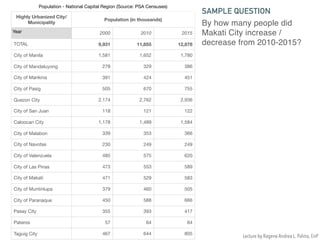
Population - National Capital Region (Source: PSA Censuses)
Highly Urbanized City/
Municipality
Population (in thousands)
Year 2000 2010 2015
TOTAL 9,931 11,855 12,878
City of Manila 1,581 1,652 1,780
City of Mandaluyong 278 329 386
City of Marikina 391 424 451
City of Pasig 505 670 755
Quezon City 2,174 2,762 2,936
City of San Juan 118 121 122
Caloocan City 1,178 1,489 1,584
City of Malabon 339 353 366
City of Navotas 230 249 249
City of Valenzuela 485 575 620
City of Las Pinas 473 553 589
City of Makati 471 529 583
City of Muntinlupa 379 460 505
City of Paranaque 450 588 666
Pasay City 355 393 417
Pateros 57 64 64
Taguig City 467 644 805
By how many people did
Makati City increase /
decrease from 2010-2015?
SAMPLE QUESTION
Lecture by Ragene Andrea L. Palma, EnP
Population - National Capital Region (Source: PSA Censuses)
Highly Urbanized City/
Municipality
Population (in thousands)
Year 2000 2010 2015
TOTAL 9,931 11,855 12,878
City of Manila 1,581 1,652 1,780
City of Mandaluyong 278 329 386
City of Marikina 391 424 451
City of Pasig 505 670 755
Quezon City 2,174 2,762 2,936
City of San Juan 118 121 122
Caloocan City 1,178 1,489 1,584
City of Malabon 339 353 366
City of Navotas 230 249 249
City of Valenzuela 485 575 620
City of Las Pinas 473 553 589
City of Makati 471 529 583
City of Muntinlupa 379 460 505
City of Paranaque 450 588 666
Pasay City 355 393 417
Pateros 57 64 64
Taguig City 467 644 805
By how many people did
Makati City increase /
decrease from 2010-2015?
SAMPLE QUESTION
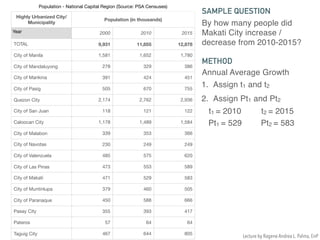
Annual Average Growth
METHOD
1. Assign t1 and t2
2. Assign Pt1 and Pt2
t1 = 2010 t2 = 2015
Pt1 = 529 Pt2 = 583
Lecture by Ragene Andrea L. Palma, EnP
By how many people did
Makati City increase /
decrease from 2010-2015?
Population - National Capital Region (Source: PSA Censuses)
Highly Urbanized City/
Municipality
Population (in thousands)
Year 2000 2010 2015
TOTAL 9,931 11,855 12,878
City of Manila 1,581 1,652 1,780
City of Mandaluyong 278 329 386
City of Marikina 391 424 451
City of Pasig 505 670 755
Quezon City 2,174 2,762 2,936
City of San Juan 118 121 122
Caloocan City 1,178 1,489 1,584
City of Malabon 339 353 366
City of Navotas 230 249 249
City of Valenzuela 485 575 620
City of Las Pinas 473 553 589
City of Makati 471 529 583
City of Muntinlupa 379 460 505
City of Paranaque 450 588 666
Pasay City 355 393 417
Pateros 57 64 64
Taguig City 467 644 805
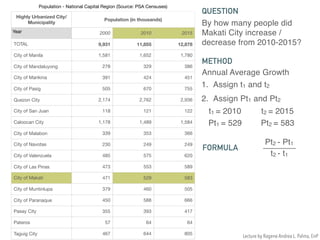
QUESTION
Annual Average Growth
METHOD
1. Assign t1 and t2
2. Assign Pt1 and Pt2
FORMULA
t1 = 2010 t2 = 2015
Pt1 = 529 Pt2 = 583
Pt2 - Pt1
t2 - t1
Lecture by Ragene Andrea L. Palma, EnP
By how many people did
Makati City increase /
decrease from 2010-2015?
Population - National Capital Region (Source: PSA Censuses)
Highly Urbanized City/
Municipality
Population (in thousands)
Year 2000 2010 2015
TOTAL 9,931 11,855 12,878
City of Manila 1,581 1,652 1,780
City of Mandaluyong 278 329 386
City of Marikina 391 424 451
City of Pasig 505 670 755
Quezon City 2,174 2,762 2,936
City of San Juan 118 121 122
Caloocan City 1,178 1,489 1,584
City of Malabon 339 353 366
City of Navotas 230 249 249
City of Valenzuela 485 575 620
City of Las Pinas 473 553 589
City of Makati 471 529 583
City of Muntinlupa 379 460 505
City of Paranaque 450 588 666
Pasay City 355 393 417
Pateros 57 64 64
Taguig City 467 644 805
SAMPLE QUESTION
Annual Average Growth
METHOD
1. Assign t1 and t2
2. Assign Pt1 and Pt2
FORMULA
t1 = 2010 t2 = 2015
Pt1 = 529 Pt2 = 583
Pt2 - Pt1
t2 - t1
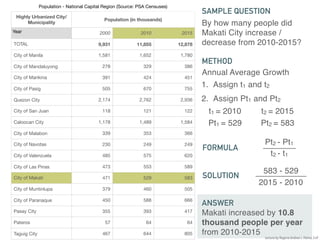
SOLUTION
583 - 529
2015 - 2010
ANSWER
Makati increased by 10.8
thousand people per year
from 2010-2015
Lecture by Ragene Andrea L. Palma, EnP
Population - National Capital Region (Source: PSA Censuses)
Highly Urbanized City/
Municipality
Population (in thousands)
Year 2000 2010 2015
TOTAL 9,931 11,855 12,878
City of Manila 1,581 1,652 1,780
City of Mandaluyong 278 329 386
City of Marikina 391 424 451
City of Pasig 505 670 755
Quezon City 2,174 2,762 2,936
City of San Juan 118 121 122
Caloocan City 1,178 1,489 1,584
City of Malabon 339 353 366
City of Navotas 230 249 249
City of Valenzuela 485 575 620
City of Las Pinas 473 553 589
City of Makati 471 529 583
City of Muntinlupa 379 460 505
City of Paranaque 450 588 666
Pasay City 355 393 417
Pateros 57 64 64
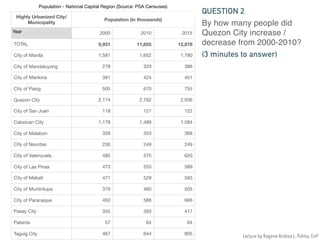
Taguig City 467 644 805
By how many people did
Quezon City increase /
decrease from 2000-2010?
QUESTION 2
(3 minutes to answer)
Lecture by Ragene Andrea L. Palma, EnP
Population - National Capital Region (Source: PSA Censuses)
Highly Urbanized City/
Municipality
Population (in thousands)
Year 2000 2010 2015
TOTAL 9,931 11,855 12,878
City of Manila 1,581 1,652 1,780
City of Mandaluyong 278 329 386
City of Marikina 391 424 451
City of Pasig 505 670 755
Quezon City 2,174 2,762 2,936
City of San Juan 118 121 122
Caloocan City 1,178 1,489 1,584
City of Malabon 339 353 366
City of Navotas 230 249 249
City of Valenzuela 485 575 620
City of Las Pinas 473 553 589
City of Makati 471 529 583
City of Muntinlupa 379 460 505
City of Paranaque 450 588 666
Pasay City 355 393 417
Pateros 57 64 64
Taguig City 467 644 805
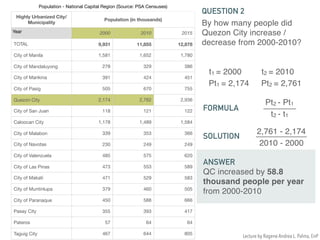
By how many people did
Quezon City increase /
decrease from 2000-2010?
QUESTION 2
FORMULA
t1 = 2000 t2 = 2010
Pt1 = 2,174 Pt2 = 2,761
Pt2 - Pt1
t2 - t1
SOLUTION
2,761 - 2,174
2010 - 2000
ANSWER
QC increased by 58.8
thousand people per year
from 2000-2010
Lecture by Ragene Andrea L. Palma, EnP
Population - National Capital Region (Source: PSA Censuses)
Highly Urbanized City/
Municipality
Population (in thousands)
Year 2000 2010 2015
TOTAL 9,931 11,855 12,878
City of Manila 1,581 1,652 1,780
City of Mandaluyong 278 329 386
City of Marikina 391 424 451
City of Pasig 505 670 755
Quezon City 2,174 2,762 2,936
City of San Juan 118 121 122
Caloocan City 1,178 1,489 1,584
City of Malabon 339 353 366
City of Navotas 230 249 249
City of Valenzuela 485 575 620
City of Las Pinas 473 553 589
City of Makati 471 529 583
City of Muntinlupa 379 460 505
City of Paranaque 450 588 666
Pasay City 355 393 417
Pateros 57 64 64
Taguig City 467 644 805
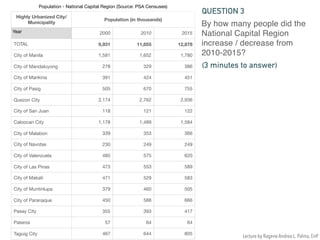
By how many people did the
National Capital Region
increase / decrease from
2010-2015?
QUESTION 3
(3 minutes to answer)
Lecture by Ragene Andrea L. Palma, EnP
Population - National Capital Region (Source: PSA Censuses)
Highly Urbanized City/
Municipality
Population (in thousands)
Year 2000 2010 2015
TOTAL 9,931 11,855 12,878
City of Manila 1,581 1,652 1,780
City of Mandaluyong 278 329 386
City of Marikina 391 424 451
City of Pasig 505 670 755
Quezon City 2,174 2,762 2,936
City of San Juan 118 121 122
Caloocan City 1,178 1,489 1,584
City of Malabon 339 353 366
City of Navotas 230 249 249
City of Valenzuela 485 575 620
City of Las Pinas 473 553 589
City of Makati 471 529 583
City of Muntinlupa 379 460 505
City of Paranaque 450 588 666
Pasay City 355 393 417
Pateros 57 64 64
Taguig City 467 644 805
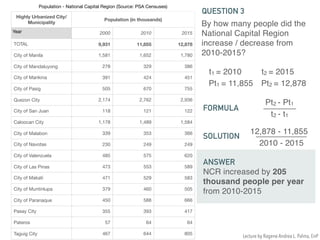
By how many people did the
National Capital Region
increase / decrease from
2010-2015?
QUESTION 3
FORMULA
t1 = 2010 t2 = 2015
Pt1 = 11,855 Pt2 = 12,878
Pt2 - Pt1
t2 - t1
SOLUTION
12,878 - 11,855
2010 - 2015
ANSWER
NCR increased by 205
thousand people per year
from 2010-2015
Lecture by Ragene Andrea L. Palma, EnP
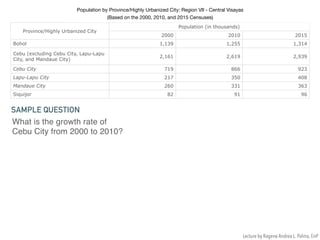
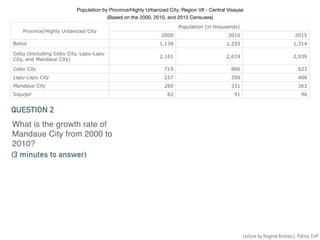
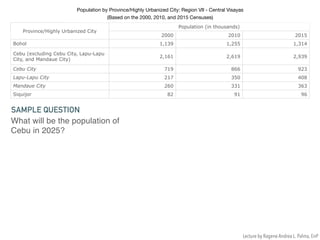
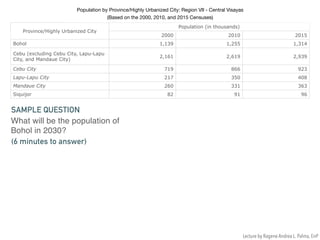
Population by Province/Highly Urbanized City: Region VII - Central Visayas 

(Based on the 2000, 2010, and 2015 Censuses)
Province/Highly Urbanized City
Population (in thousands)
2000 2010 2015
Bohol 1,139 1,255 1,314
Cebu (excluding Cebu City, Lapu-Lapu
City, and Mandaue City)
2,161 2,619 2,939
Cebu City 719 866 923
Lapu-Lapu City 217 350 408
Mandaue City 260 331 363
Siquijor 82 91 96
What is the growth rate of
Cebu City from 2000 to 2010?
SAMPLE QUESTION
Lecture by Ragene Andrea L. Palma, EnP
Population by Province/Highly Urbanized City: Region VII - Central Visayas 

(Based on the 2000, 2010, and 2015 Censuses)
Province/Highly Urbanized City
Population (in thousands)
2000 2010 2015
Bohol 1,139 1,255 1,314
Cebu (excluding Cebu City, Lapu-Lapu
City, and Mandaue City)
2,161 2,619 2,939
Cebu City 719 866 923
Lapu-Lapu City 217 350 408
Mandaue City 260 331 363
Siquijor 82 91 96
What is the growth rate of
Cebu City from 2000 to 2010?
SAMPLE QUESTION
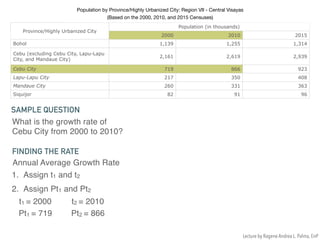
Annual Average Growth Rate
FINDING THE RATE
1. Assign t1 and t2
2. Assign Pt1 and Pt2
t1 = 2000 t2 = 2010
Pt1 = 719 Pt2 = 866
Lecture by Ragene Andrea L. Palma, EnP
Population by Province/Highly Urbanized City: Region VII - Central Visayas 

(Based on the 2000, 2010, and 2015 Censuses)
Province/Highly Urbanized City
Population (in thousands)
2000 2010 2015
Bohol 1,139 1,255 1,314
Cebu (excluding Cebu City, Lapu-Lapu
City, and Mandaue City)
2,161 2,619 2,939
Cebu City 719 866 923
Lapu-Lapu City 217 350 408
Mandaue City 260 331 363
Siquijor 82 91 96
What is the growth rate of
Cebu City from 2000 to 2010?
SAMPLE QUESTION
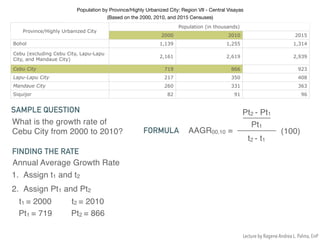
Annual Average Growth Rate
FINDING THE RATE
1. Assign t1 and t2
2. Assign Pt1 and Pt2
t1 = 2000 t2 = 2010
Pt1 = 719 Pt2 = 866
FORMULA AAGR00,10 =
Pt2 - Pt1
t2 - t1
Pt1
(100)
Lecture by Ragene Andrea L. Palma, EnP
Population by Province/Highly Urbanized City: Region VII - Central Visayas 

(Based on the 2000, 2010, and 2015 Censuses)
Province/Highly Urbanized City
Population (in thousands)
2000 2010 2015
Bohol 1,139 1,255 1,314
Cebu (excluding Cebu City, Lapu-Lapu
City, and Mandaue City)
2,161 2,619 2,939
Cebu City 719 866 923
Lapu-Lapu City 217 350 408
Mandaue City 260 331 363
Siquijor 82 91 96
What is the growth rate of
Cebu City from 2000 to 2010?
SAMPLE QUESTION
Annual Average Growth Rate
FINDING THE RATE
1. Assign t1 and t2
2. Assign Pt1 and Pt2
t1 = 2000 t2 = 2010
Pt1 = 719 Pt2 = 866
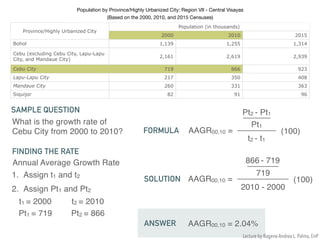
FORMULA AAGR00,10 =
Pt2 - Pt1
t2 - t1
Pt1
(100)
SOLUTION AAGR00,10 =
866 - 719
2010 - 2000
719
(100)
ANSWER AAGR00,10 = 2.04%
Lecture by Ragene Andrea L. Palma, EnP
Population by Province/Highly Urbanized City: Region VII - Central Visayas 

(Based on the 2000, 2010, and 2015 Censuses)
Province/Highly Urbanized City
Population (in thousands)
2000 2010 2015
Bohol 1,139 1,255 1,314
Cebu (excluding Cebu City, Lapu-Lapu
City, and Mandaue City)
2,161 2,619 2,939
Cebu City 719 866 923
Lapu-Lapu City 217 350 408
Mandaue City 260 331 363
Siquijor 82 91 96
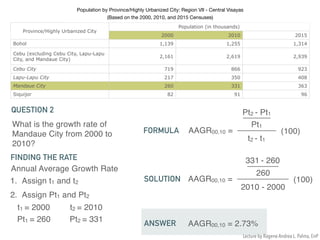
What is the growth rate of
Mandaue City from 2000 to
2010?
QUESTION 2
(3 minutes to answer)
Lecture by Ragene Andrea L. Palma, EnP
Population by Province/Highly Urbanized City: Region VII - Central Visayas 

(Based on the 2000, 2010, and 2015 Censuses)
Province/Highly Urbanized City
Population (in thousands)
2000 2010 2015
Bohol 1,139 1,255 1,314
Cebu (excluding Cebu City, Lapu-Lapu
City, and Mandaue City)
2,161 2,619 2,939
Cebu City 719 866 923
Lapu-Lapu City 217 350 408
Mandaue City 260 331 363
Siquijor 82 91 96
What is the growth rate of
Mandaue City from 2000 to
2010?
QUESTION 2
Annual Average Growth Rate
FINDING THE RATE
1. Assign t1 and t2
2. Assign Pt1 and Pt2
t1 = 2000 t2 = 2010
Pt1 = 260 Pt2 = 331
FORMULA AAGR00,10 =
Pt2 - Pt1
t2 - t1
Pt1
(100)
SOLUTION AAGR00,10 =
331 - 260
2010 - 2000
260
(100)
ANSWER AAGR00,10 = 2.73%
Lecture by Ragene Andrea L. Palma, EnP
Population by Province/Highly Urbanized City: Region VII - Central Visayas 

(Based on the 2000, 2010, and 2015 Censuses)
Province/Highly Urbanized City
Population (in thousands)
2000 2010 2015
Bohol 1,139 1,255 1,314
Cebu (excluding Cebu City, Lapu-Lapu
City, and Mandaue City)
2,161 2,619 2,939
Cebu City 719 866 923
Lapu-Lapu City 217 350 408
Mandaue City 260 331 363
Siquijor 82 91 96
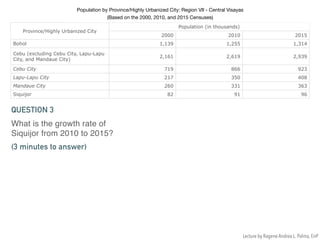
What is the growth rate of
Siquijor from 2010 to 2015?
QUESTION 3
(3 minutes to answer)
Lecture by Ragene Andrea L. Palma, EnP
Population by Province/Highly Urbanized City: Region VII - Central Visayas 

(Based on the 2000, 2010, and 2015 Censuses)
Province/Highly Urbanized City
Population (in thousands)
2000 2010 2015
Bohol 1,139 1,255 1,314
Cebu (excluding Cebu City, Lapu-Lapu
City, and Mandaue City)
2,161 2,619 2,939
Cebu City 719 866 923
Lapu-Lapu City 217 350 408
Mandaue City 260 331 363
Siquijor 82 91 96
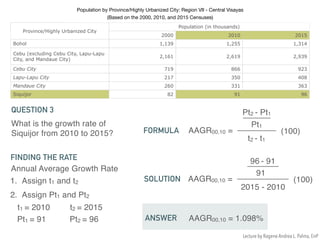
What is the growth rate of
Siquijor from 2010 to 2015?
QUESTION 3
Annual Average Growth Rate
FINDING THE RATE
1. Assign t1 and t2
2. Assign Pt1 and Pt2
t1 = 2010 t2 = 2015
Pt1 = 91 Pt2 = 96
FORMULA AAGR00,10 =
Pt2 - Pt1
t2 - t1
Pt1
(100)
SOLUTION AAGR00,10 =
96 - 91
2015 - 2010
91
(100)
ANSWER AAGR00,10 = 1.098%
Lecture by Ragene Andrea L. Palma, EnP
Population by Province/Highly Urbanized City: Region VII - Central Visayas 

(Based on the 2000, 2010, and 2015 Censuses)
Province/Highly Urbanized City
Population (in thousands)
2000 2010 2015
Bohol 1,139 1,255 1,314
Cebu (excluding Cebu City, Lapu-Lapu
City, and Mandaue City)
2,161 2,619 2,939
Cebu City 719 866 923
Lapu-Lapu City 217 350 408
Mandaue City 260 331 363
Siquijor 82 91 96
SAMPLE QUESTION
What will be the population of
Cebu in 2025?
Lecture by Ragene Andrea L. Palma, EnP
Population by Province/Highly Urbanized City: Region VII - Central Visayas 

(Based on the 2000, 2010, and 2015 Censuses)
Province/Highly Urbanized City
Population (in thousands)
2000 2010 2015
Bohol 1,139 1,255 1,314
Cebu (excluding Cebu City, Lapu-Lapu
City, and Mandaue City)
2,161 2,619 2,939
Cebu City 719 866 923
Lapu-Lapu City 217 350 408
Mandaue City 260 331 363
Siquijor 82 91 96
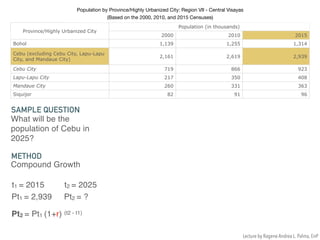
What will be the
population of Cebu in
2025?
SAMPLE QUESTION
Pt2 = Pt1 (1+r) (t2 - t1)
t1 = 2015 t2 = 2025
Pt1 = 2,939 Pt2 = ?
METHOD
Compound Growth
Lecture by Ragene Andrea L. Palma, EnP
( )
Population by Province/Highly Urbanized City: Region VII - Central Visayas 

(Based on the 2000, 2010, and 2015 Censuses)
Province/Highly Urbanized City
Population (in thousands)
2000 2010 2015
Bohol 1,139 1,255 1,314
Cebu (excluding Cebu City, Lapu-Lapu
City, and Mandaue City)
2,161 2,619 2,939
Cebu City 719 866 923
Lapu-Lapu City 217 350 408
Mandaue City 260 331 363
Siquijor 82 91 96
What will be the
population of Cebu in
2025?
SAMPLE QUESTION
Pt2 = Pt1 (1+r) (t2 - t1)
t1 = 2015 t2 = 2025
Pt1 = 2,939 Pt2 = ?
METHOD
Compound Growth
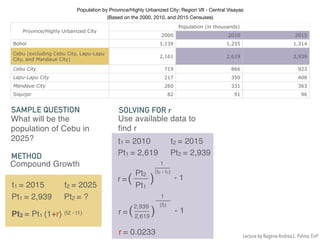
SOLVING FOR r
Use available data to
find r
t1 = 2010 t2 = 2015
Pt1 = 2,619 Pt2 = 2,939
r =
Pt2
Pt1
1
(t2 - t1)
- 1
( )r =
2,939
2,619
1
(5)
- 1
r = 0.0233 Lecture by Ragene Andrea L. Palma, EnP
( )
Population by Province/Highly Urbanized City: Region VII - Central Visayas 

(Based on the 2000, 2010, and 2015 Censuses)
Province/Highly Urbanized City
Population (in thousands)
2000 2010 2015
Bohol 1,139 1,255 1,314
Cebu (excluding Cebu City, Lapu-Lapu
City, and Mandaue City)
2,161 2,619 2,939
Cebu City 719 866 923
Lapu-Lapu City 217 350 408
Mandaue City 260 331 363
Siquijor 82 91 96
What will be the
population of Cebu in
2025?
SAMPLE QUESTION
Pt2 = Pt1 (1+r) (t2 - t1)
t1 = 2015 t2 = 2025
Pt1 = 2,939 Pt2 = ?
METHOD
Compound Growth
SOLVING FOR r
Use available data to
find r
t1 = 2010 t2 = 2015
Pt1 = 2,619 Pt2 = 2,939
r =
Pt2
Pt1
1
(t2 - t1)
- 1
( )r =
2,939
2,619
1
(5)
- 1
r = 0.0233
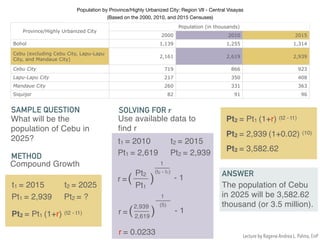
Pt2 = Pt1 (1+r) (t2 - t1)
Pt2 = 2,939 (1+0.02) (10)
Pt2 = 3,582.62
ANSWER
The population of Cebu
in 2025 will be 3,582.62
thousand (or 3.5 million).
Lecture by Ragene Andrea L. Palma, EnP
Population by Province/Highly Urbanized City: Region VII - Central Visayas 

(Based on the 2000, 2010, and 2015 Censuses)
Province/Highly Urbanized City
Population (in thousands)
2000 2010 2015
Bohol 1,139 1,255 1,314
Cebu (excluding Cebu City, Lapu-Lapu
City, and Mandaue City)
2,161 2,619 2,939
Cebu City 719 866 923
Lapu-Lapu City 217 350 408
Mandaue City 260 331 363
Siquijor 82 91 96
SAMPLE QUESTION
What will be the population of
Bohol in 2030?
(6 minutes to answer)
Lecture by Ragene Andrea L. Palma, EnP
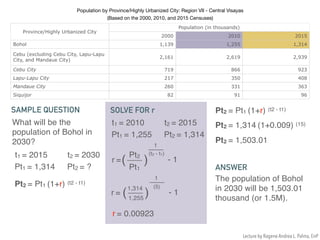
Population by Province/Highly Urbanized City: Region VII - Central Visayas 

(Based on the 2000, 2010, and 2015 Censuses)
Province/Highly Urbanized City
Population (in thousands)
2000 2010 2015
Bohol 1,139 1,255 1,314
Cebu (excluding Cebu City, Lapu-Lapu
City, and Mandaue City)
2,161 2,619 2,939
Cebu City 719 866 923
Lapu-Lapu City 217 350 408
Mandaue City 260 331 363
Siquijor 82 91 96
SAMPLE QUESTION
What will be the
population of Bohol in
2030?
Pt2 = Pt1 (1+r) (t2 - t1)
t1 = 2015 t2 = 2030
Pt1 = 1,314 Pt2 = ?
SOLVE FOR r
( )
t1 = 2010 t2 = 2015
Pt1 = 1,255 Pt2 = 1,314
Pt2
Pt1
1
(t2 - t1)
- 1
( )
1,314
1,255
1
(5)
- 1
r = 0.00923
r =
r =
Pt2 = Pt1 (1+r) (t2 - t1)
Pt2 = 1,314 (1+0.009) (15)
Pt2 = 1,503.01
ANSWER
The population of Bohol
in 2030 will be 1,503.01
thousand (or 1.5M).
Lecture by Ragene Andrea L. Palma, EnP
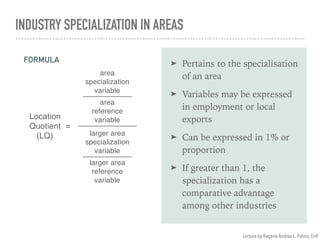
INDUSTRY SPECIALIZATION IN AREAS
➤ Pertains to the specialisation
of an area
➤ Variables may be expressed
in employment or local
exports
➤ Can be expressed in 1% or
proportion
➤ If greater than 1, the
specialization has a
comparative advantage
among other industries
Location
Quotient
(LQ)
=
area
specialization
variable
area
reference
variable
larger area
specialization
variable
larger area
reference
variable
FORMULA
Lecture by Ragene Andrea L. Palma, EnP
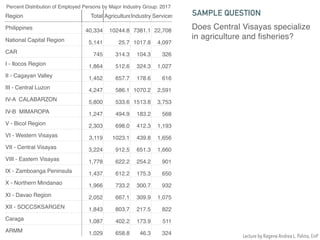
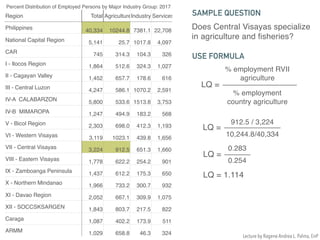
Percent Distribution of Employed Persons by Major Industry Group: 2017
Region Total AgricultureIndustry Services
Philippines 40,334 10244.8 7381.1 22,708
National Capital Region 5,141 25.7 1017.8 4,097
CAR 745 314.3 104.3 326
I - Ilocos Region 1,864 512.6 324.3 1,027
II - Cagayan Valley 1,452 657.7 178.6 616
III - Central Luzon 4,247 586.1 1070.2 2,591
IV-A CALABARZON 5,800 533.6 1513.8 3,753
IV-B MIMAROPA 1,247 494.9 183.2 568
V - Bicol Region 2,303 698.0 412.3 1,193
VI - Western Visayas 3,119 1023.1 439.8 1,656
VII - Central Visayas 3,224 912.5 651.3 1,660
VIII - Eastern Visayas 1,778 622.2 254.2 901
IX - Zamboanga Peninsula 1,437 612.2 175.3 650
X - Northern Mindanao 1,966 733.2 300.7 932
XI - Davao Region 2,052 667.1 309.9 1,075
XII - SOCCSKSARGEN 1,843 803.7 217.5 822
Caraga 1,087 402.2 173.9 511
ARMM 1,029 658.8 46.3 324
Does Central Visayas specialize
in agriculture and fisheries?
SAMPLE QUESTION
Lecture by Ragene Andrea L. Palma, EnP
Percent Distribution of Employed Persons by Major Industry Group: 2017
Region Total AgricultureIndustry Services
Philippines 40,334 10244.8 7381.1 22,708
National Capital Region 5,141 25.7 1017.8 4,097
CAR 745 314.3 104.3 326
I - Ilocos Region 1,864 512.6 324.3 1,027
II - Cagayan Valley 1,452 657.7 178.6 616
III - Central Luzon 4,247 586.1 1070.2 2,591
IV-A CALABARZON 5,800 533.6 1513.8 3,753
IV-B MIMAROPA 1,247 494.9 183.2 568
V - Bicol Region 2,303 698.0 412.3 1,193
VI - Western Visayas 3,119 1023.1 439.8 1,656
VII - Central Visayas 3,224 912.5 651.3 1,660
VIII - Eastern Visayas 1,778 622.2 254.2 901
IX - Zamboanga Peninsula 1,437 612.2 175.3 650
X - Northern Mindanao 1,966 733.2 300.7 932
XI - Davao Region 2,052 667.1 309.9 1,075
XII - SOCCSKSARGEN 1,843 803.7 217.5 822
Caraga 1,087 402.2 173.9 511
ARMM 1,029 658.8 46.3 324
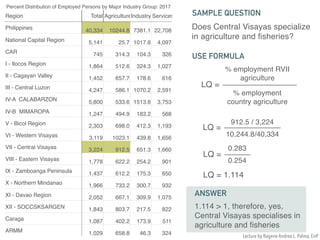
Does Central Visayas specialize
in agriculture and fisheries?
SAMPLE QUESTION
LQ =
% employment RVII
agriculture
% employment
country agriculture
USE FORMULA
LQ =
912.5 / 3,224
10,244.8/40,334
LQ =
0.283
0.254
LQ = 1.114
Lecture by Ragene Andrea L. Palma, EnP
Percent Distribution of Employed Persons by Major Industry Group: 2017
Region Total AgricultureIndustry Services
Philippines 40,334 10244.8 7381.1 22,708
National Capital Region 5,141 25.7 1017.8 4,097
CAR 745 314.3 104.3 326
I - Ilocos Region 1,864 512.6 324.3 1,027
II - Cagayan Valley 1,452 657.7 178.6 616
III - Central Luzon 4,247 586.1 1070.2 2,591
IV-A CALABARZON 5,800 533.6 1513.8 3,753
IV-B MIMAROPA 1,247 494.9 183.2 568
V - Bicol Region 2,303 698.0 412.3 1,193
VI - Western Visayas 3,119 1023.1 439.8 1,656
VII - Central Visayas 3,224 912.5 651.3 1,660
VIII - Eastern Visayas 1,778 622.2 254.2 901
IX - Zamboanga Peninsula 1,437 612.2 175.3 650
X - Northern Mindanao 1,966 733.2 300.7 932
XI - Davao Region 2,052 667.1 309.9 1,075
XII - SOCCSKSARGEN 1,843 803.7 217.5 822
Caraga 1,087 402.2 173.9 511
ARMM 1,029 658.8 46.3 324
Does Central Visayas specialize
in agriculture and fisheries?
SAMPLE QUESTION
LQ =
% employment RVII
agriculture
% employment
country agriculture
USE FORMULA
LQ =
912.5 / 3,224
10,244.8/40,334
ANSWER
LQ =
0.283
0.254
LQ = 1.114
1.114 > 1, therefore, yes,
Central Visayas specialises in
agriculture and fisheries
Lecture by Ragene Andrea L. Palma, EnP
Percent Distribution of Employed Persons by Major Industry Group: 2017
Region Total AgricultureIndustry Services
Philippines 40,334 10244.8 7381.1 22,708
National Capital Region 5,141 25.7 1017.8 4,097
CAR 745 314.3 104.3 326
I - Ilocos Region 1,864 512.6 324.3 1,027
II - Cagayan Valley 1,452 657.7 178.6 616
III - Central Luzon 4,247 586.1 1070.2 2,591
IV-A CALABARZON 5,800 533.6 1513.8 3,753
IV-B MIMAROPA 1,247 494.9 183.2 568
V - Bicol Region 2,303 698.0 412.3 1,193
VI - Western Visayas 3,119 1023.1 439.8 1,656
VII - Central Visayas 3,224 912.5 651.3 1,660
VIII - Eastern Visayas 1,778 622.2 254.2 901
IX - Zamboanga Peninsula 1,437 612.2 175.3 650
X - Northern Mindanao 1,966 733.2 300.7 932
XI - Davao Region 2,052 667.1 309.9 1,075
XII - SOCCSKSARGEN 1,843 803.7 217.5 822
Caraga 1,087 402.2 173.9 511
ARMM 1,029 658.8 46.3 324
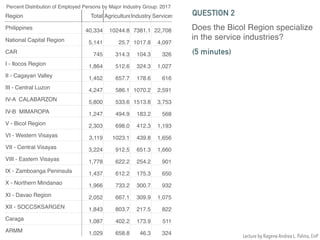
Does the Bicol Region specialize
in the service industries?
QUESTION 2
(5 minutes)
Lecture by Ragene Andrea L. Palma, EnP
Percent Distribution of Employed Persons by Major Industry Group: 2017
Region Total AgricultureIndustry Services
Philippines 40,334 10244.8 7381.1 22,708
National Capital Region 5,141 25.7 1017.8 4,097
CAR 745 314.3 104.3 326
I - Ilocos Region 1,864 512.6 324.3 1,027
II - Cagayan Valley 1,452 657.7 178.6 616
III - Central Luzon 4,247 586.1 1070.2 2,591
IV-A CALABARZON 5,800 533.6 1513.8 3,753
IV-B MIMAROPA 1,247 494.9 183.2 568
V - Bicol Region 2,303 698.0 412.3 1,193
VI - Western Visayas 3,119 1023.1 439.8 1,656
VII - Central Visayas 3,224 912.5 651.3 1,660
VIII - Eastern Visayas 1,778 622.2 254.2 901
IX - Zamboanga Peninsula 1,437 612.2 175.3 650
X - Northern Mindanao 1,966 733.2 300.7 932
XI - Davao Region 2,052 667.1 309.9 1,075
XII - SOCCSKSARGEN 1,843 803.7 217.5 822
Caraga 1,087 402.2 173.9 511
ARMM 1,029 658.8 46.3 324
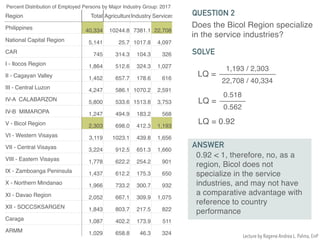
Does the Bicol Region specialize
in the service industries?
QUESTION 2
SOLVE
LQ =
1,193 / 2,303
22,708 / 40,334
LQ =
0.518
0.562
LQ = 0.92
ANSWER
0.92 < 1, therefore, no, as a
region, Bicol does not
specialize in the service
industries, and may not have
a comparative advantage with
reference to country
performance
Lecture by Ragene Andrea L. Palma, EnP
Percent Distribution of Employed Persons by Major Industry Group: 2017
Region Total AgricultureIndustry Services
Philippines 40,334 10244.8 7381.1 22,708
National Capital Region 5,141 25.7 1017.8 4,097
CAR 745 314.3 104.3 326
I - Ilocos Region 1,864 512.6 324.3 1,027
II - Cagayan Valley 1,452 657.7 178.6 616
III - Central Luzon 4,247 586.1 1070.2 2,591
IV-A CALABARZON 5,800 533.6 1513.8 3,753
IV-B MIMAROPA 1,247 494.9 183.2 568
V - Bicol Region 2,303 698.0 412.3 1,193
VI - Western Visayas 3,119 1023.1 439.8 1,656
VII - Central Visayas 3,224 912.5 651.3 1,660
VIII - Eastern Visayas 1,778 622.2 254.2 901
IX - Zamboanga Peninsula 1,437 612.2 175.3 650
X - Northern Mindanao 1,966 733.2 300.7 932
XI - Davao Region 2,052 667.1 309.9 1,075
XII - SOCCSKSARGEN 1,843 803.7 217.5 822
Caraga 1,087 402.2 173.9 511
ARMM 1,029 658.8 46.3 324
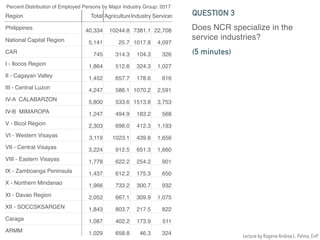
Does NCR specialize in the
service industries?
QUESTION 3
(5 minutes)
Lecture by Ragene Andrea L. Palma, EnP
Percent Distribution of Employed Persons by Major Industry Group: 2017
Region Total AgricultureIndustry Services
Philippines 40,334 10244.8 7381.1 22,708
National Capital Region 5,141 25.7 1017.8 4,097
CAR 745 314.3 104.3 326
I - Ilocos Region 1,864 512.6 324.3 1,027
II - Cagayan Valley 1,452 657.7 178.6 616
III - Central Luzon 4,247 586.1 1070.2 2,591
IV-A CALABARZON 5,800 533.6 1513.8 3,753
IV-B MIMAROPA 1,247 494.9 183.2 568
V - Bicol Region 2,303 698.0 412.3 1,193
VI - Western Visayas 3,119 1023.1 439.8 1,656
VII - Central Visayas 3,224 912.5 651.3 1,660
VIII - Eastern Visayas 1,778 622.2 254.2 901
IX - Zamboanga Peninsula 1,437 612.2 175.3 650
X - Northern Mindanao 1,966 733.2 300.7 932
XI - Davao Region 2,052 667.1 309.9 1,075
XII - SOCCSKSARGEN 1,843 803.7 217.5 822
Caraga 1,087 402.2 173.9 511
ARMM 1,029 658.8 46.3 324
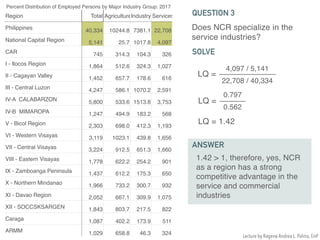
Does NCR specialize in the
service industries?
QUESTION 3
SOLVE
LQ =
4,097 / 5,141
22,708 / 40,334
LQ =
0.797
0.562
LQ = 1.42
ANSWER
1.42 > 1, therefore, yes, NCR
as a region has a strong
competitive advantage in the
service and commercial
industries
Lecture by Ragene Andrea L. Palma, EnP

Exercises for Population Projection and Location Quotient

  • 1.
  • 2.
    Population - NationalCapital Region (Source: PSA Censuses) Highly Urbanized City/ Municipality Population (in thousands) Year 2000 2010 2015 TOTAL 9,931 11,855 12,878 City of Manila 1,581 1,652 1,780 City of Mandaluyong 278 329 386 City of Marikina 391 424 451 City of Pasig 505 670 755 Quezon City 2,174 2,762 2,936 City of San Juan 118 121 122 Caloocan City 1,178 1,489 1,584 City of Malabon 339 353 366 City of Navotas 230 249 249 City of Valenzuela 485 575 620 City of Las Pinas 473 553 589 City of Makati 471 529 583 City of Muntinlupa 379 460 505 City of Paranaque 450 588 666 Pasay City 355 393 417 Pateros 57 64 64 Taguig City 467 644 805 By how many people did Makati City increase / decrease from 2010-2015? SAMPLE QUESTION Lecture by Ragene Andrea L. Palma, EnP
  • 3.
    Population - NationalCapital Region (Source: PSA Censuses) Highly Urbanized City/ Municipality Population (in thousands) Year 2000 2010 2015 TOTAL 9,931 11,855 12,878 City of Manila 1,581 1,652 1,780 City of Mandaluyong 278 329 386 City of Marikina 391 424 451 City of Pasig 505 670 755 Quezon City 2,174 2,762 2,936 City of San Juan 118 121 122 Caloocan City 1,178 1,489 1,584 City of Malabon 339 353 366 City of Navotas 230 249 249 City of Valenzuela 485 575 620 City of Las Pinas 473 553 589 City of Makati 471 529 583 City of Muntinlupa 379 460 505 City of Paranaque 450 588 666 Pasay City 355 393 417 Pateros 57 64 64 Taguig City 467 644 805 By how many people did Makati City increase / decrease from 2010-2015? SAMPLE QUESTION Annual Average Growth METHOD 1. Assign t1 and t2 2. Assign Pt1 and Pt2 t1 = 2010 t2 = 2015 Pt1 = 529 Pt2 = 583 Lecture by Ragene Andrea L. Palma, EnP
  • 4.
    By how manypeople did Makati City increase / decrease from 2010-2015? Population - National Capital Region (Source: PSA Censuses) Highly Urbanized City/ Municipality Population (in thousands) Year 2000 2010 2015 TOTAL 9,931 11,855 12,878 City of Manila 1,581 1,652 1,780 City of Mandaluyong 278 329 386 City of Marikina 391 424 451 City of Pasig 505 670 755 Quezon City 2,174 2,762 2,936 City of San Juan 118 121 122 Caloocan City 1,178 1,489 1,584 City of Malabon 339 353 366 City of Navotas 230 249 249 City of Valenzuela 485 575 620 City of Las Pinas 473 553 589 City of Makati 471 529 583 City of Muntinlupa 379 460 505 City of Paranaque 450 588 666 Pasay City 355 393 417 Pateros 57 64 64 Taguig City 467 644 805 QUESTION Annual Average Growth METHOD 1. Assign t1 and t2 2. Assign Pt1 and Pt2 FORMULA t1 = 2010 t2 = 2015 Pt1 = 529 Pt2 = 583 Pt2 - Pt1 t2 - t1 Lecture by Ragene Andrea L. Palma, EnP
  • 5.
    By how manypeople did Makati City increase / decrease from 2010-2015? Population - National Capital Region (Source: PSA Censuses) Highly Urbanized City/ Municipality Population (in thousands) Year 2000 2010 2015 TOTAL 9,931 11,855 12,878 City of Manila 1,581 1,652 1,780 City of Mandaluyong 278 329 386 City of Marikina 391 424 451 City of Pasig 505 670 755 Quezon City 2,174 2,762 2,936 City of San Juan 118 121 122 Caloocan City 1,178 1,489 1,584 City of Malabon 339 353 366 City of Navotas 230 249 249 City of Valenzuela 485 575 620 City of Las Pinas 473 553 589 City of Makati 471 529 583 City of Muntinlupa 379 460 505 City of Paranaque 450 588 666 Pasay City 355 393 417 Pateros 57 64 64 Taguig City 467 644 805 SAMPLE QUESTION Annual Average Growth METHOD 1. Assign t1 and t2 2. Assign Pt1 and Pt2 FORMULA t1 = 2010 t2 = 2015 Pt1 = 529 Pt2 = 583 Pt2 - Pt1 t2 - t1 SOLUTION 583 - 529 2015 - 2010 ANSWER Makati increased by 10.8 thousand people per year from 2010-2015 Lecture by Ragene Andrea L. Palma, EnP
  • 6.
    Population - NationalCapital Region (Source: PSA Censuses) Highly Urbanized City/ Municipality Population (in thousands) Year 2000 2010 2015 TOTAL 9,931 11,855 12,878 City of Manila 1,581 1,652 1,780 City of Mandaluyong 278 329 386 City of Marikina 391 424 451 City of Pasig 505 670 755 Quezon City 2,174 2,762 2,936 City of San Juan 118 121 122 Caloocan City 1,178 1,489 1,584 City of Malabon 339 353 366 City of Navotas 230 249 249 City of Valenzuela 485 575 620 City of Las Pinas 473 553 589 City of Makati 471 529 583 City of Muntinlupa 379 460 505 City of Paranaque 450 588 666 Pasay City 355 393 417 Pateros 57 64 64 Taguig City 467 644 805 By how many people did Quezon City increase / decrease from 2000-2010? QUESTION 2 (3 minutes to answer) Lecture by Ragene Andrea L. Palma, EnP
  • 7.
    Population - NationalCapital Region (Source: PSA Censuses) Highly Urbanized City/ Municipality Population (in thousands) Year 2000 2010 2015 TOTAL 9,931 11,855 12,878 City of Manila 1,581 1,652 1,780 City of Mandaluyong 278 329 386 City of Marikina 391 424 451 City of Pasig 505 670 755 Quezon City 2,174 2,762 2,936 City of San Juan 118 121 122 Caloocan City 1,178 1,489 1,584 City of Malabon 339 353 366 City of Navotas 230 249 249 City of Valenzuela 485 575 620 City of Las Pinas 473 553 589 City of Makati 471 529 583 City of Muntinlupa 379 460 505 City of Paranaque 450 588 666 Pasay City 355 393 417 Pateros 57 64 64 Taguig City 467 644 805 By how many people did Quezon City increase / decrease from 2000-2010? QUESTION 2 FORMULA t1 = 2000 t2 = 2010 Pt1 = 2,174 Pt2 = 2,761 Pt2 - Pt1 t2 - t1 SOLUTION 2,761 - 2,174 2010 - 2000 ANSWER QC increased by 58.8 thousand people per year from 2000-2010 Lecture by Ragene Andrea L. Palma, EnP
  • 8.
    Population - NationalCapital Region (Source: PSA Censuses) Highly Urbanized City/ Municipality Population (in thousands) Year 2000 2010 2015 TOTAL 9,931 11,855 12,878 City of Manila 1,581 1,652 1,780 City of Mandaluyong 278 329 386 City of Marikina 391 424 451 City of Pasig 505 670 755 Quezon City 2,174 2,762 2,936 City of San Juan 118 121 122 Caloocan City 1,178 1,489 1,584 City of Malabon 339 353 366 City of Navotas 230 249 249 City of Valenzuela 485 575 620 City of Las Pinas 473 553 589 City of Makati 471 529 583 City of Muntinlupa 379 460 505 City of Paranaque 450 588 666 Pasay City 355 393 417 Pateros 57 64 64 Taguig City 467 644 805 By how many people did the National Capital Region increase / decrease from 2010-2015? QUESTION 3 (3 minutes to answer) Lecture by Ragene Andrea L. Palma, EnP
  • 9.
    Population - NationalCapital Region (Source: PSA Censuses) Highly Urbanized City/ Municipality Population (in thousands) Year 2000 2010 2015 TOTAL 9,931 11,855 12,878 City of Manila 1,581 1,652 1,780 City of Mandaluyong 278 329 386 City of Marikina 391 424 451 City of Pasig 505 670 755 Quezon City 2,174 2,762 2,936 City of San Juan 118 121 122 Caloocan City 1,178 1,489 1,584 City of Malabon 339 353 366 City of Navotas 230 249 249 City of Valenzuela 485 575 620 City of Las Pinas 473 553 589 City of Makati 471 529 583 City of Muntinlupa 379 460 505 City of Paranaque 450 588 666 Pasay City 355 393 417 Pateros 57 64 64 Taguig City 467 644 805 By how many people did the National Capital Region increase / decrease from 2010-2015? QUESTION 3 FORMULA t1 = 2010 t2 = 2015 Pt1 = 11,855 Pt2 = 12,878 Pt2 - Pt1 t2 - t1 SOLUTION 12,878 - 11,855 2010 - 2015 ANSWER NCR increased by 205 thousand people per year from 2010-2015 Lecture by Ragene Andrea L. Palma, EnP
  • 10.
    Population by Province/HighlyUrbanized City: Region VII - Central Visayas  (Based on the 2000, 2010, and 2015 Censuses) Province/Highly Urbanized City Population (in thousands) 2000 2010 2015 Bohol 1,139 1,255 1,314 Cebu (excluding Cebu City, Lapu-Lapu City, and Mandaue City) 2,161 2,619 2,939 Cebu City 719 866 923 Lapu-Lapu City 217 350 408 Mandaue City 260 331 363 Siquijor 82 91 96 What is the growth rate of Cebu City from 2000 to 2010? SAMPLE QUESTION Lecture by Ragene Andrea L. Palma, EnP
  • 11.
    Population by Province/HighlyUrbanized City: Region VII - Central Visayas  (Based on the 2000, 2010, and 2015 Censuses) Province/Highly Urbanized City Population (in thousands) 2000 2010 2015 Bohol 1,139 1,255 1,314 Cebu (excluding Cebu City, Lapu-Lapu City, and Mandaue City) 2,161 2,619 2,939 Cebu City 719 866 923 Lapu-Lapu City 217 350 408 Mandaue City 260 331 363 Siquijor 82 91 96 What is the growth rate of Cebu City from 2000 to 2010? SAMPLE QUESTION Annual Average Growth Rate FINDING THE RATE 1. Assign t1 and t2 2. Assign Pt1 and Pt2 t1 = 2000 t2 = 2010 Pt1 = 719 Pt2 = 866 Lecture by Ragene Andrea L. Palma, EnP
  • 12.
    Population by Province/HighlyUrbanized City: Region VII - Central Visayas  (Based on the 2000, 2010, and 2015 Censuses) Province/Highly Urbanized City Population (in thousands) 2000 2010 2015 Bohol 1,139 1,255 1,314 Cebu (excluding Cebu City, Lapu-Lapu City, and Mandaue City) 2,161 2,619 2,939 Cebu City 719 866 923 Lapu-Lapu City 217 350 408 Mandaue City 260 331 363 Siquijor 82 91 96 What is the growth rate of Cebu City from 2000 to 2010? SAMPLE QUESTION Annual Average Growth Rate FINDING THE RATE 1. Assign t1 and t2 2. Assign Pt1 and Pt2 t1 = 2000 t2 = 2010 Pt1 = 719 Pt2 = 866 FORMULA AAGR00,10 = Pt2 - Pt1 t2 - t1 Pt1 (100) Lecture by Ragene Andrea L. Palma, EnP
  • 13.
    Population by Province/HighlyUrbanized City: Region VII - Central Visayas  (Based on the 2000, 2010, and 2015 Censuses) Province/Highly Urbanized City Population (in thousands) 2000 2010 2015 Bohol 1,139 1,255 1,314 Cebu (excluding Cebu City, Lapu-Lapu City, and Mandaue City) 2,161 2,619 2,939 Cebu City 719 866 923 Lapu-Lapu City 217 350 408 Mandaue City 260 331 363 Siquijor 82 91 96 What is the growth rate of Cebu City from 2000 to 2010? SAMPLE QUESTION Annual Average Growth Rate FINDING THE RATE 1. Assign t1 and t2 2. Assign Pt1 and Pt2 t1 = 2000 t2 = 2010 Pt1 = 719 Pt2 = 866 FORMULA AAGR00,10 = Pt2 - Pt1 t2 - t1 Pt1 (100) SOLUTION AAGR00,10 = 866 - 719 2010 - 2000 719 (100) ANSWER AAGR00,10 = 2.04% Lecture by Ragene Andrea L. Palma, EnP
  • 14.
    Population by Province/HighlyUrbanized City: Region VII - Central Visayas  (Based on the 2000, 2010, and 2015 Censuses) Province/Highly Urbanized City Population (in thousands) 2000 2010 2015 Bohol 1,139 1,255 1,314 Cebu (excluding Cebu City, Lapu-Lapu City, and Mandaue City) 2,161 2,619 2,939 Cebu City 719 866 923 Lapu-Lapu City 217 350 408 Mandaue City 260 331 363 Siquijor 82 91 96 What is the growth rate of Mandaue City from 2000 to 2010? QUESTION 2 (3 minutes to answer) Lecture by Ragene Andrea L. Palma, EnP
  • 15.
    Population by Province/HighlyUrbanized City: Region VII - Central Visayas  (Based on the 2000, 2010, and 2015 Censuses) Province/Highly Urbanized City Population (in thousands) 2000 2010 2015 Bohol 1,139 1,255 1,314 Cebu (excluding Cebu City, Lapu-Lapu City, and Mandaue City) 2,161 2,619 2,939 Cebu City 719 866 923 Lapu-Lapu City 217 350 408 Mandaue City 260 331 363 Siquijor 82 91 96 What is the growth rate of Mandaue City from 2000 to 2010? QUESTION 2 Annual Average Growth Rate FINDING THE RATE 1. Assign t1 and t2 2. Assign Pt1 and Pt2 t1 = 2000 t2 = 2010 Pt1 = 260 Pt2 = 331 FORMULA AAGR00,10 = Pt2 - Pt1 t2 - t1 Pt1 (100) SOLUTION AAGR00,10 = 331 - 260 2010 - 2000 260 (100) ANSWER AAGR00,10 = 2.73% Lecture by Ragene Andrea L. Palma, EnP
  • 16.
    Population by Province/HighlyUrbanized City: Region VII - Central Visayas  (Based on the 2000, 2010, and 2015 Censuses) Province/Highly Urbanized City Population (in thousands) 2000 2010 2015 Bohol 1,139 1,255 1,314 Cebu (excluding Cebu City, Lapu-Lapu City, and Mandaue City) 2,161 2,619 2,939 Cebu City 719 866 923 Lapu-Lapu City 217 350 408 Mandaue City 260 331 363 Siquijor 82 91 96 What is the growth rate of Siquijor from 2010 to 2015? QUESTION 3 (3 minutes to answer) Lecture by Ragene Andrea L. Palma, EnP
  • 17.
    Population by Province/HighlyUrbanized City: Region VII - Central Visayas  (Based on the 2000, 2010, and 2015 Censuses) Province/Highly Urbanized City Population (in thousands) 2000 2010 2015 Bohol 1,139 1,255 1,314 Cebu (excluding Cebu City, Lapu-Lapu City, and Mandaue City) 2,161 2,619 2,939 Cebu City 719 866 923 Lapu-Lapu City 217 350 408 Mandaue City 260 331 363 Siquijor 82 91 96 What is the growth rate of Siquijor from 2010 to 2015? QUESTION 3 Annual Average Growth Rate FINDING THE RATE 1. Assign t1 and t2 2. Assign Pt1 and Pt2 t1 = 2010 t2 = 2015 Pt1 = 91 Pt2 = 96 FORMULA AAGR00,10 = Pt2 - Pt1 t2 - t1 Pt1 (100) SOLUTION AAGR00,10 = 96 - 91 2015 - 2010 91 (100) ANSWER AAGR00,10 = 1.098% Lecture by Ragene Andrea L. Palma, EnP
  • 18.
    Population by Province/HighlyUrbanized City: Region VII - Central Visayas  (Based on the 2000, 2010, and 2015 Censuses) Province/Highly Urbanized City Population (in thousands) 2000 2010 2015 Bohol 1,139 1,255 1,314 Cebu (excluding Cebu City, Lapu-Lapu City, and Mandaue City) 2,161 2,619 2,939 Cebu City 719 866 923 Lapu-Lapu City 217 350 408 Mandaue City 260 331 363 Siquijor 82 91 96 SAMPLE QUESTION What will be the population of Cebu in 2025? Lecture by Ragene Andrea L. Palma, EnP
  • 19.
    Population by Province/HighlyUrbanized City: Region VII - Central Visayas  (Based on the 2000, 2010, and 2015 Censuses) Province/Highly Urbanized City Population (in thousands) 2000 2010 2015 Bohol 1,139 1,255 1,314 Cebu (excluding Cebu City, Lapu-Lapu City, and Mandaue City) 2,161 2,619 2,939 Cebu City 719 866 923 Lapu-Lapu City 217 350 408 Mandaue City 260 331 363 Siquijor 82 91 96 What will be the population of Cebu in 2025? SAMPLE QUESTION Pt2 = Pt1 (1+r) (t2 - t1) t1 = 2015 t2 = 2025 Pt1 = 2,939 Pt2 = ? METHOD Compound Growth Lecture by Ragene Andrea L. Palma, EnP
  • 20.
    ( ) Population byProvince/Highly Urbanized City: Region VII - Central Visayas  (Based on the 2000, 2010, and 2015 Censuses) Province/Highly Urbanized City Population (in thousands) 2000 2010 2015 Bohol 1,139 1,255 1,314 Cebu (excluding Cebu City, Lapu-Lapu City, and Mandaue City) 2,161 2,619 2,939 Cebu City 719 866 923 Lapu-Lapu City 217 350 408 Mandaue City 260 331 363 Siquijor 82 91 96 What will be the population of Cebu in 2025? SAMPLE QUESTION Pt2 = Pt1 (1+r) (t2 - t1) t1 = 2015 t2 = 2025 Pt1 = 2,939 Pt2 = ? METHOD Compound Growth SOLVING FOR r Use available data to find r t1 = 2010 t2 = 2015 Pt1 = 2,619 Pt2 = 2,939 r = Pt2 Pt1 1 (t2 - t1) - 1 ( )r = 2,939 2,619 1 (5) - 1 r = 0.0233 Lecture by Ragene Andrea L. Palma, EnP
  • 21.
    ( ) Population byProvince/Highly Urbanized City: Region VII - Central Visayas  (Based on the 2000, 2010, and 2015 Censuses) Province/Highly Urbanized City Population (in thousands) 2000 2010 2015 Bohol 1,139 1,255 1,314 Cebu (excluding Cebu City, Lapu-Lapu City, and Mandaue City) 2,161 2,619 2,939 Cebu City 719 866 923 Lapu-Lapu City 217 350 408 Mandaue City 260 331 363 Siquijor 82 91 96 What will be the population of Cebu in 2025? SAMPLE QUESTION Pt2 = Pt1 (1+r) (t2 - t1) t1 = 2015 t2 = 2025 Pt1 = 2,939 Pt2 = ? METHOD Compound Growth SOLVING FOR r Use available data to find r t1 = 2010 t2 = 2015 Pt1 = 2,619 Pt2 = 2,939 r = Pt2 Pt1 1 (t2 - t1) - 1 ( )r = 2,939 2,619 1 (5) - 1 r = 0.0233 Pt2 = Pt1 (1+r) (t2 - t1) Pt2 = 2,939 (1+0.02) (10) Pt2 = 3,582.62 ANSWER The population of Cebu in 2025 will be 3,582.62 thousand (or 3.5 million). Lecture by Ragene Andrea L. Palma, EnP
  • 22.
    Population by Province/HighlyUrbanized City: Region VII - Central Visayas  (Based on the 2000, 2010, and 2015 Censuses) Province/Highly Urbanized City Population (in thousands) 2000 2010 2015 Bohol 1,139 1,255 1,314 Cebu (excluding Cebu City, Lapu-Lapu City, and Mandaue City) 2,161 2,619 2,939 Cebu City 719 866 923 Lapu-Lapu City 217 350 408 Mandaue City 260 331 363 Siquijor 82 91 96 SAMPLE QUESTION What will be the population of Bohol in 2030? (6 minutes to answer) Lecture by Ragene Andrea L. Palma, EnP
  • 23.
    Population by Province/HighlyUrbanized City: Region VII - Central Visayas  (Based on the 2000, 2010, and 2015 Censuses) Province/Highly Urbanized City Population (in thousands) 2000 2010 2015 Bohol 1,139 1,255 1,314 Cebu (excluding Cebu City, Lapu-Lapu City, and Mandaue City) 2,161 2,619 2,939 Cebu City 719 866 923 Lapu-Lapu City 217 350 408 Mandaue City 260 331 363 Siquijor 82 91 96 SAMPLE QUESTION What will be the population of Bohol in 2030? Pt2 = Pt1 (1+r) (t2 - t1) t1 = 2015 t2 = 2030 Pt1 = 1,314 Pt2 = ? SOLVE FOR r ( ) t1 = 2010 t2 = 2015 Pt1 = 1,255 Pt2 = 1,314 Pt2 Pt1 1 (t2 - t1) - 1 ( ) 1,314 1,255 1 (5) - 1 r = 0.00923 r = r = Pt2 = Pt1 (1+r) (t2 - t1) Pt2 = 1,314 (1+0.009) (15) Pt2 = 1,503.01 ANSWER The population of Bohol in 2030 will be 1,503.01 thousand (or 1.5M). Lecture by Ragene Andrea L. Palma, EnP
  • 24.
    INDUSTRY SPECIALIZATION INAREAS ➤ Pertains to the specialisation of an area ➤ Variables may be expressed in employment or local exports ➤ Can be expressed in 1% or proportion ➤ If greater than 1, the specialization has a comparative advantage among other industries Location Quotient (LQ) = area specialization variable area reference variable larger area specialization variable larger area reference variable FORMULA Lecture by Ragene Andrea L. Palma, EnP
  • 25.
    Percent Distribution ofEmployed Persons by Major Industry Group: 2017 Region Total AgricultureIndustry Services Philippines 40,334 10244.8 7381.1 22,708 National Capital Region 5,141 25.7 1017.8 4,097 CAR 745 314.3 104.3 326 I - Ilocos Region 1,864 512.6 324.3 1,027 II - Cagayan Valley 1,452 657.7 178.6 616 III - Central Luzon 4,247 586.1 1070.2 2,591 IV-A CALABARZON 5,800 533.6 1513.8 3,753 IV-B MIMAROPA 1,247 494.9 183.2 568 V - Bicol Region 2,303 698.0 412.3 1,193 VI - Western Visayas 3,119 1023.1 439.8 1,656 VII - Central Visayas 3,224 912.5 651.3 1,660 VIII - Eastern Visayas 1,778 622.2 254.2 901 IX - Zamboanga Peninsula 1,437 612.2 175.3 650 X - Northern Mindanao 1,966 733.2 300.7 932 XI - Davao Region 2,052 667.1 309.9 1,075 XII - SOCCSKSARGEN 1,843 803.7 217.5 822 Caraga 1,087 402.2 173.9 511 ARMM 1,029 658.8 46.3 324 Does Central Visayas specialize in agriculture and fisheries? SAMPLE QUESTION Lecture by Ragene Andrea L. Palma, EnP
  • 26.
    Percent Distribution ofEmployed Persons by Major Industry Group: 2017 Region Total AgricultureIndustry Services Philippines 40,334 10244.8 7381.1 22,708 National Capital Region 5,141 25.7 1017.8 4,097 CAR 745 314.3 104.3 326 I - Ilocos Region 1,864 512.6 324.3 1,027 II - Cagayan Valley 1,452 657.7 178.6 616 III - Central Luzon 4,247 586.1 1070.2 2,591 IV-A CALABARZON 5,800 533.6 1513.8 3,753 IV-B MIMAROPA 1,247 494.9 183.2 568 V - Bicol Region 2,303 698.0 412.3 1,193 VI - Western Visayas 3,119 1023.1 439.8 1,656 VII - Central Visayas 3,224 912.5 651.3 1,660 VIII - Eastern Visayas 1,778 622.2 254.2 901 IX - Zamboanga Peninsula 1,437 612.2 175.3 650 X - Northern Mindanao 1,966 733.2 300.7 932 XI - Davao Region 2,052 667.1 309.9 1,075 XII - SOCCSKSARGEN 1,843 803.7 217.5 822 Caraga 1,087 402.2 173.9 511 ARMM 1,029 658.8 46.3 324 Does Central Visayas specialize in agriculture and fisheries? SAMPLE QUESTION LQ = % employment RVII agriculture % employment country agriculture USE FORMULA LQ = 912.5 / 3,224 10,244.8/40,334 LQ = 0.283 0.254 LQ = 1.114 Lecture by Ragene Andrea L. Palma, EnP
  • 27.
    Percent Distribution ofEmployed Persons by Major Industry Group: 2017 Region Total AgricultureIndustry Services Philippines 40,334 10244.8 7381.1 22,708 National Capital Region 5,141 25.7 1017.8 4,097 CAR 745 314.3 104.3 326 I - Ilocos Region 1,864 512.6 324.3 1,027 II - Cagayan Valley 1,452 657.7 178.6 616 III - Central Luzon 4,247 586.1 1070.2 2,591 IV-A CALABARZON 5,800 533.6 1513.8 3,753 IV-B MIMAROPA 1,247 494.9 183.2 568 V - Bicol Region 2,303 698.0 412.3 1,193 VI - Western Visayas 3,119 1023.1 439.8 1,656 VII - Central Visayas 3,224 912.5 651.3 1,660 VIII - Eastern Visayas 1,778 622.2 254.2 901 IX - Zamboanga Peninsula 1,437 612.2 175.3 650 X - Northern Mindanao 1,966 733.2 300.7 932 XI - Davao Region 2,052 667.1 309.9 1,075 XII - SOCCSKSARGEN 1,843 803.7 217.5 822 Caraga 1,087 402.2 173.9 511 ARMM 1,029 658.8 46.3 324 Does Central Visayas specialize in agriculture and fisheries? SAMPLE QUESTION LQ = % employment RVII agriculture % employment country agriculture USE FORMULA LQ = 912.5 / 3,224 10,244.8/40,334 ANSWER LQ = 0.283 0.254 LQ = 1.114 1.114 > 1, therefore, yes, Central Visayas specialises in agriculture and fisheries Lecture by Ragene Andrea L. Palma, EnP
  • 28.
    Percent Distribution ofEmployed Persons by Major Industry Group: 2017 Region Total AgricultureIndustry Services Philippines 40,334 10244.8 7381.1 22,708 National Capital Region 5,141 25.7 1017.8 4,097 CAR 745 314.3 104.3 326 I - Ilocos Region 1,864 512.6 324.3 1,027 II - Cagayan Valley 1,452 657.7 178.6 616 III - Central Luzon 4,247 586.1 1070.2 2,591 IV-A CALABARZON 5,800 533.6 1513.8 3,753 IV-B MIMAROPA 1,247 494.9 183.2 568 V - Bicol Region 2,303 698.0 412.3 1,193 VI - Western Visayas 3,119 1023.1 439.8 1,656 VII - Central Visayas 3,224 912.5 651.3 1,660 VIII - Eastern Visayas 1,778 622.2 254.2 901 IX - Zamboanga Peninsula 1,437 612.2 175.3 650 X - Northern Mindanao 1,966 733.2 300.7 932 XI - Davao Region 2,052 667.1 309.9 1,075 XII - SOCCSKSARGEN 1,843 803.7 217.5 822 Caraga 1,087 402.2 173.9 511 ARMM 1,029 658.8 46.3 324 Does the Bicol Region specialize in the service industries? QUESTION 2 (5 minutes) Lecture by Ragene Andrea L. Palma, EnP
  • 29.
    Percent Distribution ofEmployed Persons by Major Industry Group: 2017 Region Total AgricultureIndustry Services Philippines 40,334 10244.8 7381.1 22,708 National Capital Region 5,141 25.7 1017.8 4,097 CAR 745 314.3 104.3 326 I - Ilocos Region 1,864 512.6 324.3 1,027 II - Cagayan Valley 1,452 657.7 178.6 616 III - Central Luzon 4,247 586.1 1070.2 2,591 IV-A CALABARZON 5,800 533.6 1513.8 3,753 IV-B MIMAROPA 1,247 494.9 183.2 568 V - Bicol Region 2,303 698.0 412.3 1,193 VI - Western Visayas 3,119 1023.1 439.8 1,656 VII - Central Visayas 3,224 912.5 651.3 1,660 VIII - Eastern Visayas 1,778 622.2 254.2 901 IX - Zamboanga Peninsula 1,437 612.2 175.3 650 X - Northern Mindanao 1,966 733.2 300.7 932 XI - Davao Region 2,052 667.1 309.9 1,075 XII - SOCCSKSARGEN 1,843 803.7 217.5 822 Caraga 1,087 402.2 173.9 511 ARMM 1,029 658.8 46.3 324 Does the Bicol Region specialize in the service industries? QUESTION 2 SOLVE LQ = 1,193 / 2,303 22,708 / 40,334 LQ = 0.518 0.562 LQ = 0.92 ANSWER 0.92 < 1, therefore, no, as a region, Bicol does not specialize in the service industries, and may not have a comparative advantage with reference to country performance Lecture by Ragene Andrea L. Palma, EnP
  • 30.
    Percent Distribution ofEmployed Persons by Major Industry Group: 2017 Region Total AgricultureIndustry Services Philippines 40,334 10244.8 7381.1 22,708 National Capital Region 5,141 25.7 1017.8 4,097 CAR 745 314.3 104.3 326 I - Ilocos Region 1,864 512.6 324.3 1,027 II - Cagayan Valley 1,452 657.7 178.6 616 III - Central Luzon 4,247 586.1 1070.2 2,591 IV-A CALABARZON 5,800 533.6 1513.8 3,753 IV-B MIMAROPA 1,247 494.9 183.2 568 V - Bicol Region 2,303 698.0 412.3 1,193 VI - Western Visayas 3,119 1023.1 439.8 1,656 VII - Central Visayas 3,224 912.5 651.3 1,660 VIII - Eastern Visayas 1,778 622.2 254.2 901 IX - Zamboanga Peninsula 1,437 612.2 175.3 650 X - Northern Mindanao 1,966 733.2 300.7 932 XI - Davao Region 2,052 667.1 309.9 1,075 XII - SOCCSKSARGEN 1,843 803.7 217.5 822 Caraga 1,087 402.2 173.9 511 ARMM 1,029 658.8 46.3 324 Does NCR specialize in the service industries? QUESTION 3 (5 minutes) Lecture by Ragene Andrea L. Palma, EnP
  • 31.
    Percent Distribution ofEmployed Persons by Major Industry Group: 2017 Region Total AgricultureIndustry Services Philippines 40,334 10244.8 7381.1 22,708 National Capital Region 5,141 25.7 1017.8 4,097 CAR 745 314.3 104.3 326 I - Ilocos Region 1,864 512.6 324.3 1,027 II - Cagayan Valley 1,452 657.7 178.6 616 III - Central Luzon 4,247 586.1 1070.2 2,591 IV-A CALABARZON 5,800 533.6 1513.8 3,753 IV-B MIMAROPA 1,247 494.9 183.2 568 V - Bicol Region 2,303 698.0 412.3 1,193 VI - Western Visayas 3,119 1023.1 439.8 1,656 VII - Central Visayas 3,224 912.5 651.3 1,660 VIII - Eastern Visayas 1,778 622.2 254.2 901 IX - Zamboanga Peninsula 1,437 612.2 175.3 650 X - Northern Mindanao 1,966 733.2 300.7 932 XI - Davao Region 2,052 667.1 309.9 1,075 XII - SOCCSKSARGEN 1,843 803.7 217.5 822 Caraga 1,087 402.2 173.9 511 ARMM 1,029 658.8 46.3 324 Does NCR specialize in the service industries? QUESTION 3 SOLVE LQ = 4,097 / 5,141 22,708 / 40,334 LQ = 0.797 0.562 LQ = 1.42 ANSWER 1.42 > 1, therefore, yes, NCR as a region has a strong competitive advantage in the service and commercial industries Lecture by Ragene Andrea L. Palma, EnP