Urban governance
Tools to Support Transparency in Local Governance
Urban governance
Tools to Support Transparency in Local Governance
Rajendra P Sharma, 1
Rajendra P Sharma
rpsharma@mailcity.com
Rajendra P Sharma
rpsharma@mailcity.com
The context and challengeThe context and challenge
Global trend towards urbanisation
Increasing poverty and insecurity
Unsustainable urbanization patterns requiring preventive and
adaptive approaches
Rajendra P Sharma, 2
Limited local government implementation capacity is main bottleneck
New approach to ‘good governance’
Local authorities as ‘enablers’
Emphasis on partnership for service delivery
Focus on inclusiveness of access to city benefits and decision making
Promising innovations, but need to scale up
The missing linkThe missing link
“The key ingredient to realizing more inclusive
cities is neither money nor technology, nor
even expertise or legislative change (although
Rajendra P Sharma, 3
even expertise or legislative change (although
all these are important), but good urban
governance.”
The Global Campaign on Urban Governance, Concept Paper, 2nd Edition, March 2002
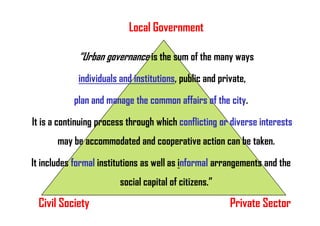
“Urban governance is the sum of the many ways
individuals and institutions, public and private,
plan and manage the common affairs of the city.
Local Government
Civil Society Private Sector
It is a continuing process through which conflicting or diverse interests
may be accommodated and cooperative action can be taken.
It includes formal institutions as well as informal arrangements and the
social capital of citizens.”
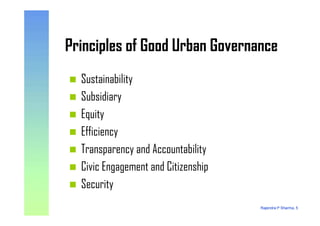
Principles of Good Urban GovernancePrinciples of Good Urban Governance
Sustainability
Subsidiary
Equity
Rajendra P Sharma, 5
Equity
Efficiency
Transparency and Accountability
Civic Engagement and Citizenship
Security
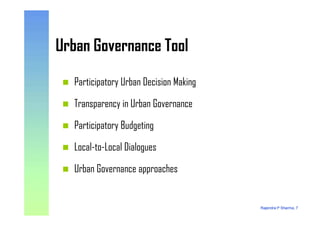
Urban Governance ToolUrban Governance Tool
Participatory Urban Decision Making
Transparency in Urban Governance
Rajendra P Sharma, 7
Participatory Budgeting
Local-to-Local Dialogues
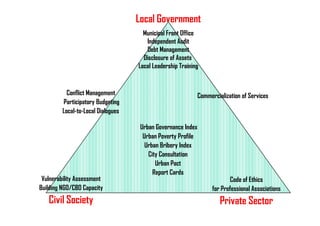
Urban Governance approaches
Conflict Management
Participatory Budgeting
Local-to-Local Dialogues
Commercialization of Services
Local Government
Municipal Front Office
Independent Audit
Debt Management
Disclosure of Assets
Local Leadership Training
Vulnerability Assessment
Building NGO/CBO Capacity
Civil Society
Code of Ethics
for Professional Associations
Private Sector
Urban Governance Index
Urban Poverty Profile
Urban Bribery Index
City Consultation
Urban Pact
Report Cards
Local-to-Local Dialogues
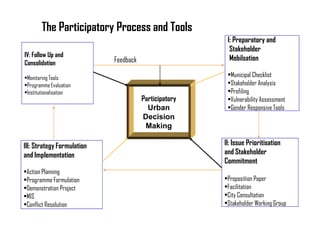
Participatory
Urban
Decision
IV: Follow Up and
Consolidation
•Monitoring Tools
•Programme Evaluation
•Institutionalisation
I: Preparatory and
Stakeholder
Mobilsation
•Municipal Checklist
•Stakeholder Analysis
•Profiling
•Vulnerability Assessment
•Gender Responsive Tools
The Participatory Process and Tools
Feedback
Decision
Making
III: Strategy Formulation
and Implementation
•Action Planning
•Programme Formulation
•Demonstration Project
•MIS
•Conflict Resolution
II: Issue Prioritisation
and Stakeholder
Commitment
•Proposition Paper
•Facilitation
•City Consultation
•Stakeholder Working Group
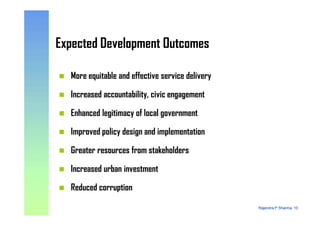
Expected Development OutcomesExpected Development Outcomes
More equitable and effective service delivery
Increased accountability, civic engagement
Enhanced legitimacy of local government
Rajendra P Sharma, 10
Enhanced legitimacy of local government
Improved policy design and implementation
Greater resources from stakeholders
Increased urban investment
Reduced corruption
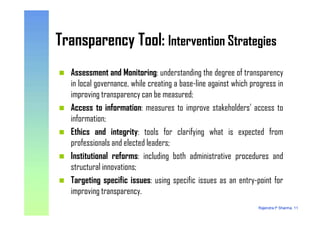
Transparency Tool: Intervention StrategiesTransparency Tool: Intervention Strategies
Assessment and Monitoring: understanding the degree of transparency
in local governance, while creating a base-line against which progress in
improving transparency can be measured;
Access to information: measures to improve stakeholders’ access to
information;
Rajendra P Sharma, 11
information;
Ethics and integrity: tools for clarifying what is expected from
professionals and elected leaders;
Institutional reforms: including both administrative procedures and
structural innovations;
Targeting specific issues: using specific issues as an entry-point for
improving transparency.
Tool on Transparency to include tools such as…Tool on Transparency to include tools such as…
Municipal Checklist
Transparent Procurement Procedures
Codes of Conduct
Rajendra P Sharma, 12
Codes of Conduct
Public Hearings
Independent Audits
Can local government make a difference?Can local government make a difference?
Some researchers suggest that local governments have to follow
neo-liberal agenda and cannot adopt localized social policies in the
face of global economic forces (Sassen, Hall)
Others researchers contend that local government policies can make
Rajendra P Sharma, 13
Others researchers contend that local government policies can make
a difference through a range of measures: institutional development,
accountability, representation, reducing corruption (Cavill, Devas,
Hasan et al.; Douglass)
Local governments cannot go it alone: they have to work with other
levels of government and international agencies to be effective –
metropolitan governance (A. Scott)
Institutional developmentInstitutional development
Local governments need to make their policies transparent and available to
citizens (using e-governance and ‘right to information’ measures)
Local governments need to put their financial house in order:
collecting taxes and other revenues effectively
Building staff capacity
Rajendra P Sharma, 14
Building staff capacity
Using accountancy methods that show capital investment as well as
cash flows
Local governments need to streamline their regulations and enforce them
effectively (illegal building not confined to slums)
Local governments need to provide services effectively
Local governments need financing for investment in infrastructure
Accountability and Participatory governanceAccountability and Participatory governance
Local governments work with ward-level representatives within cities
Local governments have privatized basic services, but often lose
effective control over them in doing so; they need to be able to make
private providers accountable to themselves and to citizens
Local governments work more in ‘partnerships’ with citizen groups;
Rajendra P Sharma, 15
Local governments work more in ‘partnerships’ with citizen groups;
ranging from participatory budgeting, implementation of services,
monitoring activities; context is influential in determining which ‘citizens’
voices’ are heard
middle-class citizens organize themselves strongly for their own
agendas and confront government directly
Poor households have little voice, and work through political
‘leaders’ to gain more voice; leaders may have their own agendas
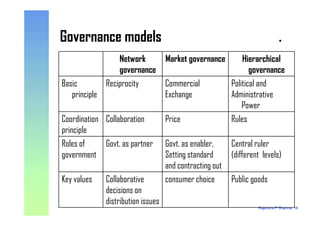
Governance models .Governance models .
Network
governance
Market governance Hierarchical
governance
Basic
principle
Reciprocity Commercial
Exchange
Political and
Administrative
Power
Rajendra P Sharma, 16
Coordination
principle
Collaboration Price Rules
Roles of
government
Govt. as partner Govt. as enabler,
Setting standard
and contracting out
Central ruler
(different levels)
Key values Collaborative
decisions on
distribution issues
consumer choice Public goods
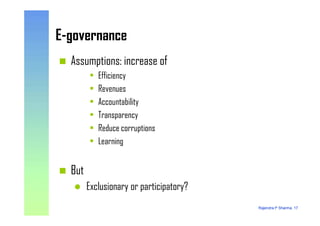
E-governanceE-governance
Assumptions: increase of
• Efficiency
• Revenues
• Accountability
• Transparency
Rajendra P Sharma, 17
• Transparency
• Reduce corruptions
• Learning
But
Exclusionary or participatory?
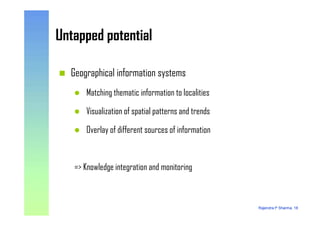
Untapped potentialUntapped potential
Geographical information systems
Matching thematic information to localities
Visualization of spatial patterns and trends
Rajendra P Sharma, 18
Visualization of spatial patterns and trends
Overlay of different sources of information
=> Knowledge integration and monitoring
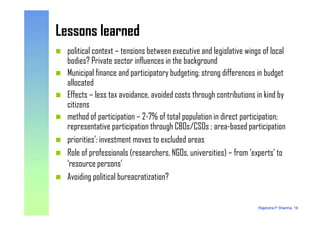
Lessons learnedLessons learned
political context – tensions between executive and legislative wings of local
bodies? Private sector influences in the background
Municipal finance and participatory budgeting; strong differences in budget
allocated
Effects – less tax avoidance, avoided costs through contributions in kind by
citizens
method of participation – 2-7% of total population in direct participation;
Rajendra P Sharma, 19
method of participation – 2-7% of total population in direct participation;
representative participation through CBOs/CSOs ; area-based participation
priorities’: investment moves to excluded areas
Role of professionals (researchers, NGOs, universities) – from ‘experts’ to
‘resource persons’
Avoiding political bureacratization?
ConclusionsConclusions
Cities and their governments more important as ‘new state space’
Urban poverty needs to be recognized as multi-dimensional
deprivations
City governments need to strengthen their own capacity and link up
with other scale levels of government – metropolitan governance
Rajendra P Sharma, 20
with other scale levels of government – metropolitan governance
and city-to-city networks, and trans-national urban governance
networks
Diversity of citizens’ identities and interests made explicit, so that
inequalities do not grow further
Participatory models can support redistributive urban policies
Urban research is necessary to analyze government – private links

Urban governance [compatibility mode]

  • 1.
    Urban governance Tools toSupport Transparency in Local Governance Urban governance Tools to Support Transparency in Local Governance Rajendra P Sharma, 1 Rajendra P Sharma rpsharma@mailcity.com Rajendra P Sharma rpsharma@mailcity.com
  • 2.
    The context andchallengeThe context and challenge Global trend towards urbanisation Increasing poverty and insecurity Unsustainable urbanization patterns requiring preventive and adaptive approaches Rajendra P Sharma, 2 Limited local government implementation capacity is main bottleneck New approach to ‘good governance’ Local authorities as ‘enablers’ Emphasis on partnership for service delivery Focus on inclusiveness of access to city benefits and decision making Promising innovations, but need to scale up
  • 3.
    The missing linkThemissing link “The key ingredient to realizing more inclusive cities is neither money nor technology, nor even expertise or legislative change (although Rajendra P Sharma, 3 even expertise or legislative change (although all these are important), but good urban governance.” The Global Campaign on Urban Governance, Concept Paper, 2nd Edition, March 2002
  • 4.
    “Urban governance isthe sum of the many ways individuals and institutions, public and private, plan and manage the common affairs of the city. Local Government Civil Society Private Sector It is a continuing process through which conflicting or diverse interests may be accommodated and cooperative action can be taken. It includes formal institutions as well as informal arrangements and the social capital of citizens.”
  • 5.
    Principles of GoodUrban GovernancePrinciples of Good Urban Governance Sustainability Subsidiary Equity Rajendra P Sharma, 5 Equity Efficiency Transparency and Accountability Civic Engagement and Citizenship Security
  • 7.
    Urban Governance ToolUrbanGovernance Tool Participatory Urban Decision Making Transparency in Urban Governance Rajendra P Sharma, 7 Participatory Budgeting Local-to-Local Dialogues Urban Governance approaches
  • 8.
    Conflict Management Participatory Budgeting Local-to-LocalDialogues Commercialization of Services Local Government Municipal Front Office Independent Audit Debt Management Disclosure of Assets Local Leadership Training Vulnerability Assessment Building NGO/CBO Capacity Civil Society Code of Ethics for Professional Associations Private Sector Urban Governance Index Urban Poverty Profile Urban Bribery Index City Consultation Urban Pact Report Cards Local-to-Local Dialogues
  • 9.
    Participatory Urban Decision IV: Follow Upand Consolidation •Monitoring Tools •Programme Evaluation •Institutionalisation I: Preparatory and Stakeholder Mobilsation •Municipal Checklist •Stakeholder Analysis •Profiling •Vulnerability Assessment •Gender Responsive Tools The Participatory Process and Tools Feedback Decision Making III: Strategy Formulation and Implementation •Action Planning •Programme Formulation •Demonstration Project •MIS •Conflict Resolution II: Issue Prioritisation and Stakeholder Commitment •Proposition Paper •Facilitation •City Consultation •Stakeholder Working Group
  • 10.
    Expected Development OutcomesExpectedDevelopment Outcomes More equitable and effective service delivery Increased accountability, civic engagement Enhanced legitimacy of local government Rajendra P Sharma, 10 Enhanced legitimacy of local government Improved policy design and implementation Greater resources from stakeholders Increased urban investment Reduced corruption
  • 11.
    Transparency Tool: InterventionStrategiesTransparency Tool: Intervention Strategies Assessment and Monitoring: understanding the degree of transparency in local governance, while creating a base-line against which progress in improving transparency can be measured; Access to information: measures to improve stakeholders’ access to information; Rajendra P Sharma, 11 information; Ethics and integrity: tools for clarifying what is expected from professionals and elected leaders; Institutional reforms: including both administrative procedures and structural innovations; Targeting specific issues: using specific issues as an entry-point for improving transparency.
  • 12.
    Tool on Transparencyto include tools such as…Tool on Transparency to include tools such as… Municipal Checklist Transparent Procurement Procedures Codes of Conduct Rajendra P Sharma, 12 Codes of Conduct Public Hearings Independent Audits
  • 13.
    Can local governmentmake a difference?Can local government make a difference? Some researchers suggest that local governments have to follow neo-liberal agenda and cannot adopt localized social policies in the face of global economic forces (Sassen, Hall) Others researchers contend that local government policies can make Rajendra P Sharma, 13 Others researchers contend that local government policies can make a difference through a range of measures: institutional development, accountability, representation, reducing corruption (Cavill, Devas, Hasan et al.; Douglass) Local governments cannot go it alone: they have to work with other levels of government and international agencies to be effective – metropolitan governance (A. Scott)
  • 14.
    Institutional developmentInstitutional development Localgovernments need to make their policies transparent and available to citizens (using e-governance and ‘right to information’ measures) Local governments need to put their financial house in order: collecting taxes and other revenues effectively Building staff capacity Rajendra P Sharma, 14 Building staff capacity Using accountancy methods that show capital investment as well as cash flows Local governments need to streamline their regulations and enforce them effectively (illegal building not confined to slums) Local governments need to provide services effectively Local governments need financing for investment in infrastructure
  • 15.
    Accountability and ParticipatorygovernanceAccountability and Participatory governance Local governments work with ward-level representatives within cities Local governments have privatized basic services, but often lose effective control over them in doing so; they need to be able to make private providers accountable to themselves and to citizens Local governments work more in ‘partnerships’ with citizen groups; Rajendra P Sharma, 15 Local governments work more in ‘partnerships’ with citizen groups; ranging from participatory budgeting, implementation of services, monitoring activities; context is influential in determining which ‘citizens’ voices’ are heard middle-class citizens organize themselves strongly for their own agendas and confront government directly Poor households have little voice, and work through political ‘leaders’ to gain more voice; leaders may have their own agendas
  • 16.
    Governance models .Governancemodels . Network governance Market governance Hierarchical governance Basic principle Reciprocity Commercial Exchange Political and Administrative Power Rajendra P Sharma, 16 Coordination principle Collaboration Price Rules Roles of government Govt. as partner Govt. as enabler, Setting standard and contracting out Central ruler (different levels) Key values Collaborative decisions on distribution issues consumer choice Public goods
  • 17.
    E-governanceE-governance Assumptions: increase of •Efficiency • Revenues • Accountability • Transparency Rajendra P Sharma, 17 • Transparency • Reduce corruptions • Learning But Exclusionary or participatory?
  • 18.
    Untapped potentialUntapped potential Geographicalinformation systems Matching thematic information to localities Visualization of spatial patterns and trends Rajendra P Sharma, 18 Visualization of spatial patterns and trends Overlay of different sources of information => Knowledge integration and monitoring
  • 19.
    Lessons learnedLessons learned politicalcontext – tensions between executive and legislative wings of local bodies? Private sector influences in the background Municipal finance and participatory budgeting; strong differences in budget allocated Effects – less tax avoidance, avoided costs through contributions in kind by citizens method of participation – 2-7% of total population in direct participation; Rajendra P Sharma, 19 method of participation – 2-7% of total population in direct participation; representative participation through CBOs/CSOs ; area-based participation priorities’: investment moves to excluded areas Role of professionals (researchers, NGOs, universities) – from ‘experts’ to ‘resource persons’ Avoiding political bureacratization?
  • 20.
    ConclusionsConclusions Cities and theirgovernments more important as ‘new state space’ Urban poverty needs to be recognized as multi-dimensional deprivations City governments need to strengthen their own capacity and link up with other scale levels of government – metropolitan governance Rajendra P Sharma, 20 with other scale levels of government – metropolitan governance and city-to-city networks, and trans-national urban governance networks Diversity of citizens’ identities and interests made explicit, so that inequalities do not grow further Participatory models can support redistributive urban policies Urban research is necessary to analyze government – private links